Choosing a Battery Bank for Your Van Kitchen
How to size, spec, and install a lithium battery bank for a van kitchen running fridge, induction, and water pump. Includes 100Ah, 200Ah, and 300Ah build comparisons.
Disclosure: As an Amazon Associate I earn from qualifying purchases. Links to Amazon on this page are affiliate links: if you buy through one, VanLifeKitchens.com may earn a commission at no extra cost to you. Read our affiliate disclosure.
Before you start: watts, watt-hours and the assumptions in this guide
This guide sizes a house battery for a van kitchen. To keep the numbers honest, it uses watt-hours (Wh) for energy and watts (W) for power:
- Watts are a rate: how hard an appliance pulls right now. An 1,800 W induction cooktop at full power pulls 1,800 W.
- Watt-hours are an amount: power multiplied by time. That cooktop running at 1,800 W for 30 minutes uses 900 Wh.
- Amp-hours (Ah) are watt-hours divided by voltage. Battery labels use Ah, so we convert, always at a stated voltage: 12.8 V nominal for LiFePO4 and 12 V for lead-acid/AGM. A 100 Ah LiFePO4 battery is about 1,280 Wh (100 × 12.8).
Assumptions used throughout, unless a section says otherwise:
- Inverter efficiency: 90%. Anything that runs on 120 V AC through an inverter costs about 11% more from the battery than it uses at the plug (divide by 0.9). Real efficiency varies with the inverter and the load; check your inverter's data sheet.
- Usable depth of discharge (DoD): LiFePO4 makers typically allow 80–100% of rated capacity to be used; we plan on 80% to leave a reserve and allow for ageing and cold. Lead-acid and AGM makers generally recommend using about 50% for reasonable cycle life.
- Fridge figures are daily averages, not nameplate draw. A compressor fridge's nameplate watts or amps describe what it pulls while the compressor runs. It cycles on and off, so its daily energy depends on ambient temperature, setpoint, insulation and how often you open it.
All daily loads below are our estimates for illustration. Plug your own appliances into the power sizing tool and the fridge battery calculator.
Installation and safety. A house battery, inverter and DC wiring can deliver very high fault currents. Follow each manufacturer's installation instructions for cable size, fusing, terminal torque, ventilation and mounting. Where a code, your insurer, a vehicle warranty or a converter's warranty requires it, have the system installed or inspected by a qualified RV or marine electrical technician. Nothing in this guide is a code-compliance checklist.
Why lithium (LiFePO4) vs AGM/lead-acid for a kitchen
For a van kitchen that runs a compressor fridge and possibly induction, lithium iron phosphate (LiFePO4) is usually the better fit. Lead-acid still works for light loads; it just gives you less usable energy per pound.
Usable energy. A 100 Ah 12 V AGM battery holds about 1,200 Wh (100 × 12) but, at the 50% DoD makers generally recommend, gives you about 600 Wh. A 100 Ah LiFePO4 battery holds about 1,280 Wh, and at 80% gives about 1,024 Wh. So a 200 Ah AGM bank delivers roughly what a 100 Ah LiFePO4 battery does, and two group-size AGM batteries weigh far more than one LiFePO4 battery of the same Ah.
Voltage under load. A lead-acid battery's voltage falls steadily as it discharges and sags further under heavy load. That matters for an inverter, which shuts off at a low-voltage threshold; a big load like an induction cooktop can trip that cutoff on a half-discharged lead-acid bank. LiFePO4 holds a much flatter voltage, roughly 13.0–13.3 V at rest across most of its range, so an inverter is less likely to trip.
Cycle life. LiFePO4 makers commonly publish ratings of several thousand cycles to 80% of original capacity at a stated depth of discharge. AGM ratings are typically in the hundreds of cycles at 50% DoD. Published cycle ratings are lab figures under the maker's test conditions, not a guarantee.
Charge acceptance. Many LiFePO4 batteries accept charge at up to 0.5C (50 A for a 100 Ah battery), per their spec sheets, and hold that rate until nearly full. Lead-acid batteries accept less and taper well before full. When you're trying to recover a bank on a short drive with a DC-DC charger, faster acceptance matters. Check your battery's maximum charge current before choosing a charger.
The math: (daily kitchen Wh × 2) ÷ 0.8 = battery size
Start with an honest daily load in Wh. Typical estimates for kitchen appliances:
- 12 V compressor fridge (35–60 L): roughly 300–500 Wh/day in warm weather. That's about 23–39 Ah at 12.8 V. Published examples: Dometic rates the CFX5 35 at 1.11 Ah per hour at 90°F ambient (about 320 Wh/day at 12 V), and ICECO's manual lists the VL35 ProS at 0.430 kWh per 24 hours as a lab figure. Hotter weather, lower setpoints and frequent lid openings push it higher.
- Induction cooktop through an inverter: at a 1,500 W setting for 30 minutes, the cooktop uses 750 Wh at the plug, or about 833 Wh from the battery at 90% inverter efficiency (about 65 Ah at 12.8 V). Real cooking cycles between power levels, so 30 minutes "on" often uses less than this full-power estimate.
- Water pump: roughly 50–100 W while running; 15 minutes a day is about 12–25 Wh.
- LED lights: roughly 30–60 Wh/day for a few fixtures in the evening.
A modest kitchen with a fridge, lights and gas cooking might be 400–700 Wh/day. A kitchen that cooks two meals a day on induction can reach 1,500–2,500 Wh/day.
Now the formula. Take the daily kitchen Wh, multiply by 2 (a reserve day for cloudy weather or a day you don't drive), then divide by 0.8 (the usable LiFePO4 depth of discharge we plan on). Divide by 12.8 to get Ah.
1,000 Wh/day × 2 ÷ 0.8 = 2,500 Wh of rated capacity, or about 195 Ah at 12.8 V.
It's conservative on purpose: batteries lose capacity with age, cold reduces what you can use, and loads creep up (a laptop charger, a Starlink). For a detailed appliance-by-appliance worked example, see the van kitchen power budget guide.
The 100 Ah build — minimal kitchen
One 100 Ah LiFePO4 battery stores about 1,280 Wh, or about 1,024 Wh usable at 80% DoD. That's enough for a minimal kitchen: a small compressor fridge, LED lights, a water pump, and a gas cooktop for hot food. Induction is a poor fit: an 1,800 W cooktop at full power draws roughly 150–170 A DC through the inverter, more than many 100 Ah batteries' BMS continuous rating, and 30 minutes at that power would use most of the usable energy.
Example daily budget (estimates): fridge 360 Wh + lights and pump 60 Wh + laptop charging 180 Wh + miscellaneous 120 Wh = 720 Wh/day (about 56 Ah at 12.8 V). That leaves about 300 Wh of headroom, which is thin. One cloudy day with no driving and you start the next day low.
Who it's for: weekenders, part-time vanlifers, people cooking on gas, and builds where the kitchen is secondary to the sleeping area. Budget-tier 100 Ah LiFePO4 batteries from brands such as LiTime and Renogy are sold on Amazon. Check the BMS continuous discharge rating against your inverter's maximum DC input current, not just against your average load.
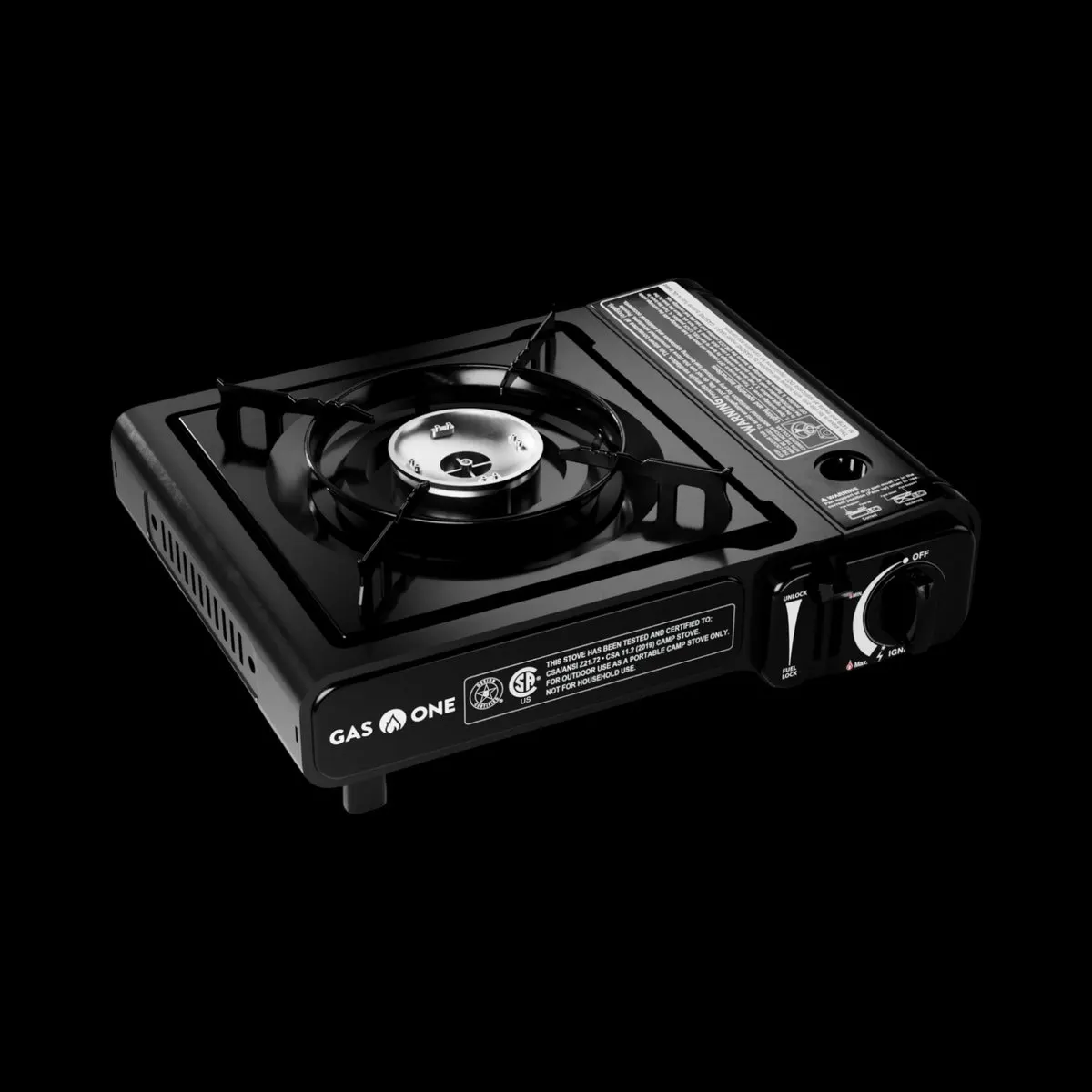
If you cook on gas: butane cassette stoves and propane camp stoves are generally labelled by their makers for outdoor use; for example, Gas One's listing for its butane stove says "outdoor use only" (see our Gas One review). Follow the label. A CO alarm is a last-line warning device, not permission to cook with an outdoor-only appliance indoors.
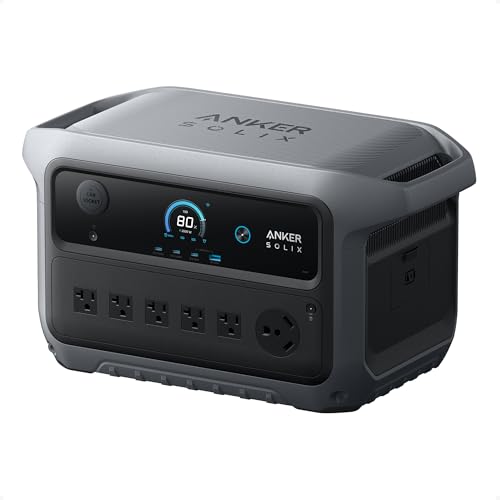
Smaller than this: in a car or small van with no house battery, a small portable power station can carry the fridge alone. The EcoFlow RIVER 3 Plus stores 286 Wh and the DC-only Anker SOLIX C300 DC 288 Wh, each about 22 Ah at 12.8 V, roughly a fifth of a 100 Ah battery. Each has a 12 V, 10 A socket and runs a typical 35 L fridge for about 14–19 hours by our estimate, so it needs recharging every day by driving, solar or a hookup. The RIVER 3 Plus has 600 W of AC, too little for any induction cooktop, and accepts EcoFlow's clip-on extra batteries up to 858 Wh. The C300 DC has no AC outlets at all.
Charging: a 20 A DC-DC charger delivers roughly 280 W (20 A × about 14.2 V), so about 280 Wh per hour of driving at full output; four hours of driving or a sunny day on about 200 W of solar can recover this bank.
The 200 Ah build — full kitchen for two
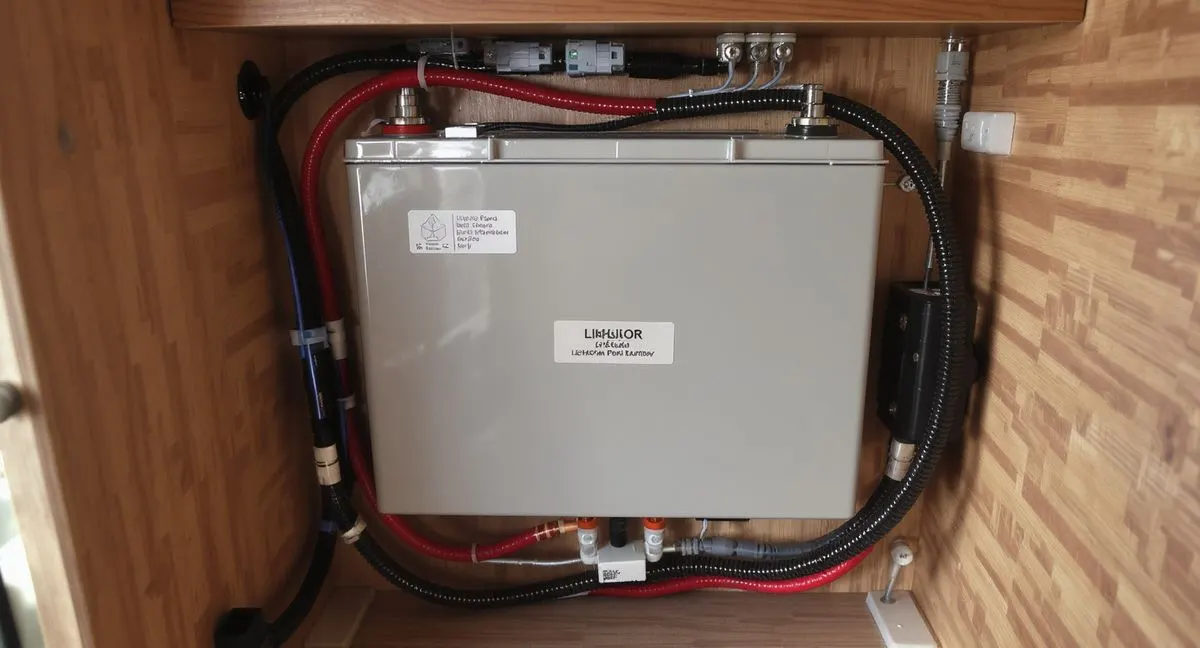
A pair of 100 Ah LiFePO4 batteries in parallel, or a single 200 Ah unit, stores about 2,560 Wh, or about 2,050 Wh usable at 80%. That runs a larger fridge, an inverter for a single-burner induction cooktop, a kettle, and a laptop and lights, with some reserve.
Example daily budget (estimates): fridge 450 Wh + induction 25 minutes at 1,500 W (about 625 Wh at the plug, about 695 Wh from the battery) + laptop 180 Wh + lights, pump and miscellaneous 120 Wh = about 1,445 Wh/day (about 113 Ah at 12.8 V). Usable capacity covers about 1.4 days. Run the formula: 1,445 × 2 ÷ 0.8 = about 3,600 Wh, or about 280 Ah, so 200 Ah is under the two-day target for a heavy-cooking couple. It works if you drive most days or have generous solar.
BMS and inverter sizing. The inverter's continuous rating must exceed the cooktop's maximum input with margin; an 1,800 W cooktop needs an inverter rated comfortably above 1,800 W continuous, and a 2,000 W pure sine wave inverter is a common choice. At full power, that inverter can draw roughly 150–175 A DC from the battery (1,800 ÷ 0.9 ÷ 12.8 = about 156 A, more as voltage drops). The battery bank's combined BMS continuous rating needs to exceed that. Check the inverter manual's maximum DC input current, and size cable and fuse to the manufacturer's instructions. For an all-in-one power station instead of a separate bank and inverter, can a power station run an induction cooktop explains why the continuous AC rating, not the surge figure, decides whether the cooktop stays on. At this tier's scale, the Anker SOLIX C2000 Gen 2 stores 2,048 Wh at 2,400 W continuous and expands to 4,096 Wh, and the BLUETTI Elite 200 V2 stores 2,073.6 Wh at 2,600 W continuous but isn't expandable. Either holds about as much as a 160 Ah LiFePO4 battery (2,048 ÷ 12.8), and either runs an 1,800 W cooktop with headroom. Anker SOLIX C2000 Gen 2 vs EcoFlow DELTA 3 Max compares the Anker with EcoFlow's 2,048 Wh, 2,400 W station.
Battery options at this tier include premium US-brand batteries such as Battle Born's 100 Ah heated models (two in parallel) and value 200 Ah units from LiTime and Renogy. Compare BMS continuous and surge ratings, low-temperature charge protection, and warranty terms, not just Ah.
The 300 Ah build — heavy induction cooking + freezer
Three 100 Ah batteries or one 300 Ah LiFePO4 battery stores about 3,840 Wh, or about 3,070 Wh usable at 80%. This is for people who cook two induction meals a day, run a dual-zone fridge-freezer, or have two people working from the van.
Example daily budget (estimates): fridge-freezer 600 Wh + induction 45 minutes at 1,500 W (about 1,125 Wh at the plug, 1,250 Wh from the battery) + two laptops and a satellite internet terminal 400 Wh + lights and pump 120 Wh = about 2,370 Wh/day (about 185 Ah at 12.8 V). Usable capacity covers about 1.3 days without charging.
Wiring at this size is a professional-grade job. A 3,000 W inverter at full output can draw roughly 260 A DC or more at 12.8 V (3,000 ÷ 0.9 ÷ 12.8), so cable gauge, fuse type and rating, bus bars and terminal torque must follow the inverter and battery makers' instructions. Many LiFePO4 makers specify a Class T fuse close to the battery positive because of its high interrupt rating. If you are not confident with high-current DC work, or if a code or insurer requires it, use a qualified installer.
At this scale, a single larger battery can be simpler to wire than three 100 Ah batteries, because paralleling needs equal-length cables and the manufacturer's paralleling guidance. If you parallel several batteries, follow the maker's instructions on matching and on charging each one fully before connecting them.
Charge sources (alternator DC-DC, solar, shore power)
A battery bank is only as useful as your ability to refill it.
Alternator via DC-DC charger. A 40 A DC-DC charger outputs about 40 A at roughly 14.2–14.6 V, so about 570 W, or roughly 550 Wh per hour of driving at full output. It draws more than 40 A from the starter side to do it, so the input wiring and fusing must follow the charger maker's instructions. Many modern vehicles have smart alternators; choose a charger that supports them. Don't connect a lithium house bank directly to the alternator: depending on the vehicle, it can overload the alternator or charge the lithium incorrectly.
Solar. Size solar in Wh, not Ah: required panel watts ≈ daily Wh ÷ (peak sun hours × 0.75), where 0.75 is an assumed harvest factor for heat, angle, shading and controller losses on a flat van roof. For 1,000 Wh/day with 4 peak sun hours, that's about 330 W. Winter and northern latitudes need much more. MPPT controllers are generally more efficient than PWM controllers with typical van panels.
Shore power. A converter/charger with a LiFePO4 charge profile can recharge from a campground pedestal. Shore-power inlets, AC wiring and transfer switches carry mains voltage; follow the manufacturer's instructions and use a qualified electrician where codes or insurers require one.
Cold weather: self-heating vs cabin heating
LiFePO4 makers generally specify that the batteries must not be charged below 32°F (0°C) without heating. Discharging below freezing is usually allowed down to a lower limit stated on the spec sheet, so you can cook in a cold van. Charging a frozen cell can cause lithium plating, which permanently reduces capacity and can damage the cell.
Self-heating batteries (several brands, including Battle Born and LiTime, sell heated models) use internal heating pads. When the BMS senses a low cell temperature and a charge source, it powers the heater until the cells are warm enough, then allows charging. Check how the heater is powered and its minimum operating temperature.
Cabin heating means mounting batteries inside the insulated living space, not in an exterior locker, so cabin heat keeps them above freezing. That works if you heat the van overnight. It doesn't work if the van sits unheated in a ski-resort lot for three days. Either way, a BMS with low-temperature charge protection is the safety net. The cold weather van cooking guide covers winter kitchen operations.
Brand notes (Battle Born vs Renogy vs LiTime vs AIMS)
We don't test batteries, so we don't rank them on longevity. What differs, per the makers' published specs and terms, is:
- Battle Born is a premium-priced US brand known for its customer support and heated models. Check its current warranty terms.
- Renogy sits in the middle of the price range, with app-connected "Smart" models that can report state of charge.
- LiTime is a budget-tier brand with a wide range of capacities, including heated options. Warranty support is handled by the brand; read the terms before you buy.
- AIMS Power sells larger-capacity batteries and inverters, often used in off-grid builds.
Compare: BMS continuous and surge current, low-temperature charge cutoff or heating, published cycle rating and its test conditions, warranty length and what it covers, and whether the maker allows series or parallel connection of the model.
Common mistakes
Undersizing the inverter. An inverter rated below the cooktop's maximum input will shut down at high settings. Size the inverter's continuous rating above the largest load you'll run (or the largest loads you'll run together) with margin, per the inverter maker's guidance.
Ignoring BMS current limits. The battery's BMS must handle the inverter's maximum DC draw. A 100 A BMS will cut out under a 150 A induction load.
Mixing old and new batteries in parallel. Most makers advise using the same model, capacity and similar age, and charging each battery fully before paralleling.
Skipping the main fuse. A LiFePO4 bank can deliver a very large current into a short circuit. Use the fuse type and rating the battery and inverter makers specify, as close to the battery as they say.
Forgetting low-temperature charge protection. If your batteries aren't heated and their BMS doesn't block cold charging, your charge sources need a temperature-sensing cutoff.
Wiring too thin. Undersized cable drops voltage, heats up, and can trip inverter low-voltage cutoffs. Use the cable gauge the inverter manual specifies for your cable length.
FAQ
How long will a 200 Ah bank run my fridge if the van is parked? At an estimated 450 Wh/day for a 60 L compressor fridge in mild-to-warm weather, a 200 Ah LiFePO4 bank (about 2,050 Wh usable at 80%) runs it for about four and a half days with no charging. Hotter weather or frequent opening shortens that.
Can I start with 100 Ah and add more later? Often yes, if the manufacturer allows parallel connection of that model. Follow its guidance on matching model, capacity and age, and charge both fully before connecting. Buying the right size up front is simpler.
Do I need a battery monitor? It's strongly recommended. LiFePO4 voltage stays flat across most of the charge range, so voltage alone is a poor state-of-charge gauge. A shunt-based monitor, or a battery with a reliable built-in monitor, tracks energy in and out.
Will my alternator charge a lithium bank directly? Don't rely on it. Use a DC-DC charger with a LiFePO4 profile. A direct connection can overload some alternators or charge lithium incorrectly, and smart alternators complicate it further.
What goes into the cost of a full 300 Ah lithium kitchen system? Batteries, inverter, DC-DC charger, solar controller and panels, fusing, cabling, a battery monitor and, if you need it, professional installation. The batteries are usually the biggest share. Check current prices on Amazon for each component.
What happens if I discharge a LiFePO4 battery all the way? The BMS disconnects the battery at its low-voltage limit to protect the cells, and you're without power until you recharge. Some BMS units need a charger to wake them. Size the bank so normal use stays well above that point.
Products covered in this guide
Disclosure: As an Amazon Associate I earn from qualifying purchases. Links to Amazon on this page are affiliate links: if you buy through one, VanLifeKitchens.com may earn a commission at no extra cost to you. Read our affiliate disclosure.



More in Power & Solar
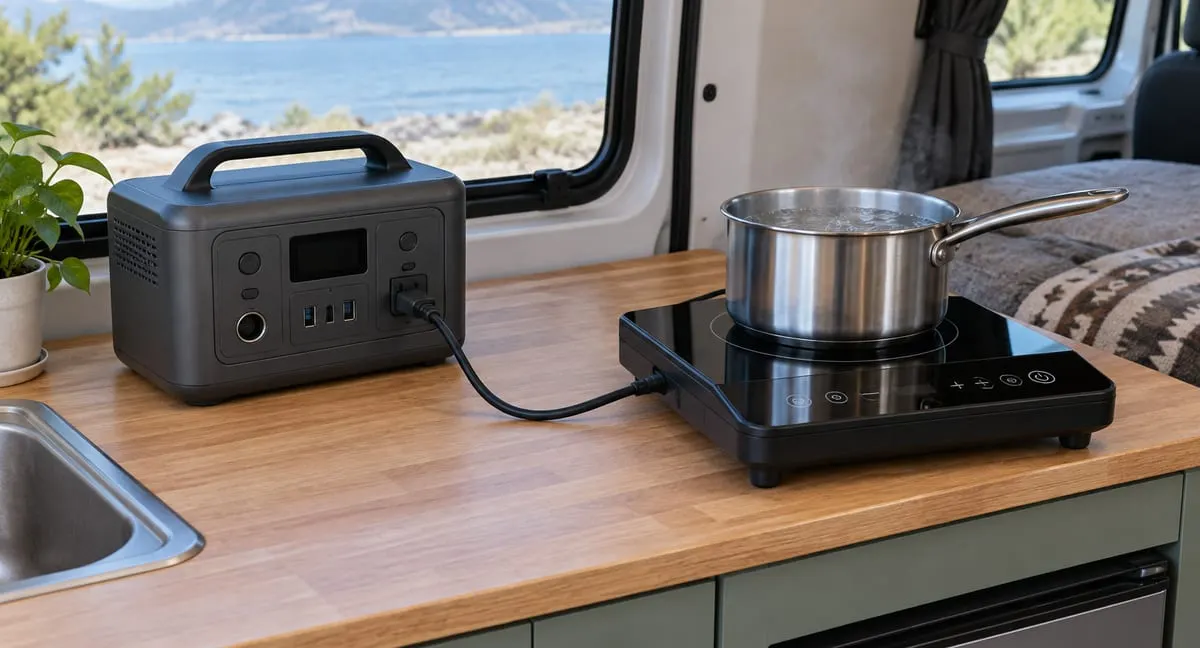
Can Your Power Station Run an Induction Cooktop?
Continuous vs surge watts, usable vs rated watt-hours, and worked runtime math for running the Duxtop 9100MC or Nuwave PIC Gold from a portable power station.
How to Size Your Van Kitchen Power Budget
A worked example of sizing a lithium battery and solar array around a realistic kitchen load — fridge, induction cooktop, water pump, and lights.

Cold-Weather Van Cooking: Gear & Power Strategy
Why butane fades and lithium won't charge below freezing, plus the winter gear kit and the cold-weather cooking setup that works.