Lodge L8DOL3 5-Quart Cast Iron Dutch Oven
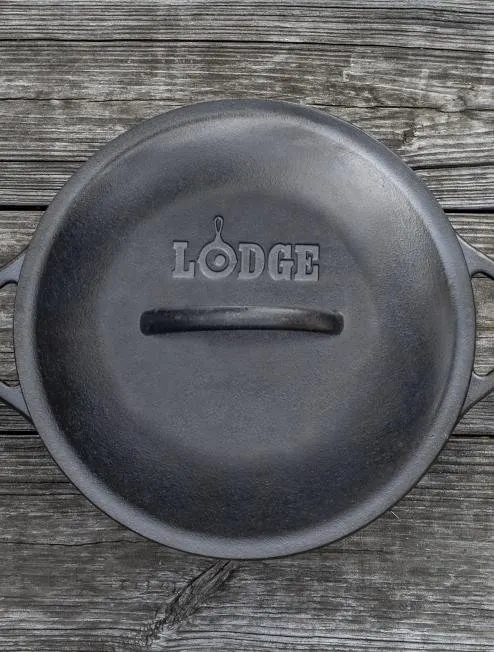
- Capacity
- 5 quarts
- Dimensions
- 12.63 x 10.38 x 6.88 in (Lodge catalog)
- Weight
- 11.64 lb (Lodge catalog)
- Materials
- Pre-seasoned cast iron
- Compatibility
- Any stovetop incl. induction / oven / grill / campfire (Lodge)
- Warranty
- Lodge Made Right warranty (Amazon: lifetime limited)
- Model
- L8DOL3
Lodge 5 Quart Dutch Oven Review: The Pot That Turns a Van Into a Real Kitchen
A Dutch oven is the piece of cookware that adds braising, stewing, roasting and bread to a van menu that otherwise runs on skillet dinners and boiled pasta. This Lodge 5 quart Dutch oven review is based on Lodge's published specs, its care instructions and the Amazon listing. The main reason to hesitate is the weight: Lodge's catalog lists the L8DOL3 at 11.64 lb.
What the Amazon link sells: the listing titled "Lodge Cast Iron Dutch Oven with Loop Handle, Oven-Safe, 5 Quart" (ASIN B00063RWYI). That title matches the L8DOL3. One caution: the listing's feature bullets describe Lodge's "Double Dutch Oven," a different model with a skillet lid, and its model field reads "Cast Iron Serving Pot". Check the photos and the lid before you buy; the review below describes the L8DOL3.
Choose this if:
- You want to braise, stew, roast and bake bread, not just fry and boil.
- You cook for two to four and like leftovers.
- You have low, secure floor-level storage and the payload for about 11.6 lb (Lodge catalog).
Skip this if:
- Weight or space is tight; it's the heaviest single piece of cookware on this site.
- You want a lid that doubles as a frying pan. The L8DOL3's lid is a plain cast iron lid with a handle on top (Lodge's Double Dutch Oven is the version with a skillet lid).
- You won't dry and oil cast iron after washing.
Overview: What You Are Actually Buying
The Lodge L8DOL3 is a 5 quart pre-seasoned cast iron Dutch oven with loop handles, made by Lodge in South Pittsburg, Tennessee, where the company has cast iron since 1896. The published specs:
| Spec | Lodge L8DOL3 (per Lodge) |
|---|---|
| Capacity | 5 qt |
| Size with handles | 12.63 x 10.38 x 6.88 in (Lodge catalog) |
| Weight | 11.64 lb (Lodge catalog); Amazon lists 12.78 lb |
| Lid | Cast iron lid with a handle on top |
| Handles | Two loop side handles, two pour spouts |
| Heat sources | Any stovetop including induction, oven, grill, campfire |
It sells at a budget price for what you get. Lodge's listing describes its Dutch ovens as having "a loop handle on each side, pour spouts on the other sides, and a handle on top of lid," and lists them as "compatible with any stovetop (including induction), oven, grill, or campfire," made in the USA and seasoned with vegetable oil. The lid is not a skillet. If you want a lid that flips over into a frying pan, that's Lodge's Double Dutch Oven or Combo Cooker, which are different products; the listing this site links to is the L8DOL3.
It has no enamel coating, no nonstick layer, no plastic handles and no electronics. There's very little on it that can fail, and seasoning problems or surface rust can be fixed with a scrub, oil and, if needed, an oven re-season. Cast iron can crack if it's dropped onto a hard surface or plunged into cold water while very hot, so it isn't unbreakable.
Why a Dutch Oven Changes Van Cooking
Without a Dutch oven, van cooking tends to look the same for everyone: skillet dinners, pasta, maybe rice and beans, a lot of eggs. Fine food, not memorable food. The missing piece is a vessel for slow, moist, covered cooking. You can sear. You can boil. You can't really braise, stew, roast or bake. A Dutch oven covers all of that.
With a 5 quart Dutch oven you can make a batch of chili that lasts several days, roast a chicken with potatoes underneath, bake crusty no-knead bread, simmer beans on low for hours, or braise a pork shoulder with onions. The thermal mass of cast iron holds heat well once it's hot, so you can run your burner low and the pot keeps a steady simmer. That helps if you're rationing propane or butane, although a long braise still burns fuel for as long as it cooks.
Most of that cooking happens on a flame stove. Butane and propane camp stoves are typically labelled by their makers for outdoor use (the Gas One GS-1000G this site links to is labelled for outdoor use only), so set the stove up outside. Check that your stove's grate is rated for a heavy pot: cassette stove manuals often list pan-size and weight limits, and a full 5 qt cast iron pot weighs around 20 lb (11.6 lb of iron plus about 4 kg of food and liquid at a typical fill). On induction, a cast iron Dutch oven works well and keeps cooking inside the van electrical rather than combustion. Long simmers are where induction energy adds up: as an estimate, an hour of simmering at an average of 400–600 W on a portable hob is roughly 450–670 Wh from the battery once you allow for a 10% inverter loss, or about 35–52 Ah at 12.8 V. The thermal mass helps here because it holds a simmer at a low setting. Use the power calculator to size the battery for your own cooking.
If you are still cooking only one-pot meals in a thin aluminum pot and wondering why everything comes out okay but never great, this is the upgrade. Our one pot meals for the road guide shows what a pot like this makes possible.
Build Quality and Pre-Seasoning
The walls are thick and the finish is functional rather than decorative. This is not precious cookware.
Lodge seasons its cast iron at the foundry with vegetable oil, a process Lodge says it introduced in 2002, so it's ready to cook on as soon as you unbox it. Older cast iron needed hours of home seasoning before it was usable. You can skip that. Rinse it, dry it, rub in a thin layer of oil if you want to be thorough, and start cooking. The factory seasoning is matte and can look a little patchy. That's normal, and it darkens and smooths with use, especially if you cook fatty foods in it early on.
The lid sits snugly enough to hold moisture in during a long braise. The side handles are loops cast into the body, so there's nothing to loosen, and the lid has a cast handle on top. Both get very hot; keep a pair of thick oven mitts with the pot.
Performance: Roasting, Baking, and Simmering
Roasting. The 5 quart size suits a small whole chicken (around 4 lb) with quartered potatoes and onions tucked around it. Brown the bird on the stove, then roast it covered in an oven if you have one, or covered on a grate over a bed of coals. The cast iron holds heat around the food evenly, and you get a meal that looks like more effort than it took.
Baking bread. A 5 quart pot is a good size for a standard no-knead boule. The usual method is to preheat the empty pot in a hot oven, drop the dough in, bake covered, then uncover to brown the crust. Note that the L8DOL3's lid is a kitchen-style lid with a top handle, not a flanged camp lid, so coals don't sit on it securely; for serious coal baking, Lodge's camp Dutch ovens with legs and a flanged lid are the purpose-built tool. Without an oven, stovetop bread in this pot is possible with a trivet and low heat but takes practice.
Simmering. Beans, chili, curry, stew, anything that needs a couple of hours at a low murmur. The heavy base spreads heat and makes scorching less likely than in a thin pot, but it can still happen if the liquid runs low or the flame is too high, so stir now and then and keep the lid on.
Heating up. It takes longer than thin cookware. Give it several minutes on medium before you start searing, and don't put an empty pot on a full flame or full induction power; heat it gradually.
Cleanup with Limited Water
Lodge's own routine is three steps: wash with warm, soapy water and a stiff brush or scrubbing pad, "dry completely," then "add a thin layer of oil." Lodge says "soap is totally okay," that "soaking cast iron in water is a recipe for rust," and that a dishwasher "will remove the seasoning and likely cause rust." For stuck food it suggests a nylon brush or pan scraper under warm water. In a van, a chainmail scrubber and a little hot water do the same job, and drying the pot on the burner for a minute makes sure it is bone dry.
Compared with stainless, a seasoned Dutch oven usually releases stews and braises with less water, because you scrape rather than soak. Compared with enamel or nonstick, it needs the extra drying and oiling step every time.
The van-specific complication is moisture. Vans get humid and cabinets don't breathe. Make sure the pot is fully dry before you put it away, and store it with a folded paper towel between the lid and the body so air can circulate. If rust does appear, scrub it off, dry, re-oil and heat the pot. For a full re-season, Lodge says to coat it with a very thin layer of oil, bake it upside down at 450–500°F for one hour, and let it cool in the oven, which needs a campground oven, a home stop or an RV oven.
Lodge 5 Qt vs Lodge 7 Qt vs Le Creuset
The obvious comparisons are Lodge's 7 quart Dutch oven and a similar-sized enameled Le Creuset.
The 7 quart Lodge (L10DOL3) is bigger and heavier: Lodge's catalog lists it at 15.16 lb and 14.75 x 12.81 x 7 in, and it gives you room for larger roasts. For a solo van lifer or couple it is more pot than you need. 5 quarts feeds two people generously with leftovers, or four people for one meal. The 7 quart makes sense in a larger rig with a family, or if you regularly cook for guests.
Le Creuset is a different conversation. A 5.5 quart enameled Le Creuset Dutch oven is a premium purchase that costs considerably more. It's easier to clean, and you can cook acidic tomato sauces in it without worrying about seasoning. In a van, though, enamel can chip if it bangs around in a cabinet on a washboard road, and the intense, uneven heat of campfire coals is hard on enamel. The Lodge wins on price and on campfire use, since Lodge lists its bare cast iron as campfire-safe.
If you want a full cookware set rather than a single heavy pot, see our Magma nesting 10 piece set review, which goes the opposite direction: several stainless pieces that nest into under half a cubic foot.
Value for Money
It's budget-priced for a pot that Lodge lists for every common heat source, including induction and campfire, with no coating to wear out. The catch is not money; it's the weight and the storage space: it needs a low, secure spot about 12.6 x 10.4 x 6.9 in.
Who Should Skip This Pot
Be honest with yourself about weight. About 11.6 lb is a lot in a van where every pound of gear is a pound of payload you aren't using for water, batteries or food. If you're in a micro-rig, a car-camping setup, or a minimalist build where your kitchen is one burner and a mug, this isn't your pot. A lighter stainless pot with a lid, such as the Sea to Summit Detour 3L, will serve you better.
Skip it also if you dislike maintenance routines. Cast iron care is easy but not zero. You have to dry it, oil it and think about it once in a while. If that sounds annoying, choose stainless instead.
Final Verdict
The Lodge L8DOL3 5 quart cast iron Dutch oven adds roasts, braises, bread, beans and stews to a van menu, on induction, a camp stove outdoors or a campfire grate. Budget price, no coating to wear out, and made in South Pittsburg, Tennessee, where Lodge has been casting iron since 1896. If you can carry and store about 11.6 lb low in the van, it's the strongest single upgrade to what you can cook. If you can't, look at a lighter pot and accept a shorter menu.
FAQ
Does the pre-seasoning need to be redone before first use? No. Rinse, dry, oil lightly if you want, and cook. The seasoning improves with use.
Does the lid double as a skillet? No. The L8DOL3 has a cast iron lid with a handle on top. Lodge's Double Dutch Oven and Combo Cooker are the designs with a skillet lid.
Can I use metal utensils? Yes. Metal spatulas, tongs and spoons are fine on cast iron; just avoid gouging the seasoning with sharp edges.
Will it rust in a humid van? It can if it's put away wet or under-oiled. Dry it completely, oil it, and store it with a paper towel for airflow.
Is it induction compatible? Yes. Cast iron is magnetic, and Lodge lists its cast iron as compatible with any stovetop including induction. Lift it rather than sliding it across a glass top.
Can I cook tomato sauce in it? Short simmers are fine in a well-seasoned pot. Long acidic braises can wear the seasoning, so if you make a lot of red sauce, plan to re-season more often or use a stainless pot for those meals.
How long does it take to heat up? Longer than thin cookware. Give it several minutes on medium heat. Once it's hot, it holds heat well on a low flame.
Sources and verification
- https://www.lodgecastiron.com/products/dutch-oven (Lodge): Dutch oven sizes including 5 qt, "compatible with any stovetop (including induction), oven, grill, or campfire", made in the USA, seasoned with vegetable oil, cast iron lid, made without PFAS, hand wash / dry / oil care (checked 2026-10-12)
- https://www.lodgecastiron.com/products/dutch-oven.json (Lodge store data): L8DOL3 listed as the 5 QT variant (checked 2026-10-12)
- https://images.orgill.com/weblarge/10031/Lodge_GL12_GC12_Catalog.pdf (Lodge catalog hosted by distributor Orgill): L8DOL3 5 qt, 12.63 x 10.38 x 6.88 in, 11.64 lb; L10DOL3 7 qt, 15.16 lb; L8DD3 Double Dutch Oven with skillet lid (checked 2026-10-12)
- https://www.lodgecastiron.com/pages/how-to-clean (Lodge): wash, dry, oil steps; soap, soaking and dishwasher guidance (checked 2026-10-12)
- https://www.lodgecastiron.com/pages/cleaning-and-care-cast-iron-restore-and-season-rusty-cast-iron (Lodge): re-seasoning at 450–500°F for one hour, upside down, cool in oven (checked 2026-10-12)
- https://www.lodgecastiron.com/blogs/story/a-look-back-125-years (Lodge): founded 1896 in South Pittsburg, Tennessee; foundry-seasoned cast iron introduced 2002 (checked 2026-10-12)
- Amazon listing ASIN B00063RWYI: title "Lodge Cast Iron Dutch Oven with Loop Handle, Oven-Safe, 5 Quart", 12.56 x 10.43 x 6 in, 12.78 lb, lifetime limited warranty; feature bullets refer to the Double Dutch Oven (checked 2026-10-12)
Compare with similar products
See how this stacks up against the other compact cookware we've reviewed.
Related Reviews
For: Solo stainless pot
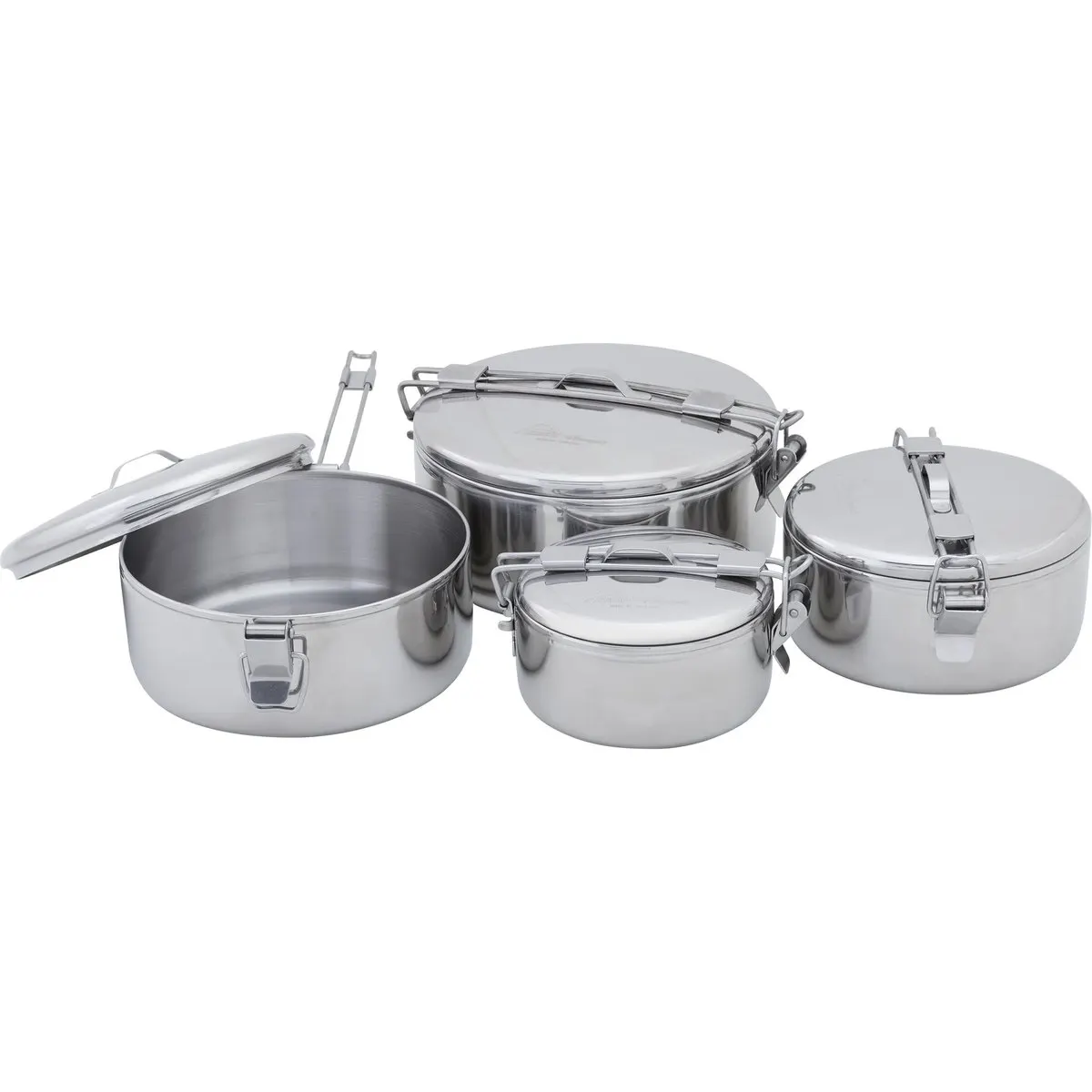
MSR Alpine Stowaway 1.6L Stainless Pot
A 1.6 L stainless pot with a lid that the folding handle holds shut for transport. MSR's all-stainless build has no coating to wear out. MSR doesn't list induction compatibility, so check with a magnet.
For: Acidic sauces, no seasoning
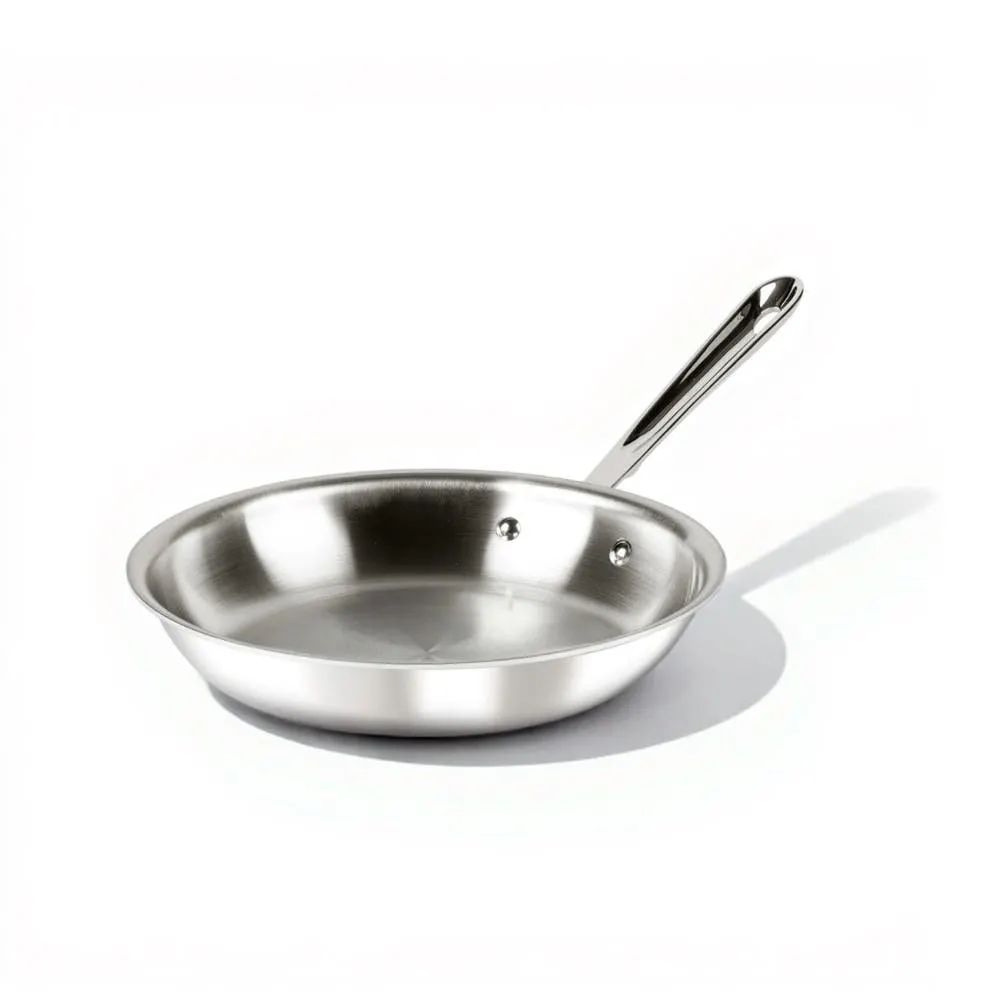
All-Clad D3 Stainless 10" Skillet
A premium tri-ply stainless pan (steel-aluminum-steel) that is induction compatible, responds quickly to heat changes, handles acidic sauces and needs no seasoning. Lighter than cast iron, but it costs considerably more.

For: Induction kit for two
Stanley Wildfare Pro 15-Piece Stainless Steel Fry Pan Cook Set, 8.75 in Tri-Ply Fry Pan
A cook-and-eat kit for two built around an 8.75-inch tri-ply 18/8 stainless fry pan with a fold-and-lock handle. Stanley lists it as induction compatible, 3.74 lb, and nesting to 8.74 x 8.74 x 2.08 in with its lid, two plates, two cutlery sets, a cutting board with trivet and a folding spatula. It's a much lighter induction option than the Magma set, but it has one pan and no pot.