PackIt Freezable Grocery Shopping Bag
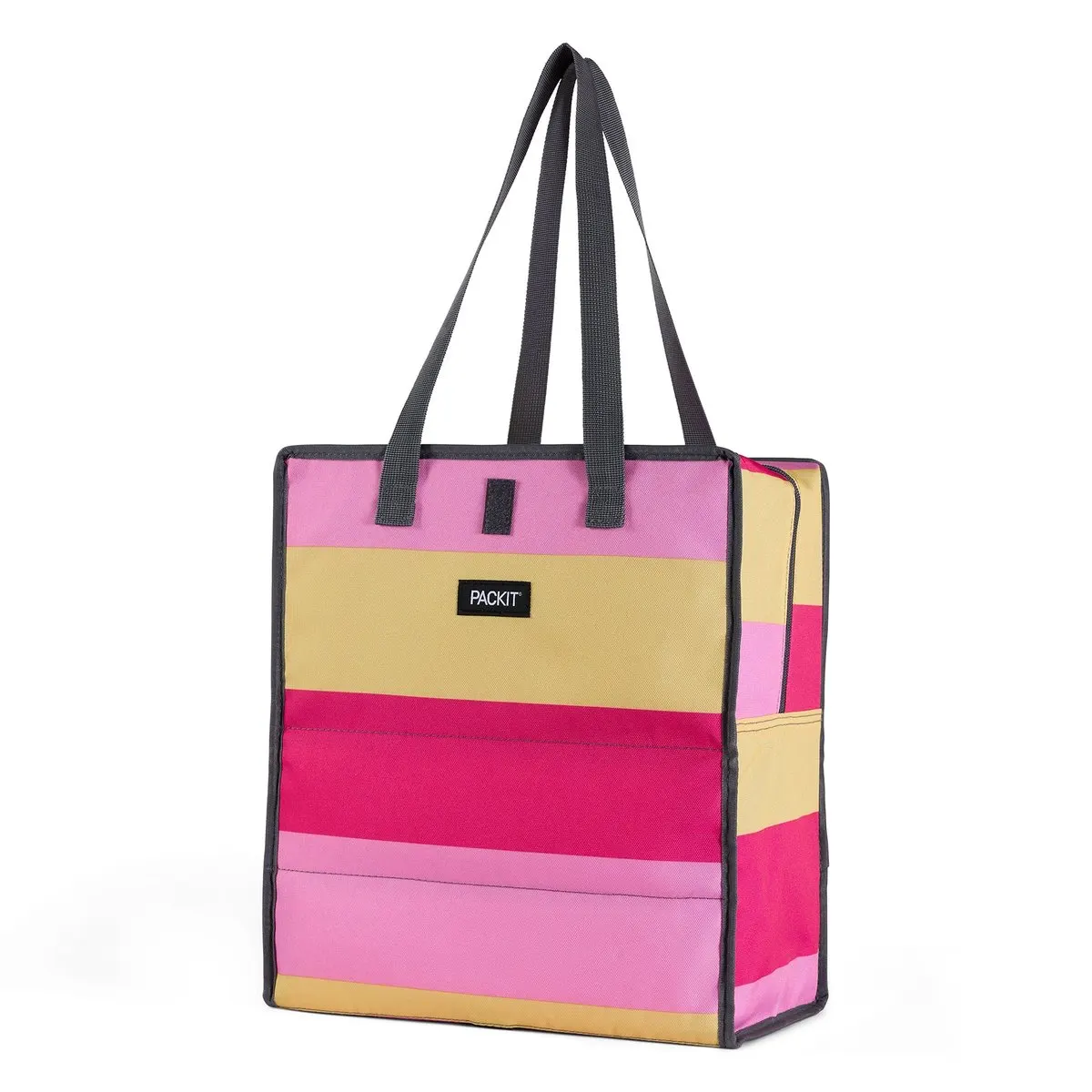
- Capacity
- 13 L (Amazon listing)
- Open Size
- 12.5 x 7.5 x 14.5 in (PackIt)
- Folded Size
- 12.5 x 2.25 x 7.5 in (PackIt)
- Weight
- About 2.8 lb (1,270 g, PackIt, one colourway)
- Freeze Time
- Overnight (8 h, PackIt)
- Care
- Hand wash; not machine washable
- Warranty
- 90 days (PackIt)
Overview — Who is this for?
The PackIt Freezable Grocery Bag is a zip-top shopping tote with freezable gel built into its walls and base. It solves one specific van-life problem: keeping perishables cold between the store's refrigerator case and your van fridge. It isn't a cooler, and it doesn't replace a 12V fridge. It's a bridge that keeps groceries chilled for a few hours without ice or electricity, then folds flat.
What the Amazon link sells: the PackIt Freezable Grocery Tote, 13 L, in black (ASIN B0CKWK72TD, PackIt part number PKO-GT-BAK). At the time of checking it was sold by Amazon.com. PackIt lists the tote at 12.5 x 7.5 x 14.5 inches open and 12.5 x 2.25 x 7.5 inches folded. The 13-litre capacity comes from the Amazon listing title; PackIt's product page doesn't state a volume.
Choose this if:
- Your grocery runs involve a drive of 30 minutes or more back to the van
- You have freezer space to keep it frozen between trips
- You want cold transport without loose ice packs
Skip this if:
- You need multi-day cold storage (get a cooler)
- Your freezer zone is tiny or doesn't hold below freezing
- You shop for large hauls of perishables (13 L is small)
What PackIt publishes
PackIt's US product page gives these details:
| Spec | PackIt figure |
|---|---|
| Open size | 12.5 x 7.5 x 14.5 in |
| Folded size | 12.5 x 2.25 x 7.5 in |
| Freeze time | Overnight; 8 hours for best cooling |
| Weight | 1,270 g (about 2.8 lb), listed for one colourway |
| Warranty | 90 days |
PackIt calls the cooling system ECOFREEZE: freezable gel "built directly into the base and walls." It describes the materials as PVC-free, BPA-free, phthalate-free and lead-free, with an "antimicrobial, food-safe lining." On hold time, PackIt says only that the tote keeps groceries chilled "for hours." It doesn't publish a specific number of hours or the test conditions behind that claim.
That last point matters, so this review doesn't invent one. How long the bag holds depends on the outside temperature, how cold the food was when it went in, how full the bag is, and how often it's opened. The section below explains how to find out what your bag actually holds.
The cold chain problem in van life
At home, the cold chain is short: a ten-minute drive in an air-conditioned car, then a full-size refrigerator. In a van, the chain is often much longer.
A realistic example: you're camped 45 minutes from the nearest grocery store. Groceries spend 15 to 20 minutes in your cart, then go into bags in a van that may be well above 90°F inside if it sat in the sun. You drive 45 minutes back, then unpack. That's easily two hours or more outside refrigeration, often in heat.
The USDA's guidance is the benchmark: discard perishable foods such as meat, poultry and eggs left at room temperature "longer than 2 hours; 1 hour in temperatures above 90 °F," because "bacteria grow rapidly between 40 and 140 °F." A long drive in a hot van can exceed that window. A pre-frozen tote buys margin, but it doesn't guarantee a temperature.
How it works
You freeze the whole bag, walls and all, overnight. PackIt says 8 hours for optimal cooling. The frozen gel walls become the cold source. Load cold groceries straight from the store's cases, zip it closed, and the gel absorbs heat until it thaws.
The gel is sealed inside the bag walls. You never handle, refill or replace it. A puncture or a failed seam would end the bag's useful life, so keep sharp items (skewers, can edges, bones in packaging) away from the walls.
The workflow:
- Before the trip: take the bag out of the freezer. Folded, it measures about 12.5 x 7.5 x 2.25 inches (PackIt).
- At the store: unfold it at checkout or at the van and load the perishables first.
- On the drive: keep it zipped, out of direct sun, and on the floor rather than on a sunny seat.
- At camp: unload into the fridge, wipe the inside if needed, let it dry, fold it and put it back in the freezer.
Will it freeze in a 12V fridge?
This is the van-specific question. PackIt's 8-hour figure assumes a household freezer. A 12V compressor fridge with a freezer zone, or a dual-zone fridge set to freeze, can work, but there are three things to check.
- Setpoint. The gel must reach and stay below 32°F (0°C). Set the freezer zone well below that; most dual-zone fridges let you set it much lower.
- Space. The folded bag needs a flat 12.5 x 7.5-inch spot about 2.25 inches tall. In a small chest fridge, that's a real slice of freezer space.
- Energy. Freezing the gel is real work for the compressor. A thawed bag going into the freezer adds load in the same way a warm bag of groceries does. If you're tight on battery, freeze it while driving or on shore power. Our fridge battery calculator helps size the battery for your fridge.
If your fridge freezer struggles to hold below freezing in hot weather, expect a longer or incomplete freeze. Leaving the bag in the freezer between trips means it's always ready.
What fits inside
At about 13 litres, the tote is smaller than a standard paper grocery bag. In practice it takes the perishables from a typical small-van run:
- A pack of chicken or a pound of ground meat
- A block of cheese and a tub of yogurt
- A quart of milk or a carton of eggs
- A bag of greens and a bag of frozen vegetables
- Butter
Dry goods, cans, bread and produce that doesn't need cold go in ordinary bags. For a bigger shop, two PackIt totes cover more perishables and still fold flatter than a soft cooler.
Find out what your bag holds
Because PackIt doesn't publish a hold time, the most useful thing you can do is measure it yourself once:
- Put a small fridge thermometer, or a probe like the AcuRite fridge and freezer thermometer, inside the frozen bag with a typical load.
- Note the time and the outside temperature.
- Check the reading when you reach the van, and again at the end of your usual drive.
That gives you a real number for your bag, your climate and your shopping habits. It's more useful than any general figure. In hot weather, treat 40°F as the line and get perishables into the fridge as soon as you arrive.
Compared with the alternatives
A plain insulated bag: it slows warming but adds no cold of its own. The PackIt's frozen walls actively absorb heat, which is the difference.
An insulated bag plus loose ice packs: this works and costs little. The downsides are that you have to freeze the packs separately, they shift around, they take up room inside the bag, and they need their own freezer space. The PackIt builds the cold into the walls instead.
A soft or hard cooler: a cooler such as the YETI Hopper M30 insulates far better and, with ice, holds much longer. It's also a permanent, bulky item. For grocery transport only, the fold-flat PackIt uses less space. For a day at the beach or a fridge failure, a cooler is the right tool.
Driving straight back and hoping: this often works in mild weather on short drives. In heat or on a long drive, it's the scenario where the USDA's one-hour rule bites.
Honest limits
It must be pre-frozen. PackIt says overnight, 8 hours for best cooling. An unfrozen bag is just an insulated tote. Keep it in the freezer between trips.
It's heavier than a regular bag. At about 2.8 lb empty (PackIt's figure for one colourway), it weighs several times as much as a reusable grocery bag. That's fine for the walk from the store to the van, not for a long carry.
It's not a cooler. It keeps groceries chilled for hours, not days.
It needs freezer space. In a small 12V fridge, the folded bag takes up a meaningful share of the freezer zone.
The gel walls reduce interior volume. The cooling has to go somewhere, so the inside is smaller than a regular bag of the same outer size.
Care is by hand. PackIt says to wipe the interior clean or hand wash as needed, spot clean the exterior, and let it dry completely before it goes back in the freezer. It isn't machine or dishwasher safe. Keeping meat in its store packaging, or in a zip bag, keeps the lining cleaner.
The warranty is short. PackIt lists a 90-day warranty, so inspect seams and the zip early.
Who should buy this
If you shop for groceries and drive more than half an hour back to your van, especially in hot weather, the PackIt is a small purchase that addresses a real food-safety gap. It's most useful for van dwellers who camp far from town and for anyone who has arrived back at camp with soft butter and warm chicken.
If you always park close to the store in mild weather, you probably don't need it. For more on planning efficient grocery runs, see our van life grocery shopping strategy guide, and for keeping the fridge itself cold in summer, see the summer van kitchen survival guide.
Final Verdict
The PackIt Freezable Grocery Bag fills the gap between the grocery store and the van fridge with no ice, no meltwater and no power draw on the drive. It folds flat between trips, and PackIt publishes clear dimensions, freeze time and care rules. Its limits are equally clear: it must be frozen ahead, it adds weight, it takes freezer space, and PackIt makes no specific hold-time claim. Use it with a thermometer the first few times, and you'll know exactly how much margin it gives you.
FAQ
Can I use the PackIt for things other than groceries? Yes. Any short trip that needs cold for a few hours suits it, such as leftovers to a potluck or drinks for a beach afternoon. For medication that must stay in a specific range, check with a thermometer rather than assuming.
How long does the gel last before it needs replacing? The gel is sealed inside the walls and isn't designed to be replaced. A puncture or failed seam ends the bag, so keep sharp items away from the walls. PackIt lists a 90-day warranty.
Can I freeze it in a small 12V van fridge/freezer? Yes, if the freezer zone holds well below 32°F (0°C) and has a flat spot about 12.5 x 7.5 x 2.25 inches. PackIt's 8-hour figure is for a household freezer; a 12V freezer zone running warmer may need longer, so leave the bag in between trips.
How long does it keep food cold? PackIt says "for hours" and doesn't publish a specific figure. Hold time depends on heat, load and how often the bag is opened. Put a thermometer in it on your usual drive to see what yours holds.
Does it come in different sizes? PackIt makes several freezable bags and coolers. The 13 L Freezable Grocery Tote suits van grocery runs: big enough for the perishables from a small shop, and flat enough to store easily.
Sources and verification
- PackIt, Freezable Grocery Tote product page: open and folded dimensions, overnight / 8-hour freeze guidance, "for hours" cooling claim, 1,270 g weight listed for one colourway, materials, care instructions, 90-day warranty; no capacity or hold-time figure published. https://www.packit.com/products/freezable-grocery-tote (checked 2026-10-12)
- USDA FSIS, Safe Handling of Take-Out Foods fact sheet (archived copy): 2-hour / 1-hour-above-90°F rule and the 40–140°F range. https://cybercemetery.unt.edu/oilspill/20130218140944mp_/http://www.fsis.usda.gov/Fact_Sheets/Safe_Handling_Take-Out_Foods/index.asp (checked 2026-10-12)
- Amazon listing for ASIN B0CKWK72TD, the listing this review links to, via the Amazon Creators API: title (13 L, black), part number PKO-GT-BAK, dimensions in the feature text, materials, care, seller (Amazon.com), availability (checked 2026-10-12)
Compare with similar products
See how this stacks up against the other kitchen storage we've reviewed.
Related Reviews

For: Quieter drawers and cabinets
Con-Tact Brand Grip Premium Non-Adhesive Shelf Liner, 18 in x 10 ft, Bright White
A cushioned, non-adhesive foamed-PVC liner with an open scrim that cuts to size with scissors. In a van it reduces sliding and rattling in drawers and cabinets and protects surfaces, but it is friction, not a restraint: heavy items still need a latched door, a lip or a strap.

For: Keeping cabinet doors shut
Southco MP-05-312-11 Round Push-to-Close Latch, Chrome on Chrome (Pack of 2)
A positive-locking marine latch that latches itself when the door closes and opens only when you pull the flush knob, so contents leaning on a van cabinet door or drawer front don't open it. Southco publishes the cutout, door-thickness range and materials, but the keeper and screws are sold separately and there is no published load or crash rating.
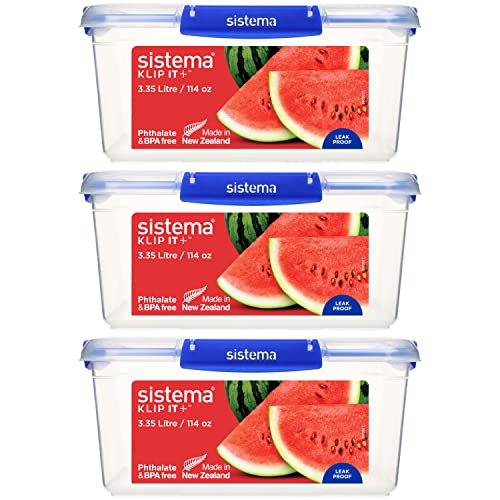
For: Latched dry-goods storage
Sistema KLIP IT PLUS 3.35L Rectangle Food Storage Containers, 3-Pack (82016)
Three 3.35-litre rectangular containers with built-in seals and four locking clips per lid. Sistema lists each at 255 x 175 x 117 mm (10.0 x 6.9 x 4.6 in) and 265.7 g. Clipped lids are less likely to pop open on a rough road than push-down or push-button lids. They stack, nest when empty, and suit pasta, rice, snacks or a fridge drawer. They are dishwasher safe on the top rack and microwave safe with the lid off.