Van Kitchen Ventilation: Fans, Hoods, and Why It Matters
Why every serious van kitchen needs active ventilation, the difference between MaxxFans and rangehoods, and how to install a 300 CFM hood that actually works.
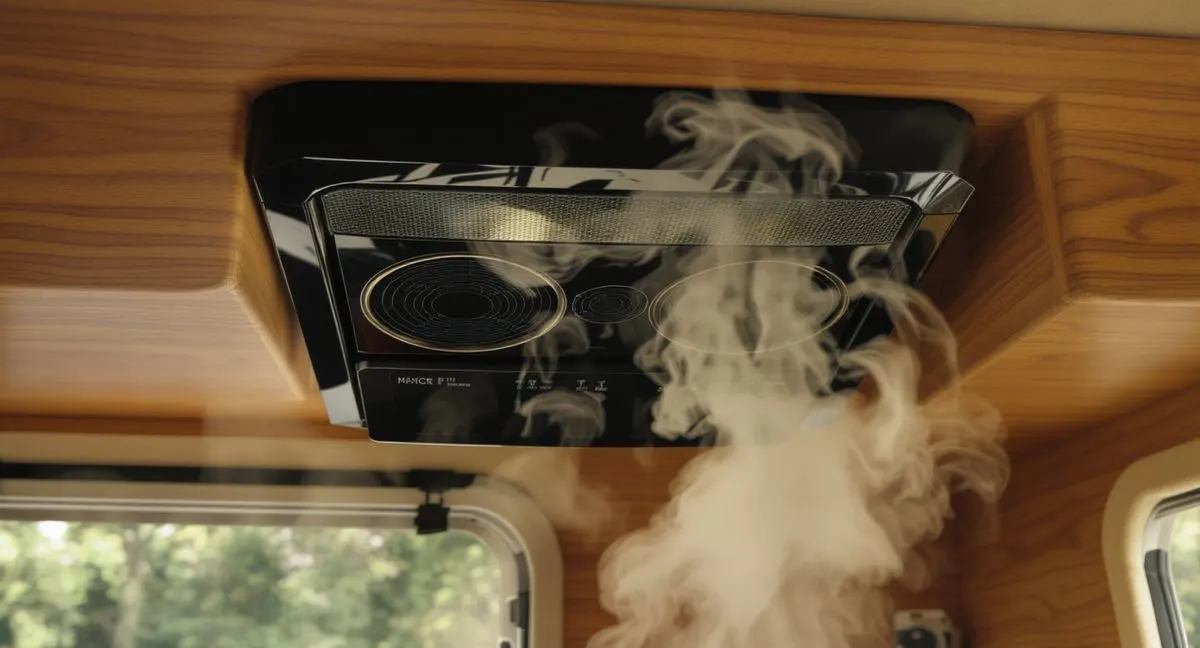
Disclosure: As an Amazon Associate I earn from qualifying purchases. Links to Amazon on this page are affiliate links: if you buy through one, VanLifeKitchens.com may earn a commission at no extra cost to you. Read our affiliate disclosure.
Why ventilation is the invisible upgrade
Van kitchen ventilation is the upgrade that no one photographs and that every experienced van dweller insists on after their second build. Cooking in an enclosed 80-square-foot space produces more water vapor, more grease, and more smell than most people expect, and if you don't actively move that air out, it ends up condensing on your windows, soaking into your cushions, and flavoring your blankets.
This guide covers why ventilation matters, the three categories of ventilation systems (roof fans, range hoods, and passive cross-ventilation), specific product choices, and how to actually install a 300 CFM range hood above an induction cooktop in a van kitchen. If you're at the rough planning stage and wondering whether to put a hood in your build, this guide is the answer: yes, and here's exactly how.
What you're actually venting
Cooking produces four things your van needs to get rid of:
- Water vapor. A pot of boiling pasta releases roughly 1 liter of water into the air over 15 minutes. Searing a steak releases almost as much. In a van with poor ventilation, that water condenses on the coldest surface — usually the windows — and over weeks it produces mold, rot, and a persistent damp smell.
- Grease aerosols. Frying anything above 300°F aerosolizes oil droplets into the air. Without a hood, those droplets coat every surface within a few feet of the cooktop. Walls get greasy. Curtains absorb the film. Cabinet faces develop a sticky coating.
- Combustion products (flame cooktops only). Burning butane or propane produces carbon monoxide, carbon dioxide, nitrogen dioxide and extra water vapour. Induction produces none of these, because nothing burns; high-heat searing on any cooktop does release fine smoke particles from the food and oil.
- Food smells. Fried onions, garlic, fish, curry spices. These are pleasant during dinner and awful the next morning when you wake up in the same smell.
It helps to separate two jobs. General cooking ventilation deals with items 1, 2 and 4 (steam, grease, odour, plus heat) and applies to every cooktop, including induction. Combustion ventilation deals with item 3: supplying air to a flame and removing its products. Combustion ventilation only matters for appliances that are certified to burn fuel inside a vehicle, such as a built-in RV propane cooktop installed to code, and it follows that appliance's installation instructions.
Portable butane and propane camp stoves are a different case. Their manufacturers label them for outdoor use (Coleman's propane stove instructions say "For outdoor use only" and "Never use inside house, camper, tent, vehicle or other unventilated or enclosed areas"; Iwatani's Cassette Feu manual says it "may not be used indoors in tents, campers, apartments or other confined areas"). No fan, hood or cracked window makes them an indoor appliance, so the ventilation advice in this guide is about cooking with induction or a certified built-in, not about running a camp stove inside. Camp stoves go outside, on a table by the slider or on a tailgate.
Active ventilation moves steam, grease and smell outside. Passive ventilation (open windows) only moves some of them, slowly.
The three ventilation categories
1. Roof fans (MaxxFan, Fantastic Fan, Fiamma)
A roof-mounted vent fan is the primary ventilation of most van builds. The standard choice is the MaxxFan Deluxe, a mid-range variable-speed 10-blade fan that mounts in a 14×14 inch roof cutout. It can exhaust or intake, with airflow from a gentle low setting up to roughly 900 CFM at the top speed (an open-air rating; real flow is lower with the lid partly closed or no intake window open).
What roof fans do well:
- Moving large volumes of air
- Cooling the cabin on hot days
- Drying out humidity
- Emergency smoke evacuation
What they don't do well:
- Capturing grease at the source (the air rises before it reaches the fan)
- Low-level smell venting (at low speeds they barely pull)
- Targeted cooktop ventilation (the fan isn't near the cooktop)
Power draw: roughly a fraction of an amp on the lowest speeds, around 1 A in the middle of the range, and a few amps at top speed at 12V (approximate figures; check the current table in the manual for your model). Assuming 30 minutes at a middle speed drawing about 1 A, a dinner session uses roughly 0.5 Ah, which is small in power-budget terms.
Install: follow the fan maker's installation instructions for the roof opening, sealing and wiring. Before cutting, check where roof ribs, wiring and any airbag or headliner components sit.
2. Range hoods (the real upgrade)
A range hood installed directly above the cooktop is the answer to the grease and water-vapor problems. A hood captures cooking output at the source — before it has a chance to spread through the cabin — and vents it directly outside through a dedicated duct.
The standard van-kitchen hood is a 12-volt, 200–400 CFM under-cabinet range hood with a built-in duct. Brands like Airxcel, Broan, and specialty RV/marine hood makers sell units designed for low-clearance installation in mobile kitchens. Budget for the hood itself plus ducting, flashing, and install hardware on top — the hardware is a real line item, not an afterthought.
What a hood does well:
- Captures grease immediately (the filter catches most of it before it enters the duct)
- Pulls hot water vapor up and out in seconds
- Contains cooking smells
- Makes the cook feel like they're in a real kitchen
Trade-offs:
- Permanent install — requires a roof cutout and a dedicated duct run
- Takes overhead space (3–4 inches of headroom above the cooktop)
- Adds a meaningful line item to the build cost
- The duct run is a water ingress point if flashed badly
3. Passive cross-ventilation
Cross-ventilation means opening a window on one side of the van and a door on the other, letting wind move through. In fair weather, it's free and effective. On a 70°F day with any breeze, an open-door van clears induction cooking steam and smell quickly.
But passive ventilation fails in four common scenarios:
- Rain
- Cold weather (you can't heat the cabin and vent it simultaneously)
- Buggy campsites (mosquitos treat open windows as invitations)
- Stealth camping in urban areas (you can't broadcast cooking smells)
For any serious full-time build, passive ventilation is a bonus, not a primary system.
The recommended van kitchen ventilation stack
Weighing all three, here's what we recommend for a full-time van kitchen:
- A MaxxFan Deluxe over the living area — does the bulk of cabin ventilation and cooling.
- A 300 CFM under-cabinet range hood above the indoor cooktop (induction, or a certified built-in) — captures grease and water vapor at the source.
- Screened opening windows for cross-ventilation in good weather — cost depends on your build.
Ventilation budget: a full system is a modest share of a typical van electrical and mechanical budget — check current prices on Amazon, they move often. Skip it and you'll regret it within the first month.
Installing a 300 CFM range hood
The hood install is the one most people are intimidated by, so here is an overview of the typical steps. Treat it as an outline, not a code-compliant procedure: the hood maker's installation instructions take priority on clearances, duct size, wiring and fusing, and a built-in gas cooktop below a hood has its own clearance requirements from its manufacturer.
Planning
- Cut line: the duct exits through the roof directly above the hood. Pick a location that (a) is above the cooktop, (b) clears any roof fans, solar panels, or roof rails, and (c) lands on a flat section of the roof. Mark with painters tape.
- Clearance: use the minimum and maximum mounting heights in the hood's installation instructions (and, for a built-in gas cooktop, the cooktop maker's overhead clearance, whichever is greater). Too close and heat damages the hood; too far and capture efficiency drops. Many residential-style hoods specify somewhere in the 24–30 inch range.
- Duct length: keep it under 4 feet total, with no more than one 90-degree elbow. Every elbow and every extra foot of duct cuts CFM significantly.
Cutting the roof
- Cut from the inside for cleaner edges and better control. Use a jigsaw with a fine metal-cutting blade.
- Seal the cut edges with a marine-grade rust converter immediately to prevent corrosion.
- Test-fit the duct flange before any sealant goes down.
Sealing the roof penetration
This is the step that kills most DIY installs. Use Dicor self-leveling lap sealant (the RV standard) or 3M 4200 marine sealant around the flange. Put a generous bead under the flange and around the perimeter after install. Check the seal every 6 months for the first 2 years — any crack and water will find it.
Wiring
- 12V DC power from your fuse block, with wire gauge and fuse or breaker size taken from the hood maker's instructions (sized for the hood's rated current and the length of the run, not a one-size-fits-all number).
- Switch: either a simple toggle on the hood itself or a remote switch near the cooktop.
- Run the wiring alongside your existing galley wiring, not through new penetrations. If your van's electrical system was professionally installed, ask the installer before adding circuits.
Duct material
Use rigid aluminum duct, not flexible dryer vent tubing. Flex duct kills airflow, collects grease in the corrugations, and is a fire hazard over time.
Induction vs propane and ventilation
One surprising thing: induction cooktops need ventilation too, even though they don't produce combustion products. Induction still heats the food, and the food still releases water vapor, grease, and smell. That is general cooking ventilation, and a hood or roof fan handles it.
Propane is where the two categories split:
- Portable propane camp stoves (Coleman Triton, Camp Chef Everest 2X and similar) are labelled by their manufacturers for outdoor use. They don't belong under a van hood at all; cook with them outside.
- Built-in, RV-certified propane cooktops can be used inside, but they need combustion ventilation whenever they run, on top of general cooking ventilation. They also need the rest of a proper gas system: a sealed propane locker vented to the outside, an LP-gas leak detector mounted low, a CO alarm listed for RV use, and installation by a qualified RV gas technician where codes or insurers require it. Follow the cooktop maker's installation instructions for its ventilation and clearances.
A CO alarm belongs in any van with a fuel-burning appliance, including diesel heaters. It is a last-line warning device: it tells you something has already gone wrong, and it is never a reason to run an outdoor-only stove inside.
See the induction vs butane vs propane guide for the full fuel comparison.
Common mistakes
Common mistakes:
- Skipping the hood entirely — "the MaxxFan is enough" is the most common mistake. A roof fan can't compete with a hood for grease capture.
- Using flex duct — kills airflow and grease risk.
- Running a hood duct past 4 feet — CFM drops 20–30% for each additional 90° elbow or extra 2 feet of duct.
- Missing the roof seal — first rainstorm and you have water in your galley.
- Treating a hood or roof fan as permission to run a camp stove inside — ventilation doesn't change a manufacturer's outdoor-only rating.
- No CO alarm in a van with any fuel-burning appliance — and no LP detector with a built-in propane system.
What a well-ventilated van kitchen feels like
The subjective difference is larger than you'd expect. With a proper hood over the cooktop:
- Your windows don't fog from cooking steam
- Your curtains don't smell like last night's dinner
- Your cabinets don't develop a greasy film
- You can cook fish without evacuating the van
- You feel like you're in a real kitchen, not a converted cargo bay
That last one is what matters most day-to-day. Van kitchens that feel like kitchens get used for real cooking. Van kitchens that feel like camp stoves get used for boiling water and heating up cans.
Final word
Van kitchen ventilation is the upgrade that separates a build you'll still be using in year three from a build you'll rip out. A proper ventilation budget isn't optional for serious full-time living — it's the difference between a kitchen that works and one that slowly ruins your van. Install a MaxxFan for cabin air movement, a 300 CFM range hood over the cooktop for grease and steam capture, and keep your windows openable for passive cross-ventilation when weather allows.
FAQ
Do I need a range hood in a van kitchen? For serious full-time cooking, yes. A MaxxFan alone can't capture grease and water vapor at the source the way a hood can. Budget for a 300 CFM under-cabinet hood plus ducting and install hardware on top.
What CFM do I need for a van range hood? 200–400 CFM is the right range. Below 200 CFM, the hood can't keep up with a 1800W induction cooktop during heavy cooking. Above 400 CFM, you're wasting power and creating negative pressure that pulls cold air in through window seals.
Can I use a dryer vent flex duct for a range hood? No. Flex duct cuts airflow by 30–50%, collects grease in the corrugations, and is a fire hazard over time. Use rigid aluminum duct for any hood install.
Does an induction cooktop need ventilation? Yes. Induction doesn't produce combustion products, but the food itself still releases water vapor, grease aerosols, and cooking smells. A hood over an induction cooktop captures those at the source before they spread through the cabin.
How do I seal a roof duct penetration? Use Dicor self-leveling lap sealant or 3M 4200 marine sealant in a generous bead under the flange and around the perimeter. Check the seal every 6 months for the first 2 years — any crack lets water in.
Does a range hood make it safe to use a butane or propane camp stove inside? No. Portable butane and propane camp stoves are labelled by their manufacturers for outdoor use, and a hood, roof fan or CO alarm doesn't change that. Inside the van, cook on induction or on a built-in RV-certified cooktop installed with its locker, LP detector, CO alarm and combustion ventilation.
Can I run a van kitchen with just a MaxxFan? For light cooking (coffee, boiling water, occasional stir-fry), yes. For serious cooking (searing, frying, bread baking), no — you need a hood to capture output at the source. Most full-timers install both.
More in Layout Guides
How to Cool a Van Without AC: 12 Strategies That Actually Work
Insulation, ventilation, reflective covers, parking strategy, and the fans worth buying — the 12 ways to keep a van under 80°F without burning 800W on air conditioning.
Van Knife Storage and Safety
Why loose knives in a moving van are dangerous, the four ways to mount a knife block in a galley, and the magnetic strip vs in-drawer block decision tree.
How to Stop Pots, Plates, and Drawers Rattling in a Van
Find where the noise comes from with a labelled-door drive, fix most of it with things you already own, choose liners, pan protectors and positive latches, and know why quiet is not the same as secured.