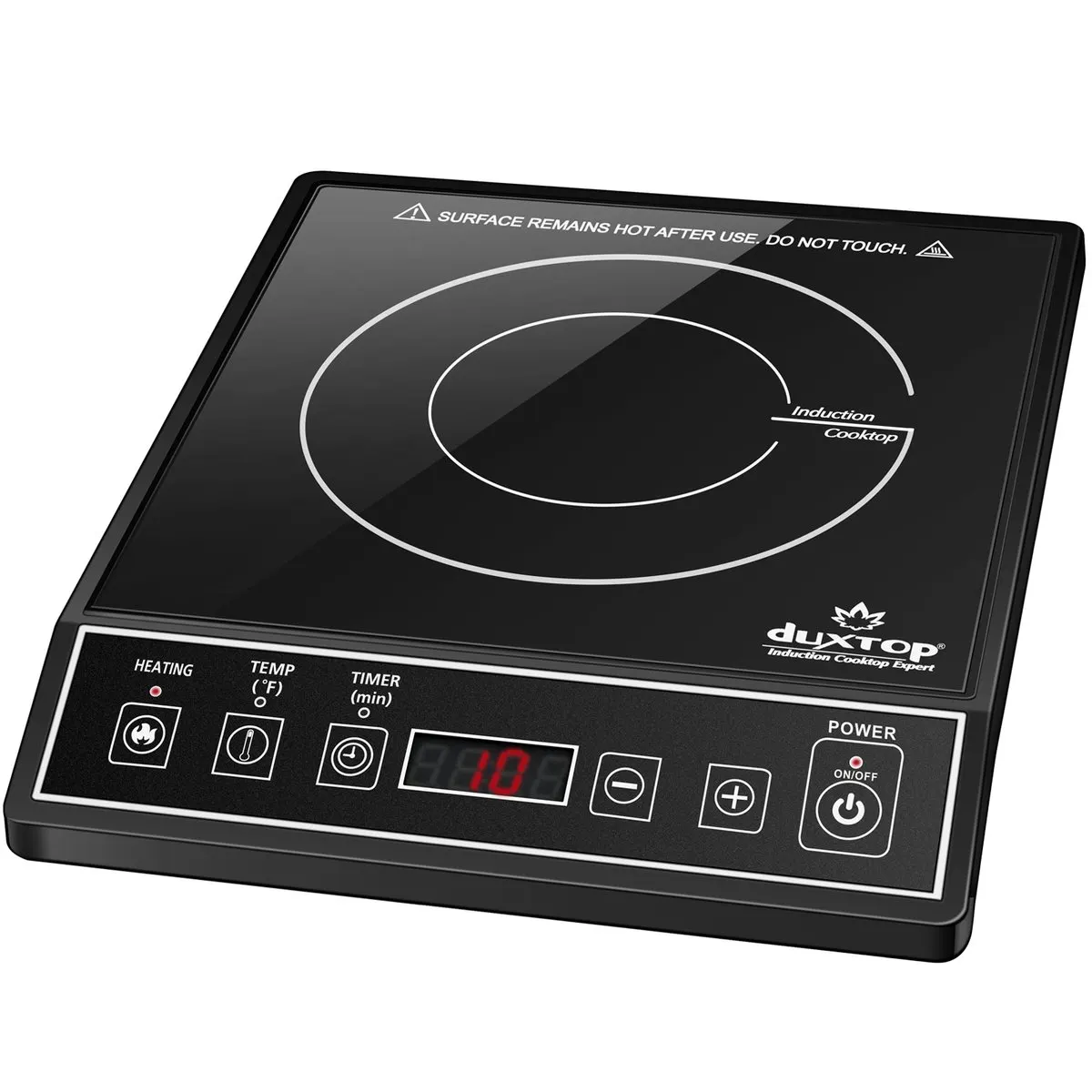
Duxtop 9100MC Portable Induction Cooktop
- Power
- 1,800 W max, 120 V / 60 Hz, 15 A circuit (manual)
- Power Levels
- 15 levels, 200–1,800 W (manual); listing says 20 levels, 100–1,800 W
- Temperature
- 140–460°F (manual); listing says 100–460°F
- Dimensions
- 11.4 x 14 x 2.5 in (manual)
- Weight
- 5 lb 12 oz (manual); 6.2 lb (listing)
- Cookware
- Magnetic base, 5 in minimum (listing)
- Clearance
- At least 4 in from walls (manual)
- Timer
- Up to 170 min; auto shut-off after 120 min without input (manual)
- Warranty
- 2 years limited (manual)
Overview: who is this for?
The Duxtop 9100MC is a budget, single-burner, 1,800 W portable induction cooktop with a push-button control panel and a ceramic glass top. It is the induction plate we suggest for most van builds that already have a serious electrical system, for unglamorous reasons: it is widely available, inexpensive to replace, uses physical buttons rather than a touch strip, and has a full US manual (published by Duxtop's maker, Secura) that spells out clearances, error codes and the warranty.
Operating location: inside the van is fine. Unlike every fuel-burning stove on this site, the Duxtop produces no combustion gases, so it doesn't need combustion ventilation and isn't labelled outdoor-only. It is a household 120 V appliance, so it needs a dry spot, the fan clearance Duxtop specifies, and its own outlet. You still want general cooking ventilation (a roof fan or open window) for steam, grease and odour, which applies to any cooking.
Choose this if:
- you have, or are building, a large lithium bank and an inverter of roughly 2,000 W continuous or more;
- you want to cook inside the van without combustion gases;
- you prefer physical buttons over a touch panel;
- you want a cheap, replaceable primary cooktop.
Skip this if:
- your inverter is under about 2,000 W continuous, or your battery and BMS can't supply around 165 A at 12.8 V;
- you cook mostly in sub-freezing weather with little solar;
- you don't want to replace aluminium or titanium cookware.
Short version: with an inverter of 2,000 W continuous or more and roughly 200 Ah of 12.8 V lithium, it is an easy recommendation. Without that, read the power section before buying anything.
Specifications
| Spec | Duxtop 9100MC (listing / manual) |
|---|---|
| Power | 1,800 W max, 120 V, 15 A circuit |
| Levels | See note below |
| Temperature | 140–460°F (manual) |
| Size | 11.4 x 14 x 2.5 in (manual) |
| Weight | 5 lb 12 oz (manual) |
| Cookware | Magnetic base, 5 in minimum |
| Warranty | 2 years (manual) |
A note on power and temperature levels: the current Amazon listing (which gives the model as BT-M20B; the title names the 9100MC) advertises 20 preset power levels from 100 to 1,800 W and 20 temperature settings from 100 to 460°F. Duxtop's US manual for the 9100MC (Silver) and 9120MC (Gold) describes 15 power levels from 200 to 1,800 W and 15 temperature settings from 140 to 460°F. The counts seem to differ between production versions; either way the range tops out at 1,800 W and 460°F. The listing gives the weight as 6.2 lb against the manual's 5 lb 12 oz. The listing also states an 83% energy-efficiency rating, ETL listing, and says the auto-pan detection switches the unit off after 60 seconds if no suitable pan is detected.
Design and build
The 9100MC is a flat slab with an ABS plastic housing, a ceramic glass cooking surface and an angled front panel of push buttons with a display. Amazon's product details list the controls as push button, and that matters in a van: capacitive touch panels can misread when the glass or your fingers are wet. Buttons register through wet or greasy fingers. That's a design difference, not a reliability guarantee, but it's a genuine one.
The glass top will scratch if you drag cast iron across it and can crack if something heavy drops on it. Lift pans rather than sliding them, and pack the unit with something soft over the glass when you drive.
The cooling fan draws air through vents in the housing. Duxtop's manual says to keep it at least 4 inches from walls for proper ventilation and not to block the air inlet and fan, so don't push it hard against a wall or recess it into a tight, unventilated cutout. Its error codes make the point: E1 covers high internal temperature, a fan fault or inadequate ventilation. The manual also says not to place objects heavier than 25 pounds on the glass. Crumbs, flour and sand get drawn into the vents over time; blowing them out occasionally is cheap maintenance. Keep it away from water: it's a household appliance, not a splash-proof one. Duxtop's manual gives a 2-year limited warranty from the date of purchase, and says it doesn't cover commercial use.
Performance
Boiling
Duxtop doesn't publish a boil time, so here is the physics instead (our estimate): heating a litre from about 60°F to boiling takes roughly 90 Wh of heat, and at 1,800 W with the listing's 83% efficiency that's a little under four minutes with a lid. Expect longer for heavy pans, cold water or uncovered pots.
Searing and pan size
Duxtop's minimum is a 5-inch magnetic base; it doesn't publish a maximum or a coil diameter. On portable plates of this size the coil is smaller than the glass, so a 9 or 10 inch cast iron or carbon steel pan is a safer bet for even heat than a 12 inch skillet, which tends to have a hot centre and cooler edges. The manual also explains a safety behaviour that matters for searing: if cookware overheats in Power Mode, typically while frying, the unit switches itself to Temperature Mode at 140°F, and the E2 code means the surface passed its 460°F limit and the unit shut down. For hard searing, a propane burner used outdoors does better.
Simmering
At low settings many budget induction plates switch the element on and off rather than running continuously at low power. With a 200 W bottom step (manual) or 100 W (listing), it can hold a gentle simmer on chili or rice with normal stirring, but it isn't as smooth as a premium built-in, and the Nuwave PIC Gold, which is built around a target temperature, is the better pick for very low, precise holding.
Power: what it takes to run this in a van
This section decides whether you should buy it. All figures below are our estimates from the rated draw, not our own measurements, and they use these assumptions:
- Cooktop draw: up to 1,800 W AC continuous on the highest setting, less at lower settings;
- Inverter efficiency: 85–90% (typical for a good inverter near its rated load);
- Battery voltage: 12.8 V nominal LiFePO4 (a sagging or lead-acid bank sits lower, which raises the amps);
- Other loads: not included, so add the fridge, water pump and anything else running at the same time.
Continuous watts and inverter size
At 1,800 W AC, the inverter pulls about 2,000–2,120 W from the battery, which is about 156–165 A at 12.8 V. The inverter's continuous rating (not its surge rating) has to exceed the cooktop's draw at the setting you use, plus anything else on the same inverter, or its overload protection shuts it off. In practice that means 2,000 W continuous as a floor for running this at full power, and 3,000 W if you want headroom for other loads.
Pure sine wave inverters are the general recommendation for induction cooktops and electronics. That's general guidance rather than an instruction in Duxtop's manual. What Duxtop's manual does specify is a 120 V / 60 Hz, 15 A circuit, and an E3 error code for input voltage that is too high or too low (the unit shuts down after one minute), so an inverter that sags under load can trigger it. If you'd run it from a portable power station, whether a power station can run an induction cooktop covers why voltage-reduction boost modes and stations rated at exactly 1,800 W are a poor match for this plate.
Battery and wiring
- BMS current: check the battery's continuous discharge rating. A single battery with a 100 A BMS can't feed 160 A. You need parallel batteries or a high-current model.
- Cables and fusing: the battery-to-inverter cables carry well over 150 A. Size them and the fuse to the inverter's rating, not the cooktop's.
- Installation: an inverter of this size is a serious DC install. Follow the inverter maker's installation instructions, and use a qualified RV electrical technician where codes or your insurer require one.
Battery use per cooking session (estimate)
| Session | AC energy | Battery Wh | Ah at 12.8 V |
|---|---|---|---|
| 1 L boil, ~4 min | ~120 Wh | ~135–140 Wh | ~10–11 Ah |
| 20 min at 1,800 W | 600 Wh | ~670–705 Wh | ~52–55 Ah |
| Dinner, ~25 min mixed | ~400 Wh | ~445–470 Wh | ~35–37 Ah |
The "dinner" row assumes about 5 minutes at full power to heat a pan or boil water, then about 20 minutes averaging roughly 750 W. Real meals vary widely; cycling between high and low settings uses noticeably less than full power for the whole time. The battery figures are AC energy divided by inverter efficiency (85–90%), then by 12.8 V for amp-hours.
By the same assumptions, two people cooking two meals a day can plausibly use 50–100 Ah a day at 12.8 V on induction alone, on top of the fridge. That's why an induction-first kitchen for two is usually planned around 200 Ah or more of lithium with solar and alternator charging. Run your own numbers in the power calculator, and see the van kitchen power budget guide for the full load calculation.
When induction is the wrong answer
In sub-freezing weather with short days, solar output drops, and LiFePO4 batteries generally must not be charged below about 32°F. A cold, under-charged bank and an 1,800 W cooktop are a poor combination. That's why many induction vans also carry a fuel stove as a backup. Those stoves, including the Gas One butane stove and the Coleman Triton+, are labelled for outdoor use, so the backup plan means cooking outside the van, not on the indoor counter.
Size, storage and daily use
At 11.4 x 14 x 2.5 inches and 5 lb 12 oz (manual; the listing says 6.2 lb) the 9100MC stows in a drawer or slide-out. Check drawer depth for the 2.5-inch thickness before you plan a slot, or store it on edge in a padded spot. The manual gives a 5 ft attached cord, so plan outlet placement so you're not running an extension cord across the galley. If you must use one, it has to be rated for the full current.
Operating details from the manual worth knowing:
- the timer runs up to 170 minutes in 1-minute steps, in either Power or Temperature Mode;
- without a timer set, the unit switches itself off after 120 minutes if no button is pressed, a useful backstop in a small space;
- the glass can stay hot from the pan after cooking (the listing warns about this), so let it cool before you stow it;
- E0 means no compatible cookware was detected. It won't run without a magnetic pan, so test pans with a fridge magnet; the manual's rule is that if a magnet sticks to the bottom, the pan will work. Cast iron, carbon steel and most magnetic stainless work; aluminium, copper, glass and titanium don't. The guide to nesting cookware for induction lists which pots and pans on this site are listed for induction and how they pack together.
Cleaning is simple: a damp cloth for most spills and a glass-top scraper for burned-on residue.
Value
At its budget price, the cooktop is the cheap part of an induction kitchen. The inverter, batteries, wiring and solar to feed it are where the money goes. If the Duxtop fails after a few years of daily use, replacing it costs far less than a built-in drop-in unit, and you don't have to cut the counter to do it.
How it compares
vs butane. Butane stoves are cheap and need no electrical system, but the manufacturers of the butane stoves on this site label them for outdoor use, they struggle near freezing, and canisters add up for daily cooking. Induction can be used inside and costs nothing per meal on solar, but needs the electrical system. See Duxtop vs Iwatani.
vs built-in induction. A drop-in unit looks more finished and draws similar power per burner, but costs several times more and is harder to replace. Living with a portable for a while tells you what you actually need. For two burners, two Duxtops side by side work, but two at full power would draw about 3,600 W, more than a 3,000 W inverter can supply, so one has to run lower.
vs Nuwave PIC Gold. The Nuwave tops out at 1,500 W, uses a touch panel, and lets you set a target temperature from 100°F to 575°F. It's slower to boil but easier on a 2,000 W inverter and better for gentle holding. See the Duxtop vs Nuwave comparison.
vs propane. See Duxtop vs Coleman Triton+. The Coleman is an outdoor-only stove, so the two cover different situations.
Who should skip this
- Anyone whose inverter can't supply about 2,000 W continuous. It will shut off under load at full power. You could cap the cooktop at lower power levels, but you'll lose the speed that makes it worthwhile.
- Anyone with a small battery bank and little charging. You'll drain it faster than you can refill it.
- Cold-weather full-timers who can't keep the battery warm and charged.
- Anyone who needs two burners at once and lacks the inverter for two plates.
- Anyone unwilling to swap out aluminium cookware.
Final verdict
The Duxtop 9100MC is a sensible, inexpensive induction plate for a van that has the electrical system to run it. Push-button controls, 1,800 W maximum, adequate simmer control and a small footprint make it a practical primary cooktop, and it's one of the few cooktops on this site you can use inside the van. The catch is the infrastructure: a 2,000 W-plus continuous inverter, a battery and BMS that can deliver about 165 A at 12.8 V, and the charging to put back 35-odd Ah per dinner. Do the power audit first, then buy it.
FAQ
Can I use the Duxtop 9100MC inside my van? Yes. It's an electric induction cooktop with no combustion, so it doesn't need the outdoor location that fuel stoves do. Give it about 4 inches of clearance for its cooling fan, keep it dry, plug it into its own outlet, and use a roof fan or open window for steam and cooking odours.
What size inverter do I need? The inverter's continuous rating must exceed what the cooktop draws at the setting you use, plus any other loads. For full 1,800 W use, 2,000 W continuous is the practical floor and 3,000 W gives headroom. Pure sine wave is the general recommendation for induction.
How much battery does a meal use? Our estimate, assuming 85–90% inverter efficiency and a 12.8 V lithium bank: about 35–37 Ah (445–470 Wh from the battery) for a 25-minute dinner using about 400 Wh at the cooktop, and about 52–55 Ah for 20 minutes at full power. Real use varies with settings and cookware.
Does it work with my camping cookware? Only if the base is magnetic. If a magnet sticks firmly to the bottom, it works. The Amazon listing asks for a magnetic base at least 5 inches across. Aluminium, copper, glass, ceramic and titanium won't heat.
How many power levels does it have? The current Amazon listing says 20 levels from 100 to 1,800 W; Duxtop's US manual describes 15 levels from 200 to 1,800 W. The maximum is 1,800 W either way.
Sources and verification
- Duxtop 9100MC / 9120MC user manual on ManualsLib, https://www.manualslib.com/manual/1595103/Duxtop-9100mc.html (pages 6, 11, 12, 14, 15, 17 and 19): 4 in wall clearance, 120 V/60 Hz 15 A circuit, 200–1,800 W in 15 levels, 140–460°F, 5 lb 12 oz, 11.4 x 14 x 2.5 in, 5 ft cord, 170-minute timer, 120-minute auto shut-off, E0–E3 codes, magnet test, 2-year limited warranty (checked 2026-10-12).
- Amazon listing, ASIN B00GMCAM2G: title (Duxtop 1800W Portable Induction Cooktop, 9100MC), model BT-M20B, 20 levels 100–1,800 W, 100–460°F, 83% efficiency, ETL listed, 5 in minimum magnetic base, 60-second pan detection, 6.2 lb, 2-year warranty, in stock (checked 2026-10-12).
Compare with similar products
See how this stacks up against the other cooktops we've reviewed.
Head-to-head comparisons
- Duxtop 9100MC Induction Cooktop vs NuWave PIC Gold Induction CooktopSpecs, fit and trade-offs side by side
- Duxtop 9100MC Induction Cooktop vs Coleman Triton+ 2-Burner StoveSpecs, fit and trade-offs side by side
- Duxtop 9100MC Induction Cooktop vs Iwatani Cassette Feu Butane StoveSpecs, fit and trade-offs side by side
- Duxtop 9100MC Induction Cooktop vs Duxtop 9620LS Double InductionSpecs, fit and trade-offs side by side
Related Reviews
 Outdoor use only
For: Backup butane burner (outdoors)
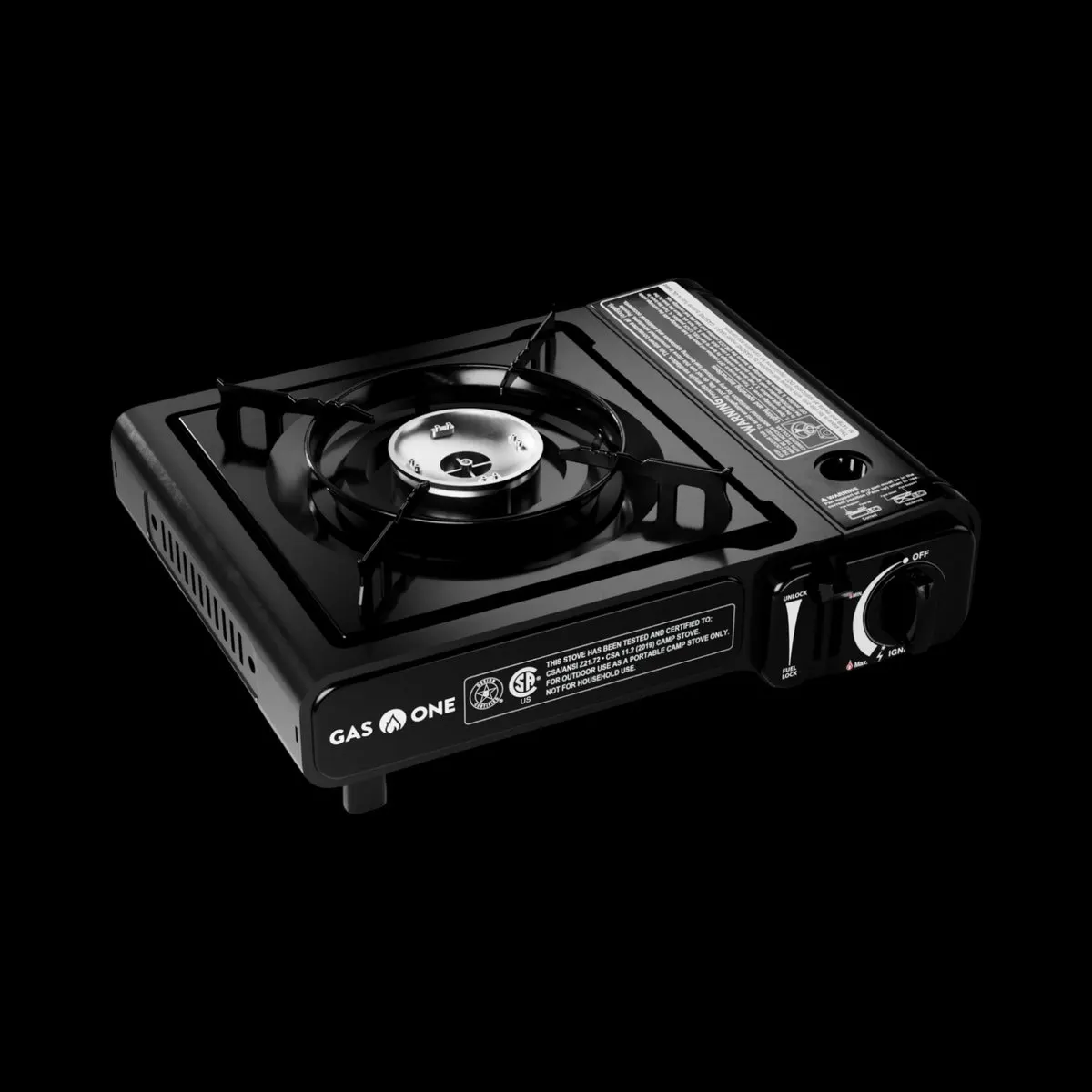
Gas One GS-1000G Portable Butane Stove
A budget single-burner butane stove for a backup or outdoor second burner. No electricity, piezo ignition with a safety shut-off and a carry case. The listing and Gas One label it for outdoor use only, so cook with it outside the van.
For: Precise low-heat induction
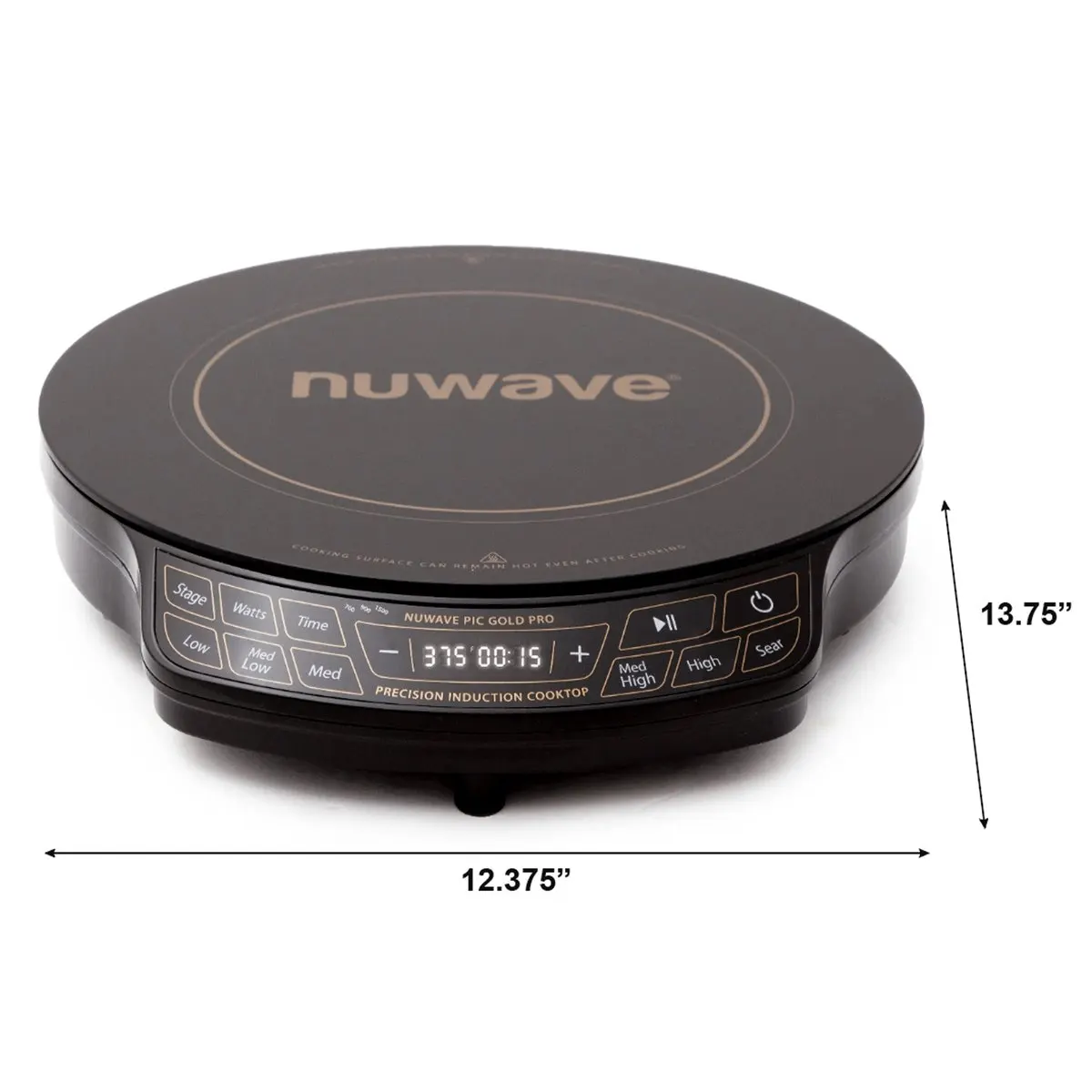
NUWAVE PIC Gold (Gold Precision) 1500W Induction Cooktop
Nuwave's PIC Gold, now sold as the Gold Precision: 1,500 W with 900 and 600 W settings and 100–575°F temperature control. The lower-wattage modes make it easier on a smaller inverter.
 Outdoor use only
For: High-output outdoor propane cooking
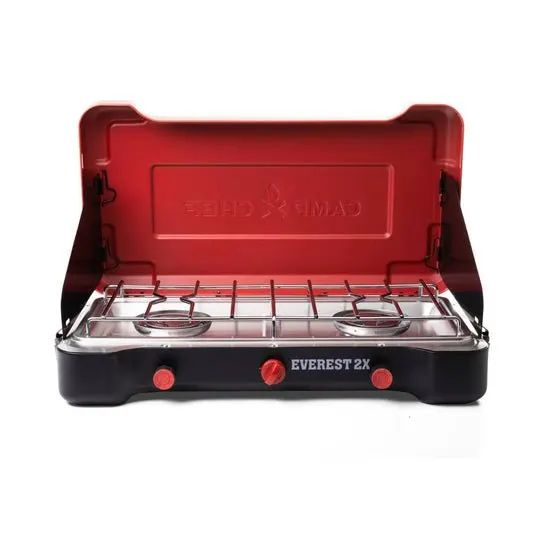
Camp Chef Everest 2X 2-Burner Propane Stove
A higher-output two-burner propane stove: Camp Chef rates each burner at 20,000 BTU, with matchless ignition on both. Its manual says outdoor use only and not in or on recreational vehicles.