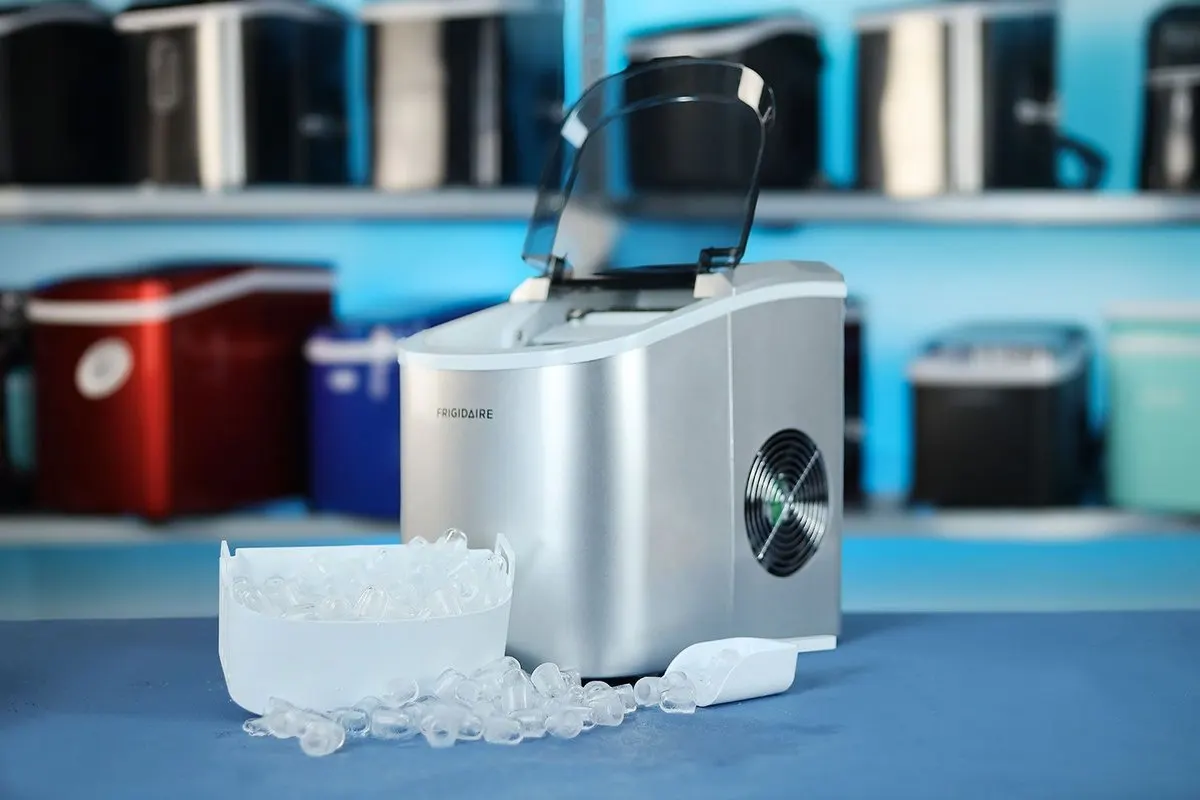
Frigidaire EFIC189 Countertop Ice Maker
- Power
- 105 W rated (EFIC189 manual)
- Ice Production
- 26 lb (12 kg) per 24 h (rated)
- Cycle
- 7-15 min, 9 pieces per cycle (manual)
- Basket
- Up to 2.2 lb (listing)
- Dimensions
- 12.2 x 9.1 x 12.8 in (manual; listing says 15 x 11 x 14.5)
- Weight
- About 17 lb (7.7 kg, manual)
- Clearance
- About 6 in on all sides (manual)
- Ambient
- Best at 50-90°F (manual)
- Power Source
- 120 V AC
Overview — Who is this for?
This Frigidaire EFIC189 review is for the van lifer who spends summers on hookups in warm places and wants ice every day without buying bags or giving up freezer space in a 12V fridge.
What the Amazon link sells: "FRIGIDAIRE EFIC189-Silver Compact Ice Maker, 26 lb per Day, Silver" (ASIN B075QP7SCP, model EFIC189-Silver). It is a countertop ice maker rated for up to 26 pounds (12 kg) of ice in 24 hours, with two ice sizes, an "ICE FULL" and an "ADD WATER" indicator, and a removable basket and scoop. It is not a freezer and it does not keep ice frozen.
Who makes it: the user manual for the EFIC189 is published by Curtis International Ltd., which uses the Frigidaire name under license from Electrolux. Warranty claims and service go to Curtis, not to Frigidaire's appliance service network. We read that manual (hosted on Amazon's servers) along with the Amazon listing; both are listed under Sources at the end.
Choose this if:
- You spend summers in hot places with regular shore power
- You want ice daily without buying bags or giving up freezer space
- You have a cooler to store the ice it makes
Skip this if:
- You boondock most of the time on a small or medium battery bank
- Your van interior regularly sits above 90°F while you'd run it (the manual says ice-making suffers above 32°C, see below)
- You only want ice occasionally
The fundamental limitation: for most vans this is a shore-power appliance. The manual rates it at 105 W at 120 V. Unlike a 12V fridge, which cycles off once it's cold, an ice maker's compressor runs for most of the time it's making ice, and it stops only when the basket is full or the reservoir is empty. Running it all day uses roughly 2 to 2.5 kWh by our estimate, which typical van battery banks don't sustain. A few hours at a time is more realistic (the power section has the numbers). The realistic use case is RV parks, campgrounds with hookups, driveway stays, and any situation where you have a 120V outlet.
Why a Van Kitchen Might Want an Ice Maker
A 12V compressor fridge keeps food cold, but it is a poor ice factory. Freezing a tray of water in the freezer zone of a dual-zone fridge takes hours, uses part of the box you'd rather fill with food, and adds load to a fridge that is already working hard in summer heat. Bagged ice works too, until you're parked somewhere without a store for days.
An ice maker fills a narrow gap: hot-weather stays with shore power, where you want cold drinks, iced coffee, an ice bath for blanching vegetables or chilling cooked pasta, and some extra cold in a cooler. If that describes your summers, a dedicated machine is useful. If it doesn't, it's a bulky single-purpose appliance.
For keeping the whole van kitchen working in extreme heat, our summer van kitchen survival guide covers cooling strategies, meal planning, and food safety beyond just ice.
How the EFIC189 Works
The EFIC189 uses a small compressor refrigeration system, the same basic technology as a 12V fridge, with R600a refrigerant per the manual. The manual describes the cycle: water is pumped from the reservoir into an ice tray below the evaporator; over 7 to 15 minutes ice forms on the evaporator; the tray then tilts back and drains the leftover water into the reservoir, and the ice drops off and is pushed forward into the basket. The tray returns and the next cycle starts.
The manual's technical table gives 9 pieces of ice per cycle and an "ice-dispensing time" of about 8 minutes, depending on ambient and water temperature. The Amazon listing says first ice comes in "less than 6 minutes". Treat both as best-case; the manual's 7-to-15-minute cycle range is the more useful planning figure.
The listing describes the ice as "clear ice cubes" in two sizes. The manual doesn't describe the shape. Either way, it's small, quick ice suited to glasses, bottles and coolers.
When the basket fills, the "ICE FULL" light comes on and the machine stops; it restarts about 5 seconds after you scoop ice out. When the reservoir runs low, the "ADD WATER" light comes on and the cycle stops until you refill and press ON/OFF again (or it restarts on its own after about 20 minutes). The manual says to fill only with drinking water, at room temperature or cooler, and never above the MAX mark.
Production Rate and Real-World Output
The rated 12 kg (26 lb) per 24 hours works out to about 1.1 pounds an hour of continuous running, and it assumes you keep emptying the basket. The Amazon listing says the basket stores up to 2.2 pounds at a time.
Heat is the big caveat for van use. The manual's troubleshooting table says that if the ambient or water temperature is too high, the cycle can run normally but produce no ice, and it tells you to start the machine where the air is below 32°C (about 90°F). For good results it recommends an ambient temperature between 10 and 32°C (50 to 90°F) and water between 8 and 28°C. A closed van in summer sun can easily exceed 90°F, so run it in the cool of the morning, in shade, or with the van ventilated, and fill it with cold water from the fridge.
In practice, plan to make a batch of a few pounds over a few hours and move it to a cooler, not to run it all day. The manual itself says that after each use you should remove all ice and drain the water, and transfer ice to a freezer.
Power Requirements — Detailed Breakdown
Rated power: the manual's technical table lists 105 W at 120V/60Hz. Some retail listings quote a higher figure, so check the rating label on your unit. Rated power is not a constant draw: it varies through the freeze and harvest parts of each cycle, and drops to almost nothing when the basket is full and the machine pauses.
Typical use, in Wh (our estimate, not a measurement): assume an average of 80 to 105 W while the machine is actively making ice, in a warm van interior.
| Run time | Ice (rough) | AC energy | From a 12.8 V battery |
|---|---|---|---|
| 1 hour | about 1 lb | 80–105 Wh | 7–10 Ah |
| 4 hours | 3–4 lb | 320–420 Wh | 29–38 Ah |
| 24 hours | up to 26 lb | 1.9–2.5 kWh | 170–225 Ah |
The battery column assumes an inverter around 87 percent efficient and a 12.8 V lithium bank (AC Wh divided by 0.87, then by 12.8). The ice column is a rough estimate in mild conditions; in heat above 90°F, output falls and can stop.
Inverter size: a compressor has a startup surge well above its running draw. Use a pure sine wave inverter with headroom, roughly 500 W continuous or more, and check its surge rating. The manual's warranty is void if the product is used on any voltage or waveform other than specified, which is another reason to use pure sine.
Is it realistic off-grid? Only for short runs on a well-equipped van. A few hours of ice-making in the middle of a sunny day, on a lithium bank of 200 Ah or more with several hundred watts of solar, is feasible. All-day running isn't, for typical van systems. For smaller banks or cloudy weather, shore power is the right answer. Large inverters and battery banks should be installed to the manufacturer's instructions, by a qualified RV electrical technician where codes or insurers require it. The power calculator helps you check your own numbers.
EFIC189 vs Using Your Dual-Zone Fridge-Freezer for Ice
The obvious question: why not just make ice in the freezer side of a dual-zone fridge? Here is how the two compare.
Speed. A freezer compartment takes hours to freeze a tray of water. The EFIC189's cycle is 7 to 15 minutes per batch, per its manual.
Capacity. The freezer side of a dual-zone van fridge is only part of the box. On the Iceco VL60 Dual Zone, for example, the freezer is usually set up in the smaller compartment. Fill it with ice trays and you've given up frozen food storage. The EFIC189 makes ice without using any fridge or freezer space.
Fridge efficiency. Every time you open the freezer compartment for ice, warm air gets in and the compressor has to recover. In summer heat, that means more power and less stable temperatures. A separate ice maker leaves the fridge closed.
Power, honestly compared. Freezing water in a 12V fridge costs energy too, and a fridge's insulated box loses less of it than an uninsulated countertop basket. If you're off-grid, a few trays in the freezer zone may be the more battery-friendly way to get a little ice. The ice maker wins on speed and volume when you're on hookups.
The dual-zone freezer is the right tool for keeping frozen food frozen. The EFIC189 is the right tool for making ice in quantity when you have shore power.
Build Quality and Design
The manual's technical table lists the housing as PP (polypropylene) plastic; the listing describes a stainless-steel-look silver finish with a large transparent window, so you can see when the basket is getting full without opening the lid. The controls are simple: on/off, ice size, and indicator lights for add-water and ice-full.
Size and weight: the manual gives the unit at 310 x 230 x 325 mm (about 12.2 x 9.1 x 12.8 inches, D x W x H) and 7.7 kg (about 17 lb) net. The Amazon listing's dimension fields say 15 x 11 x 14.5 inches, which may include packaging or handles, so plan around the larger figure. (The "26 lbs" printed on the manual cover is the daily ice output, not the weight.) Add the 6-inch ventilation gap on every side and you need roughly a 24 x 21 inch spot while it runs. In most vans it lives in a gear bin and comes out only during shore-power stays.
The drain plug on the bottom empties the reservoir; the manual says to move the machine forward so the plug clears the edge of the counter. The removable ice basket lifts out for transfer to a cooler. It is a consumer appliance, not commercial-grade.
Ventilation and placement: the manual asks for about 6 inches (15 cm) of clearance on all sides and a dry, level surface away from heat sources. In a van, that rules out a closed cabinet. Never run it while driving. The manual says not to tilt it more than 45° in transport or use, to wait 2 hours after leveling it before first use, to let it rest 30 minutes after moving it, and to stand it upright for 2 hours if it ever tips over. Strap it upright in a bin for travel.
Maintenance and Water Quality
The manual recommends cleaning once a week: unplug it, let it warm to room temperature, drain the reservoir through the drain plug, wipe the interior with a soft cloth soaked in warm water and vinegar, rinse with clean water, and drain again. Wash the basket and scoop in warm soapy water. The manual says not to clean the evaporator, and not to use solvents, boiling water, detergent, or strong acids or alkalis. It also suggests replacing the water weekly and emptying and drying the reservoir before storing the machine, which in a warm van is the step that keeps mold away.
Water quality affects both the ice and the machine. Hard water leaves mineral deposits, and mineral-heavy water makes ice that tastes off. If your tank water is hard, fill the reservoir with filtered water.
Freezing water doesn't make it safe to drink, so only fill the reservoir with water you'd drink as-is, which is also what the manual specifies. A carbon filter on your van's tap improves taste and reduces some chemicals, but it isn't a purifier and doesn't remove bacteria or viruses; if your tank water's source is uncertain, use bottled drinking water for ice. Our water filtration guide explains which filters do what.
The Storage Problem — Ice Without a Freezer
Here is the honest challenge with a countertop ice maker: it makes ice, but it doesn't keep ice frozen. The manual says so directly: "This ice maker is not designed to keep ice frozen." Ice left in the basket slowly melts back into the reservoir and gets refrozen, which wastes energy.
The solution is a good cooler. Move ice to an insulated cooler as the basket fills. How long it lasts depends on the cooler and the heat; a well-insulated rotomolded cooler kept in shade and opened rarely does much better than a thin soft cooler. The EFIC189 is one half of an ice system, and the cooler is the other half.
A vacuum-insulated tumbler or bottle is the personal-use piece of that system: fill it with ice and cold water in the morning and it stays cold far longer than an ordinary cup.
Noise Levels
Neither the manual nor the Amazon listing gives a noise figure, and we haven't measured one. Expect the compressor hum of a small refrigeration appliance, plus the water pump at the start of each cycle and the sound of ice dropping into the basket. In a small van, that's noticeable at night, so time batches for the day where you can.
Who Should Skip This
Skip the Frigidaire EFIC189 if you rarely camp in hot weather; in the Pacific Northwest, northern latitudes, or shoulder seasons, you won't use it enough to justify the space. Skip it if you have no shore power and no large solar-and-lithium setup. Skip it if your van usually sits above 90°F inside when you'd want ice, because the manual says ice-making suffers in that heat. Skip it if counter and storage space are already maxed out: with its 6-inch ventilation gap, it needs a real spot. And skip it if a bag of store ice every couple of days already works for you.
Final Verdict
The Frigidaire EFIC189 is a convenience for summer van life on hookups. It makes ice in 7-to-15-minute cycles, is rated up to 26 pounds a day, draws a modest 105 W per its manual, and weighs about 17 pounds. It needs shore power for most van builds, it doesn't store ice without a separate cooler, it needs 6 inches of airflow on every side, and its own manual says it works best below 90°F ambient, which is exactly where vans get hot.
If you spend summers in hot climates with regular shore power and value cold drinks, it does that job and you can stop buying bags. Run it in the cooler part of the day, with cold water, and keep a good cooler next to it. For off-grid travelers it's hard to justify against a few ice trays in a freezer zone.
FAQ
How long does it take to make ice? The manual says each cycle takes about 7 to 15 minutes depending on air and water temperature, with 9 pieces per cycle. The Amazon listing claims first ice in under 6 minutes. The 26 lb/day rating works out to just over 1 pound per hour in good conditions.
Does the EFIC189 keep ice frozen? No. The manual says it is not designed to keep ice frozen. Transfer ice to a cooler as the basket fills, and drain the water after each use.
Will it work in a hot van? Not well above about 90°F. The manual's troubleshooting table says too-high ambient or water temperature can stop ice production, and recommends running it between 50 and 90°F ambient with water between about 46 and 82°F.
Can I run it off my van's battery bank? For a few hours, if you have a large lithium bank (200 Ah or more), strong solar and a pure sine inverter of roughly 500 W or more. By our estimate, 4 hours of ice-making uses about 29 to 38 Ah from a 12.8 V bank. All-day running isn't realistic for typical van systems; shore power is the practical answer.
How much space does it need? The manual gives the unit at about 12.2 x 9.1 inches at the base (the listing says up to 15 x 11), plus about 6 inches of clearance on all sides for ventilation. Plan on a dedicated, level spot while it's running.
Is the ice safe to eat? Only if the water is. Use drinking water in the reservoir, replace it weekly, and clean the machine weekly as the manual recommends. Filtered water improves taste and reduces mineral buildup but doesn't make unsafe water safe.
How does it compare to buying bagged ice? A bag of store ice is typically 7 to 10 pounds. At the rated rate, the EFIC189 makes that much in roughly 7 to 10 hours of continuous running in mild conditions, and more slowly in heat. If you'd otherwise buy ice every day or two through a hot summer and you have hookups, it can replace most of those trips.
Sources and verification
- EFIC189 user manual (Curtis International Ltd., Frigidaire name used under license from Electrolux), hosted by Amazon, https://m.media-amazon.com/images/I/D1gGllx+msL.pdf (one manual covering several model numbers, including EFIC189-SILVER): technical parameters (120V/60Hz, 105 W rated, R600a, 7.7 kg net, 310 x 230 x 325 mm, PP housing, 9 pieces per cycle, about 8 minutes, 12 kg per 24 hours, climate class ST/SN/N/T), 6-inch clearance, 45° tilt limit and settling times, ice-making cycle description, indicator behavior, ambient and water temperature limits, weekly cleaning, "not designed to keep ice frozen", 1-year warranty through Curtis (checked 2026-10-12).
- Amazon listing, ASIN B075QP7SCP: exact title, model EFIC189-Silver, 26 lb per day, "less than 6 minutes", 2.2 lb storage, two ice sizes, transparent window, indicators, 1-year warranty field, 15 x 11 x 14.5 in dimension fields (checked 2026-10-12).
- Not found: a Frigidaire or Curtis product page for the EFIC189.
Compare with similar products
See how this stacks up against the other small appliances we've reviewed.
Related Reviews
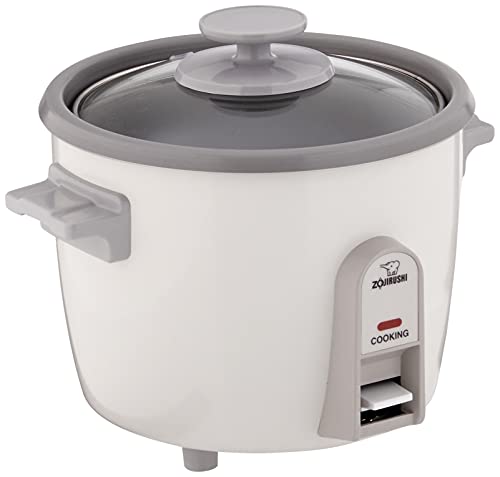
For: Rice on a small inverter
Zojirushi NHS-06 3-Cup Rice Cooker/Steamer, White
A simple one-switch rice cooker rated 120 V / 300 W, one of the lowest-wattage cookers a van inverter can run. It cooks up to 3 Zojirushi cups of raw rice, about 6 to 9 cups cooked. Zojirushi says the NHS-06 has no keep-warm and no steaming basket, unlike its larger siblings.
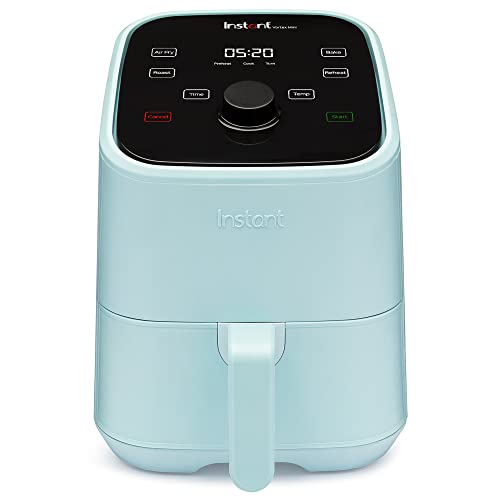
For: Crisping on a big inverter
Instant Vortex Mini 2-Quart Air Fryer (140-3013-01, Aqua)
A 2-quart air fryer that crisps, bakes, roasts and reheats for one or two people. Its manual rates it at 1,300 W, so in a van it needs an inverter or power station rated at least 1,500 W continuous and a battery that can supply roughly 110 A. Instant's manual also asks for 5 inches of clearance and a grounded outlet with no extension cord.

For: Vacuum storage without an inverter
Zwilling Fresh & Save Vacuum Sealer Machine Starter Set, 6pc (36806-005)
A handheld rechargeable vacuum pump that seals reusable zip bags and containers through built-in valves and stops on its own. It charges at 5 V and up to 1 A over USB, so a full charge costs about half an amp-hour and needs no inverter. Best for everyday resealing; a heat sealer is still better for long freezer storage.