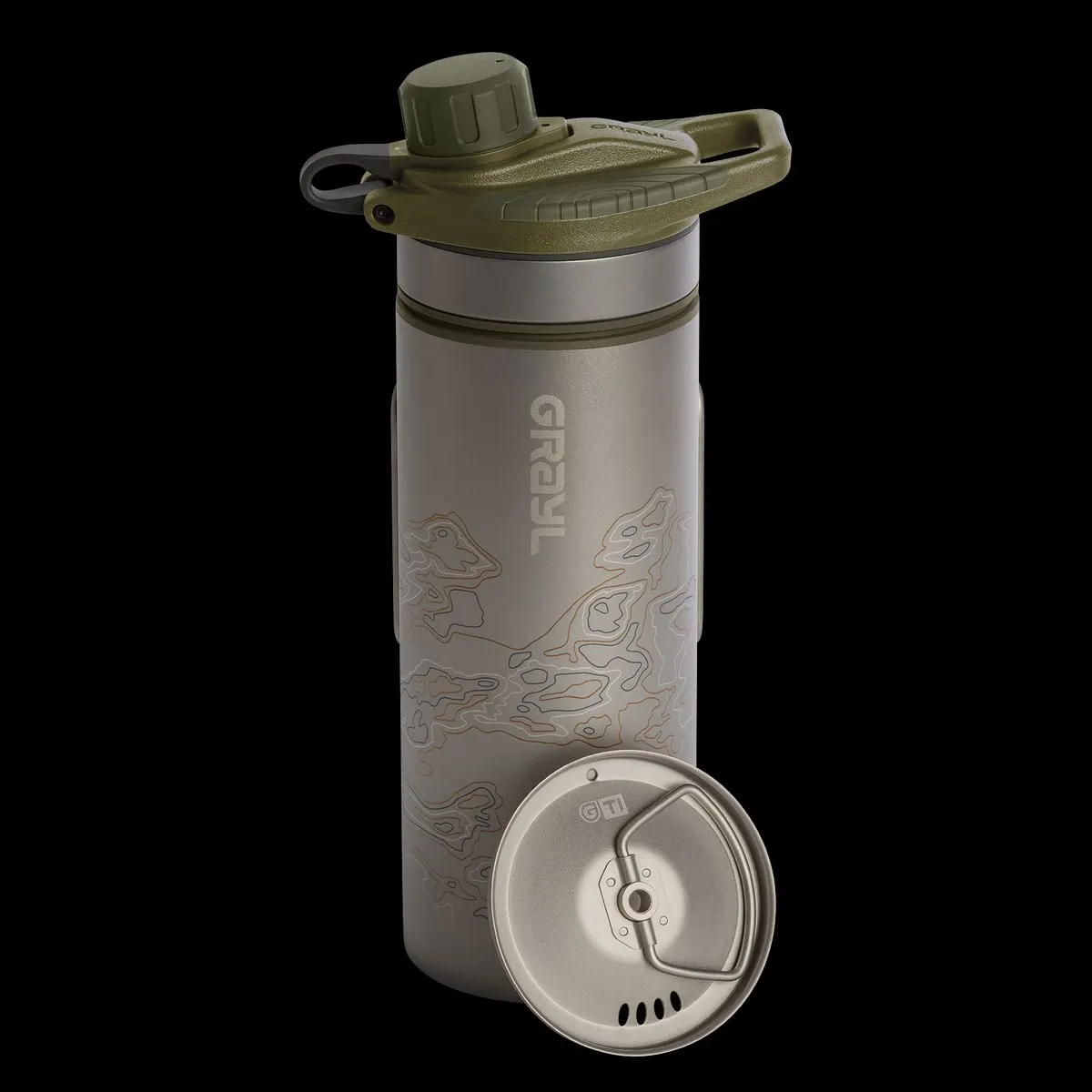
Grayl GeoPress 24oz Water Purifier Bottle
- Capacity
- 24 oz (710 ml)
- Weight
- 15.9 oz (450 g)
- Size
- 10.4 in tall, 3.4 in base diameter (Grayl)
- Filter Life
- 350 presses / ~65 gallons (250 L), or 3 years
- Removes
- Viruses, bacteria, protozoa; reduces heavy metals, chemicals, microplastics (Grayl)
- NSF Testing
- Lab-tested to NSF/ANSI 42 & 53 protocols; meets US EPA Guide Standard for microbiological purifiers
- Warranty
- 10-year, workmanship and materials (Grayl)
Overview — Who is this for?
What the Amazon link sells: the Grayl GeoPress 24 oz Water Purifier & Water Filter Bottle in the Black Camo colourway (ASIN B0C1JHC2M6, part number 411-BCO), the standard plastic bottle holding 24 fl oz (710 ml). Grayl sells the 24 oz GeoPress in several colours and editions; we checked specs on Grayl's 24 oz GeoPress Covert Edition page, and the colour doesn't change the purifier cartridge. Grayl also sells a titanium GeoPress Ti; it is not the model reviewed here.
What it is, in one line: a press-style purifier bottle. Grayl states it removes 99.99% of viruses, 99.9999% of bacteria and 99.9% of protozoan cysts, and its activated carbon also adsorbs many chemicals, heavy metals, tastes and odours. Grayl says it is for fresh water only, not salty or brackish water, and not for heavily polluted water such as industrial spills or high lead levels.
Choose this if:
- you travel where waterborne viruses are a realistic risk;
- you want drinkable water from a single bottle fast, with no setup;
- you want one portable tool that covers microbes plus some chemicals and taste.
Skip this if:
- you need bulk water for a tank or jugs;
- you mostly fill from treated US campground taps (a cheaper filter covers that);
- you find a stiff French-press plunge hard on your hands.
The Grayl GeoPress fills a gap the other products in this category don't: it is the only portable product on this site whose maker publishes virus-removal figures and a named test protocol, and it works in a press that Grayl rates at about eight seconds per bottle, with no electricity and no chemical tablets. It costs considerably more than a Sawyer Squeeze and works very differently from a LifeStraw Home gravity pitcher. It makes sense when the water source is unknown, when travel takes you where hepatitis A, rotavirus or norovirus might be in the water, and when you need to drink from a source right now.
This review is for van dwellers whose travel takes them into remote backcountry, into rural Latin America or Southeast Asia, or into situations where the water source is genuinely unknown and waiting while treating is not an option. If you are a weekender who fills from state park spigots and the occasional gas station, the Grayl is more than you need; a cheaper filter covers your actual risk profile.
What you are actually getting
The GeoPress is a two-piece bottle. The outer bottle holds 24 ounces. Inside it, an inner press fits like a French press plunger: you fill the outer bottle with untreated water, put the inner press in, and push down. Pressing forces the water through the purifier cartridge and into the inner chamber. Grayl rates this at about eight seconds per 24 oz (it quotes 5 L/min). Then you flip the cap open and drink.
According to Grayl, the cartridge combines electroadsorption media (which captures viruses and bacteria by charge) with ultra-powdered activated carbon (which adsorbs many chemicals, including some PFAS and VOCs, pesticides, herbicides, heavy metals, flavours and odours), and it also filters particulates and microplastics. Grayl does not publish a single micron rating for the cartridge on its product page, so we don't quote one.
Testing Grayl cites: independent testing by a certified laboratory to meet or exceed NSF/ANSI protocols 42 and 53, and the US EPA Guide Standard and Protocol for Testing Microbiological Water Purifiers. That EPA protocol is the "purifier" bar: a device must address viruses as well as bacteria and protozoa, which filters don't have to.
Cartridge life: Grayl rates each GeoPress cartridge at about 350 cycles, or 65 gallons (250 litres), and says to replace it when the press takes about 25 seconds or three years after first use, whichever comes first. At two presses a day, a cartridge lasts about six months (350 ÷ 2 = 175 days).
Size and weight: Grayl lists the GeoPress at 15.9 ounces (450 g) empty, 10.4 inches (26.5 cm) tall and 3.4 inches (8.6 cm) across the base. Add 710 ml of water and it is about 2.5 pounds full. That is heavier than a standard plastic bottle, and 3.4 inches is wider than many car and van cup holders, so plan on a door pocket or a bottle sleeve rather than a cup holder.
Materials and warranty: Grayl lists polypropylene #5, food-grade silicone, TPE and ABS food-grade plastic, and a ten-year warranty covering workmanship and materials. The cartridge is a consumable, not a warranty item.
How it performs in a van kitchen
Three things separate the Grayl from the other water filters on this site.
First, it covers viruses. Grayl rates it at 99.99% virus removal, and the Amazon listing names rotavirus, norovirus and hepatitis A as examples. Virus removal is the biggest gap in most consumer water filters: the hollow-fibre filters that dominate backpacking (Sawyer, Katadyn BeFree, Platypus) don't claim it. That said, "any water source" is not accurate. Grayl's FAQ says to avoid salty or brackish water, and that the cartridge is not designed for industrial disasters, coal ash spills, high lead levels, mercury, nuclear incidents, high tannin concentrations, or water with toxic blue-green algae. It reduces low levels of chemicals and metals; it is not a treatment for heavily polluted water.
Second, it is fast. Grayl rates it at about eight seconds per 24 oz, versus minutes for gravity filters and the contact times that chemical treatments require (often 30 minutes or more; follow the label). When you have just scrambled down to a creek or pulled over at a roadside tap in rural Mexico, the speed matters.
Third, it needs no setup. No bag to hang, no pouch to squeeze. Fill, press, drink.
The downsides in daily use are two. First, the press takes real hand strength, and more of it as the cartridge loads up; Grayl's own replacement cue is a press that has slowed to about 25 seconds. Pressing works best with the bottle on a firm, flat surface, using body weight rather than wrist strength. People with weak wrists or hand injuries may find it tiring. Second, it is a bottle, not a storage system. It holds one press of water at a time.
Why viruses matter (the conversation most gear reviews skip)
Most US-market water filter reviews treat viral contamination as a non-issue because in North American backcountry water it is generally considered less common. Giardia, Cryptosporidium and E. coli are the usual suspects, and hollow-fibre filters address all three.
Outside the US and Canada, in places with limited sanitation, the risk picture changes, because viruses such as hepatitis A, rotavirus and norovirus spread through faecally contaminated water. The CDC's guidance is blunt: portable filters will not remove viruses. A 0.1-micron hollow-fibre filter such as a Sawyer Squeeze or Katadyn BeFree alone won't protect you against them, and Katadyn's own BeFree manual says so. Your options are boiling (the CDC advises a rolling boil for 1 minute, or 3 minutes above 6,500 feet), UV treatment (the CDC notes it works on small amounts of clear water and poorly in cloudy water), chemical disinfection (the CDC notes it kills viruses and bacteria but may not kill parasites; follow label contact times), or a virus-rated purifier like the Grayl.
If your van life takes you across the US–Mexico border, or anywhere water infrastructure is unreliable, the Grayl is a sensible tool to carry. If you stay in the US and drink from developed campground spigots, you can skip it.
Why it works for van life specifically
First, it goes where you go. Unlike a counter pitcher or an inline filter, the Grayl comes on the hike, the bike ride, the rental car and the flight.
Second, it is zero-setup. At a trailhead with a short window before you leave, that matters.
Third, it complements, rather than replaces, a countertop filter. The Grayl is not meant to be a van's primary water system; a LifeStraw Home gravity pitcher or an inline filter handles bulk water better. The two-filter combination (pitcher at the galley, Grayl in the daypack) covers more situations than either alone.
What the Grayl is NOT good at
Bulk water. Twenty-four ounces per press is small. Filling a 5-gallon jug would take about 27 presses (640 oz ÷ 24 oz), which is close to 8% of a 350-press cartridge in one go. Use a gravity filter or an inline filter for that.
Salt, brackish or heavily polluted water. Grayl says to avoid salty or brackish water, and the cartridge isn't designed for industrial contamination, high lead or mercury, or blue-green algae blooms.
Hot water. Grayl says not to use it with hot water and to avoid temperatures above 120°F (50°C) to protect the purifier media. Purify cold water first, then heat it in a pot.
Freezing. Grayl's FAQ says a cartridge can be frozen but to stop using it after three or more freeze–thaw cycles. In cold weather, keep the bottle insulated or inside the heated cabin.
Silty water. Visible particulates load the cartridge faster and make pressing harder. For cloudy water, the CDC suggests letting it settle or straining it through a clean cloth or coffee filter before treatment, which also helps here.
Comparison to alternatives in this category
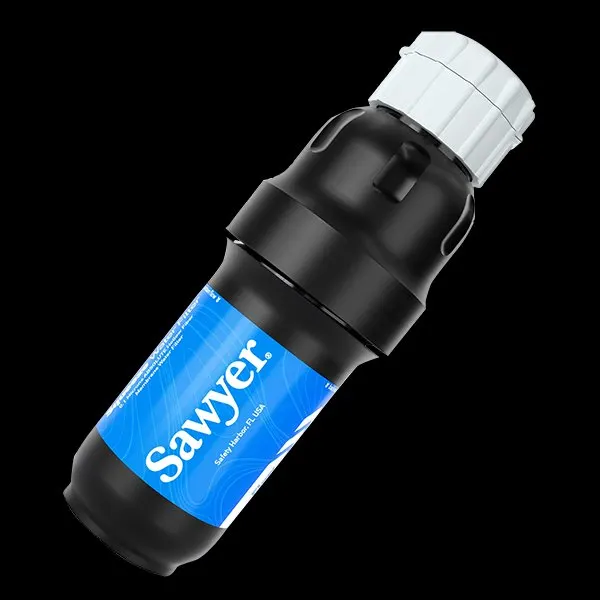
Vs Sawyer Squeeze: The Sawyer costs far less, is much lighter, and handles bacteria and protozoa. It doesn't claim virus, metal or chemical removal. Pick the Sawyer for US backcountry; pick the Grayl for international travel or any source where viral contamination is a realistic possibility. The Sawyer Squeeze vs Grayl GeoPress comparison goes through the trade-off in detail.
Vs Katadyn BeFree: The BeFree is a lighter, faster-to-pack squeeze flask with a carbon insert for taste, but Katadyn says it does not remove viruses. The Grayl is heavier and costs considerably more, and covers viruses.
Vs Clearsource Ultra: The Clearsource Ultra also makes a virus claim for its VirusGuard stage, but it is a 28 lb hose-fill system for a plumbed tank, and the pages we read don't name its test standard. The Grayl is for the water you drink away from the van.
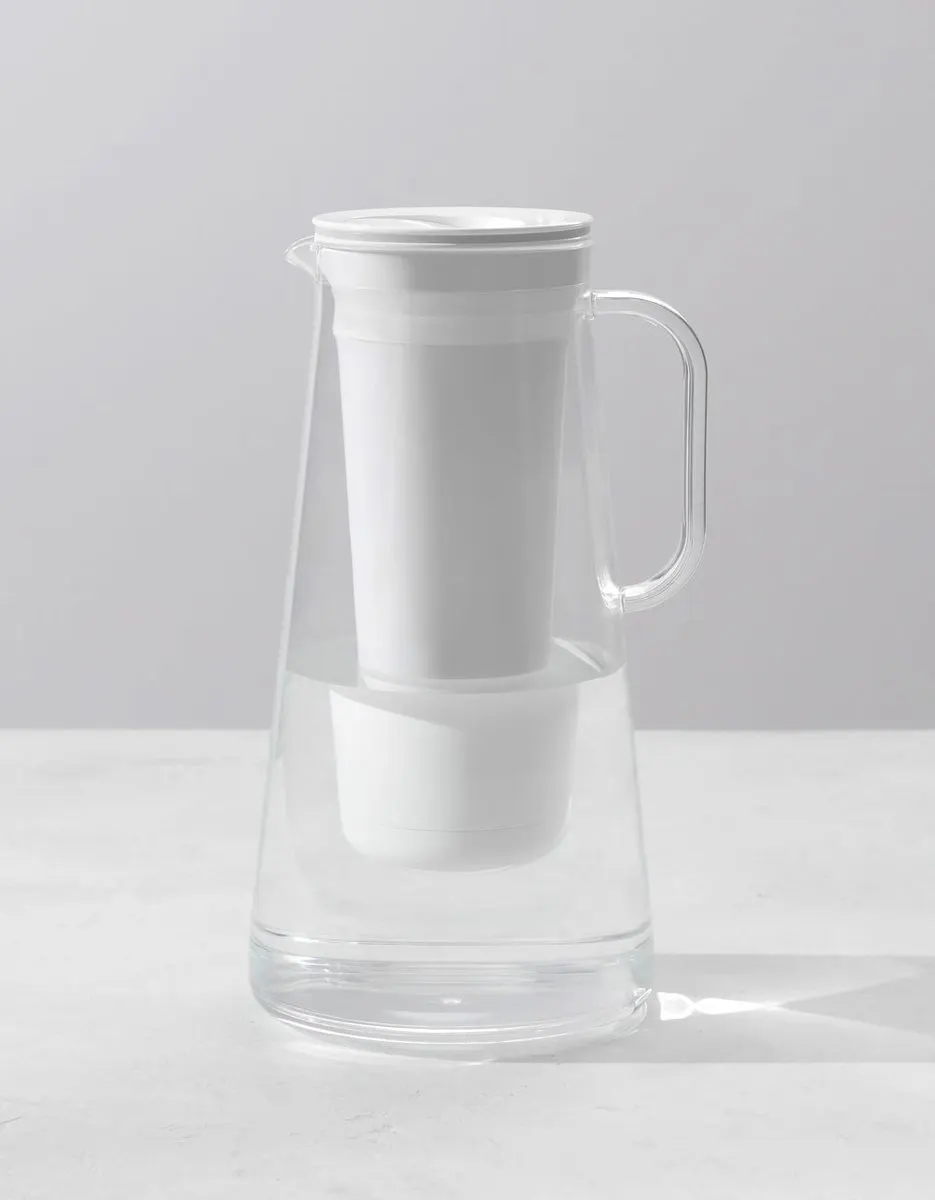
Vs LifeStraw Home Gravity Pitcher: Completely different form factor. The pitcher is a stationary counter filter for bulk water at the galley, and LifeStraw doesn't claim virus removal for it. The Grayl is a portable purifier bottle. Many full-time van cooks will want both for different jobs.
Vs UV purifier pens: UV treatment kills germs in small amounts of clear water but does nothing for heavy metals, chemicals or particulates, works poorly in cloudy water, and needs batteries or charging. The Grayl covers more contaminant categories with no electronics.
Vs chlorine dioxide tablets: Tablets are light and cheap, but they need a contact time (Cryptosporidium needs the longest; follow the label), can leave a taste, and don't address metals or particulates. Tablets make a good emergency backup in a first aid kit.
The verdict
The Grayl GeoPress is our pick for a portable water purifier for van life that takes you outside the US, into remote backcountry, or anywhere the source is unknown. It is expensive for a single-user bottle, and the cartridges are an ongoing cost at 65 gallons each, but published virus-removal testing is something no cheaper filter on this site offers. Keep its limits in mind: fresh water only, small volume, and not a fix for heavily polluted water.
Buy it if: you travel internationally, you drink from remote backcountry sources, or you want a portable backup beyond your countertop filter. Skip it if: you are a weekender drinking from developed campground spigots, your water budget is tight, or a Sawyer plus boiling already covers your real use case.
See the van water system setup guide for the full van water architecture this bottle fits into, the water filtration complete guide for the filter-versus-purifier basics, and the Sawyer Squeeze review for the backpacker-style alternative that covers a narrower contaminant profile for far less money.
FAQ
Does the Grayl GeoPress remove viruses? Grayl rates it at 99.99% virus removal, alongside 99.9999% of bacteria and 99.9% of protozoan cysts, and says it meets the US EPA Guide Standard and Protocol for Testing Microbiological Water Purifiers. That is the purifier bar, which hollow-fibre filters don't claim to meet.
Can the Grayl make seawater drinkable? No. Grayl's FAQ says to avoid salty or brackish water. It is for fresh water only.
How long does a GeoPress cartridge last? Grayl rates it at about 350 presses (65 gallons, 250 litres). Replace it when a press takes about 25 seconds, or three years after first use, whichever comes first.
Can I leave the Grayl in a freezing van? Grayl's FAQ says the cartridge can freeze, but to stop using a cartridge after three or more freeze–thaw cycles. In winter, keep it in the heated cabin and keep count if it does freeze.
Can I use it with hot water? No. Grayl says to avoid temperatures above 120°F (50°C) to prevent damage to the purifier media.
Is the Grayl enough for all my van's water? No. It treats 24 oz at a time. Use it for drinking water on the move and pair it with a counter filter such as the LifeStraw Home or a gravity filter for bulk water.
Sources and verification
- Grayl 24 oz GeoPress Covert Edition product page, https://grayl.com/products/24oz-geopress-filter-purifier-bottle-covert-edition: capacity, weight, height and base diameter, 8-second press and 5 L/min, cartridge rating, virus, bacteria and protozoa figures, carbon adsorption claims, NSF/ANSI 42 and 53 and EPA Guide Standard wording, materials, ten-year warranty (checked 2026-10-12)
- Grayl FAQ, https://grayl.com/pages/faqs: freezing, salty and brackish water, replacement at about 25 seconds or three years, contamination types it is not designed for, hot water limit, storage, cartridge life (checked 2026-10-12)
- CDC, How to Make Water Safe in an Emergency, https://www.cdc.gov/water-emergency/about/index.html (now served at https://www.cdc.gov/water-emergency/about/index.html): boiling times, portable filters not removing viruses, UV and chemical disinfection limits, settling or straining cloudy water (checked 2026-10-12)
- Amazon listing ASIN B0C1JHC2M6: exact title, Black Camo colourway, part number 411-BCO, virus examples named, 65-gallon cartridge (checked 2026-10-12)
Compare with similar products
See how this stacks up against the other water & sink gear we've reviewed.
Head-to-head comparisons
Related Reviews
For: Filtering campground hose water
Clearsource Ultra RV Water Filter System with VirusGuard
A three-canister RV filter that sits between the campground hose and your fresh-water inlet. Clearsource lists a 5-micron sediment stage, a 0.5-micron coconut-shell carbon block for chlorine, taste and VOCs, and a VirusGuard third stage it says removes or reduces bacteria, cysts and viruses, though the pages we read name no test standard for that claim. It is built for hose-fed tank fills, not for drawing from untreated lakes or streams, and the cartridges are an ongoing replacement item.
For: Filtering treated tap water
LifeStraw Home 7-Cup Gravity-Fed Water Filter Pitcher
A two-stage gravity pitcher filter and a sensible replacement for the delisted Berkey. LifeStraw rates the membrane to remove bacteria and parasites and the carbon/ion-exchange stage to reduce lead, mercury, chlorine and microplastics. It is not rated for viruses, so it suits treated tap and campground water rather than untreated sources.
For: Pocket backup filter
Sawyer Squeeze Water Filter
A pocket-size backup filter. Sawyer rates its 0.1-micron absolute hollow fibre to remove 99.99999% of bacteria and 99.9999% of protozoa, but it does not claim virus removal and has no carbon stage for chemicals or taste. Sawyer gives no end-of-life volume on its current page; backflush it and never let it freeze once wet.