NUWAVE PIC Gold (Gold Precision) 1500W Induction Cooktop
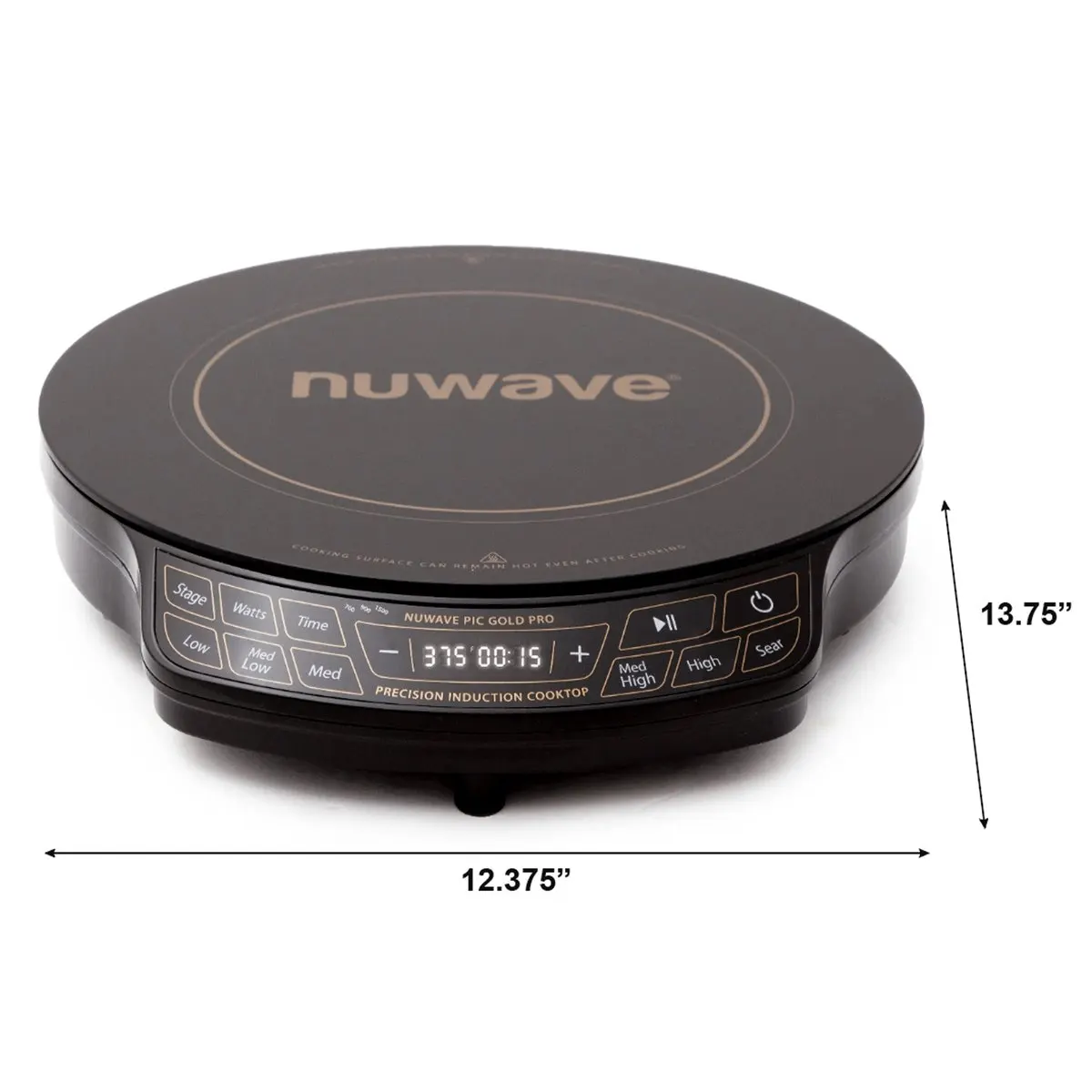
- Power
- 1,500 W, 120 V AC (manual)
- Settings
- 1,500 / 900 / 600 W (manual)
- Temp Range
- 100°F–575°F; 10°F steps per manual, 5°F per listing
- Coil
- 8 in (listing)
- Cookware
- Magnetic, 3 in minimum; up to 10 in recommended (manual)
- Voltage Limits
- 85–144 V (manual error codes)
- Clearance
- 3 in back, sides, top (manual)
- Warranty
- 1 year limited (manual)
Overview: who is this for?
This review covers the Nuwave PIC Gold, which Nuwave now sells as the "Nuwave Gold Precision Induction Cooktop". It's the same model (the Amazon listing gives the model number as PIC GOLD), and Nuwave's owner's manual is titled "PIC Gold Precision Induction Cooktop". It is a 1,500 W single-burner portable induction cooktop with an 8-inch heating coil and a touch control panel that lets you set a target temperature from 100°F to 575°F instead of choosing an abstract power level.
It suits a particular kind of van cook: one who cares more about holding a steady low temperature than about boiling water as fast as possible. If you melt chocolate, hold oil for frying, make custards or keep sauces barely simmering, the temperature-target control is the reason to choose it. If you mostly boil pasta water and fry eggs, the faster Duxtop 9100MC is the better buy.
Operating location: indoors. Nuwave's manual says "FOR HOUSEHOLD USE ONLY. NOT INTENDED FOR OUTDOOR USE." That suits a van well: it produces no combustion gases, so it's the opposite of the fuel stoves on this site, which their makers label for outdoor use. The manual says never to put the PIC against a wall or other appliances, asks for at least 3 inches of free space for the back, sides and top, and says not to block the ventilation slots. You still want general cooking ventilation (a roof fan or open window) for steam and odour.
Choose this if:
- you want precise low-temperature control (100–300°F) for delicate cooking;
- your inverter is around 2,000 W and you want headroom for other loads;
- you'd like to dial power down to 900 or 600 W to protect a smaller system.
Skip this if:
- you want the fastest possible boil (1,500 W is slower than 1,800 W);
- you prefer physical buttons to a touch panel;
- your inverter is under about 1,800 W continuous and you'd rely on the lower power settings all the time.
Specifications
| Spec | Nuwave PIC Gold (manual / listing) |
|---|---|
| Power settings | 1,500 / 900 / 600 W |
| Temperature range | 100–575°F |
| Heating coil | 8 inch (listing) |
| Cookware | Magnetic, 3 in minimum (manual) |
| Voltage limits | 85–144 V (manual) |
| Clearance | 3 in back, sides, top |
| Warranty | 1 year (manual) |
Temperature steps: Nuwave's manual says the minus and plus keys adjust temperature in 10°F increments; the current Amazon listing says 5°F increments and "96 pre-programmed temps". We go with the manual, but either way it's much finer than most budget plates. The listing also claims the PIC Gold transfers 85–90% of its electromagnetic energy into heat; that's Nuwave's figure, not one we measured. Nuwave's manual doesn't give dimensions or weight, and the listing's 12 x 14.25 x 4.5 inches looks like a packed size, so measure the slot you have in mind generously.
Maximum pan size: the manual we read contradicts itself, saying in one place that pans up to the 10-inch width of the unit can be used and "not recommended for pans larger than 10 inches", and in a notice box that pans up to 12 inches can be used. The conservative reading is 10 inches.
Design and build
The PIC Gold has a plastic housing and a ceramic glass cooking surface that Nuwave describes as "shatter-proof". In practice, treat it as glass: lift pans instead of sliding them, and pack it with padding over the top when you drive. The listing's 8-inch heating coil means 8 to 10 inch pans heat most evenly; a 12-inch skillet will have cooler edges.
The control panel is a touch panel with a display that shows the target temperature or wattage. Six preset buttons jump to Low (100°F), Med Low (175°F), Med (275°F), Med High (375°F), High (425°F) and Max/Sear (575°F), and the minus and plus keys fine-tune from there. Capacitive touch panels in general can misread through water or with wet fingers, which is the main practical difference from the Duxtop's push buttons. In a van, keep the panel dry and wipe spills promptly.
The cooling fan runs while cooking, and the manual says it can run for up to 60 seconds after you press Pause/Clear. Any cooktop fan is noticeable in a quiet van at night. The manual's cleaning steps include brushing debris out of the fan and vent, which is worth doing regularly in a dusty vehicle.
How the temperature control works
Most budget induction plates, including the Duxtop, are essentially power-level controls. Their "temperature" settings are approximate targets reached by cycling the element. The PIC Gold also cycles the element (all induction plates do at low settings), but its whole interface is built around holding a temperature target. The useful part is the lower range (roughly 100–300°F): the presets start at 100°F (Low) and 175°F (Med Low), and Nuwave's listing suggests 120°F for melting chocolate in an induction-ready pot without a double boiler. How closely the food tracks the number depends on the pan and the contents, so treat the setting as a repeatable dial rather than a thermometer.
Above roughly 400°F, the precision advantage largely disappears. At that point any induction plate is running near full power, and pan temperature depends heavily on the pan and what's in it.
What you shouldn't expect: laboratory accuracy. The cooktop senses temperature through the glass, not inside your food, and the result depends on pan material and thickness. Use a thermometer for anything where a few degrees matters, such as candy, frying oil or sous vide.
Performance
Boiling. Nuwave doesn't publish a boil time. At 1,500 W the PIC Gold delivers about a sixth less power than an 1,800 W unit, so a covered litre of water takes noticeably longer than on the Duxtop. If speed to boil is your main criterion, the PIC Gold loses.
Low and slow. The temperature-target interface is designed for long, low holds: oil for confit, a pot of beans, a water bath for eggs. The manual also supports multi-stage programs (for example, boil for 5 minutes, then simmer for 20) and a timer up to 99 hours 60 minutes, so a long hold can end on its own. It isn't a sous vide circulator: without water circulation and a probe in the bath, use a thermometer and check it, and use a circulator for long or precise cooks.
Searing. The 575°F Max/Sear setting is available, but 1,500 W limits how fast a heavy pan recovers after food goes in. For hard searing, the Duxtop's extra 300 W helps.
Power: what it takes to run this in a van
All figures here are our estimates from the rated draw, not our own measurements. Assumptions:
- Cooktop draw: 1,500 W at the default setting, or 900 W or 600 W if you select those wattage settings;
- Inverter efficiency: 85–90%;
- Battery: 12.8 V nominal LiFePO4;
- Other loads: not included.
Continuous watts and inverter size
At 1,500 W AC, the inverter pulls about 1,670–1,760 W from the battery, roughly 130–138 A at 12.8 V. The inverter's continuous rating (not its surge rating) has to exceed the cooktop's draw at the setting you use plus anything else on the inverter, or its overload protection shuts it off. A 2,000 W continuous inverter leaves a few hundred watts for a fridge and small loads.
The 900 W and 600 W settings are useful in a van. Nuwave says lower wattage is "ideal if your home does not take 1500 watts", and the same logic applies to a smaller inverter: at 900 W, an inverter with about 1,200 W continuous capacity has some margin. Cooking is slower, of course. The same wattage caps help on a portable power station; can a power station run an induction cooktop works through example runtimes at full power and at lower settings, with the assumptions stated.
Pure sine wave inverters are the general recommendation for induction cooktops; that's general guidance, not a Nuwave instruction. What the manual does specify: the PIC should be run on a separate outlet from other operating appliances "due to wattage limitations", its error codes flag input below 85 V or above 144 V, and any extension cord must be rated at least as high as the appliance. An inverter that sags under load can push voltage out of range.
An inverter of this size is a substantial DC install. Size cables and fuses to the inverter's rating, check the battery BMS can supply the current, follow the inverter maker's instructions, and use a qualified RV electrical technician where codes or your insurer require it.
Battery use per session (estimate)
| Session | AC energy | Battery Wh | Ah at 12.8 V |
|---|---|---|---|
| 20 min at 1,500 W | 500 Wh | ~555–590 Wh | ~43–46 Ah |
| 30 min at 900 W | 450 Wh | ~500–530 Wh | ~39–41 Ah |
| Dinner, ~25 min mixed | ~350 Wh | ~390–410 Wh | ~30–32 Ah |
Battery figures are AC energy divided by 85–90% inverter efficiency, then by 12.8 V for amp-hours. The dinner row assumes about 6 minutes at 1,500 W to heat a pan or boil water, then about 19 minutes averaging roughly 630 W. Low-temperature holds draw much less on average because the element cycles off once the target is reached, but we haven't measured how much less, so plan with the full-power numbers. Run your own system through the power calculator.
Nuwave PIC Gold vs Duxtop 9100MC
They suit different cooks. The Duxtop has 300 W more power, push buttons and a lower price; it's better for fast, everyday cooking. The PIC Gold has the temperature-target interface, three selectable wattage ceilings and a lower maximum draw; it's better for delicate work and smaller inverters. The Duxtop vs Nuwave comparison goes through it in detail.
Value
The PIC Gold usually costs a little more than the Duxtop. You're paying for the temperature control and the selectable wattage. If you regularly cook at low, controlled temperatures, that's money well spent. If you cook only at high heat, buy the cheaper, more powerful Duxtop.
Nuwave's manual gives a one-year limited warranty against manufacturer defects "under normal household use"; it doesn't cover drops or vibration damage. Pack the unit carefully when driving.
Who should skip this
Skip the PIC Gold if you cook mostly at high heat, want the fastest boil, prefer physical buttons, or regularly use pans much wider than its 8-inch coil. Skip it if you have no real electrical system: at that point a fuel stove is the realistic choice, used outdoors per its manufacturer's instructions. The induction vs butane vs propane guide explains the trade-offs. Skip it too if fan noise in a small sleeping space will bother you.
Final verdict
The Nuwave PIC Gold (sold as the Gold Precision Induction Cooktop) is the induction plate to pick when holding a temperature matters more than speed. It's slower than the Duxtop, but its 100–575°F target control, 8-inch coil and selectable 1,500/900/600 W settings make it a good fit for careful cooks and for vans built around a 2,000 W inverter. It's also designed for indoor household use, so it's one of the few cooktops on this site that belongs inside the van.
FAQ
Is the Nuwave Gold Precision the same as the PIC Gold? Yes. Nuwave sells the PIC Gold under the "Gold Precision Induction Cooktop" name; the Amazon listing gives the model as PIC GOLD and the manual is titled "PIC Gold Precision Induction Cooktop".
Can I use the PIC Gold inside my van? Yes. Nuwave's manual says it's for household use and not intended for outdoor use. Leave at least 3 inches of space around the back, sides and top, don't block the vents, keep it dry and give it its own outlet.
Can the PIC Gold run off a 2,000 W inverter? Generally yes: at 1,500 W it pulls roughly 1,670–1,760 W from the battery at 85–90% inverter efficiency, leaving a little room for other loads. The inverter's continuous rating must exceed the total load. The 900 W and 600 W settings reduce the draw further.
Is it accurate enough for sous vide without a circulator? Not reliably. It senses temperature through the glass, not in the water, so for a short cook in a covered pot you'd need a separate thermometer and regular checks. It isn't a substitute for a circulator on long or precise cooks.
Will a 12-inch skillet work? It will heat, but the coil is 8 inches, so the outer edge will be cooler, and one passage in Nuwave's manual says pans larger than 10 inches aren't recommended. Use 8 to 10 inch pans for even results. The minimum is a 3-inch base.
Does it work with all cookware? Only magnetic cookware. If a magnet sticks firmly to the base, it works. Aluminium, copper, glass and non-magnetic stainless won't heat.
How much battery does a meal use? Our estimate, at 85–90% inverter efficiency and a 12.8 V lithium bank: about 30–32 Ah (390–410 Wh from the battery) for a 25-minute dinner using about 350 Wh at the cooktop, and about 43–46 Ah for 20 minutes at the full 1,500 W.
Sources and verification
- Nuwave PIC Gold Precision Induction Cooktop owner's manual (PDF attached to the Amazon listing, rev. 07-31-24), https://m.media-amazon.com/images/I/A1kLitKB56L.pdf: household-use-only and not-for-outdoor-use statement, 3 in clearance, separate outlet, 1,500/900/600 W settings, presets and 10°F steps, 3 in minimum pan, 10 in vs 12 in maximum pan passages, 85–144 V error limits, fan run-on, timer and programs, 1-year limited warranty (checked 2026-10-12).
- Amazon listing, ASIN B01CHB1Y22: title (Nuwave Gold Precision Induction Cooktop, 8 in heating coil), model PIC GOLD, 100–575°F in 5°F increments, 85–90% transfer claim, 120°F chocolate suggestion, 1-year warranty, listed dimensions, in stock (checked 2026-10-12).
Compare with similar products
See how this stacks up against the other cooktops we've reviewed.
Head-to-head comparisons
Related Reviews
 Outdoor use only
For: High-output outdoor propane cooking
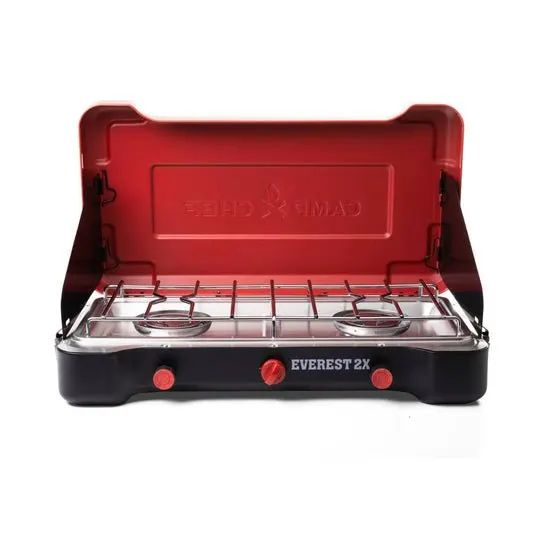
Camp Chef Everest 2X 2-Burner Propane Stove
A higher-output two-burner propane stove: Camp Chef rates each burner at 20,000 BTU, with matchless ignition on both. Its manual says outdoor use only and not in or on recreational vehicles.
 Outdoor use only
For: Outdoor butane cooking
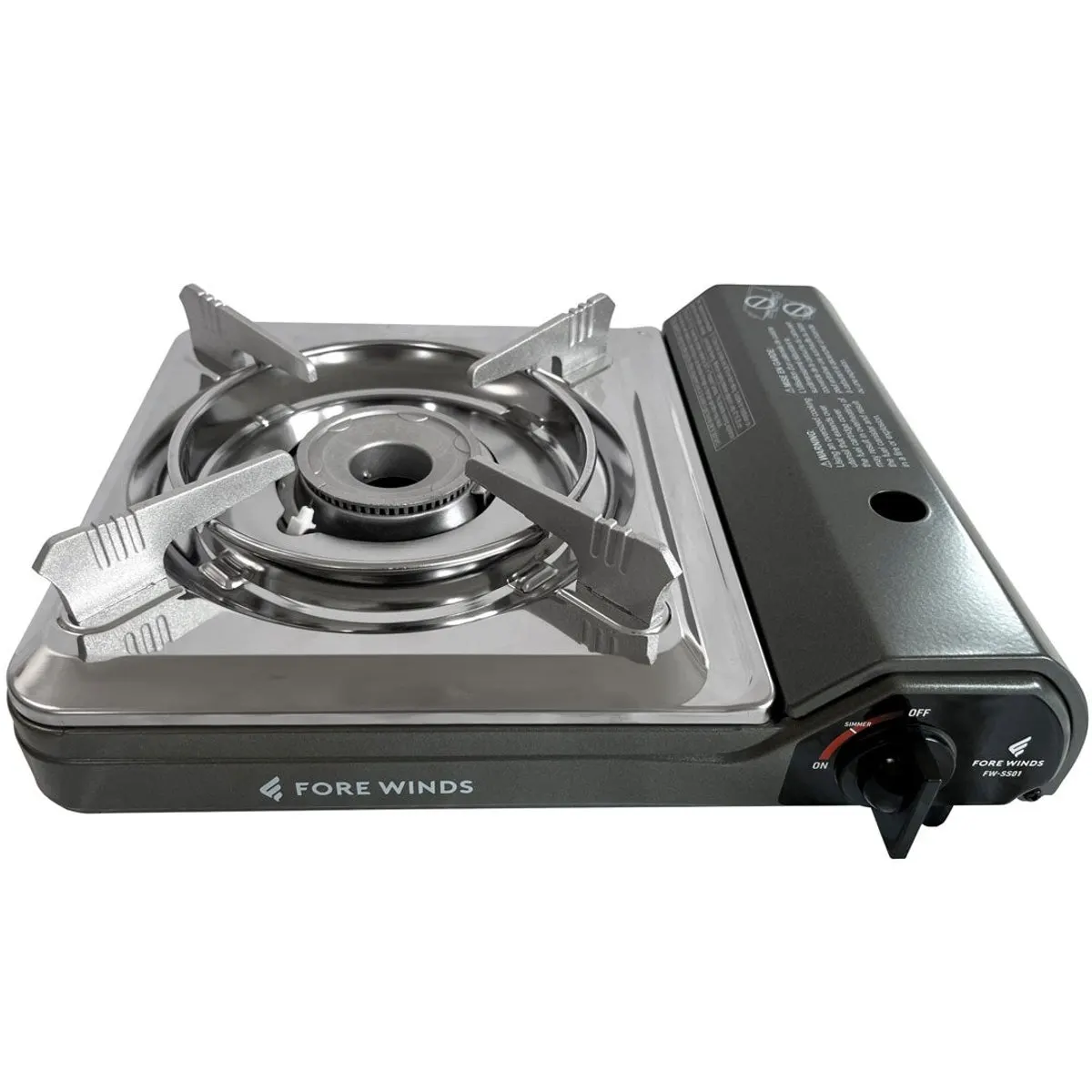
Iwatani Cassette Feu Butane Camp Stove (Gray)
Iwatani's current 12,000 BTU cassette stove adds a built-in windbreaker and lever-free magnetic canister lock over the ZA-3HP. A well-built butane option that costs considerably more than the ZA-3HP. Iwatani warns never to use cassette appliances in enclosed spaces such as a car or tent, so cook with it outdoors.
 Outdoor use only
For: Regulated outdoor propane, two burners
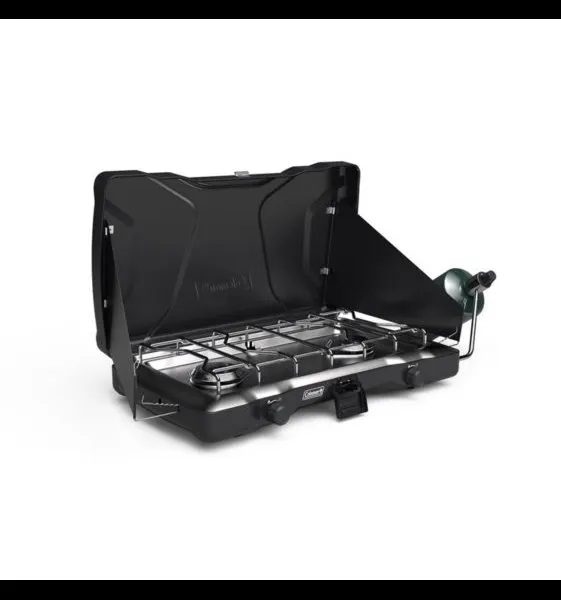
Coleman Triton+ 2-Burner Propane Stove
Coleman's regulated Triton+ two-burner with InstaStart push-button ignition, rated at 22,000 BTU across two adjustable burners. Coleman labels it for outdoor use only and not for RV use.