ICECO JP40 Pro 37L (40 qt) Wheeled 12V Fridge Freezer vs Iceco VL35 ProS 12V Fridge Freezer
Two Secop-powered Icecos at similar mid-range prices. The newer JP40 Pro gives you more space, wheels, an app and a lower lab energy rating for less money. The VL35 ProS gives you a lower, simpler steel box. Here's which one fits your build.
Disclosure: As an Amazon Associate I earn from qualifying purchases. Links to Amazon on this page are affiliate links: if you buy through one, VanLifeKitchens.com may earn a commission at no extra cost to you. Read our affiliate disclosure.
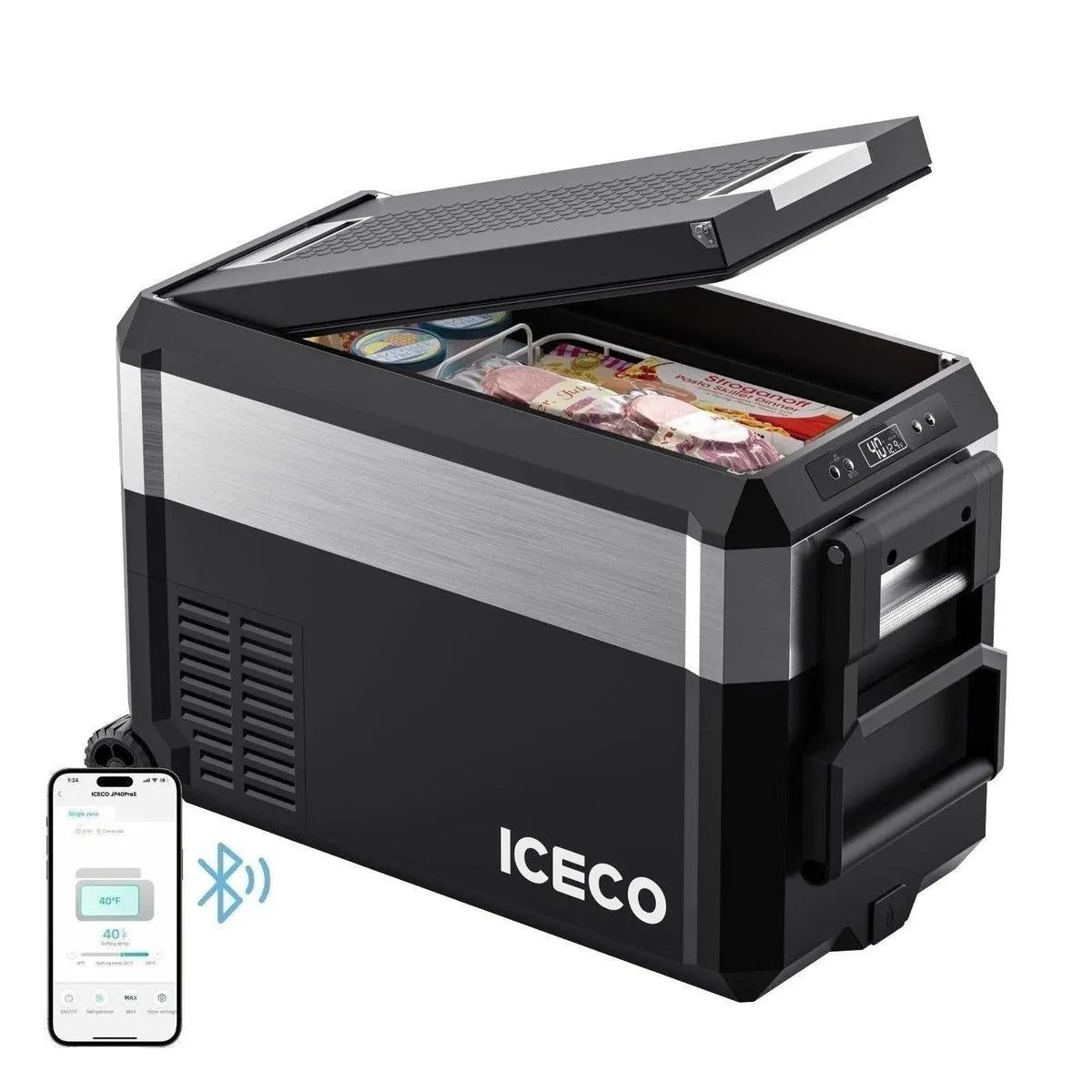
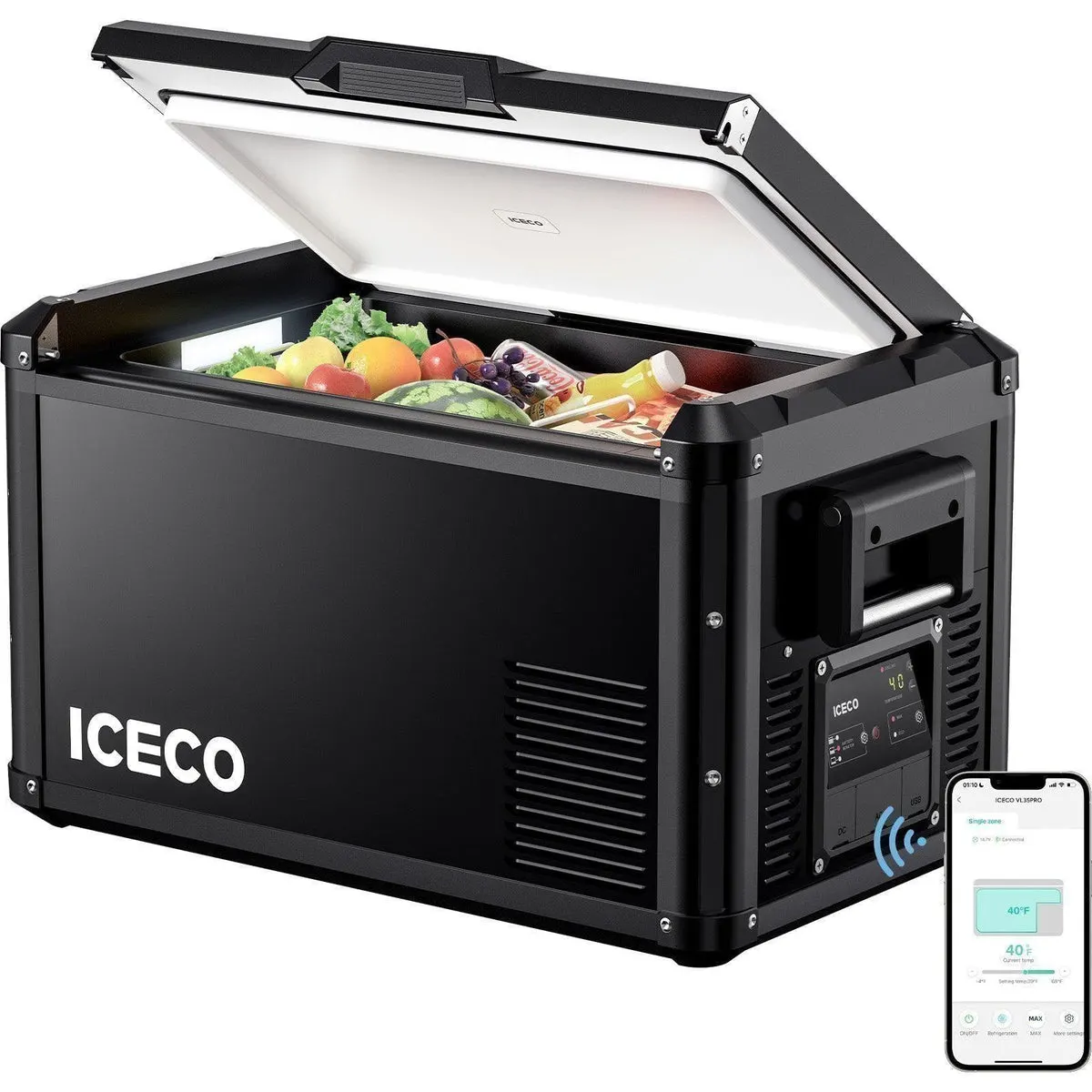
We recommend the ICECO JP40 Pro 37L (40 qt) Wheeled 12V Fridge Freezer
“The Iceco JP40 Pro wins for most van builds. It holds about 40 liters to the VL35 ProS's 35, uses a Secop compressor with the same 5-year compressor warranty, adds wheels, a reversible lid and Bluetooth app control, weighs about 10 lbs less (39.1 vs 48.7), and costs less. On paper it's also the more frugal of the two: ICECO's manuals rate it at 0.323 kWh per 24 hours versus 0.430 kWh for the VL35 ProS. The two are about the same length (28.5 vs 28.1 inches), so pick the VL35 ProS only if your bay is low (it's about 2.3 inches shorter in height) or you want a steel cabinet.”
Read the full ICECO JP40 Pro 37L (40 qt) Wheeled 12V Fridge Freezer reviewSpecifications
| Spec | ICECO JP40 Pro 37L (40 qt) Wheeled 12V Fridge Freezer | Iceco VL35 ProS 12V Fridge Freezer |
|---|---|---|
| Best for | Wheeled 40L, narrow bays | Steel-cased 35L single zone |
| Capacity | 37 L / 40 qt (ICECO manual) | 35L / 50 cans |
| Dimensions | 28.5 x 13.8 x 18.0 in | 28.1 x 15.9 x 15.7 in |
| Weight | 39.1 lbs | 48.7 lbs |
| Power Source | 12/24V DC + 110-240V AC | 12/24V DC + 120V AC |
| Power Draw | 0.323 kWh/24h (ICECO lab figure, standard test conditions; ~27 Ah/day at 12V) | 0.430 kWh/24h lab rating (~36 Ah/day) |
| Compressor | Secop (Danfoss) | Secop |
| Warranty | 5 yr compressor / 1 yr parts | 5 yr compressor / 1 yr parts |
| Ventilation | Over 5 cm at the sides, 10 cm at the front air outlet (ICECO manual) | Over 5 cm at the sides, 10 cm at the front air outlet (ICECO manual) |
ICECO JP40 Pro 37L (40 qt) Wheeled 12V Fridge Freezer
- Secop (Danfoss) compressor, 5-year compressor warranty
- Built-in wheels and pull handle for one-person moves
- Reversible, removable lid and power ports on both ends
- Narrow 13.8 in body fits tight van bays
- Only ICECO's 0.323 kWh/24h lab figure is published (standard test conditions)
- Wheeled chassis is long (28.5 in) for 40L
Iceco VL35 ProS 12V Fridge Freezer
- Secop compressor, 5-year compressor warranty
- Rated 0.430 kWh/24h (~36 Ah/day)
- Steel-cased body; basket and drain plug included
- Simple digital controls
- No app or Wi-Fi
- Heavy for its size at 48.7 lb
The short answer
For most van builds, the ICECO JP40 Pro is the better buy. It usually costs a little less than the VL35 ProS. You get 37 liters (40 quarts) to the VL35's 35, a Secop compressor, built-in wheels and Bluetooth app control. It's also about 10 pounds lighter and has the lower lab energy figure in ICECO's manuals. It's the more capable fridge for less money.
The VL35 ProS is the better choice for a low fridge bay or for anyone who wants a metal cabinet. It's about 2.3 inches lower than the JP40 Pro, its metal shell is tougher than the JP40's molded one, and it has no wheels or app to go wrong. Don't pick it for a short bay, though: at 28.1 inches it's only about 0.4 inches shorter than the JP40 Pro, and it's about 2 inches wider.
These are both ICECO fridges with Secop compressors, so neither is a gamble on cooling. For the detail on each, read our ICECO JP40 Pro review and our ICECO VL35 ProS review. The 12V fridge complete guide covers sizing and installation in more depth.
Capacity and interior space
ICECO's manuals list the JP40 Pro at 37 liters (40 quarts) and the VL35 ProS at 35 liters (37 quarts). The "40" in the JP40's name is quarts. ICECO rates them at 52 and about 50 twelve-ounce cans. The capacities are close, but the JP40 Pro's space is mostly height, and that's the useful kind. Its main well is about 13.8 inches tall inside, so two-liter bottles and milk jugs stand upright.
The VL35 is about 15.7 inches tall on the outside, so its interior is shallower, though ICECO's product page says its basket leaves room for 11-inch-tall items. It comes with one removable basket and a drain plug.
In practice, either covers four to five days of groceries for a couple, or about a week if you shop and pack carefully. Both are single-zone, so each runs as a fridge or a freezer, never both at once.
Edge: ICECO JP40 Pro, narrowly, for a little more space and room for upright bottles.
Footprint and how it fits your build
ICECO lists the JP40 Pro at 28.5 x 13.8 x 18.0 inches and the VL35 ProS at 28.1 x 15.9 x 15.7 inches. Compared with the VL35, the JP40 Pro is:
- About the same length, roughly 0.4 inches longer, even with the wheels and pull handle built into its chassis.
- About 2.1 inches narrower, which lets it slide between wheel wells and into narrow galley bays.
- About 2.3 inches taller, which matters under a bed platform or bench once you add room to open the lid.
So length doesn't separate them. The question is whether your bay is short on width or on height. If width is the constraint, the JP40 Pro's 13.8 inches is hard to beat. If height is the constraint, the VL35's lower box is the one that fits. Both lids open from either side or lift off, per ICECO. If neither shape suits your bay, the chest vs upright 12V fridge guide explains when a front-opening, built-in fridge is the better fit and what installing one involves.
Both need the same ventilation space. ICECO's manuals ask for more than 5 cm (about 2 inches) at the left and right sides and 10 cm (about 4 inches) at the front air outlet. That means roughly 32.5 x 17.8 inches of floor space for the JP40 Pro and 32 x 20 inches for the VL35.
Weight matters on a slide and when you lift the fridge out. ICECO lists the JP40 Pro at 39.1 pounds and the VL35 ProS at 48.7 pounds empty, so the JP40 Pro is about 10 pounds lighter before you add wheels to the comparison.
Edge: ICECO JP40 Pro for narrow bays and for weight; the VL35 ProS only if your bay is short on height.
Power draw and battery sizing
ICECO's manuals give both fridges a 24-hour lab figure. The JP40 Pro is listed at 0.323 kWh (323 Wh) per 24 hours, about 27 Ah per day at 12V. The VL35 ProS is listed at 0.430 kWh (430 Wh) per 24 hours, about 36 Ah per day. The VL35's figure matches its FTC EnergyGuide label (157 kWh a year). ICECO calls both laboratory figures and doesn't state the test ambient, so treat them as moderate-conditions planning numbers, not guarantees. On paper, the bigger JP40 Pro is the more frugal fridge.
ICECO doesn't publish a rated wattage for the JP40 Pro; the roughly 50 W you'll see is a dealer figure. Our JP40 Pro review's duty-cycle estimate is about 25 to 35 Ah per day in mild to moderate weather and 50 to 60 Ah in hot conditions with poor ventilation. Either fridge will draw well above its lab figure in summer heat, so add a generous margin. Both fit the same broad electrical plan:
- 100 Ah lithium with about 200 W of solar: comfortable for three-season use.
- 200 Ah lithium with 300 to 400 W of solar: the target for full-time use in hot climates or freezer mode.
Both have the same three-level battery protection. ICECO lists 12V cut-outs of 9.6V, 10.4V and 11.1V, with restarts at 10.9V, 11.7V and 12.4V. Use the lowest level your lithium battery maker allows. Our fridge battery calculator lets you run either fridge against your own climate and charging.
Edge: ICECO JP40 Pro, for the lower lab rating, about 9 Ah a day less on paper.
Wheels, lid and app
This is where the JP40 Pro pulls ahead. Wheels at one end and a fold-out pull handle at the other let one person tip it back and roll it like carry-on luggage. ICECO also fits fixed side handles for two-person lifts. Owners mention the wheels more than any other feature, because a loaded fridge is heavy to carry. ICECO's product page says it runs at up to 40 degrees of tilt.
The JP40 Pro also has Bluetooth app control for iOS and Android. You can change the setpoint, switch between ECO and MAX modes, check the internal temperature and set battery protection from the driver's seat or your bed. Bluetooth range is short, and the physical buttons work without the app, so it's a convenience rather than a requirement.
The VL35 has no wheels, no app and no Bluetooth; you control it from the button panel. Both fridges have DC ports on both sides.
Edge: ICECO JP40 Pro, for wheels and an app.
Build and ruggedness
The VL35 has the tougher cabinet: a metal outer shell with latches that owners report staying tight after long use in a slide tray. The common complaints are cosmetic, such as visible mold lines on the interior plastic. ICECO sells a tie-down kit and a slide mount as accessories for the VL ProS series. The metal is also part of why it weighs about 10 pounds more.
The JP40 Pro uses a molded shell with reinforced corners and a brushed-metal-look band. It's not the all-steel cabinet of ICECO's VL series. The plastic will scuff before powder-coated steel does, and wheels are one more part to wear. Use the included insulated cover if it rides in a truck bed.
Neither fridge has a published noise rating. Owners describe both as the typical Secop pattern: a low hum during run cycles and a faint click at start and stop. With either one, ventilation matters more than the badge. Keep ICECO's 5 cm side and 10 cm front gaps, and don't box the fridge into a closed cabinet.
Edge: ICECO VL35 ProS, for the metal shell.
Value
Both are mid-range fridges, and the JP40 Pro usually sells for a little less than the VL35 ProS while adding 2 liters, wheels, an app, less weight and a lower lab energy figure. On paper, the newer fridge is simply better value. Check current prices on Amazon, since they move often.
Warranty doesn't separate them. ICECO's manuals list 5 years on the compressor and 1 year on other parts for both. Confirm the current terms with ICECO before you buy rather than relying on a retailer listing.
The VL35's value case is fit and toughness, not price. If your bay is too low for the JP40 Pro's 18-inch height, or the fridge takes a beating in an open truck bed, the metal VL35 earns its premium.
Which one should you buy?
Buy the ICECO JP40 Pro if:
- You want the most space and features for the money.
- You move the fridge between the van, the campsite and home.
- Your bay is narrow but has height to spare.
- You want app control along with the physical buttons, and the lower rated power draw.
Buy the ICECO VL35 ProS if:
- Your fridge bay or slide is short on height (the VL35 is about 15.7 inches tall).
- The fridge stays mounted and the wheels would be wasted.
- You want a metal cabinet for rough roads.
- You'd rather have buttons than an app.
FAQ
Is the ICECO JP40 Pro better than the VL35 ProS?
For most buyers, yes. It's usually a little cheaper and adds about 2 liters, wheels and Bluetooth app control, and it's lighter with a lower lab energy rating. The VL35 ProS is better for low bays and for anyone who prefers a metal cabinet.
Do the JP40 Pro and VL35 use the same compressor?
Both use Secop compressors. ICECO specifies a Secop (Danfoss) compressor for the JP40 Pro and a Secop compressor for the VL35 ProS, and doesn't publish the exact model for either.
Which ICECO fridge uses less power?
On ICECO's lab figures, the JP40 Pro: 0.323 kWh per 24 hours (323 Wh, about 27 Ah per day at 12V) against 0.430 kWh (430 Wh, about 36 Ah per day) for the VL35 ProS. ICECO doesn't state the test conditions for either. Both will draw more in hot weather or freezer mode.
Will the JP40 Pro fit where a VL35 fits?
Not always. The two are about the same length, and the JP40 Pro is about 2.1 inches narrower, but it's about 2.3 inches taller. Measure height, plus room to open the lid, before switching.
Does the VL35 ProS have an app?
No. The VL35 ProS has no Bluetooth, Wi-Fi or app. You set it from the panel on the fridge. The JP40 Pro has Bluetooth app control and physical buttons.