Chest vs Upright Fridge for a Campervan
Chest or front-opening 12V fridge? Floor space, lid vs door clearance, ventilation per the manuals, slides and tie-downs each maker offers, and model-specific energy figures.
Disclosure: As an Amazon Associate I earn from qualifying purchases. Links to Amazon on this page are affiliate links: if you buy through one, VanLifeKitchens.com may earn a commission at no extra cost to you. Read our affiliate disclosure.
The short answer
Choose a chest (top-opening) fridge if the fridge needs to come out of the van, if it will live under a bench or bed platform, if you want to mount it on a pull-out slide, or if you haven't settled your layout yet. Every fridge this site reviews is a chest-style portable. They're freestanding, run from a 12 V socket, and can be strapped or bolted down and moved to another vehicle later.
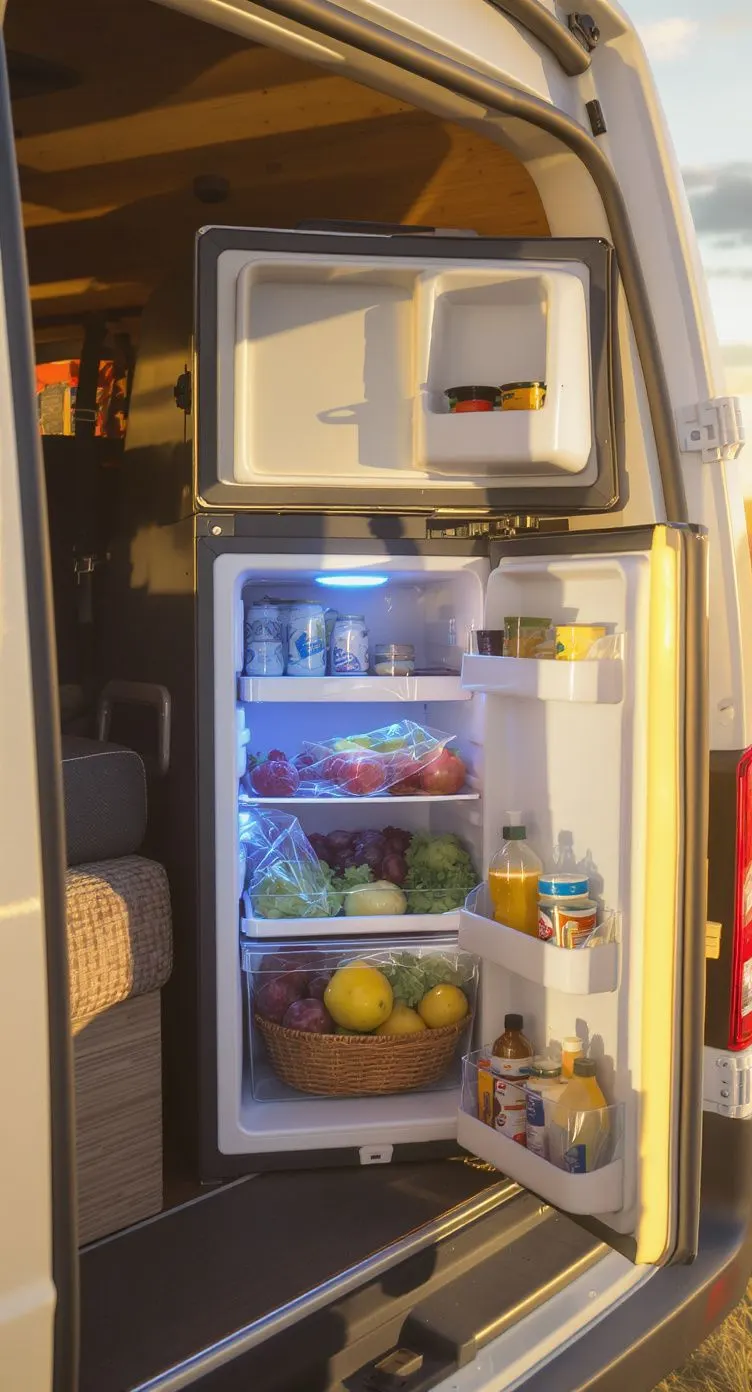
Choose an upright (front-opening) fridge if you're building a fixed galley cabinet, want to reach food at counter height while you cook, and are prepared to build it in: a cabinet cut-out to the maker's dimensions, screws through the fixing points, a ventilation path for the condenser, and a permanent 12 V supply. Upright compressor fridges such as the Dometic NRX and CRX series, Isotherm Cruise and Vitrifrigo C-series are designed by their makers for installation in vehicles and boats, not for moving around.
Neither type is better overall. The choice comes down to floor space, how you'll reach the food, and how much permanent carpentry and wiring you want to do.
What we mean by chest and upright
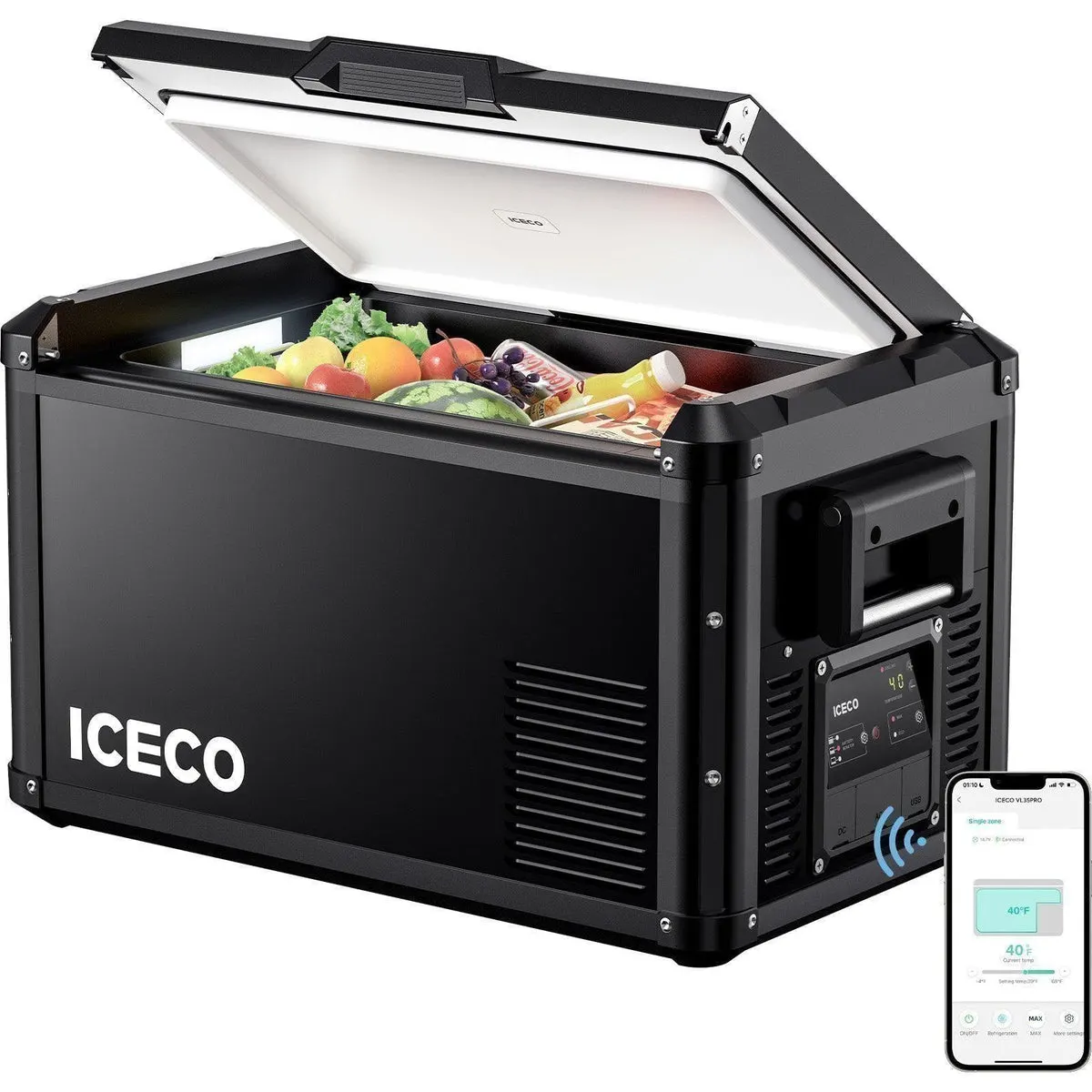
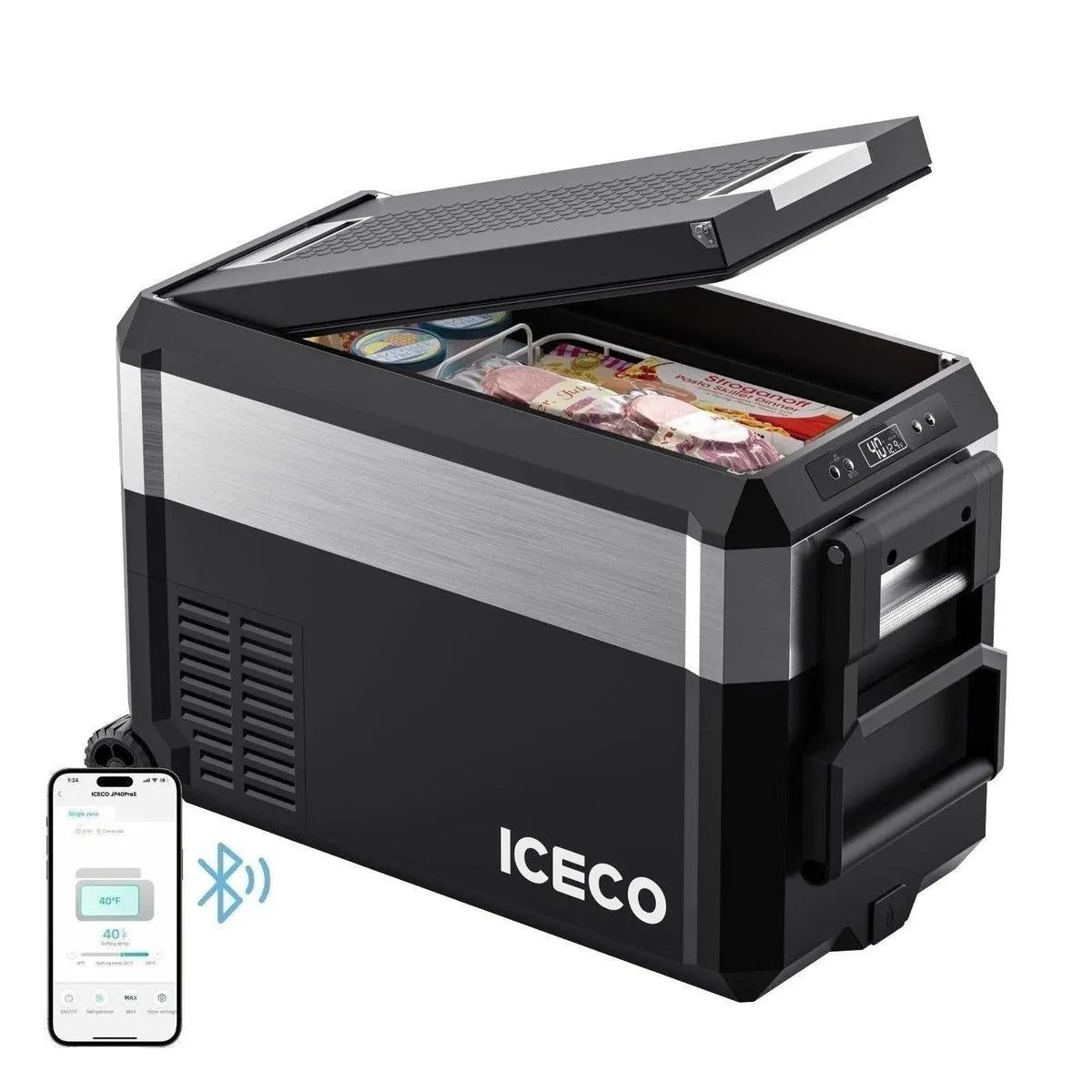
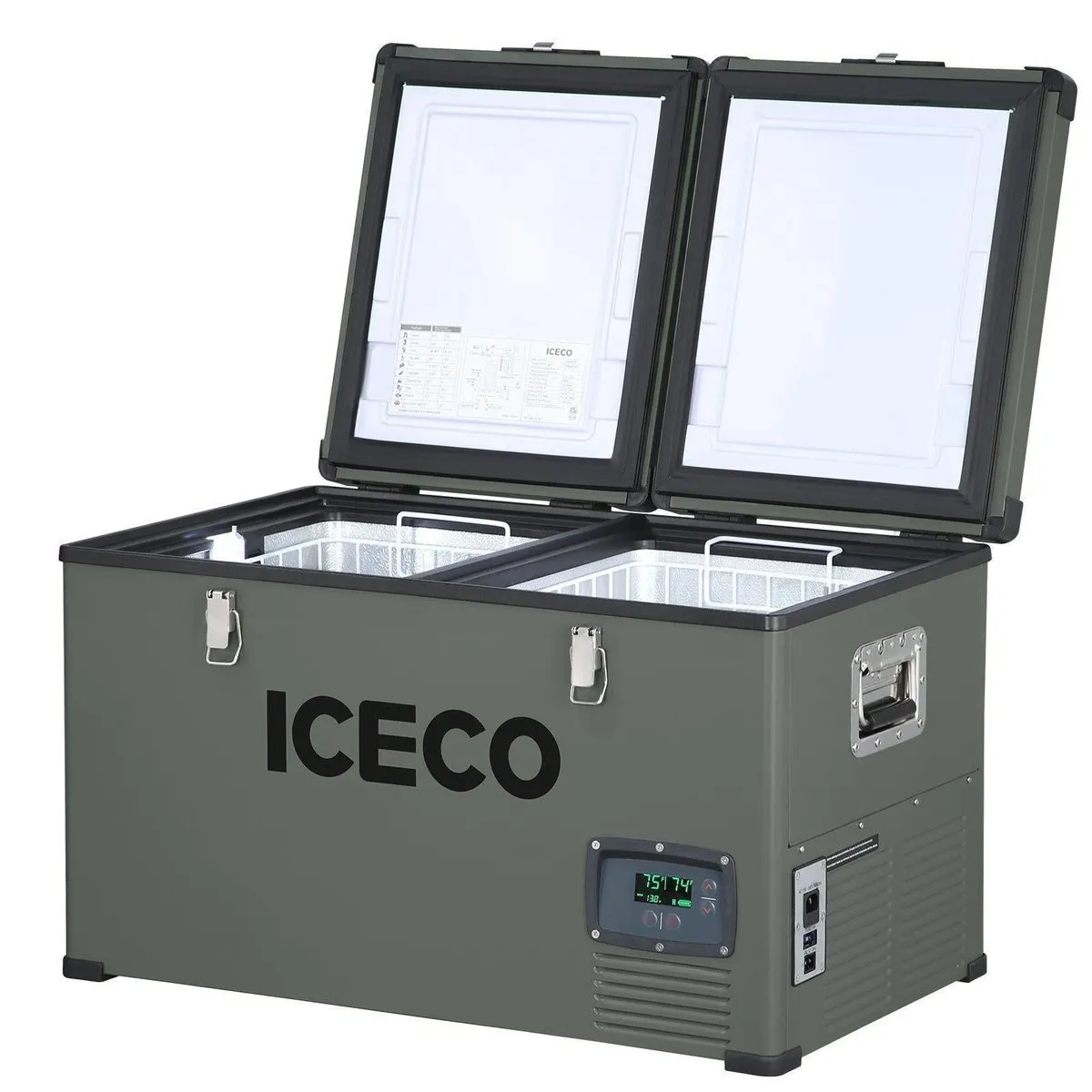
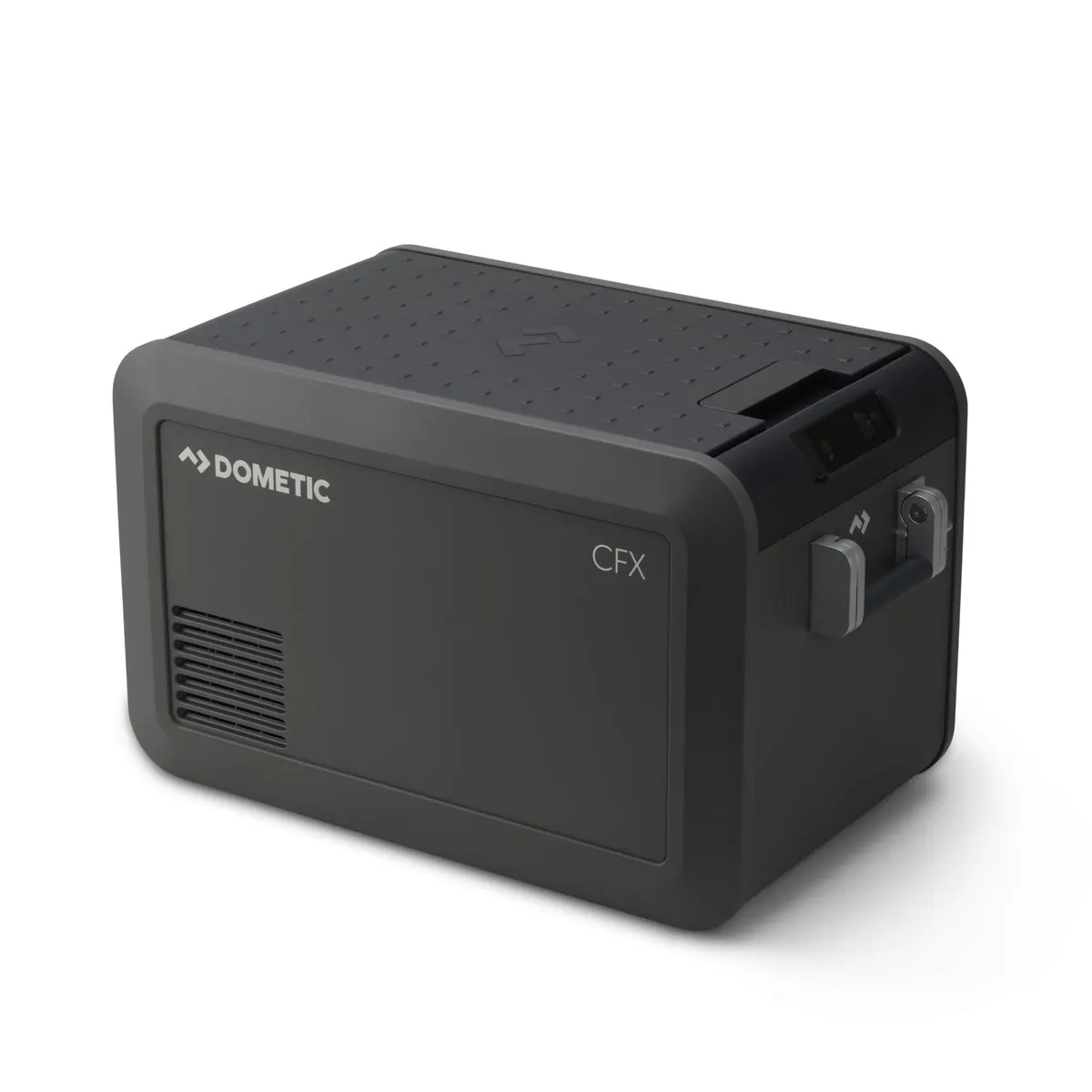
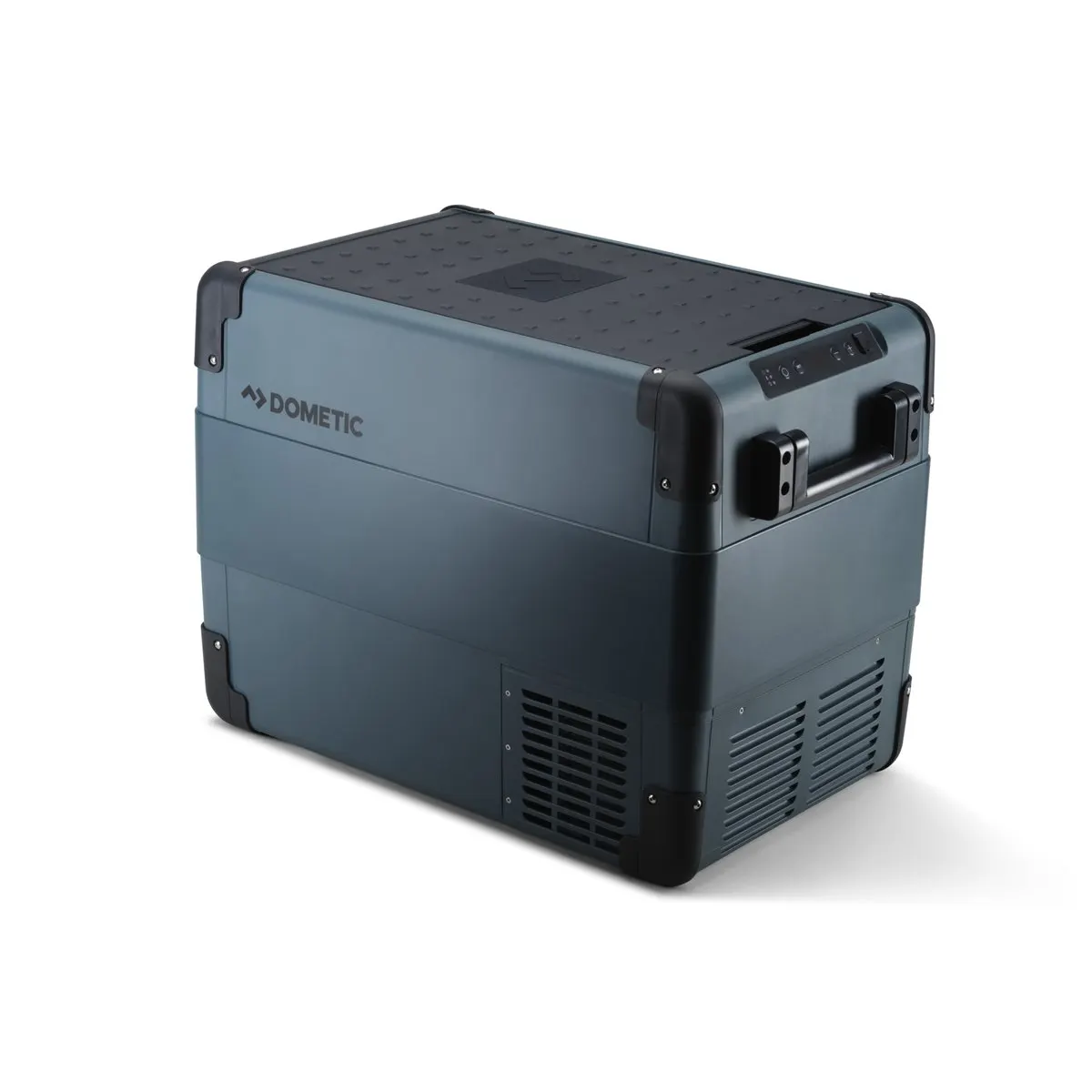
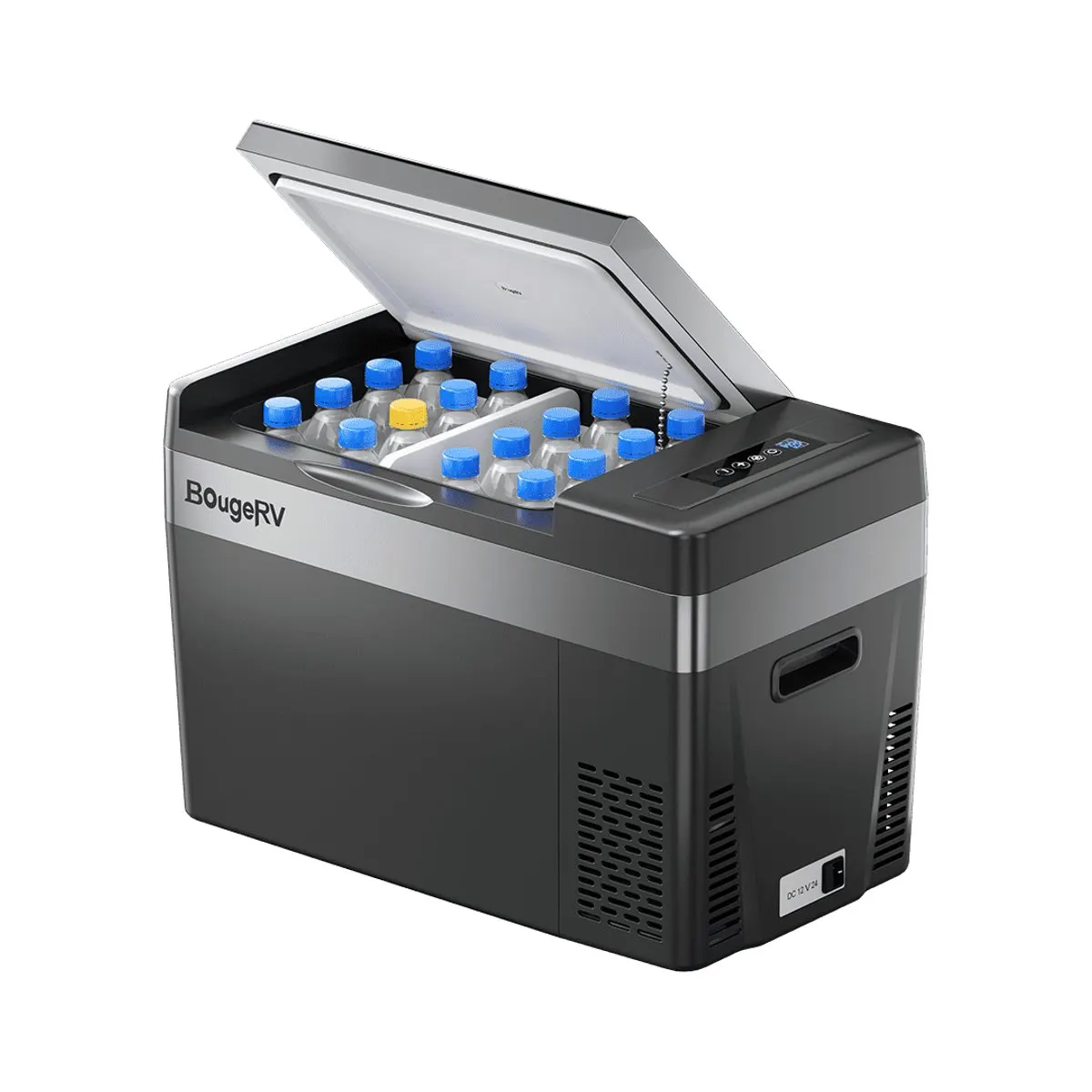
- Chest fridge: a box with a lid on top, usually with the compressor in a raised step at one end. Examples reviewed on this site: the ICECO VL35 ProS, ICECO JP40 Pro, ICECO VL60 Dual Zone, Dometic CFX5 35, Dometic CFX2 45, BougeRV CR 30 Quart and Alpicool C20.
- Upright fridge: a cabinet with a door on the front, shelves, door bins and usually a small freezer compartment at the top. These are built-in appliances. Dometic's NRX operating manual says the fridge is intended for installation in caravans, motorhomes, boats and trucks, and that "it must be fixed in accordance with the installation instructions."
This site doesn't review or link upright fridges. The upright models below are mentioned only to show typical specs, which we checked on the manufacturers' own pages and manuals.
Floor space and access
The two types use space differently.
- A chest fridge uses floor area. Typical 35 to 45-litre chest fridges are about 27 to 28.5 inches long and 14 to 16 inches wide (see the table below). It sits low, so you bend down or pull it out to reach in. What you want is often under something else.
- An upright fridge uses wall height. Dometic lists the NRX 50C at 380 mm (15.0 in) wide, 525 mm (20.7 in) tall and 510 mm (20.1 in) deep for 44 litres. It takes less floor area than a 45-litre chest but more height, and it fills a cabinet bay that could otherwise be drawers.
| Example | Type | Total volume | Footprint, W x D | Height |
|---|---|---|---|---|
| ICECO JP40 Pro | Chest | 40 qt (37 L) | 13.8 x 28.5 in | 18.0 in |
| Dometic CFX2 45 | Chest | 45 L | 15.8 x 26.7 in | 19.4 in |
| Dometic NRX 50C | Upright | 44 L | 15.0 x 20.1 in | 20.7 in |
| Dometic CRX 50 | Upright | 45 L | 15.0 x 19.7 in | 21.0 in |
| Vitrifrigo C51i | Upright | 51 L | 15.0 x 20.2 in | 20.9 in |
Chest figures are from ICECO's JP Pro manual and Dometic's CFX2 manual. Upright figures are from Dometic's NRX and CRX manuals and Vitrifrigo's C51i product page.
Access while cooking. With an upright at counter height, you open the door and see the shelves. With a chest, you need clear space above the lid. Under a counter, that usually means pulling the fridge out on a slide first. Many builders accept this because the fridge stays out of the main living space.
Lid clearance vs door clearance
- Chest lid: needs open air above it for the full swing, unless the lid lifts off. ICECO's VL ProS manual says the lid "can be opened from either side or fully removed," and ICECO lists the same multi-directional lid on the JP40 Pro. Dometic's CFX5 manual covers reversing the lid on the CFX5 55 and the dual-zone models. Check your exact model.
- Upright door: needs swing room in front, which in a van is usually the aisle. A door that blocks the aisle or the sliding door while open is a daily annoyance. Dometic says the NRX door hinge is reversible and the CRX manual shows how to move the hinge to the other side. Vitrifrigo lists a reversible door for the C51i. Choose the hinge side before you build the cabinet.
Ventilation clearance, per the manuals
Both types reject heat from a condenser and both need air. The difference is that a chest fridge carries its ventilation path with it, while an upright depends on the cabinet you build around it.
Chest fridges in this site's catalog:
- Dometic CFX5: "a minimum of 50 mm ventilation on all sides," and don't use it "in closed compartments or areas with none or minimal air flow" (CFX5 operating manual).
- Dometic CFX2: "sufficient ventilation on all four sides," with no distance given (CFX2 APAC manual).
- ICECO VL35 ProS, JP40 Pro and VL60: "more than 5cm on the left and right sides and 10cm space on the front air outlet." This appears in the troubleshooting sections of the ICECO manuals, as advice for preventing overheating faults.
- BougeRV CR 30 Quart: the BougeRV 30/23 Quart manual we opened marks the ventilation port and lists poor ventilation as a cause of faults, but its text gives no distance.
- Alpicool C20: we couldn't open a manufacturer manual. Use the figure in the manual that comes with it.
Upright fridges:
- Dometic NRX: the installation manual warns that insufficient airflow shortens the fridge's life and reduces cooling performance, says to observe minimum spacings when installing it into furniture, and marks spacings of 50 mm (2 in) on its drawings. It also gives exact cut-out sizes. For the NRX 50, the opening is 392–394 mm wide and 534–536 mm high.
- Dometic CRX: the manual says to "install the refrigerator so that the warm air produced can easily flow away (either upwards or to the sides)." Its diagram marks spacings of about 50 mm (2 in), and it gives a recess size of 390 x 544 x 550 mm (W x H x D) for the CRX 50.
If a fridge is boxed in, the cabinet needs a real inlet and outlet for air, not just a gap. Follow the installation drawing for your exact model.
Organisation
- Chest: usually one or two removable wire baskets plus the compressor step. The coldest air sits at the bottom; ICECO's manual notes that "the temperature of the bottom will be the lowest." Organising means layers: everyday items in the basket on top, longer-term food underneath, and short items on the step. Square containers make better use of the space.
- Upright: shelves, door bins and a small freezer compartment. You can see everything at once, which makes it easier to use food before it spoils. Door shelves have load limits, though: Dometic's NRX manual gives 4 kg per door shelf for the NRX 50, and 4 or 8 kg per door depending on the variant. The freezer compartments are small. Dometic lists 4.4 litres in both the NRX 50C and CRX 50, and Vitrifrigo lists 3.6 litres in the C51i. If you freeze meat in bulk, a dual-zone chest such as the ICECO VL60 gives you a much larger freezer.
Organisers are not restraints. Baskets, bins and dividers keep food from sliding around inside the fridge. They do nothing to hold the fridge in place in a sudden stop. That's the job of the tie-downs, mounting kit or screws in the next section.
Loading and unloading
- Chest on the floor: you lift items up and out. Heavy items at the bottom mean bending and lifting.
- Chest on a slide: the fridge rolls out into the aisle or out of the rear doors so you can open the lid fully. ICECO's slide for the JP Pro and VL35/45 Pro models is 27.55 inches long closed and 52.9 inches extended, with a three-position lock. ICECO notes that mounting screws aren't included.
- Upright: easiest to load and unload once installed. Groceries go straight onto shelves at counter height. The trade-off is that you can't take the fridge out to the campsite or home to pre-cool it.
- Moving a chest fridge: weight matters. ICECO lists the VL60 at 64 lb empty, while the JP40 Pro has wheels and a handle. If you'll carry it often, see the size guide: what size 12V fridge you need.
Securing the fridge for travel
A loose fridge is dangerous in a crash. Here's what each maker offers, based on the manuals and pages we opened. Check the current accessory list for your exact model and region before you buy.
| Fridge | What the manufacturer offers |
|---|---|
| Dometic CFX5 35 | Quick fixing kit QFK3545 and fridge slide SLD53545U, both listed for the CFX5 35 and 45 in the CFX5 manual |
| Dometic CFX2 45 | Quick-release fixing kit CFX-QFK, listed as suiting all CFX2 models in the APAC manual |
| ICECO VL35 ProS | Slide mount and tie-down kit, both listed as accessories in the VL ProS manual |
| ICECO JP40 Pro | ICECO's JP Pro / VL35 Pro slide, which comes with four straps |
| ICECO VL60 Dual Zone | A VL60/VL65 slide mount is listed in the VL60 manual; see note below |
| BougeRV CR 30 Quart | No mounting accessory in the manual we opened |
| Alpicool C20 | Not verified |
Note on the VL60 Dual Zone. ICECO's VL60/65 manual lists a VL60/VL65 slide mount. When we checked ICECO's slide-mount page, though, it showed only two slides: one for the APL35, JP Pro, VL45 and VL35 Pro, and one named for the APL55 and VL60 Pro. Neither was named for the VL60 dual zone. Confirm compatibility with ICECO before planning a slide install.
For any chest fridge without a dedicated kit, use rated straps from the fridge's handles or body to anchor points fixed to the vehicle structure: factory floor tie-down points, or eyes bolted through the floor. Hooks on trim panels or bungee cords aren't enough. Strap across the body, not just the lid, so the lid latches aren't holding the fridge's weight.
Upright fridges are screwed into the cabinet. The CRX manual says to "fix the refrigerator in place using suitable screws," the NRX manual says it "must be fixed in accordance with the installation instructions," and Vitrifrigo lists internal fixing points for securing the C51i to the cabinet from inside. That makes the cabinet part of the restraint, so it has to be anchored firmly to the van. The door latch also has to hold while driving. The CRX has a lock-and-vent wheel. Vitrifrigo says its Chromelock handle has been tested for more than 150,000 opening cycles, which is the maker's own claim.
Tilt. Dometic's CFX5 and CRX manuals both say the fridge can withstand a short-term inclination of 30°. The CFX2 manual says not to tilt it more than 30° so the refrigerant circulates properly. Mount the fridge level.
Installation and electrical constraints
- Chest: plugs into a 12 V socket with the supplied cable. Dometic's CFX5 manual says to use only the supplied DC cable, which has a fuse in the plug. For a dedicated outlet, follow the fridge maker's wire-size advice.
- Upright: hard-wired to the house battery with the cable size and fuse the installation manual specifies. The CRX manual lists rated current at 12 V (5.0 A for the CRX 50). Follow the installation manual, and use a qualified RV electrician where your insurer or local rules require one.
- Low-voltage cut-off: both types switch off at a set battery voltage. Dometic's NRX manual lists a 10.4 V cut-off and 11.7 V cut-in at 12 V. ICECO's chest manuals list three settings with cut-offs of 9.6, 10.4 and 11.1 V. Set it to suit your battery type.
Energy use: compare published figures, not fridge shapes
It's often said that chest fridges use less energy because cold air stays in when you lift the lid. Cold air does spill out of an open front door. But how much difference that makes depends on insulation, compressor, setpoint, climate and how often you open it, and none of the upright makers we checked publish a figure that compares the two under the same conditions.
The published figures we found:
| Fridge | Published figure | Wh/day | Ah/day at 12 V | Conditions, per maker |
|---|---|---|---|---|
| Dometic CFX5 35 (chest) | 1.11 Ah/h | ~320 | ~27 | 90°F ambient, 39°F inside |
| Dometic CFX2 45 (chest) | 0.86 Ah/h | ~250 | ~21 | 32°C ambient, 4°C inside (APAC) |
| ICECO JP40 ProS (chest) | 0.323 kWh/24 h | 323 | ~27 | Laboratory; conditions not stated |
| ICECO VL35 ProS (chest) | 0.430 kWh/24 h | 430 | ~36 | Laboratory; conditions not stated |
| Dometic CRX 50 (upright) | 40 W rated input | Not published in manual | Not published | Rating only, not daily use |
| Dometic NRX 50C (upright) | Not listed for this size in the US manual | — | — | — |
A rated input in watts is not daily use, because the compressor cycles. Compare daily figures only where both were measured under similar stated conditions, then run your own case in the fridge battery calculator and fit it into your van kitchen power budget.
Upright examples we checked
These are mentioned for reference only. This site doesn't review, test or link them.
- Dometic NRX 50C: 44 L in total including a 4.4 L freezer compartment; 380 x 525 x 510 mm (W x H x D); 12/24 V DC; reversible door; installation frame sold separately (Dometic US product page and NRX manuals).
- Dometic CRX 50: 41.2 L fridge plus 4.4 L removable freezer compartment (45 L total); 380 x 534 x 500 mm; 17 kg; 12/24 V DC; 40 W rated input (CRX manual). When we checked, Dometic's US CRX product links redirected to its refrigerator listing, which showed NRX models.
- Isotherm Cruise 49 Elegance: 525 x 380 x 452 mm (H x W x D) plus a 50 mm door; 17 kg; 12/24 V (Webasto's Cruise Elegance page; Isotherm is Webasto's marine refrigeration brand).
- Vitrifrigo C51i CHR: 51 L in total including a 3.6 L freezer compartment; 532 mm tall, 380 mm wide, 514 mm deep; 12/24 V DC; reversible single front door; internal fixing points; optional fixing frame (Vitrifrigo product page).
Which should you choose?
| If this describes you | Lean towards |
|---|---|
| Layout not final, or you may move the fridge to another vehicle | Chest |
| Fridge under a bed platform or bench | Chest, on a slide if the lid can't open in place |
| You want the fridge at the campsite or in the house | Chest |
| You freeze a lot of meat | Dual-zone chest, or two chests |
| Fixed galley with a cabinet bay at counter height | Upright |
| Bending to a floor-level fridge is a problem | Upright, or a chest on a raised slide |
| You don't want to cut cabinetry or hard-wire an appliance | Chest |
For chest fridges, the reviews and comparisons on this site cover the details: Dometic CFX5 35 vs ICECO VL35, ICECO JP40 Pro vs Dometic CFX2 45, ICECO VL60 vs ICECO JP40 Pro and ICECO VL35 vs BougeRV 30 Qt. The 12V fridge buying guide covers compressor basics, battery sizing and wiring.
FAQ
Is a chest or upright fridge better for a campervan? Neither is better overall. A chest fridge suits builds where the fridge is portable, under a bench or on a slide. An upright suits a fixed galley where you want counter-height access and will build the fridge into a cabinet.
Do upright 12V fridges use more power than chest fridges? Not necessarily. Cold air does spill from an open front door, but real use depends on the model, insulation, climate and habits. The upright makers we checked don't publish figures that allow a like-for-like comparison, so compare model-specific daily figures under stated conditions.
Can I put a portable chest fridge in a cabinet? Yes, if you keep the clearance its manual asks for and give the cabinet a real air inlet and outlet. Dometic's CFX5 manual asks for at least 50 mm on all sides and warns against closed compartments. ICECO's manuals ask for more than 5 cm on the left and right and 10 cm at the front air outlet.
How do I secure a chest fridge in a van? Use the maker's fixing kit or slide where there is one, or rated straps to anchor points fixed to the vehicle structure. Baskets and organisers keep the contents tidy but don't restrain the fridge.
How is an upright fridge secured? It's screwed into its cabinet through the fixing points or frame, following the installation manual, and the cabinet must be anchored to the van. The door latch must stay closed while driving.
Does this site sell upright fridges? No. Every fridge reviewed here is a chest-style portable. Upright models are mentioned only as examples, with specs from their manufacturers.
Sources and verification
Manufacturer pages and manuals we opened, each checked 2026-10-09:
- Dometic CFX5 operating manual (EMEA): 50 mm ventilation, closed-compartment warning, 30° short-term inclination, lid reversal models, accessory list (QFK3545, SLD53545U), DC cable fuse. Checked 2026-10-09.
- Dometic CFX5 35 US product page: 1.11 Ah/h at 90°F ambient and 39°F inside, dimensions. Checked 2026-10-09.
- Dometic CFX2 45 product page: 45 L, 0.86 Ah/h at 32°C and 4°C. Checked 2026-10-09.
- Dometic CFX2 operating manual (APAC): ventilation on all four sides, 30° tilt limit, CFX-QFK fixing kit, dimensions. Checked 2026-10-09.
- ICECO VL35/45/60 ProS manual: lid opening, clearance, accessories (slide mount, tie-down kit), battery-protection voltages, 0.430 kWh/24 h. Checked 2026-10-09.
- ICECO JP30/40/50 ProS manual: dimensions, clearance, 0.323 kWh/24 h. Checked 2026-10-09.
- ICECO VL60/65 manual: VL60 dimensions and weight, clearance, VL60/VL65 slide mount accessory. Checked 2026-10-09.
- ICECO slide mount for APL35/JP Pro/VL45/VL35 Pro: compatibility, four straps, three-position lock, lengths, screws not included. Checked 2026-10-09.
- ICECO slide mount collection: the two slides listed. Checked 2026-10-09.
- ICECO JP40 Pro product page: wheels, multi-directional lid. Checked 2026-10-09.
- BougeRV 30 Quart / 23 Quart user manual: ventilation port, ratings. Checked 2026-10-09.
- Dometic NRX 50C US product page: 44 L with 4.4 L freezer, dimensions, reversible hinge, frame sold separately. Checked 2026-10-09.
- Dometic NRX installation manual: airflow warning, 50 mm spacings, cut-out sizes. Checked 2026-10-09.
- Dometic NRX operating manual: intended use, fixing requirement, door-shelf loads, battery-protection voltages, NRX 50 volumes. Checked 2026-10-09.
- Dometic CRX installation and operating manual: fixed installation, airflow, recess sizes, screw fixing, door hinge, 30° inclination, CRX 50 specs. Checked 2026-10-09.
- Webasto Isotherm Cruise Elegance page: Cruise 49 dimensions and weight. Checked 2026-10-09.
- Vitrifrigo C51i CHR product page: 51 L with 3.6 L freezer, dimensions, reversible door, internal fixing points, fixing frame, Chromelock claim. Checked 2026-10-09.
Products covered in this guide
Disclosure: As an Amazon Associate I earn from qualifying purchases. Links to Amazon on this page are affiliate links: if you buy through one, VanLifeKitchens.com may earn a commission at no extra cost to you. Read our affiliate disclosure.
More in Buying Guides
Nesting Cookware for Induction: Compatibility and Storage
Which nesting and packable pots actually work on a portable induction hob, per their makers: magnet tests, pan-size limits for the Duxtop and NUWAVE, what nests inside what, handles, lids and glass-top care.
Best 12V Fridges for Van Life (2026): Complete Guide
How 12V compression fridges work, how to read spec sheets, size the fridge, battery and solar, install and wire it, plus our best budget, mid-range and premium picks.
Best Cooktops for Van Life (2026): Complete Guide
Induction, butane, or propane? Power math, indoor safety, cold-weather strategy, and the best van life cooktops at every price tier for 2026.