Dometic CFX5 35 Fridge vs ICECO VL35 ProS 12V Fridge
Dometic's new premium 35-liter fridge against the value pick most full-timers end up buying. Same size class, a considerably higher price. Here's what the extra money actually gets you.
Disclosure: As an Amazon Associate I earn from qualifying purchases. Links to Amazon on this page are affiliate links: if you buy through one, VanLifeKitchens.com may earn a commission at no extra cost to you. Read our affiliate disclosure.
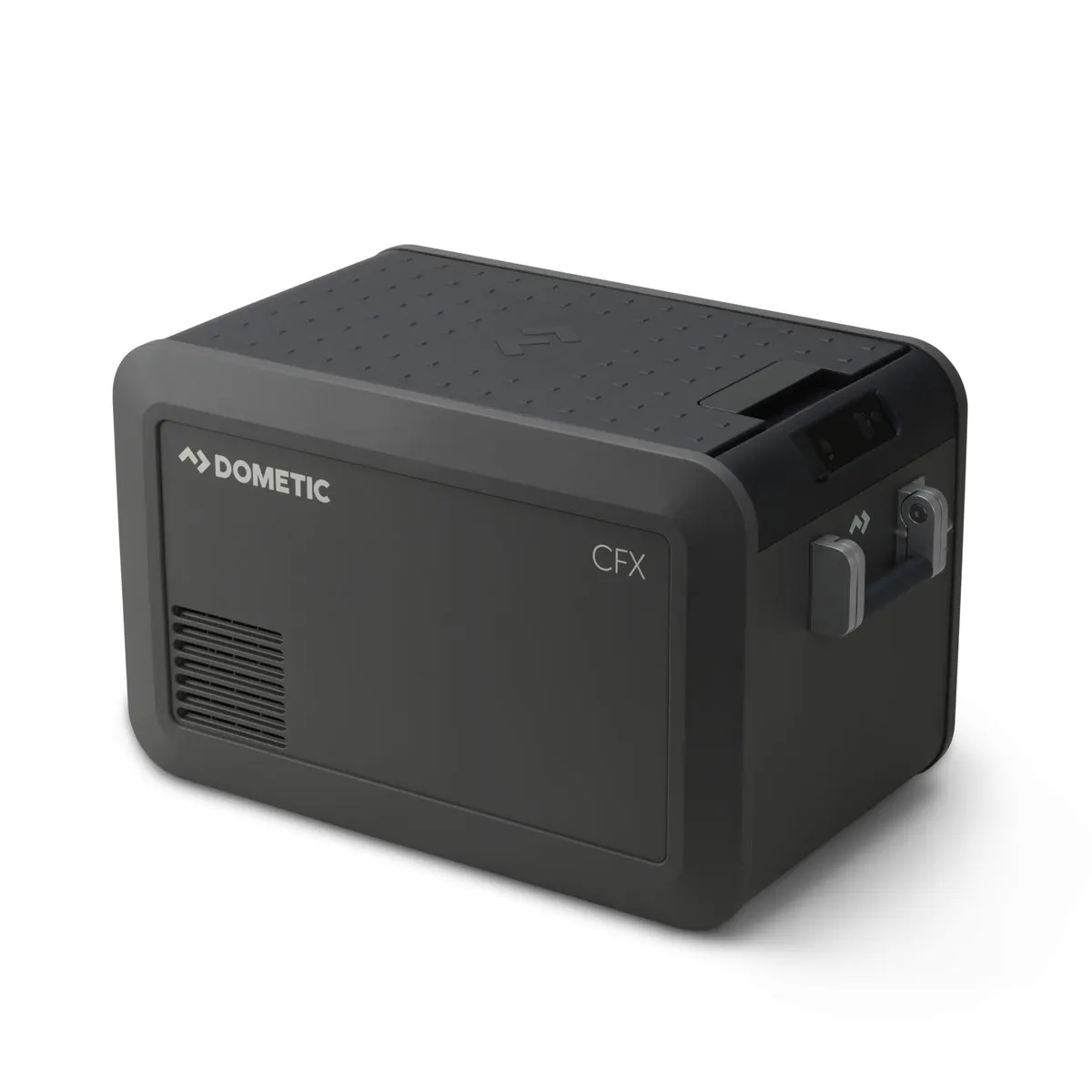
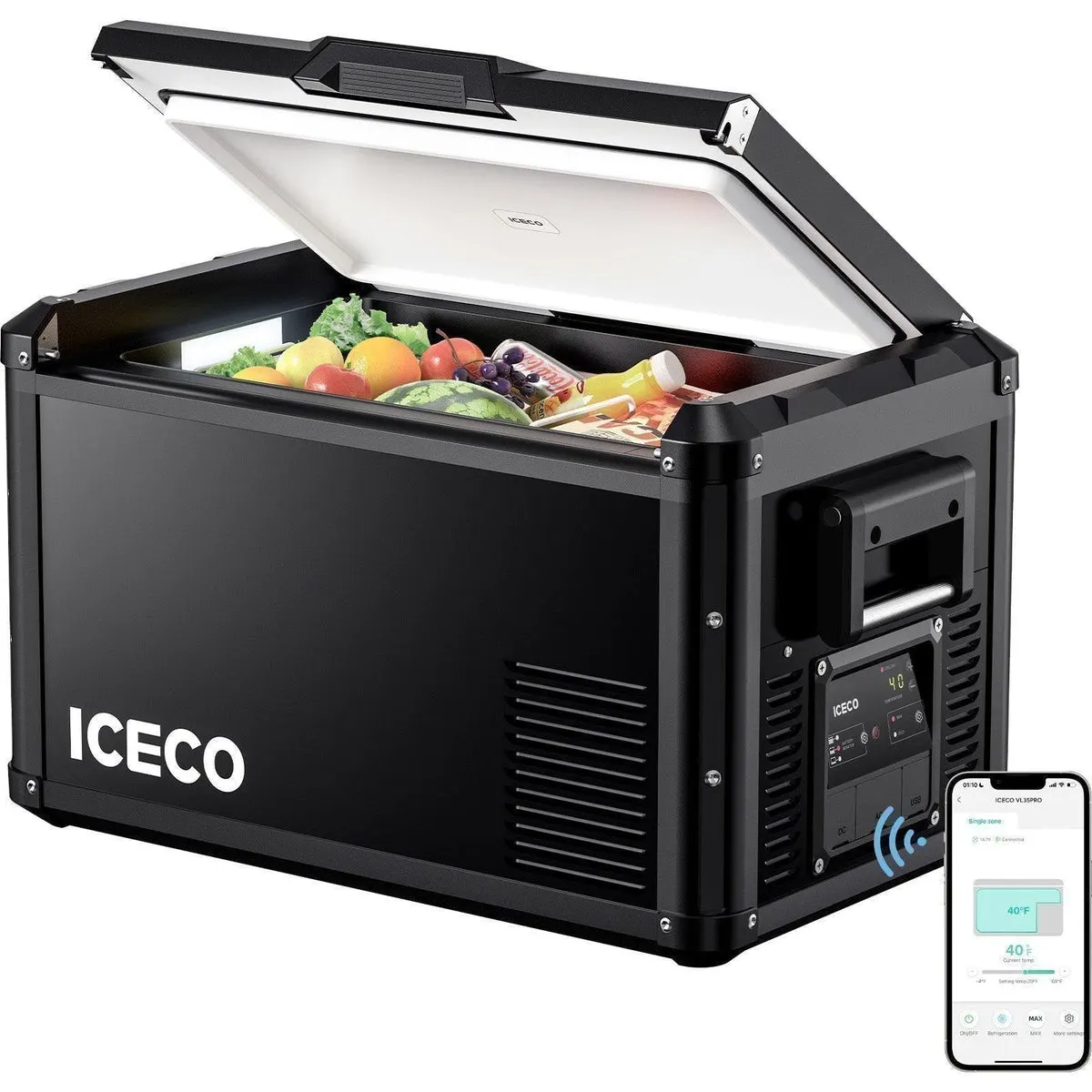
We recommend the Iceco VL35 ProS 12V Fridge Freezer
“The Iceco VL35 ProS wins for most van builders on value. It holds about the same 35 liters, runs a Secop compressor with a 5-year compressor warranty, and costs considerably less than the CFX5 35. The Dometic is lighter (36.5 vs 48.7 lbs) and has the lower published draw (1.11 Ah/h at 90°F, about 27 Ah/day, against ICECO's 0.430 kWh lab figure, about 36 Ah/day), plus vacuum insulated panels, a color display and Bluetooth. Pick it if those are worth the premium to you; otherwise the savings more than cover the extra battery the VL35 needs.”
Read the full Iceco VL35 ProS 12V Fridge Freezer reviewSpecifications
| Spec | Dometic CFX5 35 Electric Cooler | Iceco VL35 ProS 12V Fridge Freezer |
|---|---|---|
| Best for | Quiet 35L with app control | Steel-cased 35L single zone |
| Capacity | 36L / 50 cans | 35L / 37 qt |
| Dimensions | 27.3 x 15.7 x 16.0 in | 28.1 x 15.9 x 15.7 in |
| Weight | 36.5 lbs (US page; US manual says 41.9 lb) | 48.7 lbs |
| Power Source | 12/24V DC + 100-240V AC | 12/24V DC + 110-120V AC (manual) |
| Power Draw | 1.11 Ah/h rated (US spec, 90°F amb.) | 0.430 kWh/24h lab rating (~34 Ah/day at 12.8 V) |
| Compressor | Dometic VMSO3.5 (named on AU page) | Secop |
| Warranty | Confirm US term (Amazon: 2 yr; AU page: 5 yr) | 5 yr compressor / 1 yr parts |
| Ventilation | At least 50 mm on all sides (US manual) | Over 5 cm at the sides, 10 cm at the front air outlet (ICECO manual) |
Dometic CFX5 35 Electric Cooler
- Vacuum insulated panels plus PU foam
- VMSO 3.5 variable-speed compressor
- Weatherproof TFT display + Bluetooth app
- 18W QC 3.0 USB, aluminum self-folding handles
- Premium price, considerably more than an Iceco VL35
- Rated 1.11 Ah/h on Dometic's US page, above the old CFX3 35
Iceco VL35 ProS 12V Fridge Freezer
- Secop compressor, 5-year compressor warranty
- Rated 0.430 kWh/24h (~34 Ah/day at 12.8 V)
- Steel case; lid opens either side or lifts off
- Simple digital controls
- No app or Wi-Fi
- Heavy for its size at 48.7 lb
The short answer
For most van builders, the Iceco VL35 ProS is the better buy. It holds about the same 35 liters as the Dometic CFX5 35, runs a Secop compressor that ICECO backs for five years, and costs considerably less. It is the heavier box and has the higher published energy figure, so put part of the savings into battery. If your goal is a dependable cold box that leaves money in the build budget for batteries and solar, it does the job.
The Dometic CFX5 35 is the more refined fridge. It adds vacuum insulated panels, Dometic's VMSO3.5 variable-speed compressor, a weatherproof color display, Bluetooth app control and aluminum self-folding handles. Buy it if those refinements matter to you and the price gap doesn't. It also has the lower published power figure and is 7 to 12 pounds lighter, depending on which Dometic weight figure you use. Don't buy it expecting it to keep food dramatically colder, though, because nothing published shows that.
For the full detail on each fridge, read our Dometic CFX5 35 review and our Iceco VL35 ProS review. If you're still deciding on size or fridge type, start with the 12V fridge complete guide. VanLifeKitchens researches fridges rather than testing them; the figures below come from each maker's published specs and manuals, as cited in those reviews.
Insulation and efficiency
This is the Dometic's headline feature. Dometic pairs vacuum insulated panels with polyurethane foam in the walls. ICECO doesn't list vacuum panels for the VL35 ProS. Better insulation means less heat leaking in, so the compressor has less to remove, and that matters most in hot weather.
The published figures are less tidy than that sounds. Dometic's US product page rates the US CFX5 35 at 1.11 Ah per hour at 90°F (32°C) ambient with a 39°F (4°C) setpoint. Its Australian page shows a lower 0.77 Ah per hour under the same stated conditions, but that is a different market's model; for a US-bought fridge, plan around the US figure. Dometic's US page also rates the outgoing CFX3 35, which has no vacuum panels, at 0.98 Ah per hour under the same conditions, so the vacuum panels don't show up as a lower US rating. ICECO's manual lists the VL35 ProS at 0.430 kWh per 24 hours, about 34 Ah per day at 12.8 V (36 Ah counted at 12 V), and calls it a laboratory figure without stating the ambient temperature or setpoint. The two ratings come from different tests, so they aren't a precise head-to-head, but on paper the Dometic is the more frugal fridge.
Edge: Dometic CFX5 35, for vacuum panels and the lower published draw.
Power draw and battery sizing
At 1.11 Ah per hour, the CFX5 35 works out to about 27 Ah (about 320 Wh at 12 V) per day at 90°F ambient. ICECO's lab figure for the VL35 ProS, 0.430 kWh, is about 430 Wh, or 34 Ah per day on a 12.8 V lithium bank (36 Ah at 12 V). Neither is a nameplate figure: the CFX5's 47 W and 7.6 A maximum is for fuse and wire sizing, and ICECO doesn't publish a nameplate wattage or running current for the VL35, only a 15 A internal fuse. Never multiply a nameplate figure by 24.
Lid openings, warm groceries and a cabin that gets hotter than 90°F in summer sun all add to either number. Our CFX5 35 review adds 20 to 30 percent for summer planning, about 30 to 35 Ah per day. Our VL35 review estimates about 51 Ah per day in a hot van above 95°F, against about 27 in a cool shoulder season. Those are our estimates, not maker figures. Running either one as a freezer near 0°F uses considerably more.
The gap on paper is roughly 7 to 9 Ah a day. That's real, but it doesn't move either fridge out of the same broad battery class:
- 100 Ah lithium: roughly two to three days of fridge-only use with no charging, less for the VL35 in summer heat. Fine for weekends, tight once lights, fans and devices share the bank.
- 200 Ah lithium with solar or alternator charging: comfortable for full-time use with either fridge.
Both have three-level battery protection. ICECO's manual gives 12 V cut-out and restart voltages of 9.6/10.9 V, 10.4/11.7 V and 11.1/12.4 V. Dometic's CFX5 manual shows its values only in a graphic, and says to use HIGH on a vehicle starting battery and LOW on a separate house battery. On a lithium bank, set the cutoff to the lowest level your battery maker recommends so the fridge doesn't shut off early. Run your own numbers, including your climate and other loads, in our fridge battery calculator.
Edge: Dometic CFX5 35, narrowly. Its published figure is lower, though neither fridge changes the class of battery you need.
Footprint and fit in the van
The two are close in size. Dometic lists the CFX5 35 at 27.32 x 15.67 x 16.02 inches, and ICECO lists the VL35 ProS at 28.1 x 15.9 x 15.7 inches, so the Iceco is about 0.8 inches longer and a fraction wider, while the Dometic is a fraction taller. The bigger difference is weight: ICECO lists 48.7 pounds empty for the VL35 ProS. Dometic's US product page gives 36.5 pounds for the CFX5 35, but the technical data in its US manual says 41.9 pounds, so plan a slide or a lift around the heavier figure. Either way, the Dometic is 7 to 12 pounds lighter, which matters if you lift the fridge in and out, mount it on a slide, or watch payload.
Clearance changes the picture a little. Dometic's US manual asks for at least 50 mm (about 2 inches) on all sides of the CFX5. ICECO's manual asks for more than 5 cm at the left and right sides and 10 cm (about 4 inches) at the front air outlet of the VL35. In practice that means roughly 31.3 x 19.6 inches of floor space for the Dometic and about 32 x 20 inches for the Iceco.
The lids differ too. ICECO's manual says the VL35 lid opens from the right or the left side, or comes off completely when you press both latches inward. The Dometic's lid is removable, but Dometic's US manual shows lid reversal only for the CFX5 55IM and the dual-zone models, not the 35, so plan for the hinge side it ships with. For how much open space a chest lid needs compared with an upright door, see the chest vs upright 12V fridge guide.
If you're upgrading from a CFX3 35, Dometic lists both at 27.32 x 15.67 x 16.02 inches, so the footprint is the same; see the CFX3 35 review for how the two differ.
At about 16 inches tall, neither has much interior height. A wine bottle is about 12 inches tall, and once you subtract the floor, walls and lid insulation, expect tall bottles to lie down in the CFX5 35. ICECO's product page says the VL35 basket leaves room for 11-inch-tall items. If you carry a lot of tall containers, a taller 40 or 45-liter fridge is easier to live with.
Edge: Dometic CFX5 35, for being lighter, with a near-identical footprint.
Compressor and warranty
The Iceco runs a Secop compressor; ICECO doesn't publish the exact model. Secop (formerly Danfoss) DC compressors are used across many established 12V fridge brands, and ICECO backs this one for five years. Neither fact guarantees any individual unit, but the warranty is a protection you can count on.
The Dometic uses its own VMSO3.5, which Dometic's Australian page names; the US page doesn't name the compressor. It's a newer design than the Secop units used across the industry, so there's less public service history behind it.
Both are variable-speed DC compressors that ramp up and down rather than switching hard on and off.
Edge: Iceco VL35 ProS, for a widely used compressor and the 5-year compressor warranty.
Noise
Neither maker publishes a noise figure for these US models. Dometic's US page lists none for the CFX5 35, and ICECO doesn't publish a sound level for the VL35. Like any compressor fridge, each is quiet between cycles and makes a low hum plus fan noise while the compressor runs. In a small van, put the compressor end away from the bed if you're a light sleeper.
With either fridge, ventilation affects noise as much as the compressor does. A fridge boxed into a hot, cramped cabinet runs longer and louder, so leave real airflow at the compressor end.
Edge: tie. There's no published figure to compare.
Controls, app and build
Here the Dometic is clearly ahead. You get a weatherproof color TFT display, Bluetooth control through Dometic's Mobile Cooling app (set and monitor temperature, track energy use), an 18W Quick Charge 3.0 USB port, self-folding aluminum handles with a bottle opener, a removable textured non-slip lid, TPE gaskets and an anti-condensation coil around the lid seal. Dometic's US listing describes Bluetooth only, not the Wi-Fi the CFX3 35 offered. The display can be locked so a sliding bag doesn't change the setpoint.
The VL35 is deliberately simple: a steel case, a lid held by two plastic latches that also release it for removal, and an LED button panel covering MAX and ECO modes, temperature and battery protection. It has a USB port that ICECO says works only on DC. There's no app, no Bluetooth and nothing to pair: ICECO's manual has no app section, and neither its product page nor the Amazon listing lists app control. The interior liner is plain molded plastic. Check the latches for play now and then if the fridge rides in a slide tray on rough roads, and plan on ICECO's tie-down kit or slide mount, or a strap to solid anchor points.
Weather tolerance differs on paper. Dometic's US manual says the CFX5 "shall not be exposed to rain" and can withstand only a short-term 30° inclination. ICECO's manual allows light rain with the vents kept clear of water, but not moderate or heavy rain, and rates the fridge for ambient temperatures up to 55°C (131°F). Dometic lists an operating range of 61°F to 109°F (16°C to 43°C), climate class N/T. Keep either one under cover.
Edge: Dometic CFX5 35, for the app, display, USB fast charging and better finish.
Value
The CFX5 35 is a premium fridge and the VL35 ProS sits in the mid-range, so the Dometic costs considerably more. Check current prices on Amazon, since they move often. In this comparison, the extra money buys vacuum insulated panels, a color display, Bluetooth app control, a fast-charge USB port and nicer handles. It also buys a lower published power figure and 7 to 12 pounds less weight. It does not buy more space.
For most builds, that difference does more as battery capacity or solar than as fridge refinement, and it more than covers the extra battery the VL35's higher rated draw calls for. Warranty favors the Iceco on the compressor. ICECO's manual gives 5 years on the compressor and 1 year on other parts, with a 30-day refund window from delivery. For the CFX5 35, the Amazon listing shows a 2-year manufacturer warranty and Dometic's Australian page lists 5 years for that market, while the US manual only points to Dometic's US warranty page, which doesn't state a term for this cooler. Confirm the US term with Dometic before you buy.
Which one should you buy?
Buy the Iceco VL35 ProS if:
- You want a Secop compressor and the money left over for batteries or solar.
- You want the longer compressor warranty (5 years).
- You'd rather have physical buttons than an app.
- Your bay is low and you want a lid that opens from either side or lifts off.
Buy the Dometic CFX5 35 if:
- You want vacuum insulated panels, which the VL35 lacks, and the price isn't a constraint.
- You want to check and adjust the temperature from your phone.
- You want the lighter fridge and the lower published power draw.
- You value a weatherproof color display, an 18W USB port and aluminum handles.
FAQ
Is the Dometic CFX5 35 worth the extra cost over the Iceco VL35?
For most van builders, no. Both hold about 35 liters, both are single-zone fridge-freezers, and both land in the same broad battery class, though the Dometic's published draw is lower. The CFX5 35 is worth it if you specifically want its vacuum insulation, color display, Bluetooth app and lighter box, and the considerable extra cost doesn't take away from your electrical system.
Which uses less power, the CFX5 35 or the VL35?
On published figures, the Dometic. Its US page rates the CFX5 35 at 1.11 Ah per hour at 90°F ambient, about 27 Ah (320 Wh) per day. Dometic's Australian page lists 0.77 Ah per hour for that market's model. ICECO's manual rates the VL35 ProS at 0.430 kWh (430 Wh) per 24 hours, about 34 Ah per day at 12.8 V or 36 Ah at 12 V, as a lab figure with no stated conditions. Plan around those as baselines, and more in summer heat or freezer mode.
Do both fridges use a Secop compressor?
No. The Iceco VL35 ProS uses a Secop compressor (ICECO doesn't publish the exact model). The Dometic CFX5 35 uses Dometic's own VMSO3.5 variable-speed compressor, named on Dometic's Australian page. Both are variable-speed DC designs.
Which fridge is smaller?
They're nearly the same size. The CFX5 35 is listed at 27.32 x 15.67 x 16.02 inches and the VL35 ProS at 28.1 x 15.9 x 15.7 inches. The CFX5 35 is lighter: Dometic gives 36.5 pounds on its US page and 41.9 pounds in its US manual, against 48.7 for the VL35. With each maker's ventilation clearance added, the Dometic needs about 31.3 x 19.6 inches of floor space and the Iceco about 32 x 20.
Does the Iceco VL35 have an app like the Dometic?
No. The VL35 ProS has no Bluetooth, Wi-Fi or app. You control it from the panel on the fridge. The CFX5 35 connects over Bluetooth to Dometic's Mobile Cooling app.
Sources and verification
- Dometic CFX5 35 review: specs and sources for the CFX5 35, including Dometic's US and Australian product pages and US operating manual (checked 2026-10-12)
- ICECO VL35 ProS review: specs and sources for the VL35, including ICECO's VL35/45/60 ProS manual and product page (checked 2026-10-12)