Best 12V Fridges for Van Life: Complete Guide
How 12V compression fridges work, how to read spec sheets, size the fridge, battery and solar, install and wire it, plus our best budget, mid-range and premium picks.
Disclosure: As an Amazon Associate I earn from qualifying purchases. Links to Amazon on this page are affiliate links: if you buy through one, VanLifeKitchens.com may earn a commission at no extra cost to you. Read our affiliate disclosure.
Short answer
- Most full-time van builds: the ICECO VL35 ProS. It has a Secop compressor with a 5-year compressor warranty, 35 liters inside, a low 15.7-inch metal cabinet, and a published 0.430 kWh per 24 hours (about 36 Ah/day at 12V, a lab figure).
- If you move the fridge or want an app: the ICECO JP40 Pro. It has wheels, a lid that opens from either side, Bluetooth, and a narrow 13.8-inch body. It's 37 liters (40 quarts), not 40 liters.
- Premium single zone: the Dometic CFX5 35. It has vacuum insulated panels, weighs 36.5 lbs, and has the clearest published energy rating here: 1.11 Ah/h at 90°F ambient, about 27 Ah/day.
- Fridge and freezer at once: the ICECO VL60 Dual Zone. It has 60 liters across two lids and two setpoints. Plan on about 45 Ah/day and a 200 Ah bank.
- Budget or weekends: the BougeRV 30 Quart, a 28-liter compressor fridge-freezer at 24 lbs. Go smaller and cheaper with the 20-liter Alpicool C20.
Who this guide is for
This guide is for anyone fitting a portable 12V compressor fridge into a camper van, a truck camper, an SUV or a pickup bed. That covers:
- weekend trips on a single 100 Ah battery
- full-time living on 200 Ah or more with solar and alternator charging
It assumes your fridge power comes from a 12V house battery, with or without a portable power station. It also assumes you'll travel in a mix of climates, including hot summers, which is when fridge choice matters most.
It is not for:
- Built-in drawer fridges or upright RV fridges installed into cabinetry. Those follow the manufacturer's installation manual and often need a dedicated vent path designed into the build. The one built-in upright we review, the Dometic NRX 50S, is covered with the chest-or-upright decision in chest vs upright 12V fridges.
- Three-way absorption (propane) fridges. These need a sealed, vented gas installation that a qualified RV gas technician should fit and check.
- Thermoelectric coolers. They are fine for a day trip but can't freeze, and they draw power more or less continuously.
VanLifeKitchens researches products; we don't test them. Every spec below comes from a manufacturer page, manual or the Amazon listing we link, and we say who measured any real-world figure. The pages we checked are listed in "Sources and verification" at the end.
How to choose a 12V fridge
Six criteria do almost all the work. In rough order of importance:
- Daily energy use at stated conditions. This decides your battery and solar size. Look for Ah per hour, or kWh per 24 hours, with the ambient temperature and setpoint stated. Dometic publishes 1.11 Ah/h at 32°C (90°F) ambient and 4°C (39°F) inside for the US CFX5 35. ICECO publishes a 24-hour lab figure but no conditions. BougeRV and Alpicool publish no daily figure at all. Never use the nameplate watts multiplied by 24. More on this below.
- Capacity, external size and clearance: three separate numbers. Interior liters tell you how much food fits. External dimensions tell you whether the box fits. The manufacturer's ventilation clearance tells you how much space the install really takes. It ranges from about 2 inches per side (Dometic, ICECO) to about 8 inches behind (BougeRV).
- One zone or two. A dual-zone fridge holds fridge and freezer temperatures at once, but it is larger, heavier and uses more energy. Most people who shop every three to five days don't need one.
- Access and handling. Check which way the lid opens and whether it lifts off, whether the fridge has wheels, and its empty weight. All seven fridges here load from the top.
- Compressor and warranty. ICECO uses Secop compressors and covers them for 5 years, with 1 year on other parts. Dometic uses its own variable-speed compressors. BougeRV and Alpicool don't name their compressor maker. Owner durability reports at the budget end are more mixed.
- Battery protection and wiring. Every fridge here has a three-level low-voltage cutoff. The cut-out voltages differ, and so does how well each brand documents them.
Comparison table
Sizes are from each maker's manual or product page. Clearance is what the manufacturer asks for around the fridge.
| Fridge | Capacity | Outside (L x W x H, in) | Clearance asked | Zones / wheels |
|---|---|---|---|---|
| Alpicool C20 | ~20 L / 21 qt | 23.5 x 12.6 x 12.6 | Not published | 1 / no |
| BougeRV 30 Quart | 28 L / 30 qt | 22.7 x 12.6 x 15.5 | 7.9 in back, 3.9 in sides | 1 / no |
| ICECO VL35 ProS | 35 L / 37 qt | 28.1 x 15.9 x 15.7 | 5 cm sides, 10 cm front | 1 / no |
| Dometic CFX5 35 | 36 L | 27.3 x 15.7 x 16.0 | 50 mm all sides | 1 / no |
| ICECO JP40 Pro | 37 L / 40 qt | 28.5 x 13.8 x 18.0 | 5 cm sides, 10 cm front | 1 / yes |
| Dometic CFX2 45 | 45 L | 26.7 x 15.8 x 19.4 | "Sufficient", all sides | 1 / no |
| ICECO VL60 Dual Zone | 60 L / 63 qt | 31.2 x 19.5 x 18.9 | 5 cm sides, 10 cm front | 2 / no |
Daily energy for each fridge is in the power section further down. Price position, from lowest to highest: Alpicool and BougeRV are budget; the ICECO fridges are mid-range; both Dometics are premium-priced.
The picks
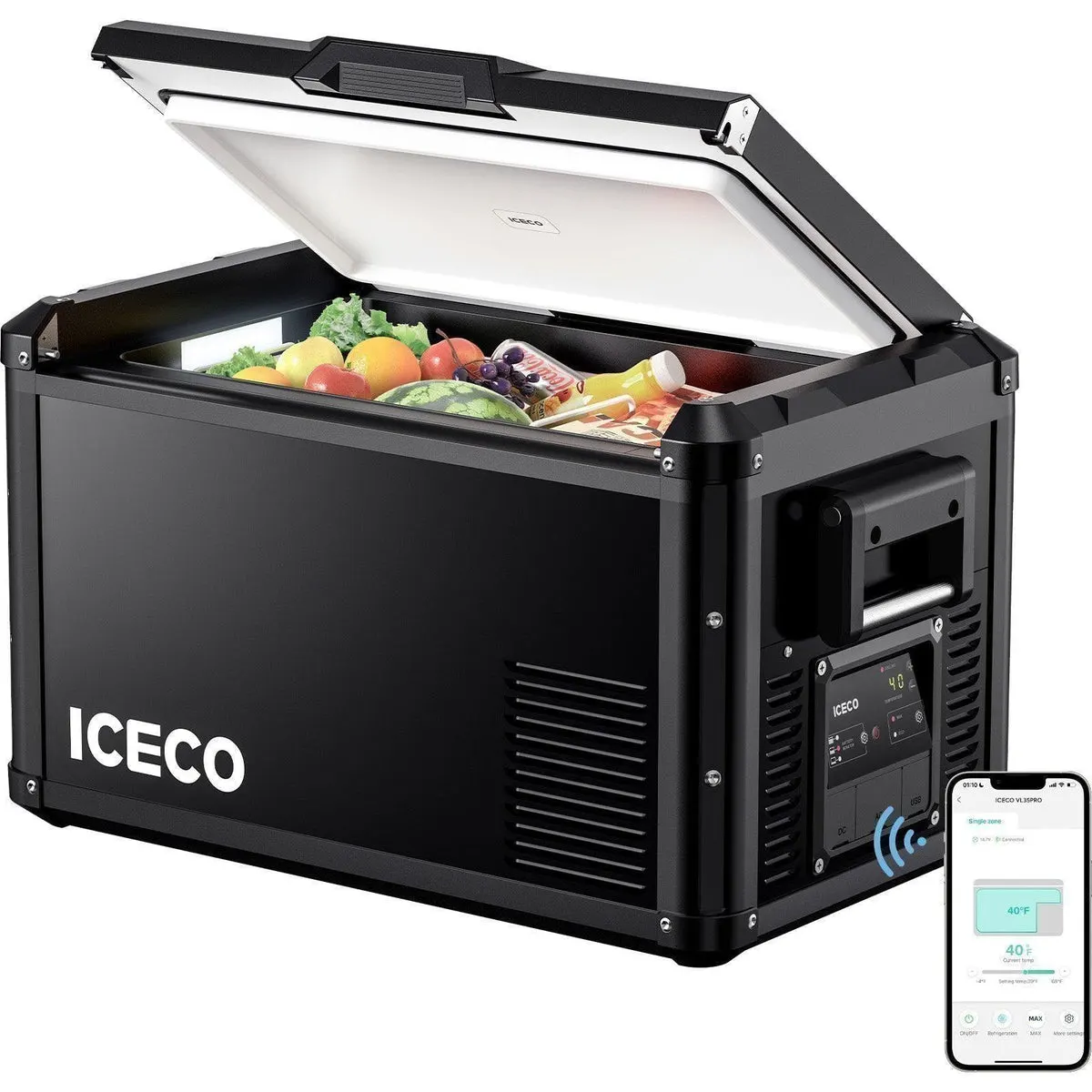
ICECO VL35 ProS
A 35-liter (37-quart) single-zone fridge-freezer in a metal cabinet, with a Secop compressor. ICECO lists a range of 0°F to 50°F.
Choose this if:
- You want a Secop compressor and a 5-year compressor warranty at a mid-range price.
- Your bay is low; it is 15.7 inches tall.
- You prefer physical buttons to an app.
Skip this if:
- You lift the fridge often. It weighs 48.7 lbs empty, the most of the single-zone fridges here.
- You want an app. ICECO's manual has no Bluetooth or app section.
Fit and operation. It measures 28.1 x 15.9 x 15.7 inches. ICECO asks for more than 5 cm on each side and 10 cm at the front air outlet. The lid opens from the left or the right, or lifts off when you press both latches. There are no wheels; a handle and corner guards ship in the box, and ICECO lists a tie-down kit and slide mount as accessories.
Power. ICECO doesn't publish a nameplate wattage. Its lab figure is 0.430 kWh per 24 hours (430 Wh, about 36 Ah at 12V), with no conditions stated. Its FTC EnergyGuide label gives the same figure as 157 kWh a year.
Strengths and limits. It's the lowest fridge here at 35 liters or more, the lid is flexible, and the compressor warranty is long. On the other side, it's heavy, the interior finish is utilitarian, the parts warranty is only 1 year, and ICECO's draw figure is higher than Dometic's rated figures.
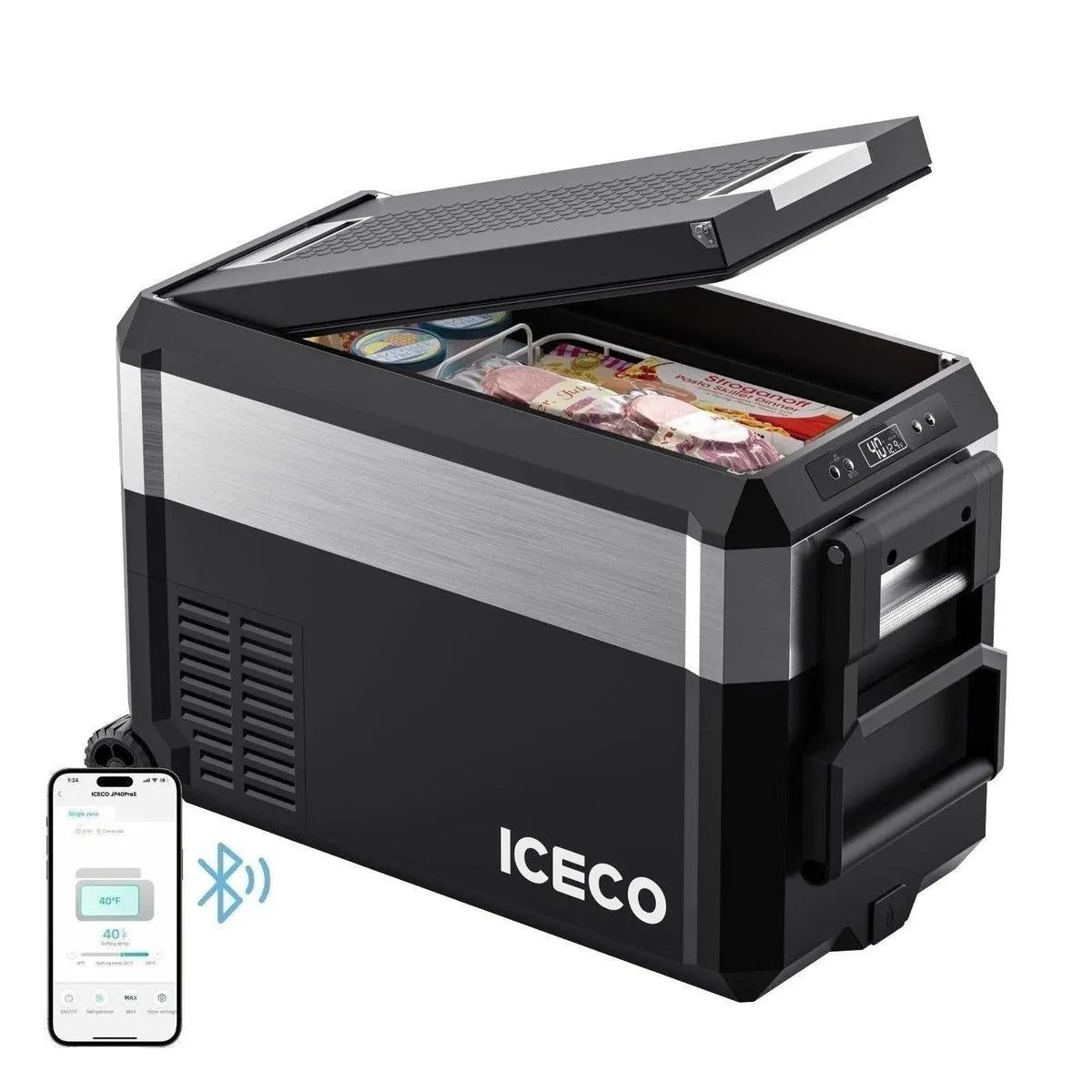
ICECO JP40 Pro
A wheeled single-zone fridge-freezer with a Secop (Danfoss) compressor and Bluetooth app control. ICECO's manual calls it the JP40 ProS and lists 37.0 liters (40.0 quarts), with a range of -4°F to 68°F.
Choose this if:
- You roll the fridge between the vehicle, the campsite and home.
- Your bay is narrow; it is 13.8 inches wide.
- You want app control as well as physical buttons.
Skip this if:
- Your bay is low; it is 18.0 inches tall.
- It sits on a fixed slide, where the wheels just add length.
Fit and operation. It measures 28.5 x 13.8 x 18.0 inches and weighs 39.1 lbs, per ICECO's manual. ICECO's clearance is the same as the VL35: more than 5 cm at the sides, 10 cm at the front outlet. The multi-directional lid opens from either side or lifts off. There are DC ports on both ends.
Power. ICECO doesn't publish a nameplate wattage; dealers quote about 50 W while running. ICECO's lab figure is 0.323 kWh per 24 hours (323 Wh, about 27 Ah at 12V), with no stated conditions.
Strengths and limits. It's the lowest lab figure among the ICECOs, with wheels, an app and a flexible lid. But the long wheeled chassis is long for 37 liters, and the molded shell is less rugged than ICECO's metal VL cabinets.
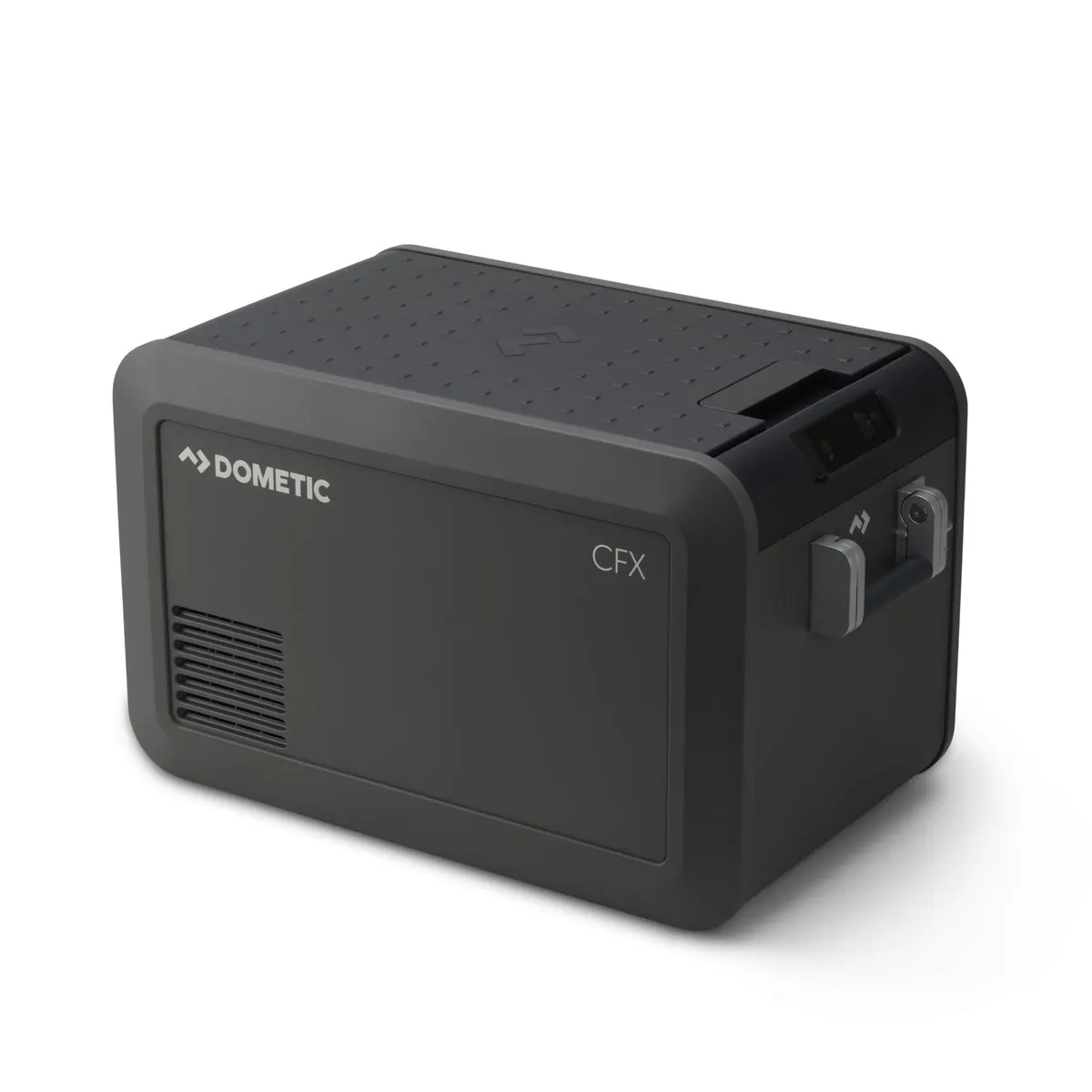
Dometic CFX5 35
Dometic's premium 36-liter single zone, the US model "Dometic CFX5 35L Electric Cooler". It has vacuum insulated panels with PU foam, a VMSO 3.5 variable-speed compressor, a color display, Bluetooth app control, an 18W QC 3.0 USB port and self-folding aluminum handles.
Choose this if:
- You want the best-documented energy rating here, at a stated 90°F ambient.
- You want a lighter box: 36.5 lbs.
- You want app control and a weatherproof display.
Skip this if:
- Value matters most; it costs considerably more than the VL35 ProS.
- You need more than 36 liters, or two zones.
Fit and operation. It measures 27.32 x 15.67 x 16.02 inches including handles. Dometic's US manual asks for at least 50 mm (about 2 inches) of ventilation on all sides and warns against closed compartments. The lid is removable; Dometic doesn't list the 35 among the models whose lid opening reverses. There are no wheels.
Power. The nameplate is 47 W, or 7.6 A at 12V maximum. Dometic's US page rates it at 1.11 Ah/h at 32°C ambient and 4°C inside, which is about 27 Ah or 320 Wh per day. Its European model, with a different refrigerant, is rated lower at 0.77 Ah/h. Plan on the US figure.
Strengths and limits. It has the best insulation spec, the lightest box at this size, and clear documentation. On the other side, it's premium-priced, and Dometic's US warranty term wasn't printed in the manual we checked, so confirm it before buying.
Dometic CFX2 45
Dometic's entry-line 45-liter single zone, the US model "Dometic CFX2 45L Electric Cooler". It has a basic display, Bluetooth app control, folding ABS handles, stainless steel hinges and a produce crisper.
Choose this if:
- You want the most single-zone space here.
- You have about 20 inches of clear height plus room for the lid.
- You want tall bottles to stand upright.
Skip this if:
- You want a published US energy figure; there isn't one.
- Value matters; the JP40 Pro costs considerably less.
Fit and operation. It measures 26.69 x 15.79 x 19.41 inches and weighs 36.6 lbs. Dometic's US manual asks for "sufficient ventilation on all four sides" without giving a distance; plan on Dometic's CFX5 figure of 50 mm. The lid is removable, but only the CFX2 57 has a reversible lid opening. There are no wheels.
Power. The US nameplate is 8.8 A at 12V maximum. The US page publishes no energy figure. Dometic Australia rates its version, which uses R600a refrigerant where the US model uses R1234yf, at 0.86 Ah/h at 32°C/4°C. That's about 21 Ah or 250 Wh per day; treat it as a guide only. The US manual lists 12V cut-outs of 10.1V (LOW), 11.2V (MED) and 11.8V (HIGH).
Strengths and limits. It's roomy, light for 45 liters, and has a simple app. But it's tall, premium-priced for a mid-range feature set, and has no US energy rating.
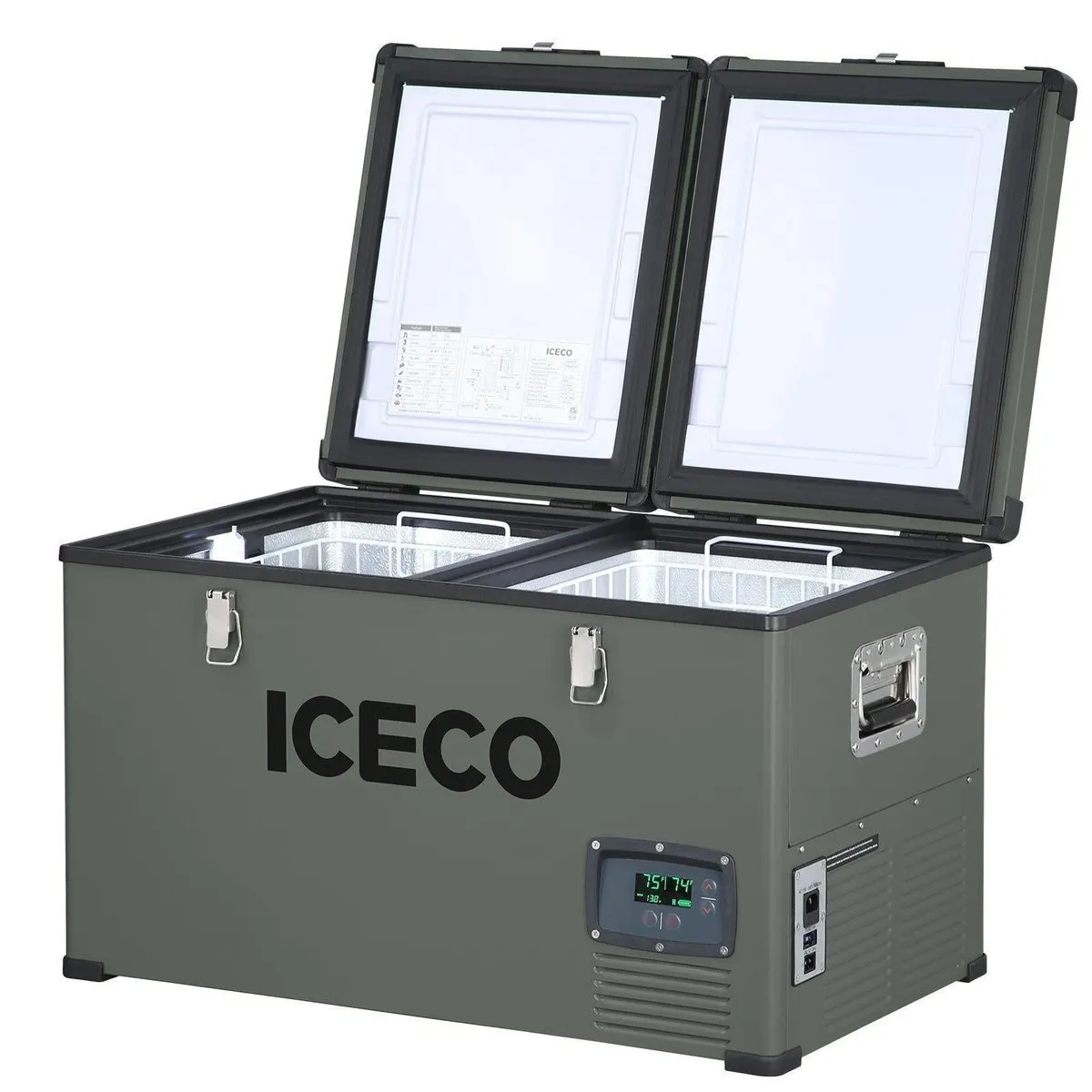
ICECO VL60 Dual Zone
A 60-liter (63-quart) dual-zone fridge-freezer in a steel cabinet, with one Secop compressor serving two lids and two setpoints. ICECO lists a range of 0°F to 50°F. Either zone can be switched off, and an insulated cover is included.
Choose this if:
- You want frozen and fresh food at the same time.
- You feed two or more people for a week or longer between shops.
- You have about 200 Ah of lithium and good charging.
Skip this if:
- Your van is small. With clearance it needs about 35 x 23.5 inches of floor space.
- You need deep-freeze temperatures below 0°F, or app control.
Fit and operation. It measures 31.2 x 19.5 x 18.9 inches and weighs 64 lbs, with no wheels. ICECO's clearance is the same as its other fridges: more than 5 cm at the sides, 10 cm at the front. Each zone has its own lid; ICECO's manual doesn't state which way they hinge.
Power. ICECO's manual catalog and its Amazon listing give 0.545 kWh per 24 hours (545 Wh, about 45 Ah at 12V). One table in the same manual shows 0.416, but that table appears to be misaligned. Camp Addict's 24-hour run, with one side at 0°F and one at 38°F, works out to roughly 50 Ah. That is our conversion of their result.
Strengths and limits. It's the only true dual zone here, with a rugged cabinet. But it's heavy, large and the most power-hungry pick. In Camp Addict's review, one zone drifted up to 8°F from its setpoint.
Full ICECO VL60 Dual Zone review
BougeRV 30 Quart (budget pick)
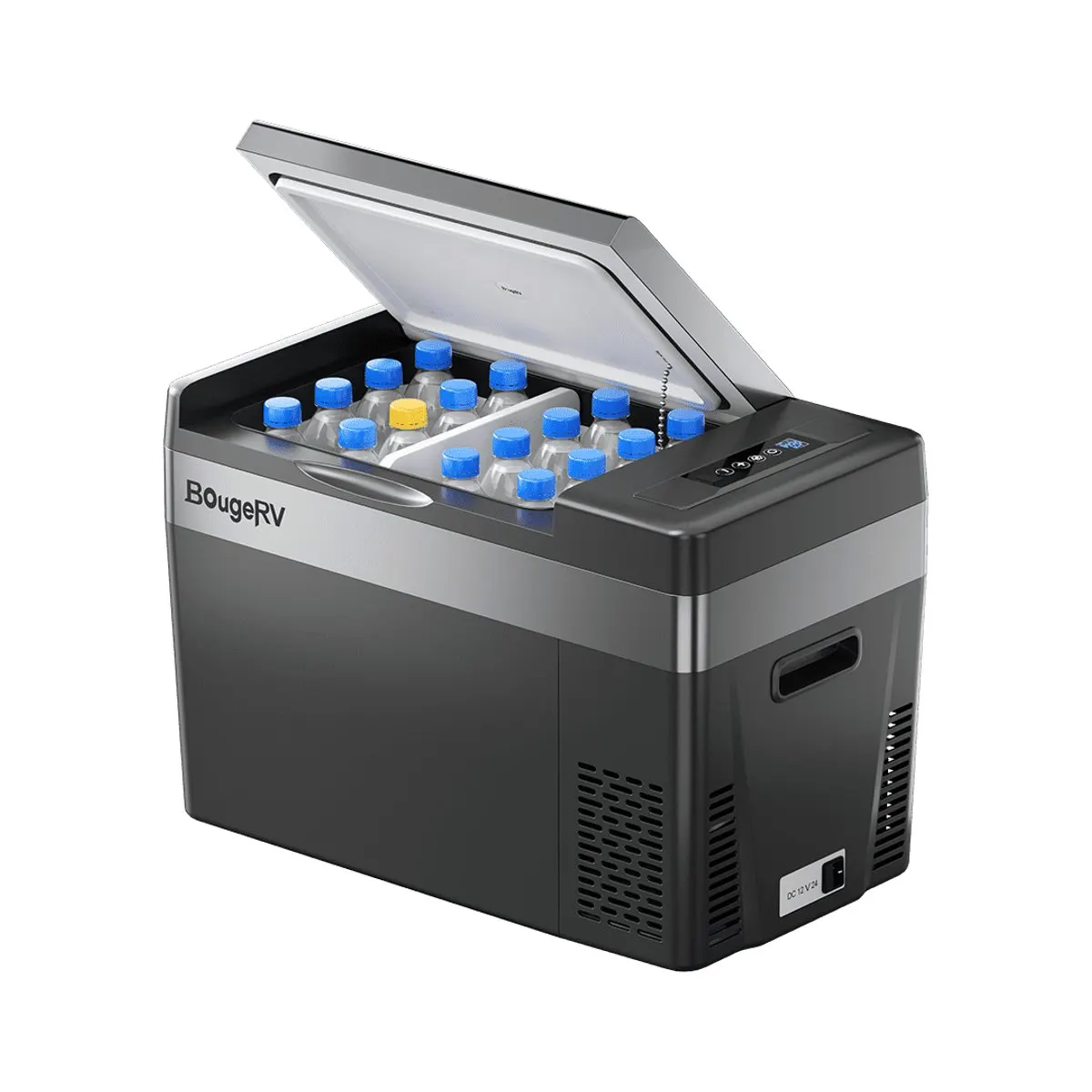
A 30-quart (28-liter) single-zone compressor fridge-freezer, sold on Amazon as "BougeRV 12v refrigerator 30 Quart, -8℉~50℉" (model CR28). It has no app and no interior light.
Choose this if:
- You camp on weekends, or this is a first build.
- You want a light (about 24 lbs), narrow (12.6-inch) box.
- You want a second fridge or a dedicated freezer.
Skip this if:
- It will run every day in a full-time build.
- You can't give it about 8 inches of space behind and 4 inches at the sides.
Fit and operation. It measures 22.7 x 12.6 x 15.5 inches. BougeRV's current manual asks for at least 7.9 inches (20 cm) behind and 3.9 inches (10 cm) at the sides. The lid hinges on the long rear edge. There are no wheels. The manual says to let it stand level for 12 hours before first use.
Power. It's rated at 45 W in ECO mode and 60 W in MAX mode while the compressor runs, with no published daily figure. Footprint Hero reported three days of continuous use on a 100 Ah LiFePO4 battery, which is about 27–33 Ah per day. Its 12V cut-outs are 8.5V (L), 10.1V (M) and 11.3V (H).
Strengths and limits. It's light, compact, and has well-documented clearances and cutoffs. But the compressor maker isn't disclosed and durability reports are mixed.
Alpicool C20 (smaller budget alternative)
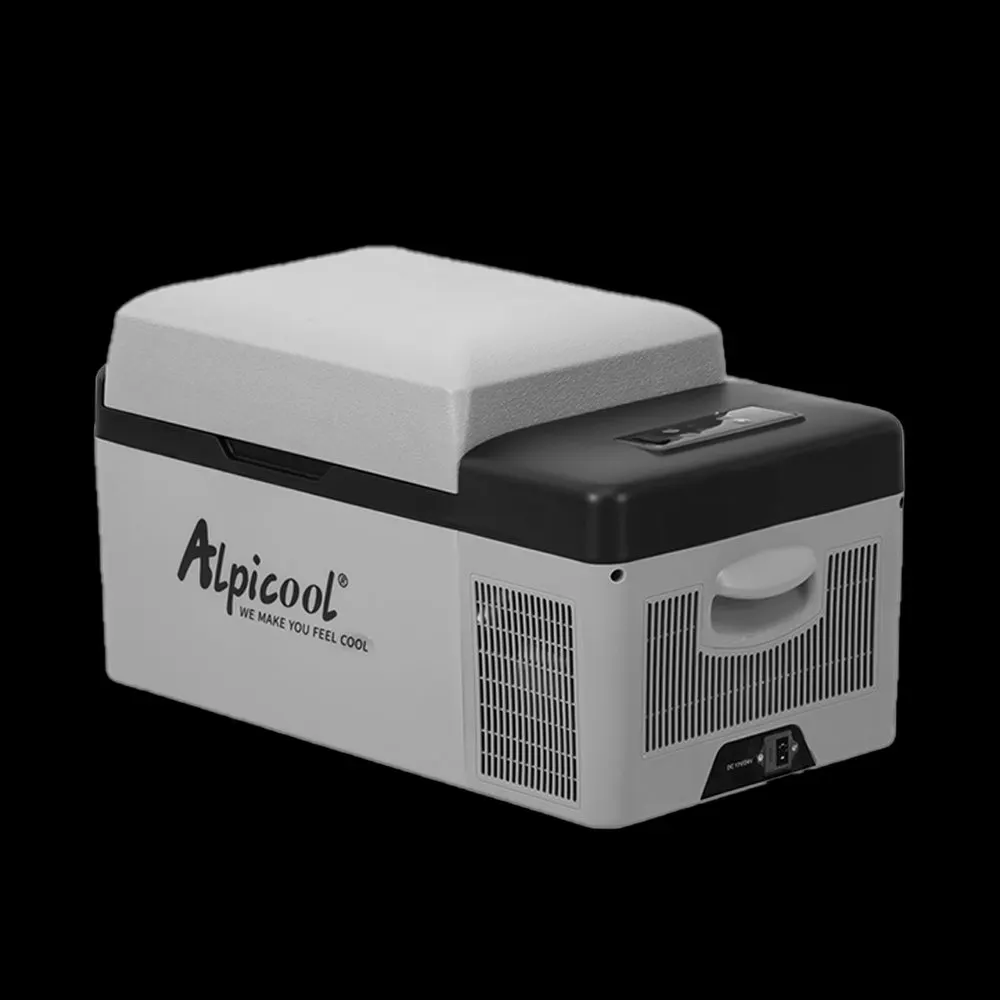
A roughly 20-liter (21-quart) single-zone compressor fridge-freezer, the lowest and lightest box here. Alpicool lists 19.8 lbs and a range of -4°F to 68°F.
Choose this if:
- You're solo, or it's a drinks fridge.
- It has to fit behind a seat or under a 13-inch bench.
- Your budget is tight.
Skip this if:
- You want published specs. Alpicool gives no rated wattage, no cutoff voltages and no clearance figure.
- You need more than about 20 liters.
Fit and operation. Alpicool's image gives 23.5 x 12.6 x 12.6 inches. With no clearance figure published, leave at least 2 inches per side. The lid hinges on the long rear edge. There are no wheels. Alpicool's store page mentions app control, but the listing doesn't clearly show it, so confirm before you buy.
Power. Alpicool claims "1kWH for 2-4 days", which is about 21–42 Ah per day at 12V, with no conditions. Our planning figure is about 30 Ah per day in mild-to-warm weather.
Strengths and limits. It's small, light and cheap. But it's the most thinly documented fridge here, and the warranty is 1 year on the whole unit (2 years on the compressor, per Alpicool's store FAQ).
Capacity vs external size vs clearance
Three numbers get mixed up on fridge listings.
- Capacity is the interior volume, in liters or quarts. Liters is the international standard. Quart figures on US listings can look like a size class up: ICECO's "JP40" is 40 quarts but 37 liters. Use liters to compare.
- External dimensions decide whether the box fits your bay. Wall thickness varies, so two fridges with the same capacity can have quite different outsides. The VL35 ProS and CFX5 35 are 35 and 36 liters, but the VL35 is about 0.8 inches longer and 12 lbs heavier.
- Installation clearance is the space the manufacturer asks you to leave so the condenser can shed heat. ICECO asks for more than 5 cm (about 2 inches) at the sides and 10 cm (about 4 inches) at the front air outlet. Dometic asks for 50 mm on all sides for the CFX5. BougeRV asks for 7.9 inches behind and 3.9 inches at the sides. A fridge that can't shed heat runs longer, uses more energy, and can throw overheating error codes. ICECO's E4/E5 fix is literally "give it more space".
For a recessed install, add the clearance to the outside dimensions, and add the height the lid needs to open. Then give hot air a path out of the cabinet: a low intake and a high exhaust vent is the usual approach. A small thermostatic fan helps in tight spaces. Keep the fridge out of direct sun. BougeRV warns that sun can deform its lid, and ICECO says its compressors can fail above 55°C (131°F) ambient, which a closed van in summer sun can approach. See how to cool a van without AC.
Lids, access and wheels
All seven fridges are top-opening chest designs. If you're weighing a chest fridge against an upright, see chest vs upright 12V fridges for a campervan. Less cold air spills out when you open a chest fridge than with an upright, but what you want is often under what you don't. Removable baskets help, and so does a fridge slide, which lets you reach in without bending under a counter. Lid details matter in a van:
- ICECO VL35 ProS and JP40 Pro: the lid opens from either long side or lifts off completely. That suits layouts where the fridge faces a sliding door or a galley, or sits under a low counter.
- Dometic CFX5 35 and CFX2 45: the lids are removable. Dometic's manuals cover reversing the lid opening only for other models (the CFX2 57, and the larger CFX5 models), so plan for the hinge side these ship with.
- ICECO VL60: two lids, one per zone, so opening the fridge side doesn't vent the freezer.
- BougeRV 30 Quart and Alpicool C20: single lids hinged on the rear long edge, opened from the front.
Only the JP40 Pro has wheels, plus a pull handle. Everything else is carried by its handles. That matters at the heavy end: the VL60 weighs 64 lbs empty and the VL35 48.7 lbs, before any food. Strap any fridge to solid anchor points with proper tie-downs or a mounting kit, not bungees, because a loaded fridge becomes a projectile in a hard stop. Make sure the lid latches positively for travel.
Power rating vs daily energy use
This is where most fridge comparisons go wrong.
The published power rating (nameplate watts or amps) is what the fridge draws while the compressor runs, or the maximum it can draw. Use it to size the fuse and wire. Examples:
- Dometic CFX5 35: 47 W, 7.6 A at 12V
- Dometic CFX2 45 (US): 8.8 A at 12V
- BougeRV: 45 W ECO, 60 W MAX
ICECO and Alpicool don't publish one. Do not multiply the nameplate figure by 24. A compressor fridge cycles off for much of the day.
Daily energy use is the 24-hour average. Here it is in Wh per day and in Ah per day at 12V nominal (Wh divided by 12), with who published or measured each figure:
| Fridge | Wh/day | Ah/day at 12V | Basis and conditions |
|---|---|---|---|
| Dometic CFX2 45 | ~250 | ~21 | Dometic AU rating, 90°F amb.; no US figure |
| Dometic CFX5 35 | ~320 | ~27 | Dometic US rating, 90°F amb., 39°F inside |
| ICECO JP40 Pro | ~323 | ~27 | ICECO lab figure, conditions not stated |
| BougeRV 30 Quart | ~325–400 | ~27–33 | Footprint Hero, 3 days on 100 Ah |
| Alpicool C20 | ~360 | ~30 | Our estimate; Alpicool claim 21–42 Ah |
| ICECO VL35 ProS | ~430 | ~36 | ICECO lab figure, conditions not stated |
| ICECO VL60 Dual Zone | ~545 | ~45 | ICECO catalog; Camp Addict run ~50 Ah |
How to read this table:
- Conditions differ. Dometic states 90°F ambient and 39°F inside. ICECO states nothing beyond "laboratory testing". BougeRV's figure is one reviewer's trip. Close numbers are effectively a tie.
- Expect more in summer. In a parked van in summer sun, or with frequent lid openings, real draw is commonly 20–50% above these figures, and more in freezer mode.
- Plan on the hot case. Size your bank for that, not for the lab number.
Duty cycle, low-voltage cutoff and battery sizing
Duty cycle is the share of the day the compressor runs. Daily energy is roughly running power × duty cycle × 24 hours. For example, a fridge drawing 50 W while running, with a 25% duty cycle, uses about 300 Wh (25 Ah) a day. Heat, a cramped bay, warm groceries, lid openings and a cold setpoint all raise the duty cycle. Thick insulation and good ventilation lower it. That's why the same fridge can use half again as much in July as in April.
Low-voltage cutoff. Every fridge here has three battery-protection levels. They switch the compressor off when the voltage at the fridge drops to a threshold, and back on at a higher restart voltage. Published 12V cut-out voltages:
- ICECO (all three models): 9.6V Low, 10.4V Medium, 11.1V High. Restarts at 10.9, 11.7 and 12.4V.
- Dometic CFX2: 10.1V LOW, 11.2V MED, 11.8V HIGH. Restarts at 11.4, 12.2 and 12.6V. The CFX5 manual shows its values only in a graphic.
- BougeRV, current manual: 8.5V L, 10.1V M, 11.3V H. Restarts at 9.6, 11.4 and 12.5V; the factory default is M.
- Alpicool: three levels, but no voltages published.
Use the highest level if the fridge can draw from a vehicle starting battery. On a LiFePO4 house bank, use the lowest level your battery maker is comfortable with. Lithium holds its voltage until it's nearly empty, so a high cutoff mostly causes nuisance shutoffs.
Battery sizing, worked example. Assume a 35–45 L single-zone fridge planned at 30 Ah/day (360 Wh) for summer. Add other loads:
| Load | Ah/day |
|---|---|
| LED lights | 4 |
| Water pump | 2 |
| Roof fan overnight | 15 |
| Phones and USB | 6 |
| Laptop work | 20 |
That's 47 Ah/day, so the total is about 77 Ah/day at 12V. These are example numbers; substitute your own.
- Battery: LiFePO4 is commonly used to about 80% of rated capacity. For two days with no charging, that's (77 × 2) / 0.8 ≈ 193 Ah, so round to a 200 Ah bank.
- Solar: assume 4 peak sun hours and about 75% real-world harvest for a flat roof array. That's (77 × 12) / (4 × 0.75) ≈ 308 W, so plan on 300–400 W.
A fridge at 45 Ah/day, like the VL60 with both zones on, pushes the same build toward 240 Ah and roughly 370 W.
For a fridge-only sense of scale: a 100 Ah LiFePO4 battery gives about 80–90 Ah usable. That's roughly 2.5–3 days of a fridge using 30 Ah/day with no charging, and closer to 2 days for the VL35 ProS at its 36 Ah rating.
Run your own fridge, climate and battery in the 12V fridge battery calculator, and your whole system in the Power Calculator. The van kitchen power budget guide and the battery bank guide cover the full kitchen math, and induction vs butane vs propane covers the cooking-fuel decision that pairs with it.
The fridge keeps running when the van is parked for a week. Either the bank and solar must cover that, or you empty the fridge and switch it off.
Wiring and installation safety
Don't run it from the cigarette-lighter socket long-term. Most fridges ship with a 12V accessory plug, but vehicle accessory circuits often use thin wire with significant voltage drop. The fridge then sees low voltage and trips its own cutoff while the battery is actually fine. Most "my fridge keeps turning off" complaints are wiring problems, not fridge problems.
Hard-wire to the house battery. Use wire sized for the fridge's maximum current and the length of the run, with a fuse at the source sized to protect that wire. Follow the fridge maker's instructions on cable size and fusing. ICECO, for example, lists a 15A internal fuse. If the fridge can ever draw from the starter battery, use a DC-DC charger or isolator.
Battery banks, DC-DC chargers, inverters and shore power should follow the manufacturers' installation instructions. Where codes, an insurer or your own confidence call for it, have a qualified RV electrical technician do or check the work.
Level and settle. Compressor fridges tolerate vehicle tilt while running, but they want to sit level for long-term use. BougeRV's manual says to keep it under 5° for long-term running, and to let a new fridge stand for 12 hours before first use.
Single zone vs dual zone
A dual-zone fridge has two separately controlled compartments, usually one fridge and one freezer. It's worth having if you want ice, frozen vegetables for off-grid weeks, or meat storage stretched past a week. The trade-offs:
- Size and weight. The VL60 is 60 liters, 64 lbs empty and needs about 35 x 23.5 inches of floor space with clearance.
- Energy. It is the highest-use fridge here, about 45 Ah/day planned.
- Cost. It is more expensive than single-zone fridges of similar quality.
If 60 liters isn't enough, the premium Dometic CFX5 75DZ splits 75 liters into a 45-liter and a 30-liter zone under two lids. Dometic rates it at 2.76 Ah per hour at 90°F ambient with a 39°F fridge zone and a 5°F freezer zone, about 62 Ah a day at 12.8 V, so it needs 200 Ah or more of lithium. Dometic CFX5 75DZ vs ICECO VL60 covers when the bigger box earns its premium.
Most van dwellers who shop every three to five days don't need a freezer. Whatever you choose, keep the fridge side at 40°F (4°C) or below and any freezer at 0°F (-18°C). Use a standalone fridge thermometer to check the display. Camp Addict found thermometer readings 5–6°F warmer than the VL60's display.
How big? Plan roughly 4–5 liters per person per day between grocery runs:
- Solo: 20–35 liters
- Two people: 35–50 liters
- Families, or anyone wanting real freezer space: 50 liters and up
For a fuller walk-through, see what size 12V fridge you need. Don't oversize "just in case". A bigger fridge has a bigger daily draw, and a full fridge is more efficient than an empty one, because the cold food acts as thermal mass. Our grocery shopping strategy guide covers how to shop for a smaller fridge.
Why compression, not ice or thermoelectric
- Ice coolers need fresh ice every one to two days in warm weather, and food sits in melt water. They're fine for a weekend; the Ford Transit Weekend Warrior setup shows a cooler-based kitchen for short trips. To weigh a rotomolded hard cooler against a 12V fridge of similar footprint, including ice space, power needs and weight, see YETI Tundra 45 vs ICECO VL35.
- Thermoelectric coolers can only cool a fixed amount below the surrounding air, can't freeze, and run more or less continuously.
- Absorption fridges need to sit close to level, struggle in high heat, and need a properly sealed and vented propane installation.
A 12V compression fridge cycles on and off, holds a set temperature regardless of ambient within its rated range, and can freeze. That's why it's the standard choice for van builds.
Head-to-head comparisons
- Dometic CFX5 35 vs Iceco VL35 ProS: whether the premium is worth it over the value pick
- Dometic CFX2 45 vs Iceco VL60 Dual Zone: a big-brand single zone vs a value dual zone
- Iceco VL35 ProS vs BougeRV 30Qt: budget vs value
- Iceco JP40 Pro vs Iceco VL35 ProS: wheels and an app vs a lower metal box
- Dometic CFX5 35 vs Dometic CFX2 45: Dometic's premium line vs its simpler, bigger one
- Iceco VL60 Dual Zone vs Iceco JP40 Pro: whether you need a real freezer
- Iceco JP40 Pro vs Dometic CFX2 45: is the Dometic name worth the premium?
- Dometic CFX5 75DZ vs Iceco VL60 Dual Zone: a premium 75-liter dual zone vs the mid-range 60-liter one
Browse every fridge we cover in the 12V fridges category. For real builds, see the Minimalist Sprinter setup, built around an Iceco VL35 ProS, and the Off-Grid Chef Promaster setup, which scales up to dual-zone refrigeration.
Overland specialists such as ARB, Engel and National Luna also build well-regarded fridges. We focus on fridges available on Amazon with straightforward US warranty support. Of the overland brands, we review the ARB Elements 63: a 60-liter single zone with a 304 stainless body and lid, a PIN lock and four threaded inserts for bolting it down. ARB's manual lists 90 kWh a year, about 19 Ah a day at 12.8 V, without stating test conditions. At 70 lbs empty, it suits exposed, permanent mounting, such as a truck bed or a rear slide, more than a cabinet inside the van.
Frequently asked questions
What is the best 12V fridge for van life?
For most full-time builds, the ICECO VL35 ProS offers the best balance: a Secop compressor with a 5-year compressor warranty, 35 liters, a low 15.7-inch cabinet and a published 0.430 kWh per 24 hours. The ICECO JP40 Pro adds wheels and an app. The Dometic CFX5 35 is the premium single zone. The ICECO VL60 Dual Zone is the pick for fridge and freezer at once, and the BougeRV 30 Quart is the budget entry point.
How much power does a 12V fridge use per day?
The 35–45 liter single-zone fridges here are published or measured at roughly 21–36 Ah per day at 12V, about 250–430 Wh. The dual-zone VL60 is about 45 Ah (545 Wh). Those figures come from different test conditions. Dometic tests at 90°F ambient, while ICECO doesn't state its conditions. Expect 20–50% more in a hot van, and more in freezer mode.
How much space does a 12V fridge need around it?
Check the manual. ICECO asks for more than 5 cm (about 2 inches) at the sides and 10 cm (about 4 inches) at the front air outlet. Dometic asks for 50 mm on all sides for the CFX5. BougeRV asks for 7.9 inches behind and 3.9 inches at the sides. Add the height the lid needs to open, and don't enclose the fridge without a vent path.
Is a compression fridge or a thermoelectric cooler better for a van?
Compression. A thermoelectric cooler can only cool a fixed amount below the surrounding air, can't freeze, and draws power more or less continuously. A compression fridge cycles on and off, holds a set temperature within its rated ambient range, and can freeze.
Is a 12V fridge better than a cooler with ice?
For anything longer than a weekend, yes. A compression fridge holds a steady temperature as long as it has power. An ice cooler needs fresh ice every one to two days in warm weather, its temperature drifts as the ice melts, and food ends up sitting in melt water.
What size 12V fridge do I need?
Plan roughly 4–5 liters per person per day between grocery runs. Solo travelers do well with 20–35 liters, two people with 35–50 liters, and families or anyone who wants real freezer space with 50 liters and up. Compare liters, not quarts: ICECO's JP40 Pro is 40 quarts but 37 liters.
How much battery do I need for a 12V fridge?
A 100 Ah LiFePO4 battery gives about 80–90 Ah usable, which is roughly 2.5–3 days of a fridge using 30 Ah per day with no charging, and about 2 days at the VL35 ProS's 36 Ah rating. For a full van kitchen, plan on 200 Ah of LiFePO4 as a sensible minimum, plus solar or alternator charging. Try your numbers in the fridge battery calculator.
Can I run a 12V fridge off my car's starter battery?
Only while driving, or for short periods with battery protection on its highest setting. A starter battery isn't designed for deep, continuous discharge, and a fridge running with the engine off can leave you unable to start. For anything beyond day trips, use a dedicated house battery charged by a DC-DC charger or isolator.
Do I need a dual-zone fridge?
Most van dwellers who shop every three to five days don't. A dual zone is worth it if you want ice, frozen vegetables or long-term meat storage. But it's larger, heavier and uses more power: about 45 Ah per day for the VL60, against roughly 21–36 Ah for the single-zone fridges here.
Why does my 12V fridge keep shutting off?
Usually because of voltage drop or heat, not a faulty fridge. An accessory socket or undersized wire lets the voltage at the fridge sag when the compressor starts, which trips the low-voltage cutoff. Hard-wire it to the house battery with properly sized wire and a fuse, set the cutoff to suit your battery chemistry, and give it the manufacturer's ventilation clearance.
Sources and verification
These are the manufacturer and third-party pages we opened for this guide. All were checked 2026-10-09.
- Dometic CFX5 35 US product page (SKU 97000050754), https://dometic.com/en/product/cfx5-35-electric-cooler-97000050754: checked 2026-10-09
- Dometic CFX5 US operating manual, https://media.dometic.com/externalassets/07-0703-070328-070328002_97000050754_152475.pdf: checked 2026-10-09
- Dometic CFX5 35 European product page (SKU 97000050760): checked 2026-10-09
- Dometic CFX2 45 US product page (SKU 97000040397), https://dometic.com/en/product/cfx2-45-electric-cooler-97000040397: checked 2026-10-09
- Dometic CFX2 US operating manual (CFX2 28/37/45/57), https://media.dometic.com/externalassets/07-0703-070327-070327003_97000040397_157175.pdf: checked 2026-10-09
- Dometic CFX2 45 Australian product page: checked 2026-10-09
- ICECO VL35/45/60 ProS manual V7.0 and VL35 ProS EnergyGuide label (both linked from https://icecofreezer.com/products/vl35pros-iceco-freezer): checked 2026-10-09
- ICECO JP30/40/50 ProS manual V5.0 and JP40 Pro product page, https://icecofreezer.com/products/jppro-40l-wheeled-portable-freezer-iceco: checked 2026-10-09
- ICECO VL60/65 manual V5.0 and VL60 product page, https://icecofreezer.com/products/vl60-dual-zone-portable-fridge-with-cover: checked 2026-10-09
- BougeRV 30 Quart product page, https://bougerv.com/products/12v-30-quart-28l-portable-refrigerator-black, and its current CR fridge user manual: checked 2026-10-09
- Alpicool C20 US store page, https://carfridge.alpicool.com/products/alpicool-c20, and its spec images: checked 2026-10-09. No C20 manual could be found.
- Camp Addict ICECO VL60D review, https://campaddict.com/12-volt-portable-refrigerator/iceco: checked 2026-10-09
- Footprint Hero BougeRV 30 Quart review, https://footprinthero.com/bougerv-30-quart-fridge-review: checked 2026-10-09
Products covered in this guide
Disclosure: As an Amazon Associate I earn from qualifying purchases. Links to Amazon on this page are affiliate links: if you buy through one, VanLifeKitchens.com may earn a commission at no extra cost to you. Read our affiliate disclosure.
More in Buying Guides
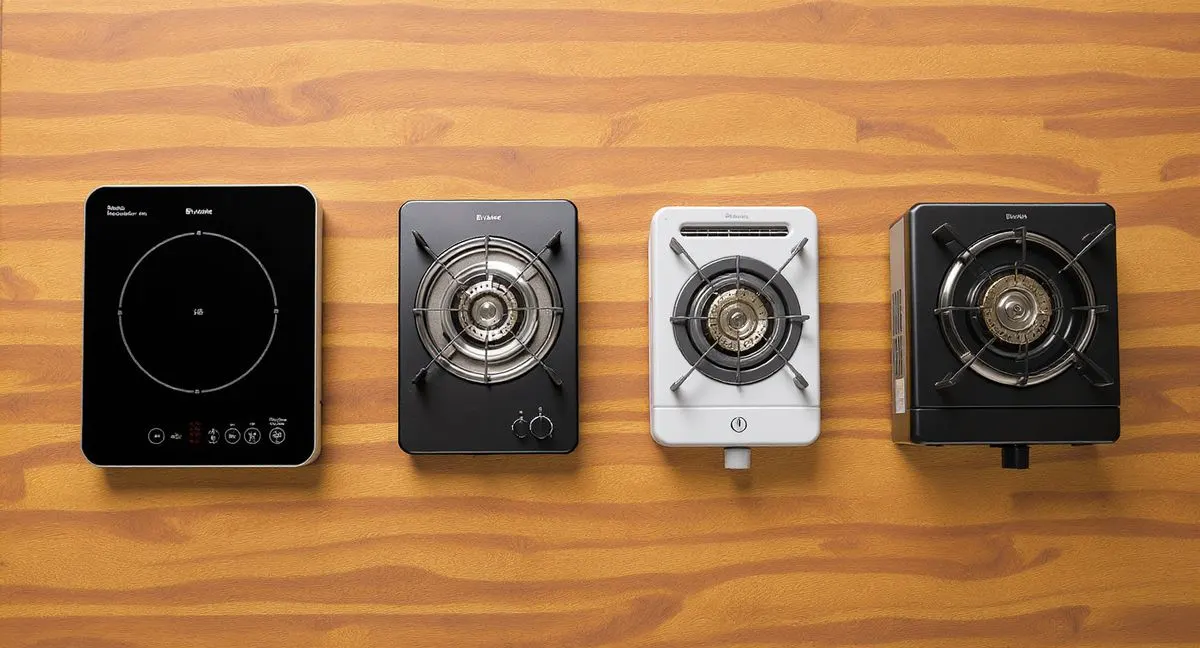
Best Cooktops for Van Life: Complete Guide
Induction, butane, or propane? Power math, indoor safety, cold-weather strategy, and the best van life cooktops at every price tier for 2026.
Best Van Life Cookware Sets: Complete Guide
The two-pan kit, the best nesting cookware sets by budget, induction compatibility, cast iron care without an oven, and how to stow pans so they never rattle.
Best Water Filters for Van Life: Complete Guide
What van water filters actually remove — bacteria, protozoa, viruses, metals, chemicals — plus certifications, a layered setup for full-timers, winterizing, and our 2026 picks.