Bonavita 1.0L Electric Gooseneck Kettle
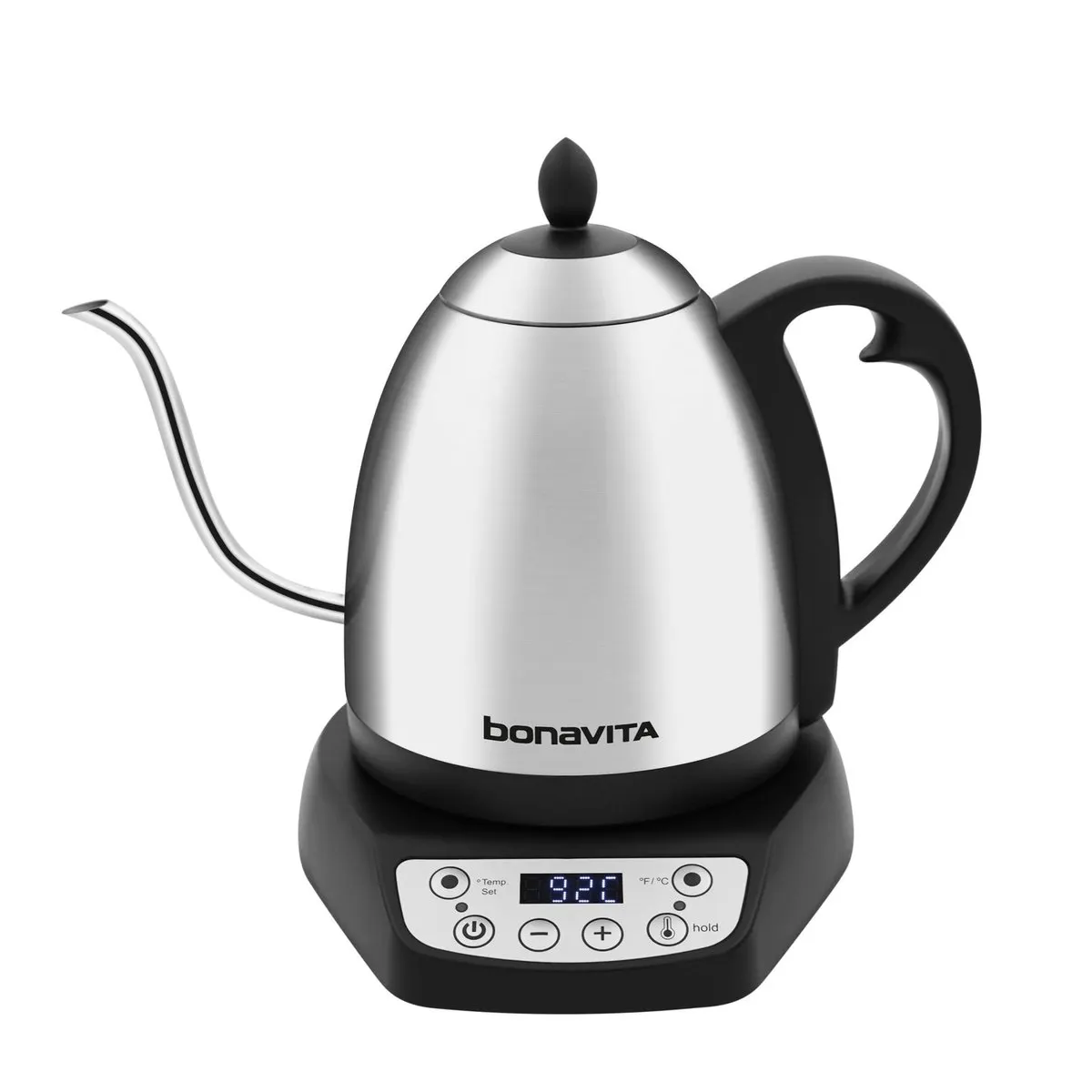
- Model
- BV382510V, 120 V US version (Amazon)
- Capacity
- 1.0 L
- Power
- 1200 W (Amazon listing)
- Voltage
- 120 V AC
- Temperature
- 140-208 F / 60-98 C in 1-degree steps, 6 presets (Amazon)
- Hold
- Up to 60 minutes (Amazon, manual)
- Materials
- 304 stainless steel, BPA-free plastics (Amazon)
- Warranty
- 1 year limited, US and Canada (manual)
Bonavita Gooseneck Kettle Review: The Pour-Over Kettle for Vans With Real Power
A gooseneck kettle is what makes pour-over coffee controllable. The long, narrow spout lets you pour a thin, steady stream exactly where you aim it. The Bonavita 1.0L Digital Variable Temperature Gooseneck adds a heating base with a temperature dial and a hold function. In a van, the important number is on the listing: 1200 watts at 120 V AC. That's fine on shore power or a properly sized inverter, and impossible on a small power station. This review is about when that trade makes sense.
What the Amazon link sells: the Bonavita 1L Digital Variable Temperature Gooseneck Electric Kettle, model BV382510V (ASIN B005YR0F40), the 120 V US version, rated at 1200 W on the listing.
Choose this if:
- You brew pour-over most mornings and want precise temperature and pour control.
- You have shore power, or a battery bank and pure sine wave inverter that can deliver at least 1200 W continuously.
- You'd rather not run a flame to make coffee.
Skip this if:
- Your inverter or power station is rated under about 1500 W continuous.
- Your battery bank is small (a few hundred watt-hours) or you rely on modest solar.
- You already cook on a stove you're happy with. A stovetop gooseneck pours just as well.
Published specs
| Spec | Figure | Source |
|---|---|---|
| Capacity | 1.0 L | Amazon, manual |
| Power (US) | 1200 W, 120 V AC | Amazon |
| Temperature | 140–208°F (60–98°C), 1° steps | Amazon |
| Hold | Up to 60 minutes | Amazon, manual |
| Warranty | 1 year limited (US and Canada) | Manual |
The Amazon listing describes 304 stainless steel with BPA-free plastics, six preset temperatures, an LED panel and a boil in about 5 minutes at 1200 W. The user manual checked for this review is the international edition (220–240 V models BV382510VCEV, BV382510VCEB and BV382510V AUS), which is rated at 1000 W. The US 120 V version linked here is rated at 1200 W on its listing, so use 1200 W when sizing an inverter.
What the manual says about where to use it. Bonavita's manual says the kettle is "for household use only" and "Do not use outdoors or in damp areas". It also warns against running another high-wattage appliance on the same circuit. In a van, that means using it inside on a dry, level counter, never on a wet outdoor table, and not running it at the same time as an induction hob or a microwave on the same inverter.
Why the gooseneck matters for pour-over
A pour-over cone like the Hario V60 02 has one large hole and little built-in flow restriction, so the speed and placement of your pour control the brew. A standard kettle spout is wide and close to the handle, so it gushes. A gooseneck's long, narrow, S-curved spout gives you a thin, aimable stream for the bloom and a slightly heavier stream for the main pours. If you brew pour-over, a gooseneck is the piece of gear that makes the method repeatable.
How it works
The kettle sits on a separate powered base. Set a temperature with the preset button or the plus and minus buttons, and the display shows the current water temperature as it heats. According to the manual:
- After it reaches the set temperature, the heater switches off, and the display keeps showing the water temperature for up to an hour if the kettle stays on the base.
- With hold selected, the heater cycles to keep the set temperature for up to one hour. When you lift the kettle to pour and put it back, you have to press hold again.
- If you lift the kettle off the base mid-cycle, heating stops. When you put it back without hold, the display shows the temperature for 7 minutes and then the kettle powers off.
- A count-up timer of up to 7 minutes helps you time a pour-over.
- The manual includes a high-altitude chart, because water boils at lower temperatures at elevation. That's relevant if you camp in the mountains.
Power: 1200 W is a lot
A heating element draws close to its rated power the whole time it heats. That's a continuous load, not a brief surge, so the inverter's continuous rating is what matters. A 300 W or 500 W portable power station can't run it, and a 1000 W inverter will overload. Plan on a pure sine wave inverter rated comfortably above 1200 W continuous (1500 W or more is common), or shore power.
On the 12 V side, 1200 W of output from a 90%-efficient inverter draws about 1330 W from the battery, or roughly 105 A at 12.8 V. The battery's BMS discharge rating, the fuse and the cabling all have to be sized for that current. An inverter of this size is a permanent installation. Follow the inverter manufacturer's installation instructions, and use a qualified RV or marine electrician where codes or your insurer require one.
Energy per use, an estimate with stated assumptions. Heating 1.0 L from about 15°C (59°F) to boiling needs about 99 Wh of heat. Assume around 85% of the element's energy ends up in the water and a 90%-efficient inverter. That comes to roughly 125–130 Wh from the battery per full kettle, or about 10 Ah at 12.8 V. A 500 ml half-fill for one pour-over is roughly 60–65 Wh, or about 5 Ah. Several things push these figures up: colder starting water, heating to a full boil rather than about 200°F, and leaving the hold function on.
A 100 Ah, 12.8 V lithium battery stores about 1280 Wh nominal, so a daily half-fill uses roughly 5% of it. The kettle shares that budget with your fridge, lights, fans and phones. The van kitchen power budget guide and the power calculator help you work out what your system can handle.
Heat-up time. The listing says it reaches a boil in about 5 minutes at 1200 W. That's consistent with the physics of heating a full litre from cool water. A half-fill heated to a pour-over temperature takes noticeably less.
Electric vs stovetop gooseneck
A stovetop gooseneck such as the Hario V60 Buono pours just as well, costs less and draws nothing from your battery. Its listing names induction, gas and electric hobs (see that review). It follows the stove's rules on where it can be used. With a butane or canister stove labelled outdoor-only, that means outside.
Reasons to choose the Bonavita anyway:
- Exact temperature. Presets and 1-degree steps replace a thermometer, which makes lighter-roast recipes repeatable.
- No combustion. An electric kettle burns no fuel, so it produces no carbon monoxide or other combustion gases. That's why it can be used inside the van where an outdoor-only stove can't. You still need general ventilation for steam, which adds to condensation on cold mornings.
- Hands-free. Set it and grind your beans while it heats, then let hold keep the water ready.
If your electrical system is built for 1200 W loads, the Bonavita is a real convenience. If it isn't, the stovetop gooseneck is the better answer.
Living with it in a van
- Storage and travel. The kettle body is stainless steel, and the base has a recess underneath for the cord. Secure both while driving. Bonavita's manual says to check the kettle for cracks, damage or leaks after any impact before using it.
- Keep the base dry. The manual says to dry the bottom of the kettle before placing it on the base and never to immerse the base. In a van, water sloshing onto the base contact while driving is the risk to avoid. Empty the kettle before you move.
- Descaling. Bonavita recommends descaling when you can see mineral build-up. It suggests a descaler rather than vinegar, which it says may not descale effectively and can leave an odour. If you fill from campground taps with hard water, check it more often.
- Fill limit. Don't fill above the max line. The manual warns that an overfilled kettle can eject hot water.
Value
The Bonavita is priced in the middle of the electric gooseneck market. It costs considerably less than a Fellow Stagg EKG and more than basic no-name goosenecks. You can check the current price with the "Check price on Amazon" button. In a well-powered van used for daily pour-over, it's fair value. For occasional pour-over, a stovetop gooseneck is the better buy.
Limitations
- It needs 120 V AC at 1200 W, so shore power or a large inverter. It won't run on small power stations or directly on 12 V.
- The manual says household use only, not outdoors and not in damp areas.
- It's a pour-over kettle. The narrow spout makes it slow for filling a French press or a pot.
- The hold function keeps drawing power intermittently for up to an hour. Switch it off on battery.
- The 1-year limited warranty, valid in the US and Canada per the manual, requires proof of purchase.
Final verdict
The Bonavita 1.0L Digital Variable Temperature Gooseneck is the right tool for the right van. If you have shore power, or a lithium bank with a pure sine wave inverter rated comfortably above 1200 W continuous, and you brew pour-over every morning, it gives you precise temperature and a controlled pour without a flame. If your electrical system isn't built for that load, buy a stovetop gooseneck and put the money toward a better grinder, which usually improves pour-over more than a kettle upgrade does. The best coffee setup for van life guide puts the pieces together.
FAQ
Can I run the Bonavita on a Jackery 500 or similar power station? No. Power stations in that class typically cap their AC output at around 500 W. The Bonavita is rated at 1200 W and draws close to that continuously while heating. The station's overload protection will shut its output off.
Does the variable temperature control matter for coffee? It's convenient rather than essential. You can get close by boiling water and waiting briefly before pouring, ideally with a thermometer. The presets and 1-degree steps make results more repeatable. On battery, set the temperature you need rather than a full boil, and turn hold off once you've poured.
Can I use it outside at camp? Bonavita's manual says not to use it outdoors or in damp areas, and describes it as for household use only. Use it inside on a dry, level surface.
Will it work on 12V directly? No. It's a 120 V AC appliance. You need an inverter rated for its 1200 W continuous load, shore power or a generator.
How does the 1-year warranty work on the road? The manual describes a 1-year limited warranty from the date of original purchase, valid in the US and Canada, for the original purchaser. Proof of purchase is required. Keep a copy of your Amazon order. If you're full-timing, a mail forwarding service is the practical way to receive a replacement.
Sources and verification
- https://www.essentialutensil.au/cdn/shop/files/Bonavita-1-0L-Variable-Temp-Gooseneck-Kettle-User-Manual.pdf: Bonavita 1.0L Digital Variable Temperature Gooseneck user manual, international 220–240 V edition (1000 W; models BV382510VCEV, VCEB, AUS). Covers household use only, no outdoor or damp-area use, no other high-wattage appliance on the same circuit, the hold function (up to one hour), 7-minute auto-off, count-up timer, high-altitude chart, descaling advice, the max fill warning, the impact check, and the 1-year limited warranty for the US and Canada (checked 2026-10-12)
- Amazon listing ASIN B005YR0F40: model BV382510V, 1200 W, 1.0 L, 140–208°F range in 1-degree steps, six presets, 60-minute hold, 304 stainless steel and BPA-free plastics, boil in about 5 minutes (checked 2026-10-12)
Compare with similar products
See how this stacks up against the other coffee gear we've reviewed.
Related Reviews
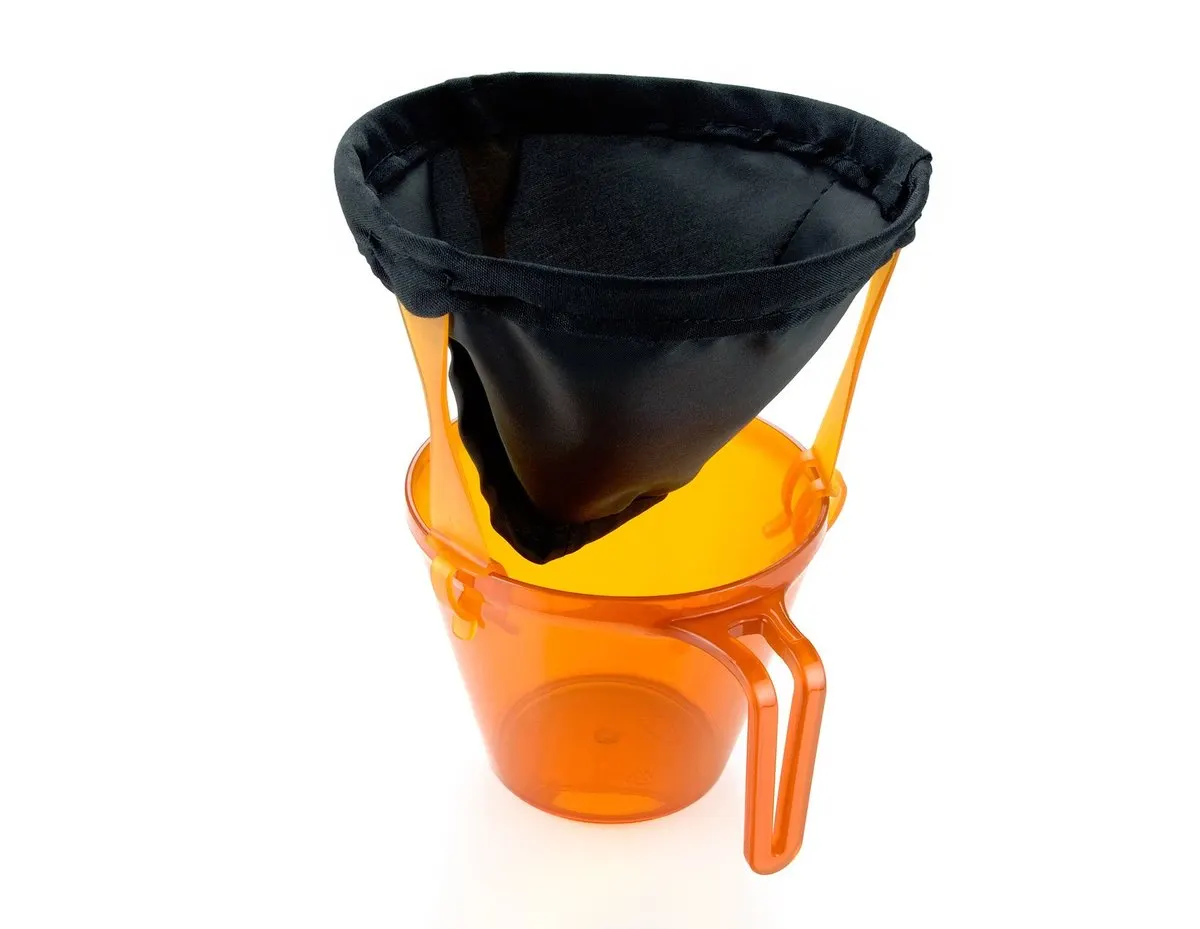
For: Backup single-cup pour-over
GSI Outdoors Ultralight Java Drip Pour-Over Filter
An inexpensive backup pour-over that fits in a glove box. Folds flat, weighs almost nothing, and clips onto a cup or thermos for a single-serving pour-over without paper filters. Useful when the kettle and dripper are packed away.

For: Espresso and filter, one grinder
1Zpresso K-Ultra Manual Coffee Grinder (Iron Gray, with Carrying Case)
A full-size, all-round hand grinder with an external dial of 100 clicks per rotation at 20 microns per click, a heptagonal steel conical burr and a 35-40 g magnetic catch cup. It grinds fine enough for a Picopresso or Flair and coarse enough for French press, and holds two filter doses at once. It is premium-priced, about twice the weight of the Q Air, and too wide to nest inside an AeroPress.

For: Lever espresso with pressure gauge
Flair 2GO Portable Collapsible Lever Espresso Maker (Grounds Model)
A manual lever espresso maker that folds into a 9.5 x 5.25 x 4 in case. Flair rates it for 6-9 bar with a built-in pressure gauge, a 12-18 g dose and a 45 ml yield, and its thin-walled cylinder needs no preheating. It needs boiling water from a kettle and an espresso-capable burr grinder, and at 3.7 lb in its case it is much bulkier than a Picopresso.