Lodge Chainmail Cast Iron Scrubber
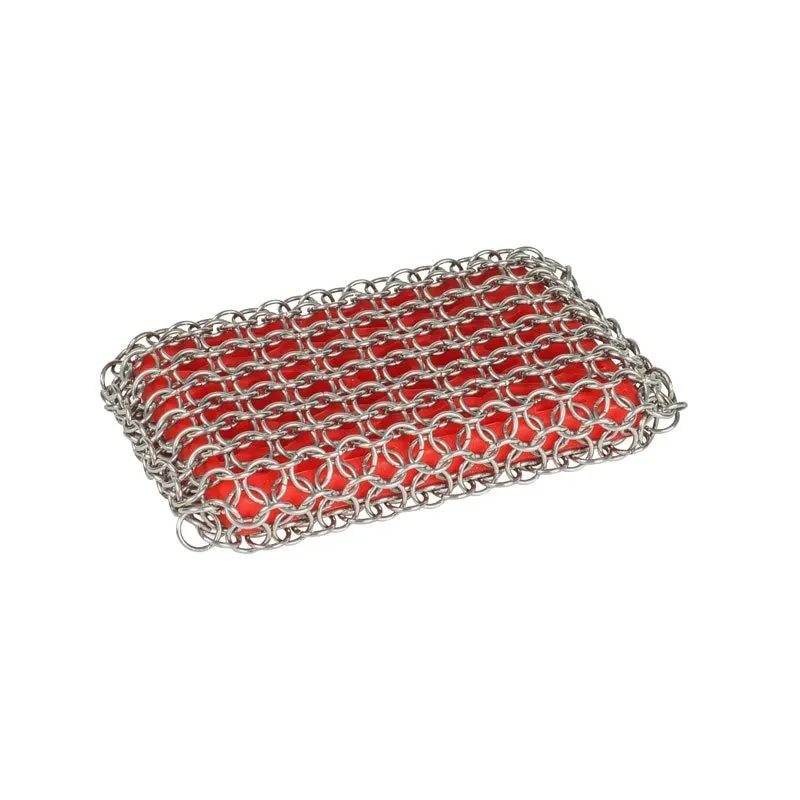
- Model
- ACM10R41
- Material
- 304 stainless chainmail with silicone core (Lodge)
- Dimensions
- 4.33 x 3.0 x 0.75 in (Lodge)
- Weight
- 0.34 lb
- Dishwasher Safe
- Yes (Lodge)
- Origin
- Made in China (Lodge)
Overview — Who is this for?
The Lodge Chainmail Cast Iron Scrubber is an inexpensive stainless steel mesh pad that does exactly one thing: it cleans stuck-on food from cast iron and carbon steel without destroying the seasoning you have spent months building. That single-purpose pitch sounds underwhelming until you have stood at a campsite spigot scrubbing carbonized egg off your skillet with a plastic scraper that is not working, or spent ten minutes grinding coarse salt into a pan surface with a paper towel while your hands cramp. The chainmail scrubber replaces most of that with a short scrub and a splash of hot water.
It is the natural companion to a Lodge 10.25-inch cast iron skillet or the Lodge 5-quart Dutch oven, and it is budget-priced and small.
What the Amazon link sells: Lodge's red Chainmail Scrubbing Pad (Lodge SKU ACM10R41). Lodge's product page describes it as 304 stainless steel chainmail around a silicone core and gives 4.33 x 3.0 x 0.75 in and 0.34 lb (about 5.5 oz). It says the pad is dishwasher safe, "Cleans Lodge Cast Iron and Carbon Steel Cookware," and is made in China. It has no sponge to go sour and no coating to wear off, so the main thing that ends its life is physical damage to the rings.
This review covers why it works, how Lodge says to use it, what it replaces, and the limits that keep it from being a general-purpose scrubber.
Choose this if:
- You cook on bare cast iron or carbon steel, such as the Lodge skillet or Dutch oven.
- You want to clean stuck food with very little water and without soaking.
- You want a cleaning tool that doesn't go sour in a humid van like a sponge does.
Skip this if:
- Your cookware is all nonstick, ceramic, enameled or polished stainless; chainmail can scratch those surfaces.
- You mostly need to cut grease; it removes stuck solids, not oil films.
Compatibility at a glance: for seasoned cast iron and carbon steel used on any heat source, induction included. Keep it off the glass top of an induction or ceramic cooktop and off nonstick, ceramic and enamel coatings.
The core problem it solves
Cast iron seasoning is polymerized oil — a thin, hard, slick layer that builds up over time as you cook with fat at high temperatures. It is what makes cast iron nonstick without a synthetic coating, and it is what makes cast iron better the more you use it. Protecting that seasoning is the central maintenance obligation of owning cast iron.
The problem is that cast iron also produces the most aggressive stuck-on food of any cookware material. When you sear a steak at 500 degrees on cast iron, the fond — the browned bits of protein and fat that caramelize on the surface — bonds to the pan with real tenacity. When you cook eggs and the butter scorches in one spot, you get a ring of carbonized residue that laughs at a sponge. When you bake cornbread and a thin ring of batter overflows and bakes onto the rim, it fuses to the iron.
You need something abrasive enough to remove that stuck-on food but gentle enough to leave the seasoning intact. This is harder than it sounds, because the line between "stuck food" and "seasoning" is essentially a matter of degree — both are carbonized organic material bonded to iron. Scrub too hard with the wrong tool, and you strip seasoning along with the food. Scrub too gently, and you leave residue that builds up into uneven, bumpy seasoning over time.
The Lodge chainmail scrubber is built for that balance. The interlocking stainless steel rings are hard enough to dislodge burnt food but smooth enough to glide over well-bonded seasoning without scratching it. The mesh conforms to the contours of the pan — including the curved sidewalls and the area around the handle base that scrapers cannot reach — and the open weave lets food particles fall through rather than getting trapped against the surface.
How to use it — the full cast iron cleaning workflow
The chainmail scrubber is one step in a workflow, not a standalone solution. Lodge's own cleaning guidance is short: wash with warm, soapy water and a brush or scrubbing pad, dry completely, then add a thin layer of oil. For stuck food, Lodge's cleaning-tools page says the chainmail scrubber works "combined with warm, soapy water," and suggests simmering water in the skillet for 3 to 5 minutes first if the mess is really burnt on. Here is that process adapted for a van, where water is limited:
Step 1: While the pan is still warm (not screaming hot, but warm enough that water sizzles slightly), run a small amount of hot water into the pan. In a van, this might be a cup of water from your kettle or a quick pass under your galley faucet. You do not need much — just enough to loosen the surface.
Step 2: Scrub with the chainmail. Hold the scrubber flat against the cooking surface and work in circular motions, with a drop of dish soap if you like (Lodge says soap is fine). For stubborn spots, such as carbon from a hard sear, do what Lodge suggests: simmer a little water in the pan for 3 to 5 minutes, then scrub. In a van, that costs some stove fuel but much less water than soaking. You should feel the resistance drop as the stuck bits come free.
Step 3: Rinse. Pour out the dirty water and give the pan a quick rinse. In a van where water is precious, this can be as little as a quarter-cup of clean water swirled around the pan.
Step 4: Dry immediately and completely. This is the step you can't skip. Lodge says to dry completely with a paper towel or lint-free cloth, and warns that "soaking cast iron in water is a recipe for rust." In a van, humidity from cooking, breathing and condensation makes rust more likely. A minute on a low burner after towel-drying drives off what the towel missed. Don't leave it unattended.
Step 5: Oil. Lodge says to add "a thin layer of oil, using a paper towel to distribute it over the entire surface." A neutral cooking oil works. Thin means thin: you should barely see a sheen. Too much oil goes sticky. Wipe off the excess until the paper towel comes away nearly clean.
That is the whole process. From dirty pan to oiled and stored, it takes a couple of minutes. The chainmail scrubber handles step two, which is the step where most people either damage their seasoning (by using steel wool or aggressive abrasives) or fail to clean properly (by using a soft sponge that cannot dislodge carbonized food).
Why it beats the alternatives
Vs plastic scrapers: Lodge's cleaning guidance mentions pan scrapers and nylon brushes for stuck food. A plastic scraper works for light cleaning — a pan where you fried eggs in butter and there is minimal residue. It does not work for serious stuck food. Hard-seared protein fond, burned sugar, carbonized cornbread edges — the plastic scraper just slides over these without effect. You end up pressing harder and harder, which is both exhausting and ineffective. The chainmail scrubber handles the same residue in seconds with minimal pressure.
Vs the salt scrub method: The classic cast iron cleaning hack is to pour coarse kosher salt into the warm pan and scrub with a paper towel or cloth, using the salt as a mild abrasive. This works, and it is a long-standing method. But it has three problems in a van. First, it uses a lot of salt, because you need a thick layer each time. Second, it generates a messy salt-grease paste that is annoying to rinse out, especially with limited water. Third, the paper towel tears constantly because the salt crystals shred it, which means you are using multiple towels per cleaning and generating paper waste in a van where trash capacity is limited. The chainmail scrubber eliminates all three problems.
Vs steel wool or stainless steel scour pads: Lodge's guidance is that steel wool or a metal scrubber "is not recommended for daily cleanup," but is fine for removing rust. Steel wool cuts into seasoning and can leave bare patches that rust quickly. Chainmail rings are smooth and ride over well-bonded seasoning, which is why Lodge says the pad removes stubborn food "without removing seasoning."
Vs regular sponges: A standard kitchen sponge does not have the abrasive power to clean cast iron after anything more than a very light cook. You end up soaking the pan, which Lodge calls "a recipe for rust." The chainmail scrubber means you rarely need to soak. Quick scrub, rinse, dry, oil. Done.
Van-specific benefits
In a house kitchen, the chainmail scrubber is a nice convenience. In a van kitchen, it solves specific constraints.
Minimal water usage. Many van lifers carry a few jugs or a small tank of fresh water and guard every drop. Our estimate is that you can clean a skillet with the chainmail scrubber using roughly half a cup of water: a splash to loosen, a splash to rinse. Compare that to the salt method (which usually needs an extra rinse to get the salt out) or soaking (which uses a full pan of water and is hard on seasoning). As a rough estimate, assuming one skillet cleanup a day and about half a cup saved each time versus the salt method, that is a gallon or so a month. That matters when your supply is a couple of jugs.
No consumables. The salt scrub method consumes salt and paper towels. Plastic scrapers eventually crack and need replacing. Sponges get sour in a van's humid galley within days and need replacing weekly. The chainmail scrubber is stainless steel with nothing that gets used up, so it's normally a one-off purchase. In a van where resupply runs are infrequent and storage for extra consumables is limited, a tool that never runs out is valuable.
Fast cleanup. When you are cooking dinner in a pullout at sunset and want to eat while the light is still good, ten minutes of cleanup is a real cost. Chainmail removes stuck food with fewer passes than a scraper, and there's no salt paste to rinse out, so cleanup is usually quicker.
Works without a water heater. Lodge's instructions assume warm water, and warm water loosens food faster. Many vans don't have hot water on tap, though. With cold water the chainmail still does the mechanical work, just more slowly. Warming a cup in the kettle you're already using is the easy fix.
Comparison to Lodge's own alternatives
Lodge makes several cast iron cleaning products, and it is worth clarifying which ones are useful. Check current Lodge listings for exact kit contents, since bundles change.
Lodge Chainmail Scrubbing Pad: This one. The most useful of the three for stuck-on food.
Lodge plastic pan scrapers: Useful as a supplement for deglazing fond that you want to keep in the pan (it pushes food around without removing it). Not powerful enough for stuck residue. Worth keeping one in the galley, but expect to reach for it occasionally versus the chainmail daily.
Lodge care kits: Lodge sells bundles that pair scrapers or brushes with its seasoning spray. Any neutral, high-smoke-point cooking oil does the same job as a branded seasoning product, so there is little reason to buy a kit just for the oil.
Lodge silicone hot handle holders: Not a cleaning product, though they sometimes come in Lodge bundles. They protect your hand from the hot handle, which is worth having, but they have nothing to do with cleaning.
Build quality and longevity
The Lodge pad is made of 304 stainless steel chainmail wrapped around an ergonomic silicone core, which Lodge says makes it easier to grip. Lodge lists it at 4.33 x 3.0 x 0.75 in and 0.34 lb. The silicone core also means it holds a flat shape against the pan rather than bunching up. Check the rings now and then. If a ring opens or the mesh starts to separate, replace the pad, because a loose ring can scratch or snag.
304 stainless resists rust. That is a meaningful advantage in a van where humidity is constant. A regular steel wool pad left in a damp galley drawer can rust within days. The chainmail pad stays usable as long as you let it dry between uses.
To clean the scrubber itself, rinse it and let it dry, or run it through a dishwasher when you have access to one (Lodge says it is dishwasher safe). Food particles mostly fall through the open mesh, so it holds far less residue than a sponge, though the silicone core should be dried before you put it away. Some van lifers hang theirs from a small hook near the galley sink; it lives naturally in the utensil drawer, tossed in loose. It takes up less space than a deck of cards.
Honest limits
Only useful for cast iron and carbon steel. Lodge markets it for cast iron and carbon steel, such as the de Buyer Mineral B carbon steel pan. Metal rings can scratch polished stainless finishes and will damage nonstick and ceramic coatings. Enameled cast iron isn't on Lodge's list for this pad, so follow the enamel care instructions instead. Never use it on the glass surface of an induction or ceramic cooktop. If your van cookware kit is all stainless steel, this tool is not for you. If you have even one cast iron or carbon steel pan — and if you have read our cookware complete guide, you probably should — the chainmail scrubber earns its spot.
Does not replace soap for grease. The chainmail scrubber removes stuck solids. It does not cut grease. If your pan is coated in a film of rendered bacon fat but has no stuck food, the chainmail scrubber will not make the pan feel clean — you need a drop of dish soap and a regular sponge for that. In practice, the cast iron workflow usually does not require degreasing (you want a thin fat film for seasoning), but if you do need to degrease, soap is fine for cast iron despite the old myth.
Not a scrubber for pots and pans in general. Some people buy chainmail hoping it will replace their sponge for all dishes. It will not. It is specifically designed for the stuck-on-food-on-seasoned-iron use case. For plates, cups, stainless pots, and everything else, use a normal sponge.
The rings can pinch skin. When you bunch the chainmail up in your hand, the rings can occasionally pinch the skin between your fingers. It is not painful, but it is noticeable. Some people hold it flat against the pan rather than gripping it, which eliminates the issue.
Who should buy this
If you own any cast iron or carbon steel cookware and you cook in a van, this is an easy recommendation. It saves water, saves time, replaces consumables like salt and paper towels, and cleans without stripping seasoning when used as described. It pairs naturally with the Lodge 10.25-inch skillet, our first pick for a single van pan, and it makes the daily maintenance of cast iron much lighter.
Final Verdict
The Lodge Chainmail Cast Iron Scrubber is a simple product with a clear job. Lodge says it removes stubborn food from cast iron and carbon steel without removing seasoning. It uses very little water, has no consumables, and is stainless steel that Lodge lists as dishwasher safe. It is one of the cheapest pieces of gear that will meaningfully improve your daily van kitchen routine. If you own a cast iron skillet, it is the first cleaning tool to add.
FAQ
Will the chainmail scrubber damage my cast iron seasoning? Not when it's used as intended. Lodge says it removes stubborn food "without removing seasoning." Very new or thin seasoning can still wear if you scrub hard, so use moderate pressure on a new pan, and re-oil after every wash.
Can I use it on a Lodge enameled Dutch oven? Lodge markets the pad for cast iron and carbon steel, not enamel. Metal rings risk scratching an enamel surface, so use a regular sponge or nylon brush on enameled cast iron and follow its care instructions.
Do I need to use soap with it? It's optional. Lodge's guidance pairs the chainmail with warm, soapy water and says soap "is totally okay," because modern dish soap isn't strong enough to remove seasoning. Hot water and chainmail alone handle a lot of daily cleaning, but a drop of soap helps with grease.
How do I store it in a van? At 4.33 x 3.0 x 0.75 in, it's about the size of a deck of cards. Toss it in a utensil drawer, hang it from a small hook, or keep it in the cast iron skillet itself during storage, once both are dry.
Sources and verification
- https://www.lodgecastiron.com/product/chainmail-scrubbing-pad: SKU ACM10R41, 4.33 x 3.0 x 0.75 in, 0.34 lb, 304 stainless steel chainmail with silicone core, dishwasher safe, "removes stubborn food easily, without removing seasoning", for cast iron and carbon steel, made in China, Lodge warranty reference (checked 2026-10-12)
- https://www.lodgecastiron.com/pages/how-to-clean: wash with warm soapy water, dry completely, thin layer of oil; soap is OK; soaking causes rust; steel wool only for rust; no dishwasher for cast iron (checked 2026-10-12)
- https://www.lodgecastiron.com/blogs/story/which-cleaning-tools-should-you-use-0: chainmail scrubber used with warm, soapy water; simmer water 3 to 5 minutes for burnt-on food; dry and oil afterwards (checked 2026-10-12)
- Amazon listing ASIN B07FRVWBYT: Lodge Chainmail Scrubbing Pad, Stainless Steel, Red, part number ACM10R41, silicone core, dishwasher safe (checked 2026-10-12)
Compare with similar products
See how this stacks up against the other knives & prep we've reviewed.
Related Reviews

For: Vegetable prep on small counters
MAC Superior Series 6.5-Inch Santoku Knife (SK-65)
A thin, light, Japanese-made santoku: MAC lists a 6.75 in blade, 2.0 mm thickness and 5.4 oz. Its shorter, flatter blade suits a narrow van counter and push-cutting vegetables, and MAC sharpens its knives at 15 degrees per side. Harder, thinner steel means more care than a Victorinox: no bones, no frozen food, no dishwasher.

For: Sharpening without water
HORL 3 Cruise Rolling Knife Sharpener with Magnetic Angle Support (15 and 20 degrees)
A compact rolling sharpener: a diamond disc and a stainless honing disc on one roller, plus a magnetic angle block with fixed 15 and 20 degree sides. It needs no water or oil, which suits a van, and covers both Japanese and European kitchen knives. It is for plain edges only, costs considerably more than a pull-through, and its strong magnets need care near electronics and pacemakers.
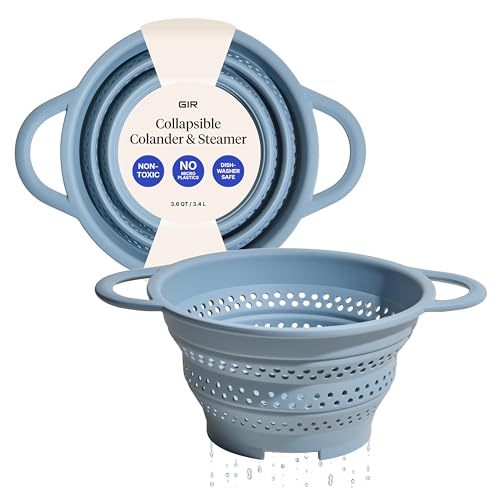
For: Draining pasta, storing flat
GIR Collapsible Colander & Steamer, 3.6 Quart (Slate)
A 3.6-quart platinum-cured silicone colander with an embedded steel rim, rated to 425°F, that folds flat for storage. The rim keeps the handles rigid when you drain boiling pasta water, and the heat rating lets it double as a steamer insert. GIR doesn't publish a collapsed height, and it's sized for one or two people's pasta rather than a family batch.