Best Van Life Cookware Sets: Complete Guide
The two-pan kit, the best nesting cookware sets by budget, induction compatibility, cast iron care without an oven, and how to stow pans so they never rattle.
Disclosure: As an Amazon Associate I earn from qualifying purchases. Links to Amazon on this page are affiliate links: if you buy through one, VanLifeKitchens.com may earn a commission at no extra cost to you. Read our affiliate disclosure.
Short answer
- Most van kitchens: start with the Lodge L8SK3 10.25-inch cast iron skillet and add one stainless pot. It's budget-priced, works on induction, gas and campfire, and has no coating to wear out.
- Full-time cooks with one cabinet for everything, especially on induction: the Magma Nesting 10-Piece (A10-360L-IND), five stainless vessels that nest to 13 x 10.25 x 7.25 in. It weighs 13 lb.
- Two to four people cooking on a camp stove outdoors: the GSI Glacier Stainless Camper 4 Person, stainless pots plus dishes for four in an 8.4 x 8.4 x 5.4 in bundle. Assume it won't work on induction.
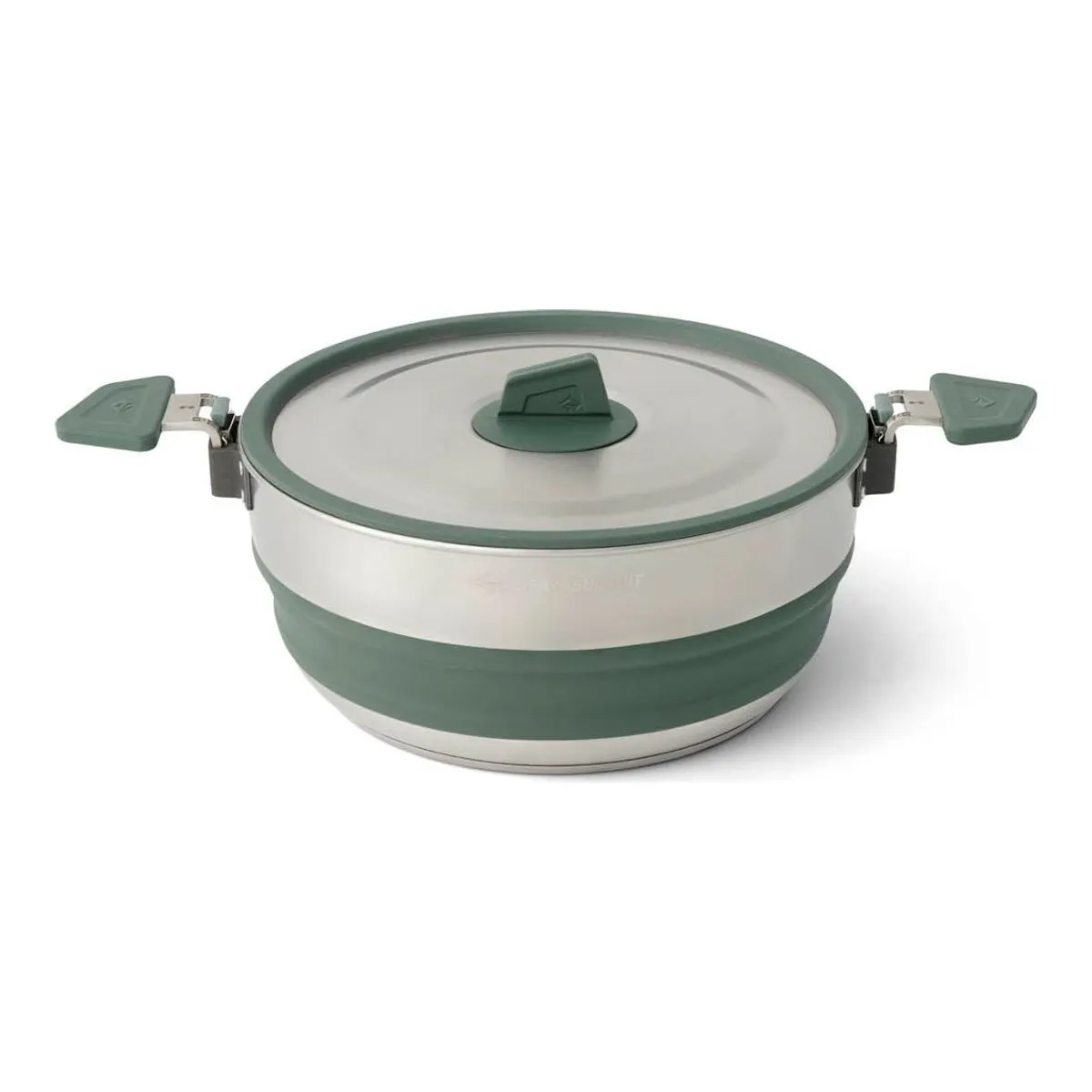
- Tight drawers on induction: the Sea to Summit Detour 3L, a collapsible stainless pot with an induction-ready base.
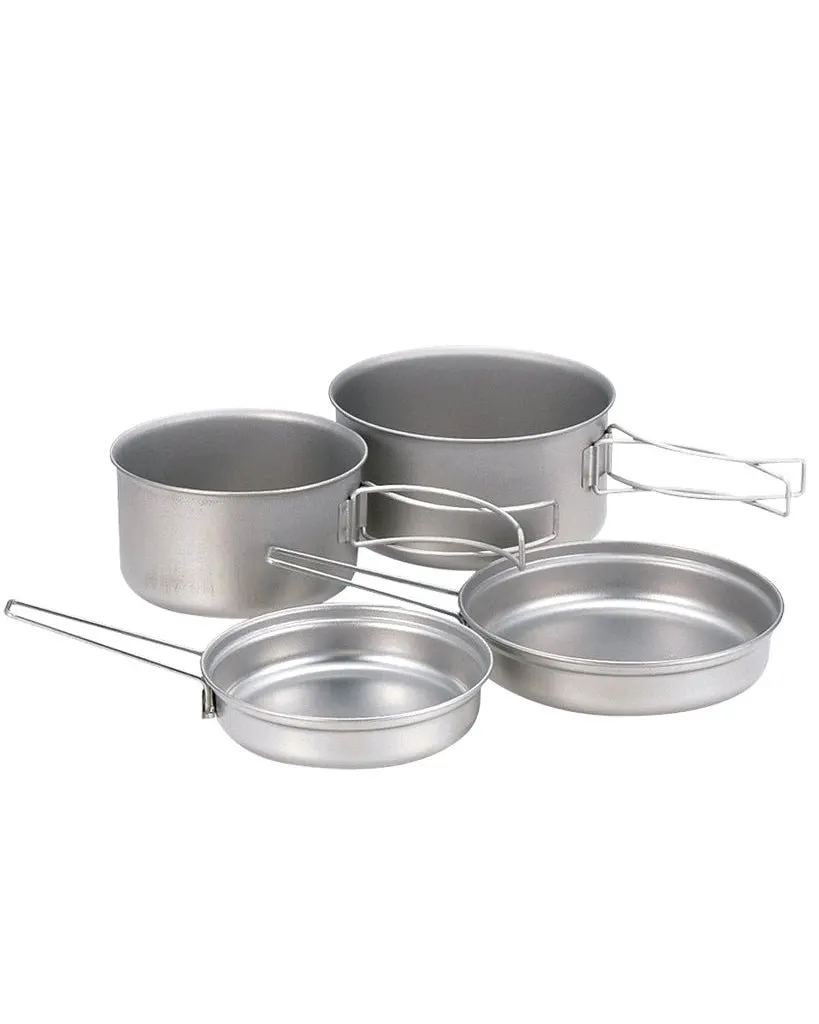
- Ultralight or hybrid backpacking builds: the four-piece Snow Peak Titanium Multi Compact Cookset, about 11.6 oz.
Cookware for a van kitchen is a problem of constraints, not abundance. A house kitchen can own 15 pans. A van kitchen owns two or three, and they have to cover every task for years, ride out washboard roads in a cabinet, and work with whatever heat source you run. This guide is based on manufacturer specs and documentation, not hands-on testing.
Who this guide is for
It's for you if:
- You're outfitting a cargo van (Transit, Sprinter, ProMaster), a small van (Transit Connect, ProMaster City, minivan), a truck camper or a skoolie, and cookware has to share one or two drawers.
- You travel weekends and want a simple kit, or you live on the road full time and cook most meals.
- You cook on any mix of induction (from a battery bank or shore power), butane or propane camp stoves used outdoors, or a campfire.
- You're in a hot or humid climate (rust and coating care matter more), or a cold one (butane stoves struggle below about freezing, so a propane stove or induction may drive your cookware choice).
It's not for you if:
- You have a full RV kitchen with house-size cabinets and a residential range; ordinary home cookware will do.
- You only ever boil water for freeze-dried meals; a single small pot is enough, and a backpacking guide will serve you better.
How to choose
- Your heat source. Induction only works with magnetic cookware: cast iron, carbon steel and stainless with a magnetic base. Check the manufacturer listing, or hold a fridge magnet to the base; if it doesn't grab firmly, it won't heat. Butane and propane work with anything, but thin pans hot-spot over a small flame. Campfires ruin nonstick coatings and plastic handles. Use the power calculator if you're sizing a battery for induction.
- How many you cook for. One person needs a skillet and a pot of about 1.5 L. Two to four people need two pots (around 2 L and 3 L) and a pan, or a Dutch oven for one-pot dinners.
- Packed size and nesting. Measure the drawer or locker first. Sets with removable or clip-on handles nest inside the largest pot; fixed handles stick out. Collapsible pots save height, not width.
- Weight and handling. Cast iron is heavy (the Lodge skillet is 5.34 lb, the 5 qt Dutch oven 11.64 lb per Lodge); titanium is very light. Heavy pieces must ride low and secured. Clip-on grippers and detachable handles nest better but need care when lifting full pots.
- Cleanup with limited water. Nonstick wipes clean with the least water but wears out. Cast iron uses little water but must be dried and oiled every time. Stainless can be scrubbed hard but food sticks more, so deglaze while it's hot. Titanium is easy unless you scorch something.
- How long it should last. Coatings wear out with use. Bare metal (cast iron, carbon steel, stainless, titanium) has no coating to lose and is commonly used for many years.
Comparison table
| Product | Induction | Packed size | Weight | Cleanup |
|---|---|---|---|---|
| Lodge L8SK3 10.25" skillet | Yes | 16.1 x 10.75 x 2.25 in | 5.34 lb | Low water; dry and oil |
| Magma Nesting 10-Piece A10-360L-IND | Yes | 13 x 10.25 x 7.25 in nested | 13 lb | Scrub-safe; sticks more |
| GSI Glacier Stainless Camper 4 Person | Assume no | 8.4 x 8.4 x 5.4 in | 56.8 oz | Hand wash; scrub-safe |
| All-Clad D3 10" fry pan with lid | Yes | 18.6 x 11.5 x 3.7 in | 3.73 lb | Deglaze; hand wash |
| GSI Pinnacle Ceramic Camper 4 Person | No | 9.1 x 9.1 x 5.8 in | 58.1 oz | Easiest wipe-out |
| Lodge L8DOL3 5 qt Dutch oven | Yes | 12.6 x 10.4 x 6.9 in | 11.64 lb | Low water; dry and oil |
| MSR Alpine StowAway 1.6 L | Not listed; magnet test | 8.3 x 7.2 x 4.0 in | 19.5 oz | Scrub-safe |
| Sea to Summit Detour 3L | Yes | 9.2 x 8.3 x 2.5 in | 30.7 oz | Hand wash; dry fold |
| Snow Peak Titanium Multi Compact SCS-020T | No | about 6 x 4 in | about 11.6 oz | Easy unless scorched |
Sizes and weights are the manufacturers' published figures (Snow Peak's weight is from retailer spec sheets; see the picks). Skillet and pan sizes include the handle.
The picks
Lodge L8SK3 10.25-inch Cast Iron Skillet (budget pick)
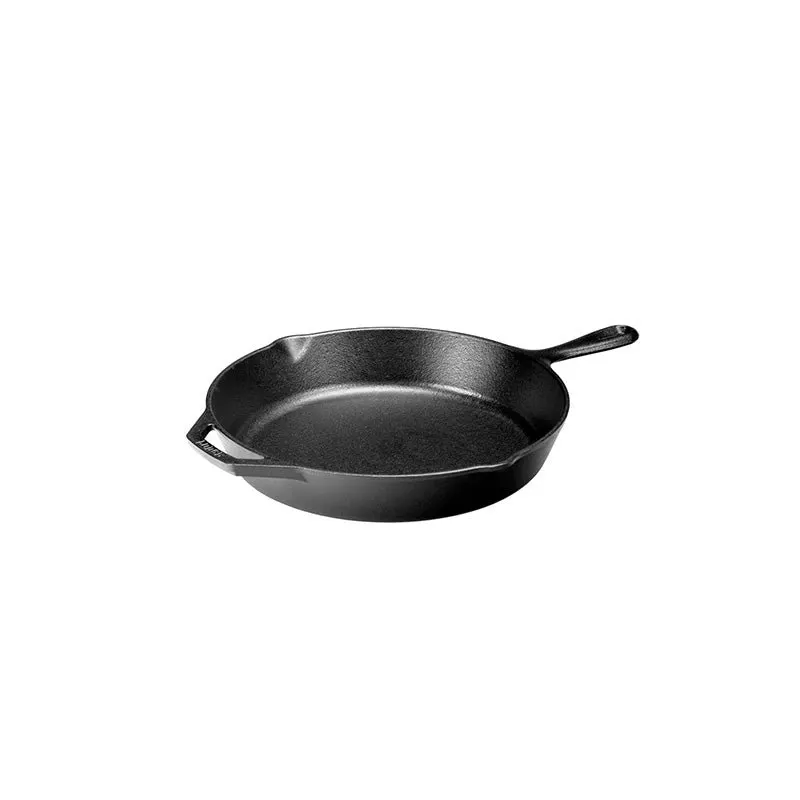
What it is: a pre-seasoned cast iron skillet, 10.25 in across with about 8 in of flat cooking surface. Lodge lists its cast iron as compatible with any stovetop including induction, the oven, the grill and the campfire.
Choose this if:
- You want one pan that sears, fries, bakes and braises.
- You cook on induction, gas or a campfire, or all three.
- You want the lowest-cost route to durable cookware.
Skip this if:
- Weight is your binding constraint (5.34 lb).
- You won't dry and oil a pan after washing.
- You mostly simmer tomato or wine sauces for long periods.
Fit and care: about 16.1 in long with the handle, so it needs a low drawer or a vertical slot. It doesn't nest; stack another pan on it only with a protector between them. Wash warm, dry on the burner, wipe on a little oil. A chainmail scrubber handles stuck food with a splash of water.
Strengths and limits: holds heat well for searing; no coating to wear off; budget price. It's slow to respond when you turn the heat down, can rust if stored wet, and can crack if dropped onto a hard surface. Full review.
Magma Nesting 10-Piece Stainless Cookware Set (A10-360L-IND)
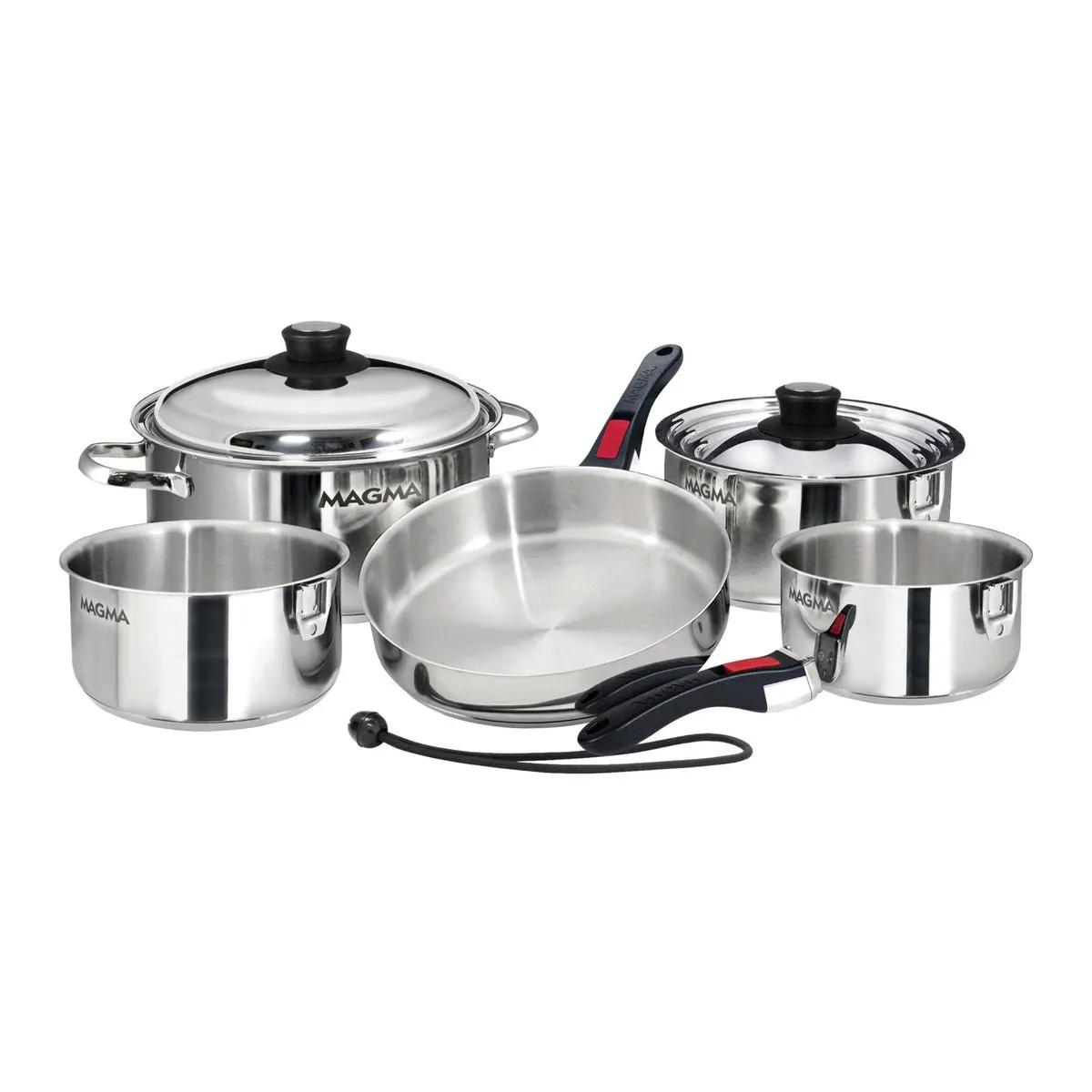
What it is: a boat-galley set with a 5 qt stock pot, 3, 2 and 1.5 qt sauce pans, a 10 in sauté pan, two lids, two removable handles and a bungee cord. Magma lists a tri-clad base with a magnetic stainless outer layer and compatibility with gas, electric, ceramic and induction cooktops.
Choose this if:
- You cook multi-pot dinners most nights.
- You cook on induction, or may switch to it.
- All your cookware has to fit in one drawer or locker.
Skip this if:
- You can't carry 13 lb of cookware.
- You cook simple one-pan meals; most pieces would sit unused.
- You want a long warranty (Magma's is one year).
Fit and care: nests to 13 x 10.25 x 7.25 in (Magma says under half a cubic foot); the sauce pans and lids go inside the stock pot. The handles are thermoplastic with a stainless heat shield: take them off before the oven (pans are oven-safe to 500°F) and keep them away from fire. Pots and pans are dishwasher-friendly without the handles. Stainless sticks more than nonstick, so preheat and deglaze.
Strengths and limits: the most vessels per cubic inch on this site, induction-ready, no coating. Heavy, premium-priced, and the aluminum is only in the base, so the walls heat less than fully clad pans. Full review.
GSI Glacier Stainless Camper 4 Person
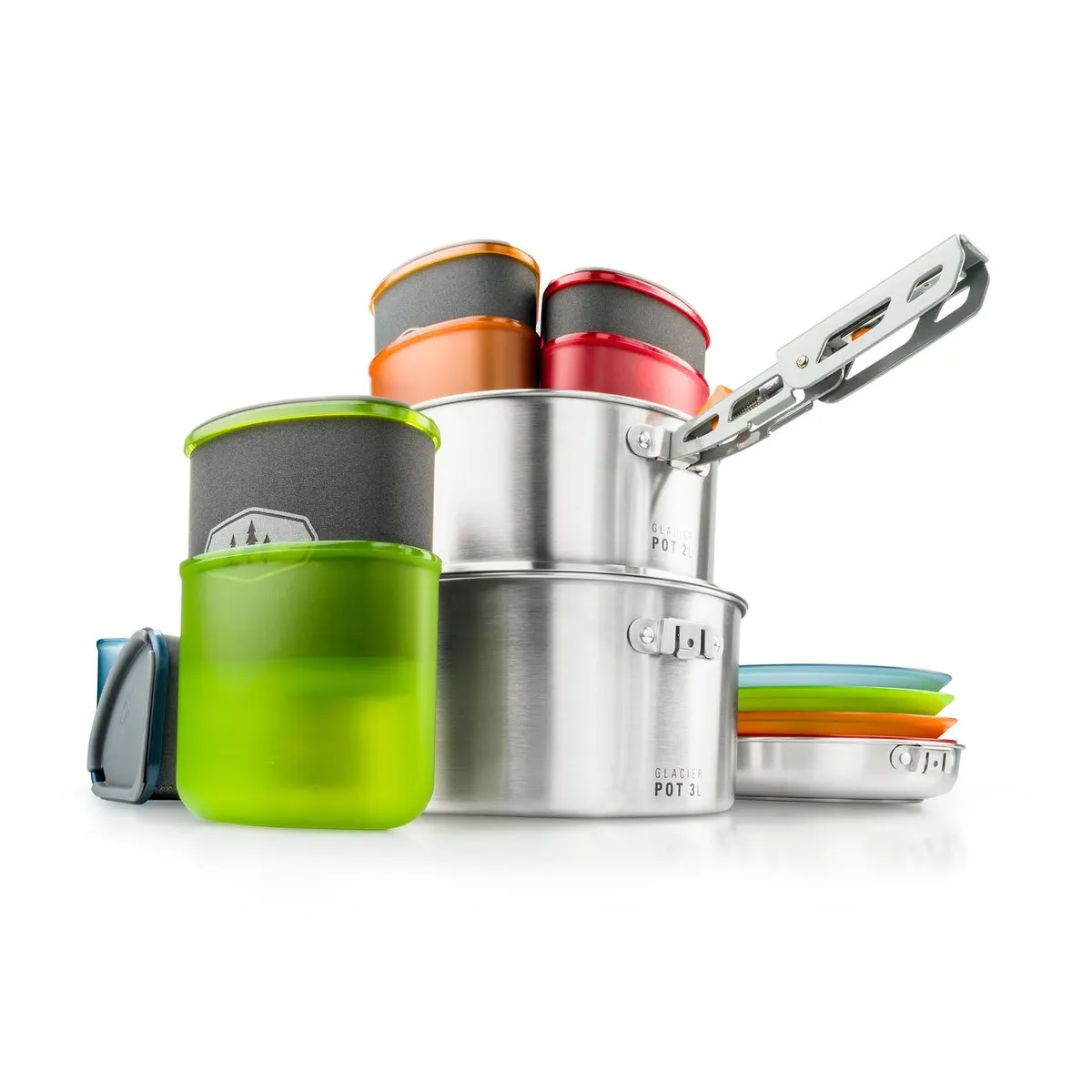
What it is: a cook-and-eat kit with 3 L and 2 L clad 18/8 stainless pots, a 9 in fry pan, a strainer lid, a folding gripper, and plastic mugs, bowls and plates for four, packed in a welded sack that doubles as a sink.
Choose this if:
- You cook for two to four on a propane or butane camp stove, outdoors.
- You're starting from scratch and need dishes too.
- You want stainless cookware with a lifetime warranty.
Skip this if:
- You cook on induction (GSI doesn't list induction compatibility, so don't count on it).
- You cook solo.
- You want more than one handle for moving hot pots.
Fit and care: packs to 8.4 x 8.4 x 5.4 in, 56.8 oz. GSI says the stainless is durable enough for open flame or coals; keep the plastic and silicone parts away from the fire. Hand wash only.
Strengths and limits: complete, compact, coating-free cookware. One gripper for three vessels, plastic dinnerware, no utensils. Full review.
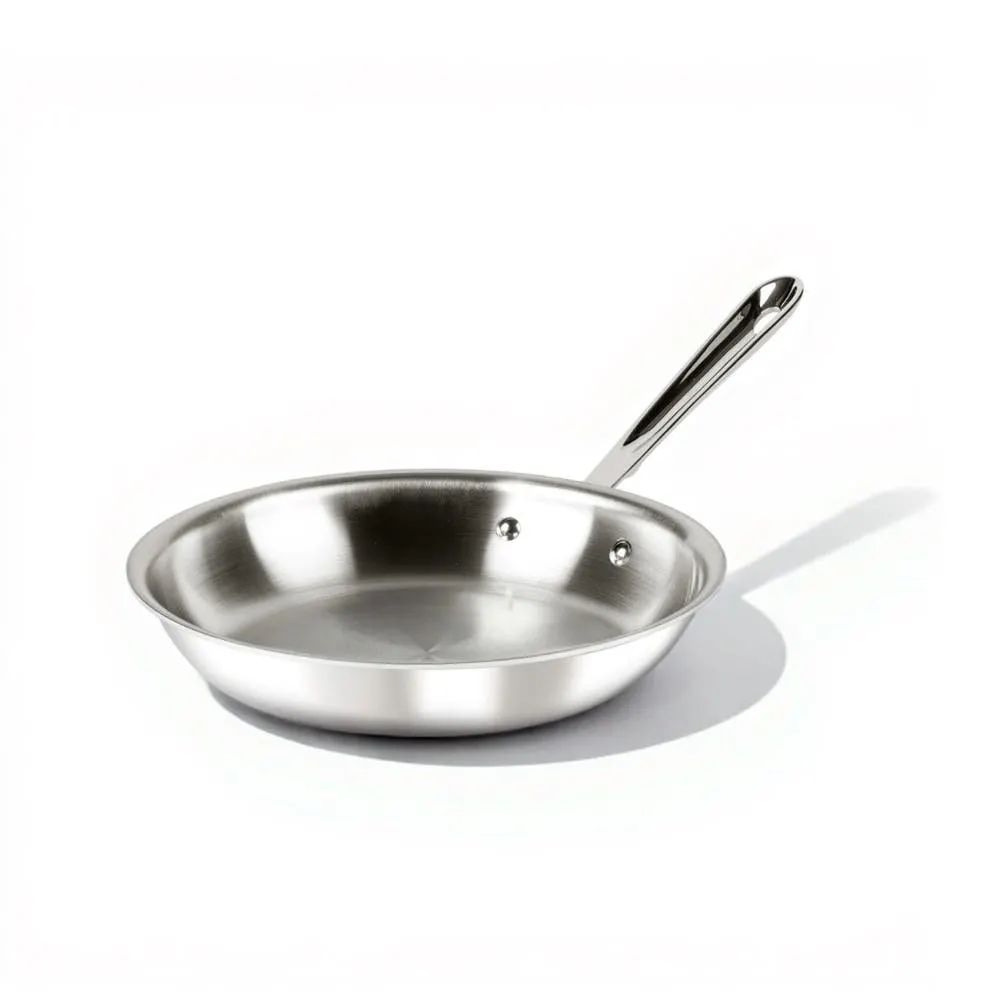
All-Clad D3 Stainless 10-inch Fry Pan with Lid
What it is: a fully clad tri-ply pan (stainless outside, aluminum core, 18/10 stainless cooking surface) with a riveted stainless handle and a lid. All-Clad lists it for any stovetop including induction, pan and lid oven-safe to 600°F.
Choose this if:
- You cook multi-step meals and want fast heat response.
- You cook tomato, wine or citrus sauces often.
- You want a lighter alternative to cast iron (3.73 lb with lid).
Skip this if:
- You're buying your first and only pan on a budget; the Lodge costs a fraction as much.
- You cook over campfires; All-Clad doesn't list it for open fire.
Fit and care: about 18.6 in long with the handle. All-Clad lists it as hand wash only. Deglaze while warm, then a cup of hot water and a sponge; Bar Keepers Friend for stubborn spots.
Strengths and limits: even heat up the walls, quick response, no coating. Premium price, holds less heat than cast iron for searing, doesn't nest. Full review.
GSI Pinnacle Ceramic Camper Cookset, 4 Person
What it is: hard-anodized aluminum pots and frypan with ceramic nonstick, a strainer lid, a gripper, and mugs, bowls and plates for four, in a bag that doubles as a sink.
Choose this if:
- You want the lightest complete four-person kit on this site (58.1 oz).
- You cook gently and want easy-release surfaces that wipe clean with little water.
Skip this if:
- You cook on induction (aluminum isn't magnetic) or over a campfire (GSI says it isn't designed for open campfires).
- You sear on high heat; ceramic coatings are heat-sensitive.
- You want cookware with no coating to wear out.
Fit and care: packs to 9.1 x 9.1 x 5.8 in. GSI approves it for camp stove use only, not in-home use. Hand wash, non-metal utensils, no abrasive pads, and cook at medium or lower.
Strengths and limits: light, complete, low-water cleanup. Like any ceramic coating, its release fades with heat and wear, and it costs more than the stainless Glacier. Full review.
Lodge L8DOL3 5 Quart Cast Iron Dutch Oven
What it is: a pre-seasoned 5 qt cast iron Dutch oven with two loop handles, pour spouts and a cast iron lid with a top handle. The lid does not double as a skillet.
Choose this if:
- You braise, stew, roast or bake bread regularly.
- You cook for two to four and like leftovers.
Skip this if:
- You can't store 11.64 lb low and secured.
- You want a lid that doubles as a frying pan.
Fit and care: about 12.6 x 10.4 x 6.9 in with handles. Works on induction, gas, oven and campfire per Lodge. Check your camp stove's load limit before putting a full pot on it. Same dry-and-oil care as the skillet.
Strengths and limits: expands the menu more than any other single piece; budget price. Heavy, slow to heat, and doesn't nest. Full review.
MSR Alpine StowAway 1.6 L Pot (budget pot)
What it is: a single-wall stainless pot with a fitted lid and a hinged handle that flips over the lid to hold it shut.
Choose this if:
- You cook for one and want a simple, coating-free second pot next to a skillet.
- You want a pot that doubles as a sealed storage container on the road.
Skip this if:
- You cook on induction and can't test it first: MSR doesn't list induction compatibility, so do a magnet test.
- You cook full dinners for two or more.
Fit and care: 8.3 x 7.2 x 4.0 in packed, 19.5 oz, per MSR. MSR says stainless pots can go over an open fire with caution (expect soot, and possible warping from excessive heat). Scrub-safe.
Strengths and limits: budget price, nothing to peel or melt. Single-wall steel can scorch thick foods, and it's heavier than many expect. Full review.
Sea to Summit Detour Stainless Collapsible Pot 3L
What it is: a 3 L pot of mostly 304 stainless with a silicone band in the wall and a three-ply stainless/aluminum base. Sea to Summit lists it for induction, radiant electric and gas stoves.
Choose this if:
- You cook on induction and gas and drawer height is tight.
- You cook for one to three.
Skip this if:
- You cook over campfires (Sea to Summit says its handles aren't intended for open fires).
- Weight matters more than height (30.7 oz).
Fit and care: collapses to 9.2 x 8.3 x 2.5 in. Hand wash only (the handle attachment is hard-anodized); keep gas flames under the base, away from the silicone; dry the silicone fold before collapsing.
Strengths and limits: the only collapsible pot on this site listed for induction. Premium price, heavy for a collapsible pot, and the practical fill is well below the 3 L brim. Full review.
Snow Peak Titanium Multi Compact Cookset (SCS-020T)
What it is: a four-piece titanium set: two pots (33.8 and 26.3 fl oz, roughly 1 L and 0.78 L) and two frying pans that double as lids, in a mesh bag.
Choose this if:
- Every ounce counts, or your van kit doubles as a backpacking kit.
- You mostly boil, rehydrate and simmer for one or two.
Skip this if:
- You cook on induction (titanium isn't magnetic).
- You fry, sear or make pancakes; thin titanium scorches over the flame.
Fit and care: nests to about 6 x 4 in. Retailer spec sheets list 11.6 oz (330 g); Snow Peak's US store lists 0.98 lb, which may include packaging. Works over gas, wood and alcohol flames; never let it boil dry.
Strengths and limits: the lightest cookware on this site; no coating; corrosion-resistant. Small capacity and poor heat spread. Full review.
Packed size and what nests inside what
- Magma: the 1.5, 2 and 3 qt sauce pans and both lids nest inside the 5 qt stock pot with the sauté pan, and a bungee cord holds the stack. 13 x 10.25 x 7.25 in total.
- GSI Glacier and Pinnacle: the 2 L pot sits inside the 3 L pot, the mugs, bowls and plates fit inside or on top, and the lid and gripper go last; everything slides into the storage sack.
- Snow Peak: the smaller pot nests inside the larger, the two frying pans cover them. Check your canister's size against the smaller pot if you want to nest fuel inside.
- MSR StowAway: the 1.6 L pot can hold a small canister stove and a small fuel canister, depending on their sizes, with the handle locking the lid.
- Sea to Summit Detour: collapses flat to 2.5 in, and the reversible handles lock the lid over anything stored inside.
- Lodge skillet, Lodge Dutch oven and All-Clad: don't nest. Store the skillet flat in a low drawer or upright in a slot; the Dutch oven needs its own floor-level space. A stainless pot can sit inside the Dutch oven with a cloth between them.
Cooktop compatibility at a glance
| Product | Induction | Gas camp stove | Open fire |
|---|---|---|---|
| Lodge skillet and Dutch oven | Yes | Yes | Yes |
| Magma A10-360L-IND | Yes | Yes | Not listed; plastic handles |
| GSI Glacier | Assume no | Yes | Yes, per GSI (coals) |
| All-Clad D3 | Yes | Yes | Not listed |
| GSI Pinnacle Ceramic | No | Yes | No, per GSI |
| MSR StowAway | Not listed; magnet test | Yes | With caution, per MSR |
| Sea to Summit Detour | Yes | Yes | No, per Sea to Summit |
| Snow Peak titanium | No | Yes | Yes, with care |
Where to cook with gas. Portable butane and propane camp stoves are typically labelled by their manufacturers for outdoor use. The Gas One GS-1000G that this site links to is labelled for outdoor use only, and Iwatani's US manual for its ZA-3HP butane stove calls it an outdoor-only camp cooking appliance and says never to use it in a camper, tent or car. Cook outside with them. A CO alarm is a last-line warning device, not permission to use an outdoor-only stove indoors. If you want to cook inside, induction is the usual route, and it still needs general cooking ventilation for steam, grease and odour. See the van cooking safety guide and the van kitchen ventilation guide.
Butane in the cold. Butane cartridges lose pressure as they get cold and struggle around freezing, which weakens the flame under heavy pans like cast iron. In cold weather, keep cartridges warm until use, or rely on propane or induction. The cold-weather van cooking guide covers this in detail.
Weight and handling
A complete van cooking kit can weigh under a pound (titanium) or well over 20 lb (cast iron skillet, Dutch oven and a full stainless set). Keep heavy cast iron low and secured, never in an upper cabinet.
- Fixed handles (Lodge, All-Clad) are secure but long: about 16 in for the Lodge skillet and 18.6 in for the All-Clad, so check drawer length.
- Detachable locking handles (Magma) let pans nest and lock firmly, but take practice and come off before the oven.
- Clip-on grippers (GSI) nest best, but you get one for three vessels; seat it firmly before lifting a full pot.
- Folding or hinged handles (MSR, Snow Peak) are metal and get hot; keep a glove or pot grip with the kit.
- Lids: the All-Clad and Magma include lids; the GSI kits share one strainer lid between two pots; Snow Peak's lids double as pans.
For galley-wide organization, see the storage complete guide; for noise from stacked pans and lids, see the FAQ below.
Cleanup with limited water
- Nonstick and ceramic (GSI Pinnacle): a paper towel and a splash of water handle most light cooking, the least water of any material. No metal utensils, no abrasive pads, and let it cool before rinsing. The coating eventually wears.
- Cast iron (Lodge): scrape while warm, a splash of hot water and a chainmail scrubber, then dry on the burner and oil. Very little water, but the drying and oiling are mandatory or it rusts.
- Stainless (Magma, GSI Glacier, All-Clad, MSR, Detour): deglaze with a splash of water while the pan is hot, which lifts most residue. Burnt-on food may need a soak or a scouring powder, which costs water. You can scrub it as hard as you like.
- Titanium (Snow Peak): mostly used for liquids, so a rinse usually does it; scorched spots need a soak.
For a full low-water routine, see the van kitchen dishwashing guide.
Cast iron care without a home oven
Most modern cast iron, including the Lodge, comes pre-seasoned, so you can start cooking right away.
Daily care:
- While the pan is still warm, scrape out food and rinse with a little hot water. A little dish soap is fine; modern polymerized seasoning isn't stripped by occasional mild soap.
- Scrub with a stiff brush or chainmail scrubber. Don't soak the pan.
- Dry it completely, ideally by setting it back on low heat for a minute or two.
- Wipe a few drops of neutral oil over the cooking surface, then wipe off the excess.
Building or restoring the seasoning on the stove: heat the clean, dry pan over medium, wipe on a very thin layer of high-smoke-point oil, and keep heating until it stops smoking, then let it cool. Repeat a few times. It smokes, so do it outdoors on a camp stove, or on induction with doors open and the fan running. Cooking fatty foods for the first few weeks builds seasoning too. If you have access to an oven, a few oil-and-bake cycles at around 450°F produce a durable finish.
In a humid van, store the pan with a paper towel on the cooking surface. A spot of rust isn't fatal: scrub it off, dry the pan, oil it, and heat it again.
Common buying mistakes
- Buying a big nonstick set as your primary cookware. Coatings wear out with daily use. One nonstick pan is plenty if you want one.
- Buying aluminum or titanium for an induction build. It won't heat. Check the listing or do the magnet test first.
- Buying thin, single-ply stainless for everyday frying. It scorches over a small flame. Clad or disc-base stainless is more forgiving.
- Buying more pieces than you'll use. Ten pieces you don't need are ten pieces to stow and secure.
- Ignoring handles. Long fixed handles may not fit a van drawer, and plastic handles don't belong near a campfire.
- Planning to cook indoors on an outdoor-only stove. Choose cookware for the stove you'll actually use where it's allowed to be used.
Frequently asked questions
What cookware works on induction in a van?
Only magnetic (ferromagnetic) cookware: cast iron, carbon steel and stainless with a magnetic base. On this site, the Lodge skillet and Dutch oven, the Magma A10-360L-IND, the All-Clad D3 and the Sea to Summit Detour are listed for induction by their makers. MSR doesn't list the Alpine StowAway, and GSI doesn't list the Glacier, so test those with a magnet. Aluminum, copper, glass and pure titanium won't work. The guide to nesting cookware for induction goes through each manufacturer's listing and how the induction-ready pieces pack together.
Is cast iron worth it in a van?
For most van cooks, yes. The Lodge 10.25-inch skillet sears, braises and bakes flatbread, and works on induction, gas and campfire. The downsides are weight (5.34 lb per Lodge) and the habit of drying and oiling it after each use.
What is the best cookware set for van life in 2026?
It depends on your stove and how you travel. For full-time cooks with one cabinet, especially on induction, the Magma Nesting 10-Piece packs five stainless vessels into under half a cubic foot, though it weighs 13 lb and carries a one-year warranty. For two to four people cooking on a camp stove outdoors, the GSI Glacier Stainless Camper is the value pick; it isn't listed for induction. For a minimalist kit, pair a Lodge 10.25-inch skillet with one stainless pot.
How many pans do you need in a van kitchen?
Two covers most cooking for most people: a 10-inch skillet for searing and frying, and a stainless pot for boiling, sauces and acidic dishes. If you want that pot to be clad rather than single-wall, the Tramontina Signature Tri-Ply 3-quart saucepan has an aluminium core between two layers of 18/10 stainless and a stainless lid, and Tramontina lists it for all cooktops including induction. It doesn't nest or collapse, and Tramontina doesn't publish its dimensions, so measure your cabinet. Add a Dutch oven or a second pot only if you regularly cook stews and bread or cook two dishes at once.
Is nonstick cookware a good idea for van life?
As a single egg pan, it can be, and it's the easiest to clean with little water. As your main cookware, it usually isn't. Coatings wear out with daily use, can't take metal utensils or very high heat, and aluminum nonstick won't work on induction. One exception is the Anolon X 10-inch Hybrid Nonstick pan: Anolon lists it as induction-suitable thanks to a full-cap stainless base, says a stainless steel mesh in the surface makes it metal-utensil-safe, and rates it oven-safe to 500°F. It's still a coated pan that will eventually wear, which is the trade-off our Anolon X vs de Buyer Mineral B comparison weighs against bare carbon steel.
Can you cook acidic foods in cast iron?
Briefly, yes: a quick tomato sauce or a squeeze of lemon in a well-seasoned pan is fine. Long-simmered tomato, wine or citrus dishes can wear down the seasoning and give food a metallic taste, so cook those in stainless.
How do you stop cookware from rattling in a van?
Nesting cookware, felt or silicone protectors between stacked pieces (the Made In silicone pan protectors come in 8, 10 and 12-inch sizes and don't soak up water the way felt does), non-slip liner and lids stored on edge stop most of the noise. Keep heavy cast iron low and strapped or latched in, and use the step-by-step guide to stopping van kitchen rattles to find and fix the source, including which cabinet latches stay shut on rough roads.
Can I use these pans on a butane stove inside the van?
Butane and propane camp stoves are typically labelled for outdoor use; the Gas One GS-1000G this site links to is labelled for outdoor use only. Use them outside. For indoor cooking, use induction with compatible cookware, and ventilate for steam and odour.
The verdict
For most van kitchens, start with the Lodge 10.25-inch cast iron skillet and add a stainless pot sized for how many you cook for. Full-time cooks on induction with one cabinet to fill should look at the Magma Nesting 10-Piece; together with the Lodge that's about 18 lb of cookware that covers nearly every everyday task. Cooks on camp stoves who need dishes too should look at the GSI Glacier Stainless Camper. For one premium stainless pan instead of a set, add the All-Clad D3. For ultralight builds, the Snow Peak Titanium saves weight at the cost of searing.
For head-to-heads, see Magma Nesting vs GSI Pinnacle Ceramic, GSI Glacier vs Magma Nesting and Lodge cast iron vs All-Clad stainless, the van cookware materials guide for the technical comparison, or browse the full cookware category. To pick a heat source, see the cooktops complete guide and induction vs butane vs propane. For ideas on getting the most from minimal cookware, see one-pot meals on the road. To see a kit in a working galley, look at the Sprinter 144 Minimalist setup, and for a lower-cost build, read The Budget Van Kitchen.
Sources and verification
Manufacturer pages we opened for the specs above:
- Magma, 10 pc Nesting Induction Cookware Set (A10-360L-IND): https://magmaproducts.com/products/nesting-cookware-set-10-piece (checked 2026-10-09)
- GSI Outdoors, Glacier Stainless Camper: https://gsioutdoors.com/products/glacier-stainless-camper (checked 2026-10-09)
- GSI Outdoors, Pinnacle Ceramic Camper: https://gsioutdoors.com/products/pinnacle-ceramic-camper (checked 2026-10-09)
- All-Clad, D3 Stainless 3-Ply Bonded Fry Pan with Lid, 10 inch: https://all-clad.com/d3-stainless-3-ply-bonded-cookware-fry-pan-with-lid-10-inch.html (checked 2026-10-09)
- Lodge, catalog with L8SK3, L10SK3, L8DOL3 and L10DOL3 dimensions and weights (PDF hosted at https://images.orgill.com/weblarge/10031/Lodge_GL12_GC12_Catalog.pdf) (checked 2026-10-09)
- Lodge, Dutch oven product page (lid and handle description): https://lodgecastiron.com/products/dutch-oven (checked 2026-10-09)
- Lodge, Chainmail Scrubbing Pad: https://lodgecastiron.com/products/chainmail-scrubbing-pad (checked 2026-10-09)
- MSR (Cascade Designs), Alpine StowAway Pots: https://cascadedesigns.com/products/alpine-stowaway-pots (checked 2026-10-09)
- Sea to Summit, Detour Stainless Steel Collapsible Pot: https://seatosummit.com/en-ca/products/detour-collapsible-pot (checked 2026-10-09)
- Snow Peak, Ti Multi Compact Cookset product data from Snow Peak's US store: https://snowpeak.com/products/ti-multi-compact-cookset.json (checked 2026-10-09; used for the model number and listed weight. The regular product page returned an access error, so the capacities and dimensions above come from retailer spec sheets that reproduce Snow Peak's contents list)
- Iwatani Corporation of America, ZA-3HP instruction manual (PDF linked from Amazon) (checked 2026-10-09)
Products covered in this guide
Disclosure: As an Amazon Associate I earn from qualifying purchases. Links to Amazon on this page are affiliate links: if you buy through one, VanLifeKitchens.com may earn a commission at no extra cost to you. Read our affiliate disclosure.
More in Buying Guides
Best Water Filters for Van Life: Complete Guide
What van water filters actually remove — bacteria, protozoa, viruses, metals, chemicals — plus certifications, a layered setup for full-timers, winterizing, and our 2026 picks.
Best Van Kitchen Storage: Complete Organizing Guide
How to organize a van kitchen that survives washboard roads: pantry tiers, spices, cookware, fridge and knife storage, plus the best bins and cases by budget.
The Complete Van Life Solar Cooking Guide
Can you really cook with the sun from a van? The definitive guide to tube cookers, box ovens, and hybrid solar-electric systems — 4 products compared, with honest notes on what actually works.