MSR PocketRocket 2 Mini Stove
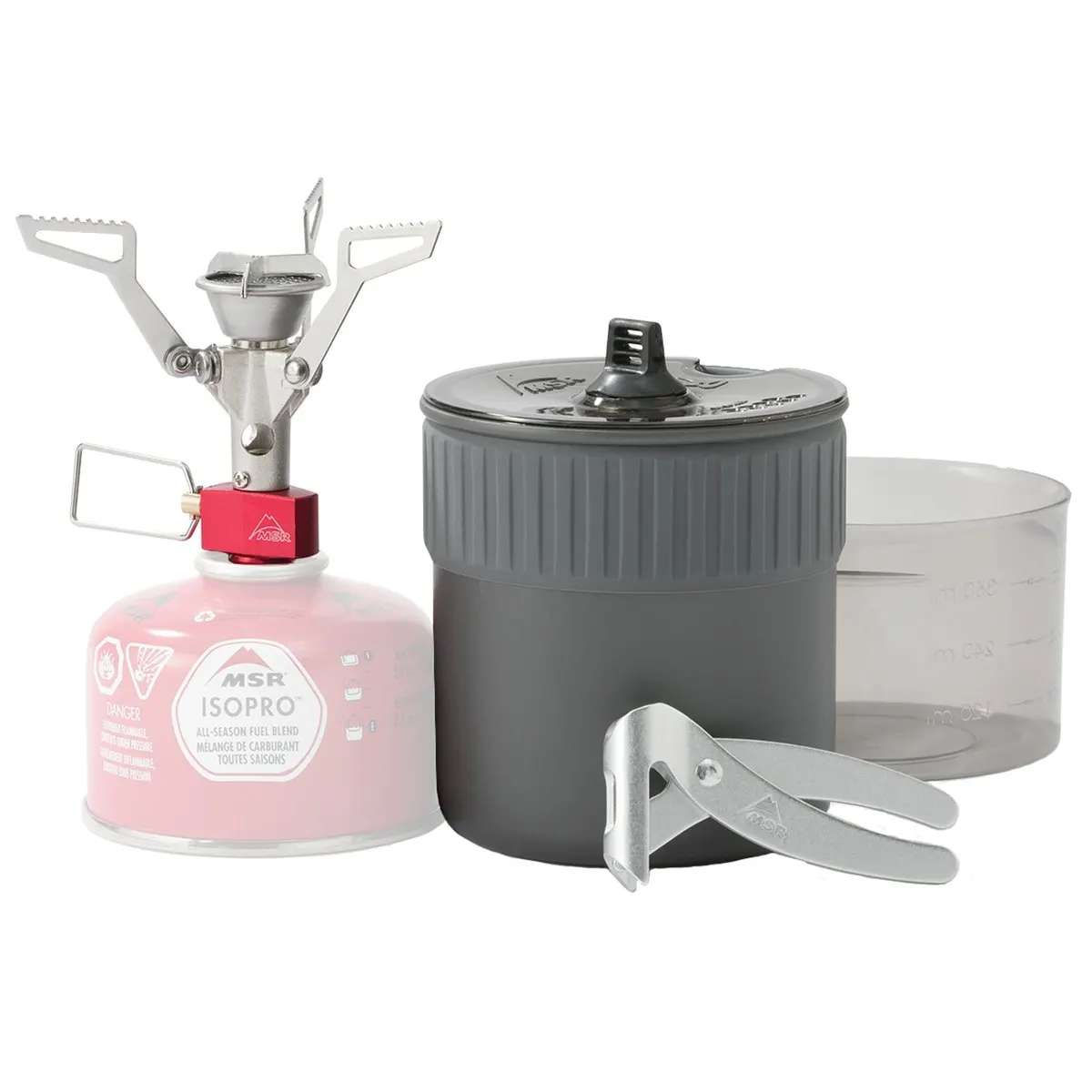
- Weight
- 2.6 oz (73 g) minimum; 3.7 oz packaged (MSR)
- Boil Time
- 3.5 min / 1 L on MSR IsoPro (MSR)
- Burn Time
- About 60 min per 8 oz canister; 16 L boiled (MSR)
- Heat Input
- 3.9 kW nominal, 280 g/h (manual)
- Fuel
- MSR 80/20 isobutane-propane canisters, EN 417 (manual)
- Dimensions
- 1.3 x 1.6 x 3.1 in (MSR)
- Cookware Limit
- 8 in diameter, 5 in high, 8 lb (manual)
- Warranty
- Limited (MSR; details at msrgear.com/warranty)
MSR PocketRocket 2 Review: The Lightest Stove That Makes Sense for Van-and-Trail Builds
The best thing about the MSR PocketRocket 2 in a van kitchen is that it barely takes up any space. It weighs 2.6 ounces, folds to about 1.3 x 1.6 x 3.1 inches by MSR's figures, and disappears into a cook pot or a corner of a drawer until you need to boil water.
It's the stove for van lifers who also hike, backpack, climb or paddle: people who need hot food both at the van and at the end of a trail. One stove, one fuel system, two uses. That's the pitch, and within its limits it delivers.
Operating location: outdoor use only. MSR's instruction manual for the PocketRocket 2 is headed "FOR OUTDOOR USE ONLY" and carries a carbon monoxide danger warning: "This stove can produce carbon monoxide, which is poisonous and has no odor. Using it in an enclosed space can kill you. Never use this stove in an enclosed space such as a camper, tent, car, or home." The manual describes it as "made for OUTDOOR USE ONLY to boil water or cook food." So at the van, it's used outside, on a stable surface away from the vehicle, never on the galley counter.
Choose this if:
- you split your time between the van and backpacking or overnight hikes;
- your cooking is mostly boiling water: coffee, oatmeal, noodles, rehydrated meals;
- you want a backup stove that takes almost no space.
Skip this if:
- you need to cook inside the van (MSR prohibits it);
- you cook real meals with wide pans: MSR limits cookware to 8 inches across;
- you cook in exposed, windy spots without shelter.
Overview: What the MSR PocketRocket 2 Is
The MSR PocketRocket 2 is an ultralight canister stove that screws onto a threaded isobutane-propane fuel canister (sold separately). MSR's product page gives a minimum weight of 2.6 oz (73 g), a packaged weight of 3.7 oz, and dimensions of 1.3 x 1.6 x 3.1 inches. The Amazon listing gives 2.6 oz (4.2 oz with its hard case), 4.8 x 4.8 x 3.6 inches open, and "2x2x3 in" folded. Three serrated pot supports fold up around the burner head, and a fold-out flame adjuster controls the valve.
MSR rates it at a 3.5-minute boil for one litre of water on MSR IsoPro fuel, about 60 minutes of burn and 16 litres boiled per 8 oz (227 g) canister. Its listing says the flame adjusts "from a simmer to a rolling boil". MSR doesn't quote a BTU figure on the page we checked; the manual gives a nominal heat input rate of 3.9 kW (280 g/h), noting that it "varies depending on test procedures". (Earlier versions of this page quoted 8,200 BTU, which we couldn't find in an MSR source.) No priming, preheating or pressurizing is needed.
Fuel. MSR's manual is specific: the stove "shall only be used with an MSR 80% isobutane / 20% propane gas cartridge certified to EN 417," and "it may be hazardous to attempt to fit other types of gas containers." Other brands' threaded canisters often fit physically, but MSR's instructions specify its own canisters, and we follow the manual. The manual also says never to use canisters larger than 8 oz (or taller than 4 inches) without MSR's canister stand or remote adapter, and never larger than 16 oz, because a big canister makes the stove top-heavy.
The Weight and Size Argument
You'll often read that weight doesn't matter in a van because you aren't carrying it. That misses a large part of the van community: hikers who sleep in the van at the trailhead, climbers using the van as base camp, paddlers who park at the put-in. If you also cook in the backcountry, carrying two separate stoves is redundant.
The PocketRocket 2 removes the redundancy. It stays in the van kitchen kit for quick boils outside the van, and goes into your pack for overnights. At 2.6 ounces and palm size, it adds almost nothing either way, and buying one dual-purpose stove costs less than buying a van stove and a backpacking stove.
Boil Time and What It Means
MSR's 3.5-minute litre is its own figure, under favourable conditions. In practice, cold water, cold canisters, altitude and wind all lengthen it. What it means day to day: coffee water, tea, oatmeal, instant noodles and rehydrated meals are quick. Set the stove up on a table outside the van, light it, boil, done.
For real cooking (sauteing, frying, simmering sauces) the PocketRocket is less suitable, for reasons covered in the limitations section.
Fuel Use
MSR's product page gives about 60 minutes of burn and 16 litres of water boiled per 8 oz (227 g) IsoPro canister, measured under MSR's test conditions. Our arithmetic from that: if a typical day is two litres (coffee in the morning, a rehydrated dinner at night), one 8 oz canister lasts about a week. Wind, cold canisters and altitude shorten that; simmering for long periods uses fuel faster than the boil figure suggests.
Isobutane-propane blends handle cold better than pure butane cassette fuel, because the propane and isobutane keep vaporizing at lower temperatures. They still lose pressure as the canister gets cold and as it empties, so keep canisters above freezing overnight in winter and expect weaker output on very cold mornings. MSR's manual sets a hard floor: the stove "should not be operated or stored at temperatures below 0°F", and it warns that O-rings can stiffen and leak in freezing temperatures, so check for leaks before and after lighting. At the other end, it says to store canisters where temperatures stay below 120°F, which rules out a closed van in summer sun or a spot near a heater.
Empty canisters can be recycled in many areas once fully empty and punctured with a suitable tool; check local rules. Partly used canisters accumulate, because the last bit of fuel is hard to use efficiently. That's a general canister-stove annoyance, not specific to MSR.
Storage in a Van
Folded, the PocketRocket 2 fits inside a mug or a 1-litre pot, and MSR includes a small protective case. A natural setup is the stove, a lighter and a canister nested inside a 1-litre pot such as the MSR Alpine Stowaway, roughly the volume of a water bottle. Store the canister out of direct sun and away from heaters; MSR's manual also says to check the seals between stove and canister are in place and in good condition before connecting.
In a larger, established kitchen, the small size matters less, but a PocketRocket tucked away as a backup or take-along stove costs almost nothing in space.
MSR PocketRocket 2 vs Integrated Systems and Wind-Resistant Stoves
Integrated canister systems, such as Jetboil's, pair a burner with a dedicated pot and heat exchanger. They're typically more fuel-efficient and better in wind, but heavier, more expensive, and limited to their own pot. The PocketRocket 2 lets you use any suitable pot up to MSR's 8-inch limit, which is more flexible in a van where you already own pots.
Stoves designed for wind resistance, such as Soto's regulated models, recess the burner and add a regulator for steadier output in the cold and as the canister empties. The PocketRocket 2 is simpler and usually cheaper; MSR's own nod to wind is the "WindClip" shaping of the burner head, which is built in, not a separate screen.
For van-based use, wind matters less if you can set up in the lee of the van (outside it, a few feet away). If you often cook exposed on picnic tables or at windy coastal spots, a wind-resistant design is worth considering. Neither type changes the location rule: every canister stove we know of is labelled for outdoor use.
Van-Specific Benefits: The Hybrid Build
The crossover scenario is where the PocketRocket makes the most sense. Say you hike two or three times a week, with the occasional overnight. On the overnights, you need a stove. If your only stove is a 12-pound two-burner, you either carry something absurd or go without hot food.
The PocketRocket is the stove that goes both places. At the van, set up outside, it handles coffee, boiling water and simple meals. On the trail, it does the same with the same fuel and pot.
If you never leave the van overnight, it's still a fast, cheap, small stove, but you lose the crossover advantage. For a van-only lifestyle, a two-burner (outdoors) or an induction cooktop (indoors) suits everyday cooking better.
Limitations
Limited low-heat control. MSR's listing says the flame adjusts from a simmer to a rolling boil. Even at its lowest, though, a small single burner puts its heat in a small spot under the pot, so rice, sauces and anything that scorches easily need attention and stirring. It's fine for boiling, adequate for simple cooking, frustrating for delicate work.
Wind sensitivity. The burner is exposed. Moderate wind deflects the flame, lengthens boils and wastes fuel. Don't add a windscreen: MSR's manual says "Never use any kind of windscreen" and "Never use a reflector or diffuser," because heat reflected onto the canister can make it explode or leak. Use the van (from a distance), a rock or your body as a windbreak instead.
Cookware size and stability. MSR's manual says "Never use cookware with a diameter greater than 8 inches (20.3 centimeters)" and warns against cookware that's ill-suited to the pot supports, such as convex or concave bottoms. Its diagram gives the limits as 8 inches in diameter, 5 inches high and 8 lb in weight. Heavy cast iron and wide skillets are out. Always set the stove and canister on a solid, stable, even surface.
No igniter. The PocketRocket 2 has no piezo. You light it with a lighter or matches every time, so keep a lighter in the kit.
No canister included. Budget for your first canister.
Build and Safety Details
The stove has folding pot supports, a burner head and a fold-out flame adjuster, and very little else; MSR's manual says there are no user-serviceable parts and that disassembly beyond what it describes voids the warranty. The parts that need care are the seals between stove and canister (MSR says not to use the stove with damaged or worn seals) and the burner head, which the hard case protects. MSR's warranty terms are on its warranty page, which the manual points to; the Amazon listing just says "Limited Warranty".
MSR's manual has several rules worth repeating:
- Never use it in an enclosed space such as a camper, tent, car or home.
- Keep combustibles at least 4 feet from the top and sides of a burning stove, and flammable liquids and vapours at least 25 feet away.
- Keep children at least 10 feet away, and never leave it burning unattended.
- Never place and operate two or more stoves together.
- Never operate it with empty or dry cookware.
- Never move a burning or hot stove; turn it off and let it cool for at least 5 minutes before moving or unscrewing the canister.
- If you smell gas, don't light it; close the valve, extinguish nearby flames, disconnect the canister and leave the area.
A CO alarm is a good idea in any van with fuel appliances, but it is a last-line warning device, not permission to use an outdoor-only stove inside.
Who Should Buy the MSR PocketRocket 2
Buy it if you're a van lifer who also backpacks or hikes overnight. Buy it if you want the lightest, smallest stove for a minimalist kit, and your cooking is mostly water-based. Buy it if you want a backup that takes essentially no space.
Skip it if you cook meals that need wide pans or fine temperature control. Skip it if you cook in exposed, windy places without shelter. Skip it if you never leave the van and would get more from a two-burner or induction. And skip it if you were hoping to use it inside: MSR's manual rules that out.
For a comparison of every cooking method on this site, see the cooktops complete guide, and for a head-to-head with a wood stove, the BioLite vs PocketRocket comparison.
Final Verdict
The MSR PocketRocket 2 is the lightest stove on this site, and the most sensible one for van lifers who split their time between van and trail. It weighs 2.6 ounces, folds to palm size, and boils water quickly by MSR's figure. Its limits are a small burner, sensitivity to wind, an 8-inch cookware limit, and no fuel or igniter in the box.
It isn't the right primary van stove for daily cooking. It is a stove worth keeping in a cook pot in the drawer, ready to use outside the van or to go in a pack.
FAQ
Can I use the MSR PocketRocket 2 inside my van? No. MSR's manual says "FOR OUTDOOR USE ONLY" and "Never use this stove in an enclosed space such as a camper, tent, car, or home." Use it outside on a stable surface, at least 4 feet from anything combustible, including the van.
Does it come with a fuel canister? No. MSR's manual specifies MSR 80% isobutane / 20% propane canisters certified to EN 417, and says fitting other types of gas container may be hazardous.
Does it have a built-in igniter? No. You need a lighter or matches. MSR sells a separate PocketRocket Deluxe model with a push-start igniter.
How many boils can I get from one 8 oz canister? MSR's figure is 16 litres boiled and about 60 minutes of burn per 8 oz IsoPro canister. Wind, cold and altitude reduce that.
Can I use a windscreen with it? No. MSR's manual says "Never use any kind of windscreen" and never to use a reflector or diffuser, because trapped heat can overheat the canister. Use a natural windbreak instead, keeping 4 feet of clearance from combustibles.
Sources and verification
- MSR PocketRocket 2 Stove instruction manual (PDF attached to the Amazon listing), https://m.media-amazon.com/images/I/81f0dbx46IL.pdf: outdoor-only and carbon monoxide warnings, EN 417 80/20 isobutane-propane canisters only, canister size limits, no windscreen, reflector or diffuser, 8 in / 5 in / 8 lb cookware limits, 4 ft and 25 ft clearances, 0°F operating floor, 120°F storage limit, 3.9 kW nominal heat input (checked 2026-10-12).
- MSR PocketRocket 2 product page (Cascade Designs), https://cascadedesigns.com/products/pocketrocket-r-2-stove: 2.6 oz minimum weight, 3.7 oz packaged, 1.3 x 1.6 x 3.1 in, 3.5-minute 1 L boil, about 60 minutes burn and 16 L boiled per 8 oz canister, WindClip, hard case (checked 2026-10-12).
- Amazon listing, ASIN B01N5O7551: title (MSR PocketRocket 2 Ultralight Camping and Backpacking Stove), part number 09884, 4.2 oz with case, 4.8 x 4.8 x 3.6 in open, simmer-to-boil wording, limited warranty, in stock (checked 2026-10-12).
Is it stable enough for a cast iron skillet? No. MSR says never to use cookware wider than 8 inches, and heavy cast iron on a small three-arm support is a tipping risk. Use a small, light pot or pan.
Compare with similar products
See how this stacks up against the other cooktops we've reviewed.
Head-to-head comparisons
Related Reviews

For: Two-pan induction cooking
Duxtop 9620LS (BT-350DZ) Portable Double Induction Cooktop, 1800W
Two induction zones on one 120 V outlet, sharing a single 1,800 W supply: the left zone reaches 1,800 W and the right 1,000 W, and together they never exceed 1,800 W. It lets you sear and simmer at once, but it needs the same inverter as a single-zone 1,800 W cooktop and about twice the counter space.
 Outdoor use only
For: Fast outdoor boiling
Jetboil Flash 1.0L Fast Boil System (FLMS3, Mountainscape)
An integrated canister stove built to boil water fast: Jetboil rates it at two minutes per half-litre, and the burner and a 100 g canister pack inside the 1-litre pot. It's a boil system rather than a frying stove, and Jetboil's manual says outdoor use only, never in a camper, car or tent.
 Outdoor use only
For: Compact two-burner outdoor cooking
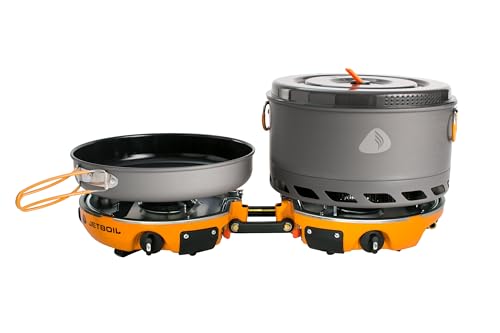
Jetboil Genesis Basecamp Two-Burner Stove System (GNSY, Orange)
A two-burner propane stove that folds and packs with its own 5 L pot and 10-inch fry pan into a 10.3 x 7.2-inch bag. Each burner is rated at 10,000 BTU/h with fine simmer control. It costs considerably more than suitcase-style stoves and, per Jetboil's manual, is for outdoor use only.