Best Cooktops for Van Life: Complete Guide
Induction, butane, or propane? Power math, indoor safety, cold-weather strategy, and the best van life cooktops at every price tier for 2026.
Disclosure: As an Amazon Associate I earn from qualifying purchases. Links to Amazon on this page are affiliate links: if you buy through one, VanLifeKitchens.com may earn a commission at no extra cost to you. Read our affiliate disclosure.
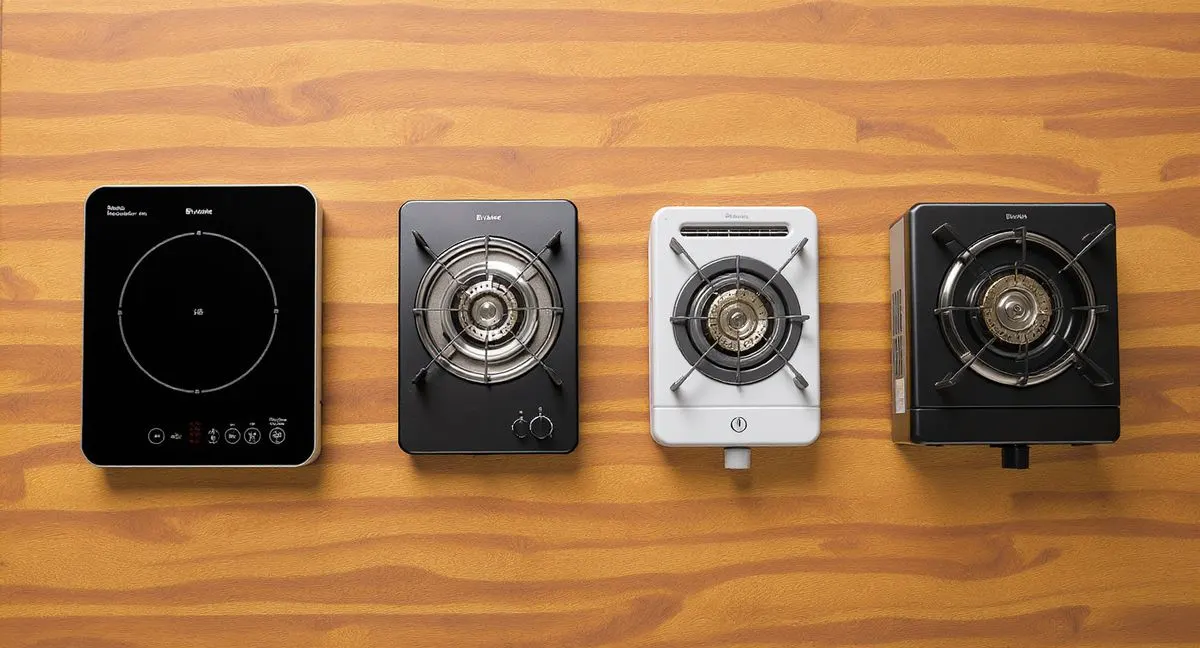
The cooktop sets the rhythm of a van kitchen, and in a van the first question isn't heat or price. It's where you're allowed to cook. Every fuel-burning stove on this site (butane, propane, canister and wood) is labelled by its manufacturer for outdoor use. Only the induction cooktops are designed for indoor use. Once you know that, the rest of the decision (power system, climate, how much you cook) falls into place.
Product specs in this guide come from manufacturer manuals and product pages and from the Amazon listings our buttons link to; the sources we checked are listed at the end. We don't test products ourselves.
Short answer
- Cooking inside the van, with a real electrical system: the Duxtop 9100MC induction cooktop (1,800 W). It needs an inverter of about 2,000 W continuous or more and a battery that can deliver roughly 170 A at 12 V.
- Inside, with a smaller inverter or for precise low-temperature cooking: the Nuwave PIC Gold (sold as the Nuwave Gold Precision), 1,500 W with 900 W and 600 W settings.
- Outdoor backup, or a weekend van with no electrical system: the budget Gas One GS-1000G butane stove, or the better-built Iwatani Cassette Feu if butane will be your main outdoor stove.
- Cooking outdoors in cold weather, or for two or more: the Coleman Triton+ two-burner propane stove, or the higher-output Camp Chef Everest 2X.
- Van plus backpacking: add the MSR PocketRocket 2.
A common pattern is induction inside for everyday cooking plus one outdoor fuel stove for backup and winter.
Who this guide is for
It's for anyone building or upgrading a kitchen in a camper van, panel van, minivan or SUV conversion, from weekenders with no electrical system to full-timers with a large lithium bank. It covers mild-weather and winter travel, and both sides of the main fork: building an electrical system big enough for induction, or cooking outdoors on fuel.
How you travel changes the answer:
- Weekend and fair-weather trips, no house battery: an outdoor butane or propane stove is the realistic choice. You'll cook at a table beside the van. The weekend car-camping kitchen checklist covers the rest of the kit for this kind of trip.
- Full-time, with 200 Ah or more of lithium, a large inverter and solar: induction can be your indoor primary, with a fuel stove for outdoor and backup cooking.
- Regular sub-freezing nights: propane outdoors is the dependable fuel; butane struggles and induction depends on a warm, charged battery.
- Small vehicles (minivans, SUVs): storage is tight, so a drawer-sized induction plate or cassette stove beats a wide two-burner.
It's not for fixed RV galleys with built-in gas ranges and ovens, which are installed appliances with their own codes and installers, or for anyone hoping to find a fuel stove that's approved for use inside a van. We didn't find one among the stoves here.
How to choose
1. Where will you cook? If you want to cook inside the van (rain, cold, privacy, stealth parking), induction is the only option here. Every fuel stove on this site says outdoor use only, and the Camp Chef manual also says not to use it "in or on recreational vehicles". If you're happy to cook outside, fuel stoves are cheaper and need no electrical system.
2. What power or fuel do you have? Induction needs an inverter whose continuous rating exceeds the cooktop's draw (1,500–1,800 W at full power, plus other loads), a battery and BMS that can supply 140–175 A at 12 V, and charging to replace roughly 30–60 Ah per cooked meal. Without that, choose between butane and propane.
3. What's your coldest regular climate? Butane fades near freezing. Propane keeps working far below it. Induction works in any air temperature, but lithium batteries generally can't be charged below about 32°F, and winter solar is weak.
4. How much do you cook? Coffee and noodles need one burner. Two or three real meals a day for two people benefit from two burners (two-burner propane, or two induction plates if your inverter can carry them) and good simmer control.
5. What cookware do you have? Induction needs a magnetic base. If your pots are aluminium or titanium, switching to induction means new cookware.
6. How much space can you give it? Induction plates and cassette stoves are drawer-sized. Two-burner propane stoves are around two feet wide and need a shelf, plus space for fuel stored away from heat.
Comparison table
| Model | Fuel / power | Output | Where to use | Best for |
|---|---|---|---|---|
| Duxtop 9100MC | Induction, 120 V | 1,800 W | Inside | Daily indoor primary |
| Nuwave PIC Gold | Induction, 120 V | 1,500 W | Inside | Low-temp precision |
| Gas One GS-1000G | Butane 8 oz | 7,650 BTU | Outdoor only | Budget backup |
| Iwatani Cassette Feu | Butane 8 oz | 12,000 BTU/hr | Outdoor (camp) | Butane primary |
| Coleman Triton+ | Propane 16 oz | 2 x 11,000 BTU | Outdoor only | Value two-burner |
| Camp Chef Everest 2X | Propane, 1–20 lb | 2 x 20,000 BTU | Outdoor, not on RVs | High output |
| GSI Selkirk 460+ | Propane 16 oz | 2 x 10,000 BTU/h (CSA) | Outdoor only | Compact two-burner |
| MSR PocketRocket 2 | Iso-propane canister | About 8,200 BTU | Outdoor only | Van plus trail |
| BioLite CampStove 2+ | Wood | About 3,000 W | Outdoor only | Forest camps |
The picks
Duxtop 9100MC Portable Induction Cooktop (1,800 W)
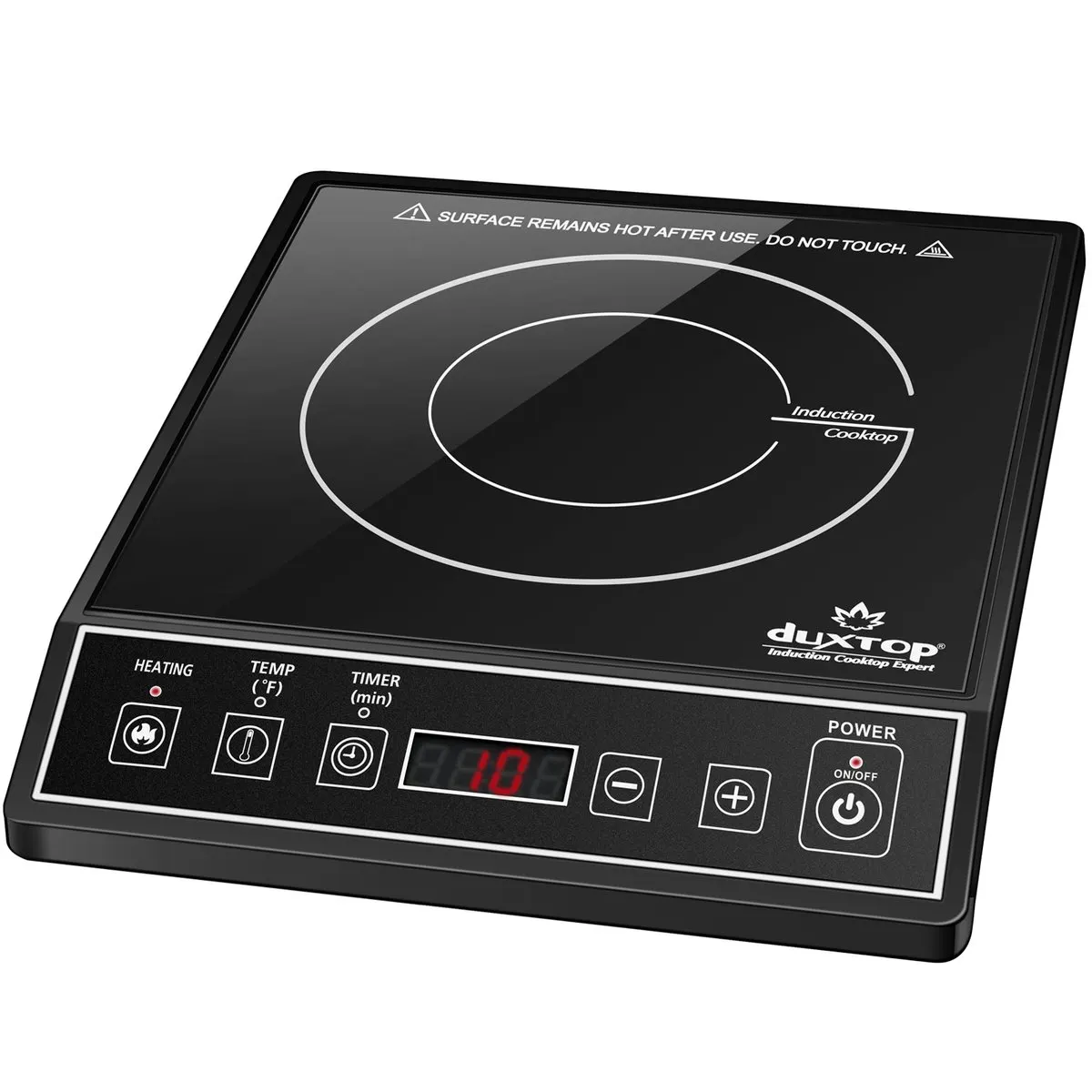
What it is: a budget single-burner induction plate with push-button controls, a ceramic glass top and a maximum of 1,800 W on a 120 V / 15 A outlet. The current listing advertises 20 power levels from 100 to 1,800 W and temperature settings from 100 to 460°F; Duxtop's US manual describes 15 levels from 200 to 1,800 W.
Choose this if:
- you want to cook inside the van without combustion gases;
- you have, or are building, about 2,000 W of continuous inverter capacity and 200 Ah or more of lithium;
- you prefer buttons to a touch panel.
Skip this if:
- your inverter or battery can't supply about 2,000 W / 170 A;
- you don't want to replace aluminium or titanium cookware.
Fit, operation and maintenance: about 2.5 inches thick and 6.2 lb per the listing, so it fits a drawer. Duxtop's manual asks for a dedicated outlet and about 4 inches of fan clearance. Keep it dry and blow out the fan vents occasionally. The listing gives a 2-year warranty.
Strengths and limitations: fast for a portable (roughly four minutes for a covered litre by our estimate; Duxtop publishes no boil time), cheap to replace, usable in any weather if the battery is healthy. The fan and button beeps are audible; at low settings it cycles the element; 12-inch pans heat unevenly. Full Duxtop 9100MC review.
Nuwave PIC Gold (Gold Precision Induction Cooktop, 1,500 W)
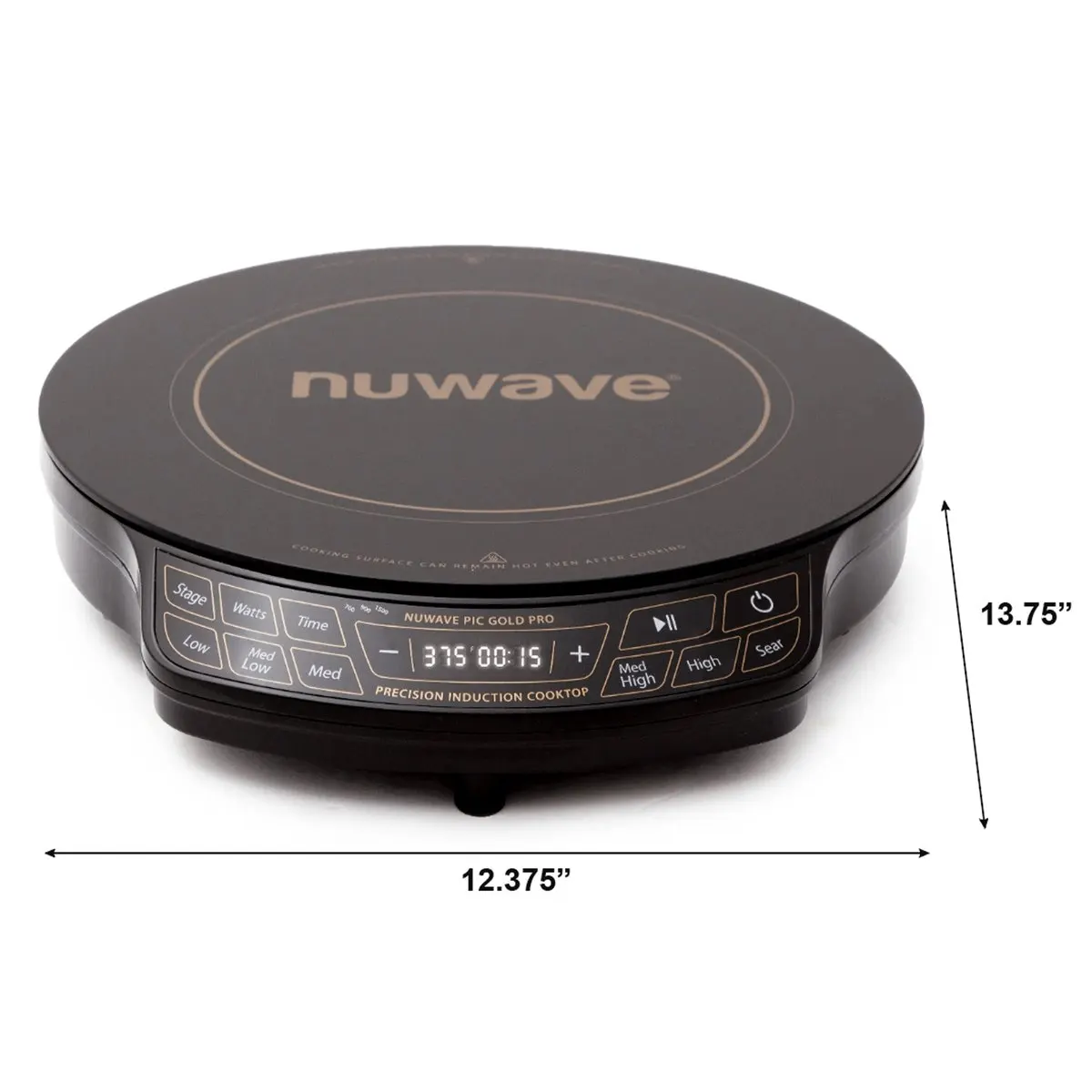
What it is: a 1,500 W induction plate with an 8-inch coil and a touch panel that sets a target temperature from 100°F to 575°F. Nuwave sells the PIC Gold under the "Gold Precision" name; the listing's model number is PIC GOLD. Wattage can be set to 1,500, 900 or 600 W.
Choose this if:
- you cook delicate things at low temperatures: chocolate, custards, slow sauces;
- your inverter is around 2,000 W, or smaller and you'll use the 900 W setting;
- you want indoor induction that's easier on the electrical system.
Skip this if:
- you want the fastest boil;
- you dislike touch panels.
Fit, operation and maintenance: Nuwave's manual says it is for household use and "not intended for outdoor use", needs its own outlet, operates between 85 and 144 V, and needs 3 inches of free space at the back, sides and top. The listing gives a 1-year warranty.
Strengths and limitations: its temperature presets (100–575°F) suit steady low-temperature holding better than power-level plates; selectable wattage helps small systems. It's slower to boil, and touch panels can be fussy with wet fingers. Full Nuwave PIC Gold review and the Duxtop vs Nuwave comparison.
Gas One GS-1000G Portable Butane Stove (budget tier)
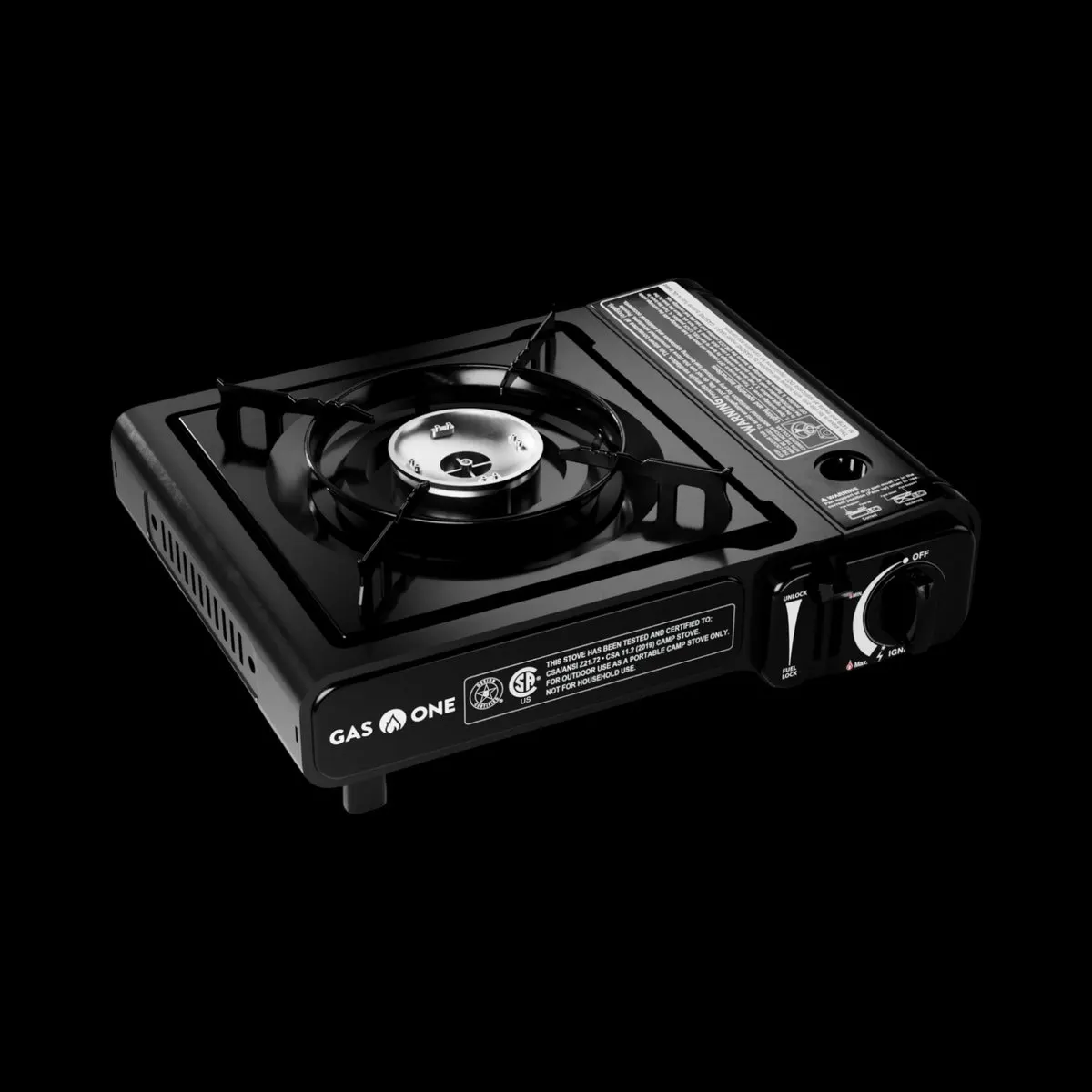
What it is: a budget single-burner butane cassette stove. The review page's URL mentions the GS-3000, but the Amazon listing our button links to is the GS-1000G, rated 7,650 BTU, with piezo ignition and safety shut-off, CSA approval and a carrying case. The listing says "OUTDOOR USE ONLY".
Choose this if:
- you want a cheap outdoor backup for an induction van;
- you're a fair-weather weekender who cooks at a camp table;
- you want something drawer-sized with nothing to install.
Skip this if:
- you need to cook inside;
- you cook near or below freezing;
- you want strong heat or two burners.
Fit, operation and maintenance: 13.5 x 11 x 4.45 inches and 3.1 lb per the listing; uses 8 oz butane canisters only. Keep a long lighter in the case in case the piezo weakens. Never let a pan overhang the canister compartment.
Strengths and limitations: very low cost, compact, ejects the canister if pressure climbs too high. Modest output, basic build, weak in the cold; we couldn't find a Gas One manual online. Full Gas One review.
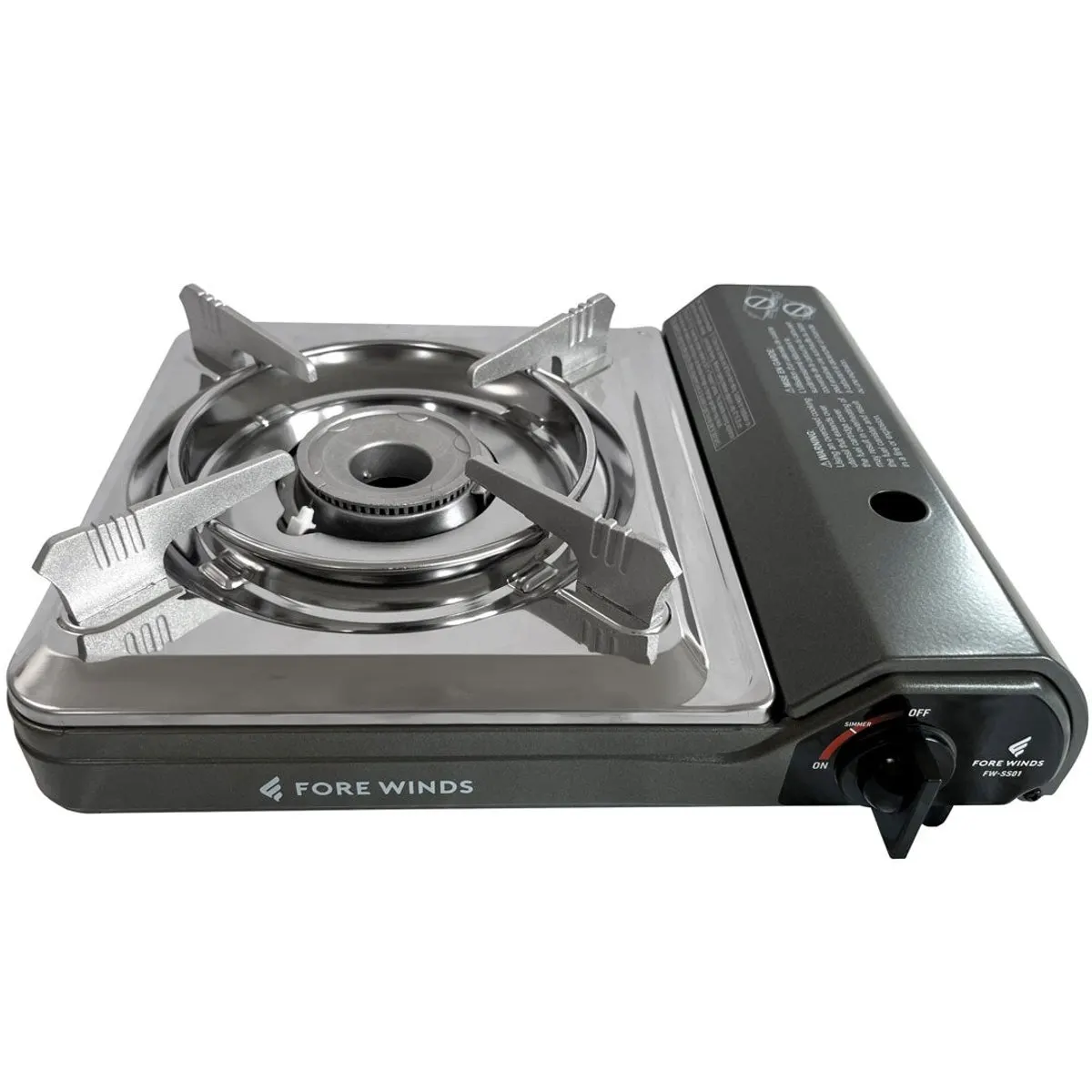
Iwatani Cassette Feu Butane Stove (Gray, VA-30 / Fore Winds FW-SS01)
What it is: Iwatani's current single-burner cassette stove on Amazon, rated 12,000 BTU/hr, with a built-in stainless windbreaker, a magnetic canister lock, Iwatani's heat panel and a pressure-sensing safety stop. The listing's model field says VA-30; the photos show the Fore Winds FW-SS01.
Choose this if:
- butane will be your main stove for outdoor cooking;
- you cook in breezes, where the windbreaker helps;
- you want a better-built stove than budget models.
Skip this if:
- you need to cook inside;
- it's only an emergency backup (the Gas One costs much less).
Fit, operation and maintenance: about 13 x 11 x 3.8 inches with a hard case; about 70 minutes per canister at full power by Iwatani's figure. Iwatani's Cassette Feu manual (the ZA-3HP edition, an earlier model) allows indoor use only in commercial restaurants, and says that as a camp appliance it is "outdoor only" and "may not be used indoors in tents, campers, apartments or other confined areas."
Strengths and limitations: steadier output as the can empties, fine simmer control, and the windbreaker is a real upgrade. It costs considerably more than budget butane stoves, and butane still struggles in the cold. Full Iwatani review and Duxtop vs Iwatani.
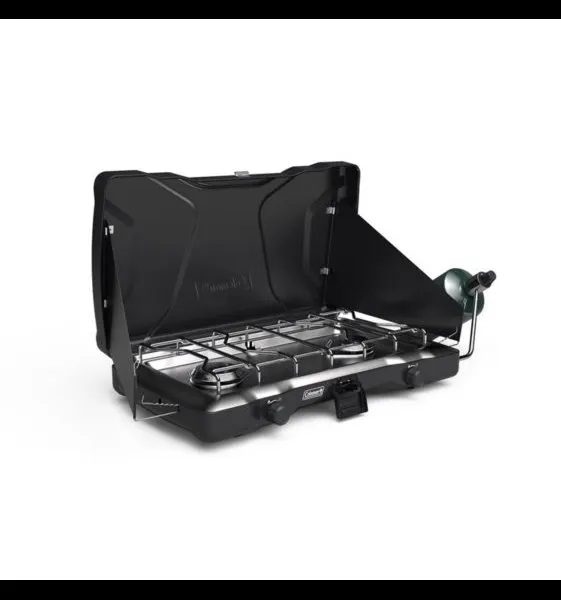
Coleman Triton+ 2-Burner Propane Stove with InstaStart (2157318)
What it is: a mid-range, regulated two-burner propane stove: 22,000 BTU total (11,000 per burner), PerfectFlow regulation, InstaStart push-button ignition, a removable chrome-plated grate and an aluminized steel cooktop. The review URL says "Triton"; the listing is the Triton+.
Choose this if:
- you cook outdoors for two and want two burners;
- you cook in the cold or at altitude, where propane and a regulator help;
- you want a mid-range price and a three-year limited warranty.
Skip this if:
- you want to run it from a bulk tank (the manual says 16 oz disposable cylinders only);
- you need to cook inside.
Fit, operation and maintenance: about 22 inches wide closed, so it needs a shelf. Coleman's manual says "For outdoor use only", "Never use inside house, camper, tent, vehicle or other unventilated or enclosed areas" and "Not for home or recreational vehicle use", with clearances of 12 inches at the sides and 48 inches above. Up to an hour on high per 16 oz cylinder, per the listing.
Strengths and limitations: two burners, cold-weather tolerance, push-button lighting. Mid-level output per burner; cylinder fuel is costly per meal and wasteful. Full Coleman Triton+ review and Duxtop vs Coleman.
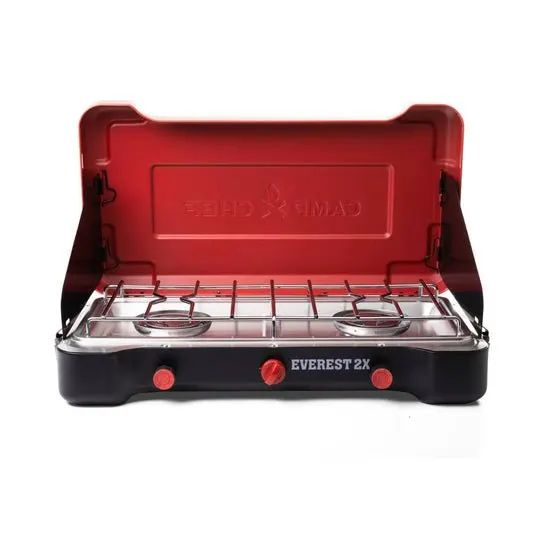
Camp Chef Everest 2X (MSHPX)
What it is: a premium two-burner propane stove: two 20,000 BTU burners (40,000 BTU/hr total), 215 square inches of cooking area, matchless ignition, and a lid that doubles as a windscreen.
Choose this if:
- you cook substantial outdoor meals for two or more;
- you want to run from a refillable tank (the manual allows up to 20 lb with Camp Chef's HRDSP hose);
- you set up a freestanding outdoor kitchen at camp.
Skip this if:
- you want to cook on or attached to the van;
- storage is tight.
Fit, operation and maintenance: Camp Chef's booklet says "For OUTDOOR use only" and "Do NOT use in or on recreational vehicles or boats", requires 2 feet of clearance from the sides, front and back to any construction, and no overhead construction. Store refillable tanks outdoors and never inside a vehicle. The booklet's warranty table lists 1 year for cooking systems; check Camp Chef's current terms.
Strengths and limitations: the highest output here, bulk-tank capable. It's the bulkiest and most expensive fuel stove on this site, with the strictest location rules. Full Camp Chef Everest 2X review.
GSI Outdoors Selkirk 460+ (compact two-burner alternative)
What it is: a two-burner propane stove with a regulator, push-button piezo ignition and wraparound windscreens, in a flat powder-coated steel box that GSI sizes at 18.3 x 12.9 x 3.8 inches. GSI rates each burner at 10,000 BTU/h (CSA). The Amazon title says 14,000 BTU, which GSI's own page doesn't support, so plan around GSI's figure.
Choose it over the Triton+ if you want two burners in a box that slides into a shallow drawer or under a bench, and you can accept slightly less heat and smaller pans: GSI says an 8-inch and a 10-inch pot fit side by side. GSI lists a lifetime warranty against material and workmanship defects.
Where to use it: GSI's product page says "This stove is for OUTDOOR USE ONLY" and to never use it in a tent, vehicle, house or any enclosed area. GSI doesn't publish clearances, burn time or a bulk-tank option, so follow the instructions in the box. Full GSI Selkirk 460+ review.
MSR PocketRocket 2 Mini Stove
What it is: a 2.6 oz canister stove that folds to 2 x 2 x 3 inches; MSR rates it at a 3.5-minute litre boil.
Choose this if:
- you also backpack or hike overnight;
- your cooking is mostly boiling water.
Skip this if:
- you need pans wider than 8 inches (MSR's limit);
- you cook exposed in wind.
Fit, operation and maintenance: MSR's manual says "FOR OUTDOOR USE ONLY", "Never use this stove in an enclosed space such as a camper, tent, car, or home", never to use a reflector or diffuser, and to use MSR 80/20 isobutane-propane canisters certified to EN 417. No igniter, so carry a lighter.
Strengths and limitations: tiny, light and quick for boiling, and isobutane-propane handles cold better than pure butane. Small burner, wind-sensitive. Full PocketRocket 2 review.
BioLite CampStove 2+
What it is: a fan-assisted wood-burning stove with a 3 W thermoelectric USB charger and a 3,200 mAh battery; 2.06 lb, 4.5-minute litre boil by BioLite's listing.
Choose this if:
- you camp in forests with dry wood where gathering is allowed;
- you want a small USB top-up from cooking.
Skip this if:
- you camp where fire restrictions are common (wood stoves are often banned when valve-controlled gas stoves are still allowed);
- you need a stove for rain or wet seasons.
Fit, operation and maintenance: BioLite's instructions say "This stove is for OUTDOOR USE ONLY. Never for use in tents, vehicles, indoors, or other places without fresh air," with flammables 18 inches from the sides and 48 inches above. Extinguish embers fully after use.
Strengths and limitations: free fuel and off-grid charging in the right conditions; needs dry fuel, constant tending and a learning curve. Full BioLite review and the BioLite vs PocketRocket comparison.
For baking: the Omnia Stove-Top Oven sits on a gas burner and bakes bread and casseroles. Omnia says it does not work on induction, so it pairs with the outdoor fuel stoves above, ideally a two-burner propane stove.
Operating location: what each manufacturer says
This is the most important table in the guide. It reflects the manufacturer's own manual or listing wording, not our opinion.
| Cooktop | Manufacturer's statement | Source |
|---|---|---|
| Duxtop 9100MC | Household appliance; dedicated 120 V outlet | Duxtop manual, listing |
| Nuwave PIC Gold | "Not intended for outdoor use" | Nuwave manual |
| Gas One GS-1000G | "OUTDOOR USE ONLY" | Gas One listing |
| Iwatani Cassette Feu | Camp use "outdoor only" | ZA-3HP manual |
| Coleman Triton+ | "For outdoor use only" | 5461 Series manual |
| Camp Chef Everest 2X | Outdoor only; not in or on RVs | MSHPX booklet |
| GSI Selkirk 460+ | "OUTDOOR USE ONLY"; never in a vehicle | GSI product page |
| MSR PocketRocket 2 | "FOR OUTDOOR USE ONLY" | MSR manual |
| BioLite CampStove 2+ | "OUTDOOR USE ONLY" | BioLite instructions |
What "outdoor use" means for a van. Cook at a table beside the van, on a tailgate, or at the open slider with the stove and the cook outside the vehicle. Keep the stove's required clearances from the van, the awning and anything combustible (Coleman: 12 inches to the sides and 48 inches above; BioLite: 18 inches and 48 inches; Camp Chef: 2 feet from the sides, front and back, and nothing overhead). If you need a surface to cook on outside, GCI Slim-Fold Cook Station vs Compact Camp Table 20 compares two folding tables for holding a camp stove beside the van; a table doesn't change where a stove can be used.
What doesn't change it. A cracked window, an open slider with the stove on the counter, a roof fan or a CO alarm does not make an outdoor-only stove acceptable inside. A CO alarm is a last-line warning device that every van with any fuel appliance should have, not permission.
Two kinds of ventilation. Combustion ventilation means supplying air to a flame and carrying away carbon monoxide, carbon dioxide, nitrogen dioxide and water vapour; that's what the outdoor-only labels are about. General cooking ventilation means removing steam, grease, odour and heat, and it applies to induction too. A roof fan is good for the second; it isn't a substitute for the first. The van kitchen ventilation guide covers fan placement for general cooking ventilation.
Induction power: the assumptions behind the numbers
All figures below are our estimates from rated draw, not measurements. Assumptions: cooktop draw as stated; inverter efficiency 85–90%; battery 12 V nominal (a LiFePO4 bank sits slightly higher, which lowers amps a little); other loads not included.
| Cooktop setting | Draw from battery | Amps at 12 V |
|---|---|---|
| Duxtop at 1,800 W | 2,000–2,120 W | 167–176 A |
| Nuwave at 1,500 W | 1,670–1,760 W | 139–147 A |
| Nuwave at 900 W | 1,000–1,060 W | 83–88 A |
Inverter size. The inverter's continuous rating (not its surge rating) has to exceed what the cooktop draws at the setting you use plus any other loads, or its overload protection trips. That makes about 2,000 W continuous the floor for the Duxtop at full power and 3,000 W comfortable; the Nuwave fits a 2,000 W inverter with a little headroom. Pure sine wave inverters are the general recommendation for induction cooktops; neither manual makes it an explicit requirement. Both manuals do have voltage limits (Duxtop shows an E3 error; Nuwave lists 85–144 V), so an inverter that sags under load can stop the cooktop. If you plan to run either plate from a portable power station rather than an installed inverter, whether a power station can run an induction cooktop walks through the station's continuous AC rating and usable watt-hours with worked runtime examples.
Battery per cooking session.
| Session | Cooktop energy | Battery at 12 V |
|---|---|---|
| Boil 1 L, ~4 min at 1,800 W | ~120 Wh | ~11–12 Ah |
| Typical dinner, ~25 min mixed | ~350–400 Wh | ~32–39 Ah |
| 20 min at 1,800 W | 600 Wh | ~56–59 Ah |
The "typical dinner" assumes about 5–6 minutes at full power to heat a pan or boil water, then about 20 minutes averaging 600–750 W. Two people cooking two meals a day can plausibly use 50–100 Ah a day on induction, on top of the fridge.
Hardware. Check the battery BMS's continuous discharge rating; a single 100 A BMS can't feed 170 A. Size battery-to-inverter cables and fuses to the inverter's rating. Plan charging (solar plus alternator) to replace what you use, and remember winter solar is weak and LiFePO4 generally can't be charged below about 32°F. An inverter of this size is a substantial install: follow the manufacturer's instructions, and use a qualified RV electrical technician where codes or your insurer require one. Run your own numbers in the power calculator, and see the van kitchen power budget guide.
Why the higher wattage is usually fine. Boiling a litre takes about the same energy at 1,500 W or 1,800 W; the lower-watt plate just takes longer. The reason to choose lower wattage is inverter capacity, not battery savings. Two induction plates at full power would draw about 3,600 W, more than a 3,000 W inverter can supply, so one has to run lower.
Cookware compatibility
- Induction: needs a magnetic (ferromagnetic) base. If a magnet sticks firmly to the bottom, it works. Cast iron, carbon steel and most magnetic stainless work; aluminium, copper, glass, ceramic and titanium don't. Duxtop asks for a base at least 5 inches across, and 8 to 10 inch pans suit both plates.
- Cassette butane stoves: any material, but never cookware that overhangs the canister compartment. Iwatani's label warns against oversized cookware, and reflected heat onto the canister is a known cause of failures.
- MSR PocketRocket 2: cookware no wider than 8 inches, per MSR, and no heavy cast iron.
- Two-burner propane: the widest choice; the Coleman listing says a 12-inch and a 10-inch pan fit together.
- Omnia oven: works on gas burners, not on induction.
Our cookware complete guide covers what to buy if you're switching to induction.
Butane in cold weather
Butane is the most temperature-sensitive fuel here. Pure n-butane boils at about 31°F, so as a canister approaches freezing it can't vaporize fast enough, and output drops; Iwatani quotes its 12,000 BTU/hr rating at 68–77°F ambient. Expect noticeably weaker output in the 40s °F and unreliable lighting near freezing. The canister also chills itself during long, high-heat sessions. Iwatani's heat panel offsets some of that once the stove is running, but can't revive a frozen can.
What helps: store canisters above freezing overnight (inside the van is fine for storage, away from heaters and dashboard sun), take them outside when you cook, and avoid long high-heat sessions on one can. Isobutane-propane canisters (PocketRocket) handle cold better than cassette butane. For regular sub-freezing cooking, use propane outdoors; propane boils at about −44°F. The cold-weather van cooking guide has the full winter playbook.
Fuel and installation safety
- Canister and cylinder storage: keep butane and propane out of direct sun and away from heaters, and never on the dashboard. Camp Chef's booklet says refillable LP tanks must be stored outdoors and never left inside a vehicle.
- Leak checks: with soapy water, outdoors, never a flame (Coleman and Camp Chef manuals).
- Fixed propane systems: a permanently plumbed tank, locker and gas line are a different category from these portable stoves. Follow applicable RV LP-gas standards and the equipment maker's installation instructions, and use a qualified RV gas technician where codes or your insurer require one. Even with a proper locker, these portable stoves' manuals don't permit indoor use.
- Fire safety for all cooktops: keep curtains, paper towels and cabinet faces away from heat, carry a fire extinguisher and fire blanket, secure the cooktop so it can't slide, and never use any stove as a heater. Induction removes combustion, not the risk of hot oil.
- Fire restrictions: many US restriction orders allow only stoves with an on/off valve and prohibit wood-burning stoves; check before using the BioLite.
The van cooking safety guide covers CO, fire, burns and galley layout.
Picks by van profile
| Your situation | Recommended setup |
|---|---|
| Full-time, 200+ Ah lithium, mild climates | Duxtop 9100MC inside + Gas One outdoor backup |
| Weekend trips, no electrical system | Gas One or Iwatani, cooked outdoors |
| Smaller inverter, careful cook | Nuwave PIC Gold inside |
| Regular sub-freezing nights | Coleman Triton+ or Everest 2X outdoors + induction inside |
| Two-burner induction, big bank | Two Duxtops (one at reduced power) + outdoor backup |
| Van plus backpacking | Your main stove + MSR PocketRocket 2 |
The layout tool helps you place a cooktop with clearances, and the power calculator shows whether your battery can carry induction alongside the fridge. For complete example kits built around two of these choices, see the one-person compact van kitchen plan, with a butane stove used outside and no inverter, and the two-person induction kitchen plan, with the Duxtop inside and the battery and inverter sizing worked through.
Buying mistakes to avoid
- Buying a fuel stove to cook inside. None of the fuel stoves here permits it.
- Buying induction before the electrical system. An 1,800 W plate on a small inverter will trip its overload protection.
- Relying on butane for winter. It's a three-season fuel.
- Using oversized pans on a cassette stove. Overhanging the canister bay can overheat the canister.
- Assuming a bulk-tank hose fits any stove. Coleman's Triton+ manual says 16 oz cylinders only; Camp Chef's allows a 20 lb tank with its own hose.
- Forgetting cookware compatibility. Induction needs magnetic pans; the Omnia doesn't work on induction.
Related reading: the cookware materials guide, the solar cooking complete guide for slow cooking without fuel or battery, the Off-Grid Chef ProMaster setup for a two-plate induction galley, the 12V fridges complete guide for the other big kitchen load, and every model in the cooktops category.
Frequently asked questions
What is the best cooktop for van life?
It depends on where you'll cook. For cooking inside with a real electrical system, the Duxtop 9100MC induction cooktop; the Nuwave PIC Gold if you have a smaller inverter or want precise low temperatures. For outdoor cooking without an electrical system, a butane stove (the budget Gas One GS-1000G, or the Iwatani Cassette Feu if butane is your main stove), or the Coleman Triton+ or Camp Chef Everest 2X propane stoves for two burners and cold weather.
Is induction or gas better for van cooking?
Induction is the only option here designed for indoor use: no combustion gases, instant response and precise control, but it needs a large inverter and battery bank. Gas (butane or propane) needs no electrical system and handles winter better (propane especially), but every gas stove here is labelled for outdoor use. Running both is a common arrangement. See our induction vs butane vs propane guide.
Can I run an induction cooktop in a van?
Yes, if the electrical system supports it. Assuming 85–90% inverter efficiency at 12 V, an 1,800 W cooktop draws about 167–176 A and a 1,500 W cooktop about 139–147 A. You need an inverter whose continuous rating exceeds that load plus anything else running, a battery and BMS that can supply the current, and charging to replace roughly 30–60 Ah per cooked meal.
Is it safe to cook with butane or propane inside a van?
The manufacturers of every butane and propane stove on this site say no. Coleman's manual says "For outdoor use only" and "Never use inside house, camper, tent, vehicle"; Camp Chef's says not to use it "in or on recreational vehicles"; Iwatani's says camp use is "outdoor only" and not in campers; Gas One's listing says "OUTDOOR USE ONLY". Ventilation and a CO alarm don't change that. Cook outside the van, for example at a table by the open slider.
Why does my butane stove stop working in cold weather?
Butane boils at about 31°F, so as the canister cools it can't vaporize fast enough to feed the burner; the canister also chills itself as fuel evaporates. Output drops in the 40s °F and the stove becomes unreliable near freezing. Storing canisters warm helps a little; for regular sub-freezing cooking, switch to propane, used outdoors.
How many BTUs do I need for van cooking?
A single burner around 7,500–12,000 BTU handles coffee, boiling and one-pan meals for one or two. Two burners matter more than raw BTUs once you cook multi-part meals. High-output stoves like the 20,000 BTU-per-burner Camp Chef Everest 2X help with big pots and searing, and come with stricter clearance rules.
Can I use a regular home cooktop in a van?
It isn't recommended. Residential cooktops aren't designed for road vibration or tight galley clearances, and household gas appliances need a proper installation and ventilation under gas codes. A portable induction plate is the practical indoor option.
Do I need special cookware for an induction cooktop?
Yes. Induction only works with magnetic cookware: cast iron, carbon steel and most magnetic stainless. If a magnet sticks firmly to the base, it works. Aluminium, copper, glass, ceramic and titanium won't heat.
Sources and verification
We opened these manufacturer documents and pages while preparing this guide:
- Coleman, 5461 Series Propane Stoves instructions (manual PDF attached to the Triton+ Amazon listing): outdoor-only wording, clearances, 16 oz cylinders only, 3-year warranty. Checked 2026-10-09.
- Camp Chef, Everest High Pressure Stove Warning & Instruction Booklet, model MSHPX (2020): outdoor-only and no-RV wording, 2 ft clearance, bulk tank via HRDSP hose, warranty table. Checked 2026-10-09.
- Camp Chef, Everest 2X product page: burner output, cooking area, ignition. Checked 2026-10-09.
- Iwatani Corporation of America, Cassette Feu Portable Butane Gas Stove manual, model ZA-3HP (manual PDF hosted on Amazon): indoor/outdoor wording, CO warning, 12,000 BTU/h rating conditions. Checked 2026-10-09.
- GSI Outdoors, Selkirk 460+ product page: outdoor-only and carbon monoxide wording, burner output (CSA and CE), dimensions, pot fit, lifetime warranty. Checked 2026-10-13.
- MSR, PocketRocket 2 instruction manual (manual PDF attached to the Amazon listing): outdoor-only wording, 8-inch cookware limit, fuel specification. Checked 2026-10-09.
- BioLite, CampStove 2 instruction manual (via ManualsLib): outdoor-only and CO wording. Checked 2026-10-09.
- Nuwave, PIC Gold Precision Induction Cooktop owner's manual (manual PDF attached to the Amazon listing): household-only wording, wattage settings, temperature steps, clearance. Checked 2026-10-09.
- The Amazon product listings our buttons link to, for each stove above (product details and manufacturer bullet points, including Gas One's "OUTDOOR USE ONLY" and Omnia's "Does not work on induction"). Checked 2026-10-09.
We could not find a Gas One manual for the GS-1000G or an Iwatani manual for the VA-30/FW-SS01 online, and the Duxtop manual PDF on the listing wasn't readable as text; Duxtop details here come from the listing and Duxtop's published US manual as described above.
Products covered in this guide
Disclosure: As an Amazon Associate I earn from qualifying purchases. Links to Amazon on this page are affiliate links: if you buy through one, VanLifeKitchens.com may earn a commission at no extra cost to you. Read our affiliate disclosure.
More in Buying Guides
Best Van Life Cookware Sets: Complete Guide
The two-pan kit, the best nesting cookware sets by budget, induction compatibility, cast iron care without an oven, and how to stow pans so they never rattle.
Best Water Filters for Van Life: Complete Guide
What van water filters actually remove — bacteria, protozoa, viruses, metals, chemicals — plus certifications, a layered setup for full-timers, winterizing, and our 2026 picks.
Best Van Kitchen Storage: Complete Organizing Guide
How to organize a van kitchen that survives washboard roads: pantry tiers, spices, cookware, fridge and knife storage, plus the best bins and cases by budget.