ThermoWorks Thermapen ONE Instant-Read Thermometer
- Response Time
- About 1 second (ThermoWorks)
- Accuracy
- ±0.5°F (±0.3°C) in key temperature ranges (ThermoWorks)
- Waterproof
- IP67; immersion to 39 in for 30 min (manual)
- Battery
- 1 x AAA, up to 2,000 hours (manual)
- Calibration
- NIST-traceable certificate; not user-recalibratable (ThermoWorks)
- Warranty
- 5 years (ThermoWorks)
Overview — Who is this for?
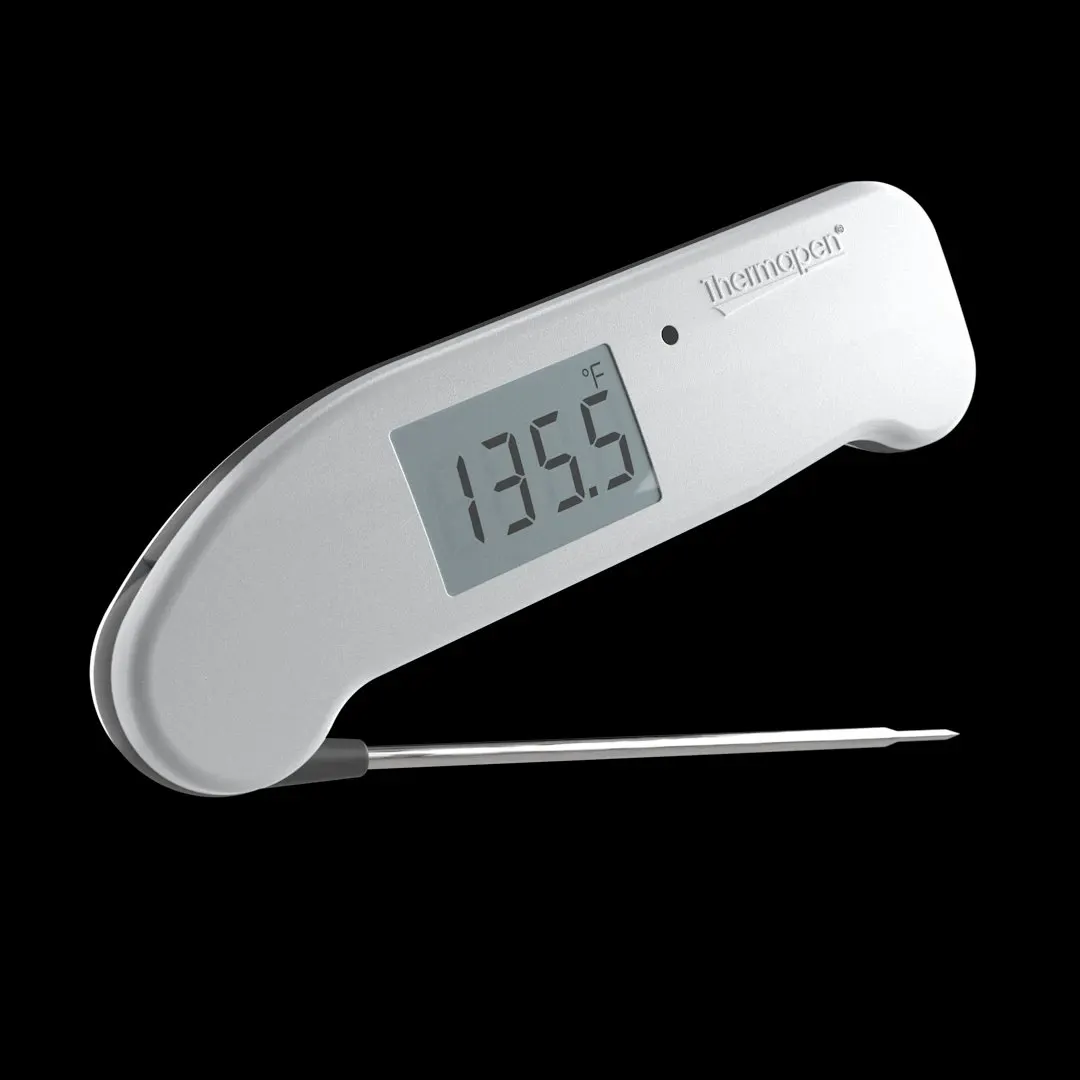
The ThermoWorks Thermapen ONE is a fold-out instant-read thermometer that ThermoWorks rates at about one second per reading and ±0.5°F (±0.3°C) accuracy "in key temperature ranges." It sits at the premium end of instant-read thermometers. What you get for that is speed, a sealed IP67 body, a display that rotates to suit either hand, and a five-year warranty.
What the Amazon link sells: the ThermoWorks Thermapen ONE in Cayenne Pepper Red (part number THS-AMN5-646). The listing gives a size of 1.9 x 6.1 x 0.75 in and a weight of 0.25 lb. It includes a NIST-traceable calibration certificate, and the listing says the unit is NSF certified.
Choose this if:
- You cook meat, poultry or fish several times a week and want a fast, trustworthy reading.
- You cook on heat sources that are uneven or hard to control, such as a single-ring butane burner, a solar oven or a campfire grate.
- You want a sealed thermometer that survives splashes and a drop into the wash bin.
Skip this if:
- You cook protein only occasionally. A budget instant-read thermometer, used carefully, is adequate for food safety.
- You want a leave-in probe that monitors a roast while it cooks.
- You want USB charging. The Thermapen ONE runs on one AAA battery.
Why fast readings matter in a van
Fridge temperatures in a van drift with battery state and ambient heat, a solar oven has no thermostat, and a small butane burner heats a skillet unevenly. Any of these can leave a piece of chicken cooked through at one end and underdone at the other. An instant-read thermometer turns that guess into a number. The Thermapen ONE's selling point is how quickly it gives you that number.
ThermoWorks' operating instructions say the Thermapen ONE "will read to within 1°F of the actual temperature of an ice bath within one second," and add that reading times in other foods "may vary slightly." In practice that means you stab, read and decide while the pan stays on the heat. With a slower thermometer you hold the probe in the meat while the number climbs, which means more time with your hand over a hot pan and more time for thin cuts like fish fillets to overcook.
Speed helps most with solar cooking. Opening the lid of a GoSun Sport or a Sunflair lets accumulated heat escape, and a solar cooker is slow to get it back. A thermometer that reads in a second or two lets you check and close up quickly. That is the difference between one short heat loss and a long one.
Accuracy — what ThermoWorks actually publishes
ThermoWorks' current product description says "±0.5°F accuracy in key temperature ranges." The Amazon listing gives the same ±0.5°F (±0.3°C) figure alongside the NIST-traceable certificate that comes with each unit. ThermoWorks' help center explains how to check this yourself: in a properly made ice bath, an accurate Thermapen ONE "will read within ± 0.5°F of 32°F (31.5 to 32.5°F)."
An earlier version of this review gave a specific temperature band for the ±0.5°F rating and a wider tolerance outside it. We couldn't confirm those figures on a ThermoWorks page we could open, so they have been removed. The accurate summary is that ThermoWorks qualifies the ±0.5°F figure as applying to key temperature ranges. If you need the exact band for professional or regulatory use, ask ThermoWorks for its spec sheet.
Calibration: the help center says the Thermapen ONE is not user-recalibratable. If the ice-bath check fails or the unit shows a calibration error, contact ThermoWorks support; the manual describes a repair service. An earlier version of this review said you could calibrate it yourself in ice water or boiling water. That was wrong. You can check accuracy at home, but you can't adjust it.
Why accuracy matters for food safety
The USDA's safe minimum internal temperatures are 165°F for poultry, 160°F for ground beef, and 145°F with a three-minute rest for whole cuts of beef and pork. Those are thresholds, and a thermometer that reads a few degrees high could tell you chicken is done when it isn't. Accuracy is only half the job, though. Probe placement matters just as much:
- Measure the thickest part, away from bone.
- On large pieces, check more than one spot.
- The manual gives a minimum immersion of only 1/8 inch (3 mm), because the sensor is at the very tip. A thin cut still reads properly, but you need the tip in the centre of the meat, not near the surface.
Using it: power, display and settings
On and off. Unfolding the probe turns the thermometer on. Folding it away and pressing the tip into the rubber retainer turns it off. ThermoWorks warns against opening the probe past 180°, which can damage the rotating hub. There is also a motion-sensing sleep mode: with the probe open, the unit sleeps after a set time without movement and wakes when moved. That makes a dead battery from leaving it switched on much less likely.
Display. The display rotates automatically, so it reads the right way up in either hand. An "intelligent backlight" switches on in low light, and also when you cover the light sensor beside the display (except in bright conditions). That helps when you're cooking after dark by a single LED strip.
User settings. The manual describes two small buttons inside the battery compartment, reached by removing one Phillips screw. They let you:
- switch between °F and °C;
- change the resolution between 1° and 0.1°;
- set the screen rotation (full 360°, 180°, or locked);
- set the sleep interval, from 10 to 180 seconds or off.
A small Phillips screwdriver is all you need. If your van toolkit lacks one, add one to the kitchen drawer.
IP67 sealing — what it does and doesn't cover
The manual describes the Thermapen ONE as "protected from dust and immersion in water to 39" depth for up to 30 minutes." That is the IP67 rating in plain terms. It survives a dunk in the wash bin, a splash at the galley sink and dusty desert campsites. ThermoWorks also lists limits:
- Not dishwasher safe, according to the manual.
- Keep oil and flour off the hub. The probe pivots in a rotating hub with an O-ring seal. The manual and help center both say oils, moisture, flour or fine powders can work past the seal over time and may cause failure. Don't push the probe in all the way to the hub, and wipe the hub after greasy jobs.
- Don't rotate the probe while it's submerged or under running water.
- Keep the body away from heat. The manual says in capitals not to leave it in an oven or on a hot surface. In a van, the edge of a stove or the dash in full sun counts as a hot surface.
- Avoid isopropyl alcohol (IPA) and solvents. The manual warns they can damage the case and screen. Clean with a damp cloth or a mild antimicrobial solution instead.
The probe needs care too. The manual says the shaft is hollow and contains the sensor, so if it bends, it may fail. Don't stab hard food, avoid bone, and don't use the probe to lift or flip food.
How it fits a van kitchen
Size and storage. The Amazon listing gives about 6.1 inches long folded and 0.25 lb. It goes in a utensil drawer next to the tongs. ThermoWorks sells protective wallets, a magnetic boot and a wall bracket. A wall mount near the stove keeps the thermometer from rattling around on rough roads.
Battery planning. The manual rates the pre-installed AAA at up to 2,000 hours. The backlight draws extra power, so night cooking shortens that. If you cook once or twice a day and take a few readings each time, a battery should last a long time. Carry one spare AAA anyway. When the battery runs low, the manual says the backlight dims to save power, and the display shows "Flat", then "Bat", before the unit shuts down.
Cold and heat. ThermoWorks' manual covers what happens to the body near heat, not cold-weather use. Instruments with LCD screens usually respond slowly in hard frost, so keep the thermometer inside the living space on winter trips rather than in an outside locker. See our cold-weather van cooking guide for the rest of a winter kitchen.
Other jobs it does in a van:
- Fridge checks. Leave a glass of water in your 12 V fridge and probe the water rather than the air. Liquid gives a steadier reading. For continuous monitoring, a dedicated fridge thermometer like the AcuRite 00986M is better, because the Thermapen only gives spot readings.
- Coffee water. If you brew pour-over with a gooseneck kettle, it tells you when the water is in the range your recipe calls for.
- Frying oil. You can check oil temperature with the tip, but keep the body well clear of the pan and remember the manual's warning about hot surfaces.
Thermapen ONE vs budget instant-read thermometers
Many budget instant-read thermometers are rated at a few seconds per reading. Most have splash resistance rather than IP67 immersion protection, and some have fixed displays. The useful questions when comparing are:
- How fast is the rated reading, and does the maker say under what conditions? ThermoWorks gives its ice-bath condition in the manual.
- What is the accuracy figure, and over what range?
- What is the water-resistance rating? Splash resistance and IP67 immersion protection are different things.
- Does it come with a calibration certificate, and can it be checked or serviced?
- What does the warranty cover? ThermoWorks gives five years.
For an occasional cook, a budget thermometer used with good probe placement gives a safe answer. It just takes longer, and you may want to check its accuracy in an ice bath when it's new. The Thermapen ONE is worth the premium mainly if you cook protein most days, cook on heat you can't control well, or want one thermometer that will last years of daily handling.
Limitations
Price. It is a premium tool. The money buys speed and build quality, not a safer answer than a good budget thermometer gives when used carefully.
Single purpose, spot readings only. It isn't a leave-in probe and has no alarm or remote monitoring.
AAA battery, not USB. The battery life is long, but it is still a battery you need to carry spares of.
Not user-calibratable. You can check it, but correcting a drift means contacting ThermoWorks.
Model transition. When we checked ThermoWorks' site, it was running a "Color Closeout" on the Thermapen ONE. Before you buy, check that the Amazon listing title still names the Thermapen ONE. If a newer model has replaced it, its specs will differ from those on this page.
Care and storage
The manual's guidance is to wipe the probe after each use and clean the whole body regularly, with sanitizing wipes or a damp towel and an antimicrobial solution. Wipe oil off the hub. Store it with the probe folded. Never put it in the dishwasher, and keep it away from hot surfaces. Change the AAA battery when the battery symbol appears. When you refit the battery cover, tighten the screw until the cover is snug on its seal, but don't overtighten it.
For the wider knife-and-prep setup this thermometer fits into, see the knives and prep complete guide. For the pan it most often checks, see the Lodge 10.25-inch cast iron skillet.
Final Verdict
The Thermapen ONE does one job quickly and is well documented by its maker: ThermoWorks rates it at about one second and ±0.5°F in key ranges, with IP67 sealing, a NIST-traceable certificate and a five-year warranty. In a van kitchen, where fridge temperatures drift and stoves heat unevenly, a fast and accurate number is useful daily if you cook meat, poultry or fish often. Know its limits. You can't recalibrate it yourself, it isn't dishwasher safe, and it must be kept off hot surfaces. If you cook protein only now and then, a careful budget thermometer is enough.
FAQ
Does the Thermapen ONE work with solar ovens? Yes. Solar ovens lose heat each time you open them, and a reading that ThermoWorks rates at about one second means you can check and close up quickly. Keep the thermometer body out of the cooking chamber, since ThermoWorks warns against leaving it in an oven or on a hot surface.
How long does the AAA battery last? ThermoWorks' manual says the pre-installed AAA "should last up to 2,000 hours." Real life depends on how often you take readings and how much the backlight is used, so carry a spare.
Can I calibrate it? Not yourself. ThermoWorks' help center says the Thermapen ONE cannot be user-recalibrated. You can check it in an ice bath, where it should read 31.5 to 32.5°F. If it fails that check, contact ThermoWorks support.
Can it go in the dishwasher? No. The manual says it is not dishwasher safe. Wipe the probe and body after use instead.
Is it worth paying the premium over a budget thermometer? If you cook protein most days and want fast, consistent readings with a long warranty, it is a reasonable buy. If you cook protein occasionally, a budget instant-read thermometer used with careful probe placement is adequate for food safety.
Sources and verification
- https://www.thermoworks.com/products/thermapen-one.js: ThermoWorks' current product description, including "±0.5°F accuracy in key temperature ranges", readings "in under one second", IP67, 180° probe and 360° display, and the NIST-traceable certificate (checked 2026-10-12)
- https://www.thermoworks.com/products/thermapen-one: product page; the full spec table didn't load, but the page showed a "Thermapen ONE - Color Closeout" banner (checked 2026-10-12)
- https://www.thermoworks.com/content/pdf/thermapen_one_operating_instructions.pdf (served from ThermoWorks' Shopify CDN): power on and off, the 1/8-inch minimum immersion, the "within 1°F of an ice bath within one second" statement, user settings, backlight, the AAA battery rated up to 2,000 hours, immersion to 39 inches for 30 minutes, not dishwasher safe, hot-surface and solvent warnings, five-year warranty, made in the UK (checked 2026-10-12)
- https://help.thermoworks.com/knowledge-base/troubleshooting-thermapen-one/: the ice-bath accuracy check, no user recalibration, the O-ring seal caution, the IPA warning, five-year warranty (checked 2026-10-12)
- https://help.thermoworks.com/knowledge-base/thermapen-one-vs-classic-thermapen/: AAA battery, IP67, five-year warranty, NIST certificate (checked 2026-10-12)
- https://blog.thermoworks.com/wp-content/uploads/2021/06/thermapen-one-info-sheet.pdf: ThermoWorks feature sheet listing the one-second readings, motion-sensing sleep and wake, IP67 and the five-year warranty (checked 2026-10-12)
- Amazon listing ASIN B0DC8MWQ8K: Cayenne Pepper Red variant, part number THS-AMN5-646, size and weight, IP67, five-year warranty, ±0.5°F with NIST-traceable certificate, NSF certification (checked 2026-10-12)
Compare with similar products
See how this stacks up against the other knives & prep we've reviewed.
Related Reviews
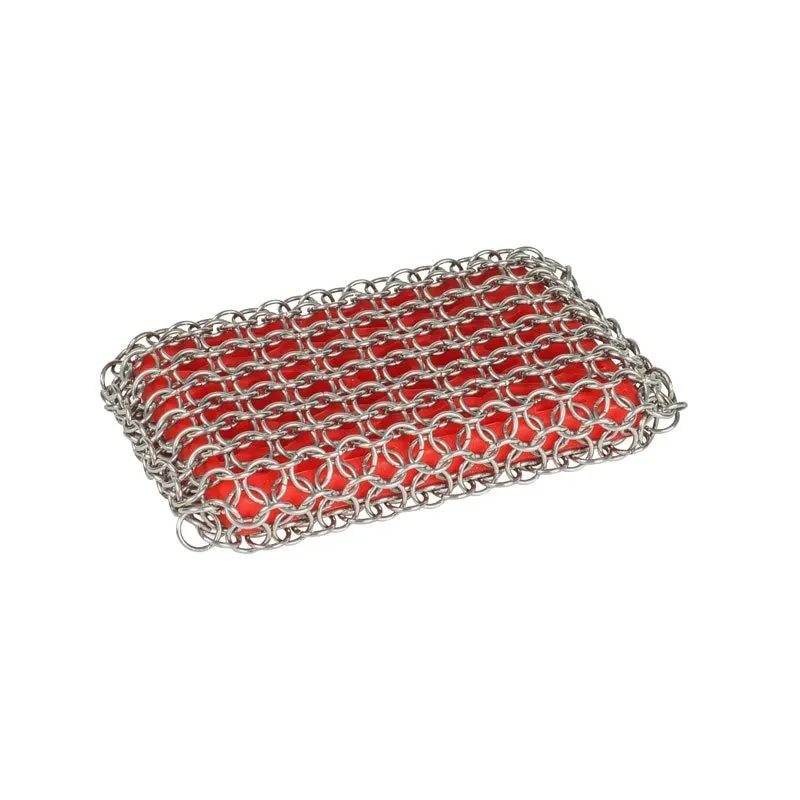
For: Cleaning cast iron
Lodge Chainmail Cast Iron Scrubber
A stainless chainmail scrubber with a silicone core for cleaning cast iron. It lifts stuck food with hot water and leaves seasoning largely intact; Lodge says a little mild soap is fine.

For: Vegetable prep on small counters
MAC Superior Series 6.5-Inch Santoku Knife (SK-65)
A thin, light, Japanese-made santoku: MAC lists a 6.75 in blade, 2.0 mm thickness and 5.4 oz. Its shorter, flatter blade suits a narrow van counter and push-cutting vegetables, and MAC sharpens its knives at 15 degrees per side. Harder, thinner steel means more care than a Victorinox: no bones, no frozen food, no dishwasher.

For: Sharpening without water
HORL 3 Cruise Rolling Knife Sharpener with Magnetic Angle Support (15 and 20 degrees)
A compact rolling sharpener: a diamond disc and a stainless honing disc on one roller, plus a magnetic angle block with fixed 15 and 20 degree sides. It needs no water or oil, which suits a van, and covers both Japanese and European kitchen knives. It is for plain edges only, costs considerably more than a pull-through, and its strong magnets need care near electronics and pacemakers.