Best Van Kitchen Knives & Prep Tools: Full Guide
The two-knife van kit, choosing a cutting board, shears, mandolines, sharpening on the road, safe storage and low-water hygiene, plus our 2026 knife and prep tool picks.
Disclosure: As an Amazon Associate I earn from qualifying purchases. Links to Amazon on this page are affiliate links: if you buy through one, VanLifeKitchens.com may earn a commission at no extra cost to you. Read our affiliate disclosure.
Knives and prep tools are the part of a van kitchen most builders underfund. A fridge gets weeks of research; a knife gets grabbed off a supermarket shelf on the way out of town. The result is a drawer of dull, flimsy blades that make every meal slower and are, counterintuitively, more dangerous to use.
This guide is for anyone setting up or simplifying a van galley. It covers the small kit that handles nearly every cooking task, how to choose a chef's knife and a pocket knife, the cutting board decision, the specialty tools that earn their space, sharpening on the road, safe use and hygiene with limited water, and our picks for 2026. Storage gets a short summary here; the full treatment lives in our van knife storage and safety guide.
The two-knife rule
Most van kitchens need two knives. More is usually clutter; fewer forces awkward compromises.
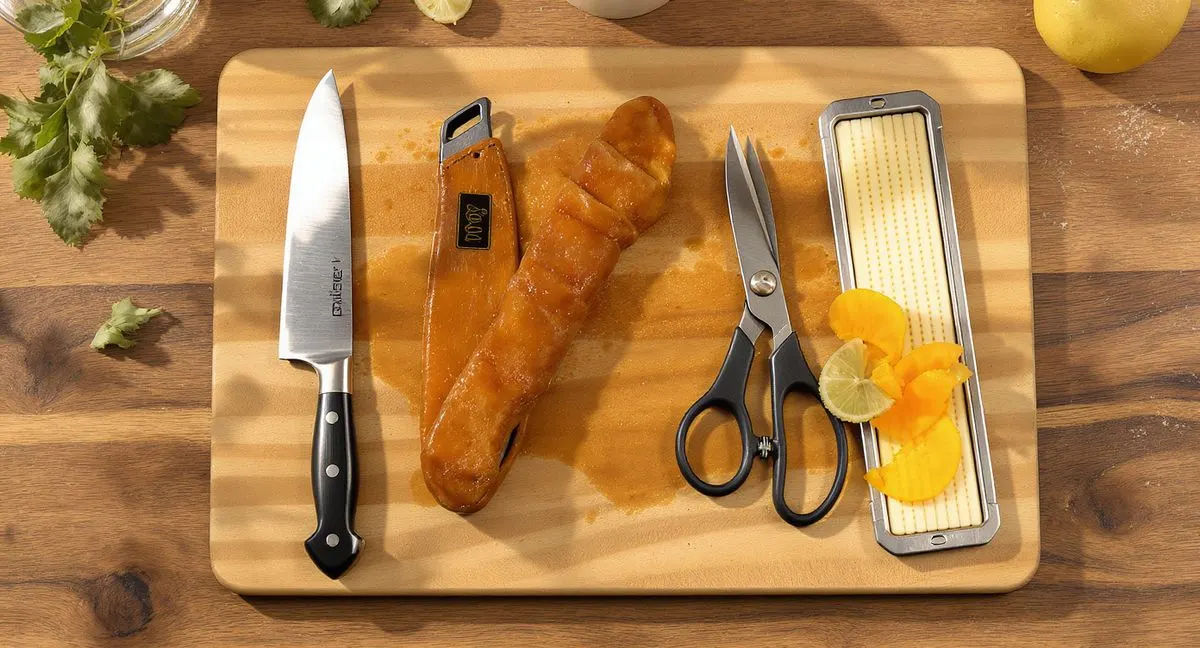
Knife 1: a full-size chef's knife (7–8 inches). This does nearly everything: slicing, dicing, chopping, mincing, breaking down a chicken or a squash. A van cook with one good chef's knife and the skill to use it is better equipped than one with a 15-piece block set.
Knife 2: a small utility or folding knife (about 3–4 inches). For fruit, cheese, small precision work, and everything that happens away from the counter — lunch at a trailhead, an apple on a hike, opening packages at camp. A folding knife makes sense in a van because it also lives in your pocket or daypack.
Optional third knife: a serrated bread knife if you regularly buy crusty whole loaves, or a flexible boning knife if you butcher whole birds or fish often. If you mostly buy rolls or sliced bread, skip it — a sharp chef's knife handles occasional bread.
Choosing a chef's knife for a van
What matters in a van is different from what matters in a home kitchen display:
- Toughness over hardness. Very hard Japanese steels take a superb edge but are more prone to chipping if they rattle into other metal or hit a bone. A tougher, slightly softer stainless steel shrugs off rough handling and is easy to re-sharpen.
- Stainless steel. Vans are humid — cooking steam, condensation, wet dish routines. Carbon steel rusts quickly if not wiped dry immediately.
- A grippy handle. You will often be prepping with wet hands on a small counter. A textured polymer handle is safer than polished wood.
- Easy to sharpen. If you cannot maintain the edge, the knife's original sharpness is irrelevant within a few months.
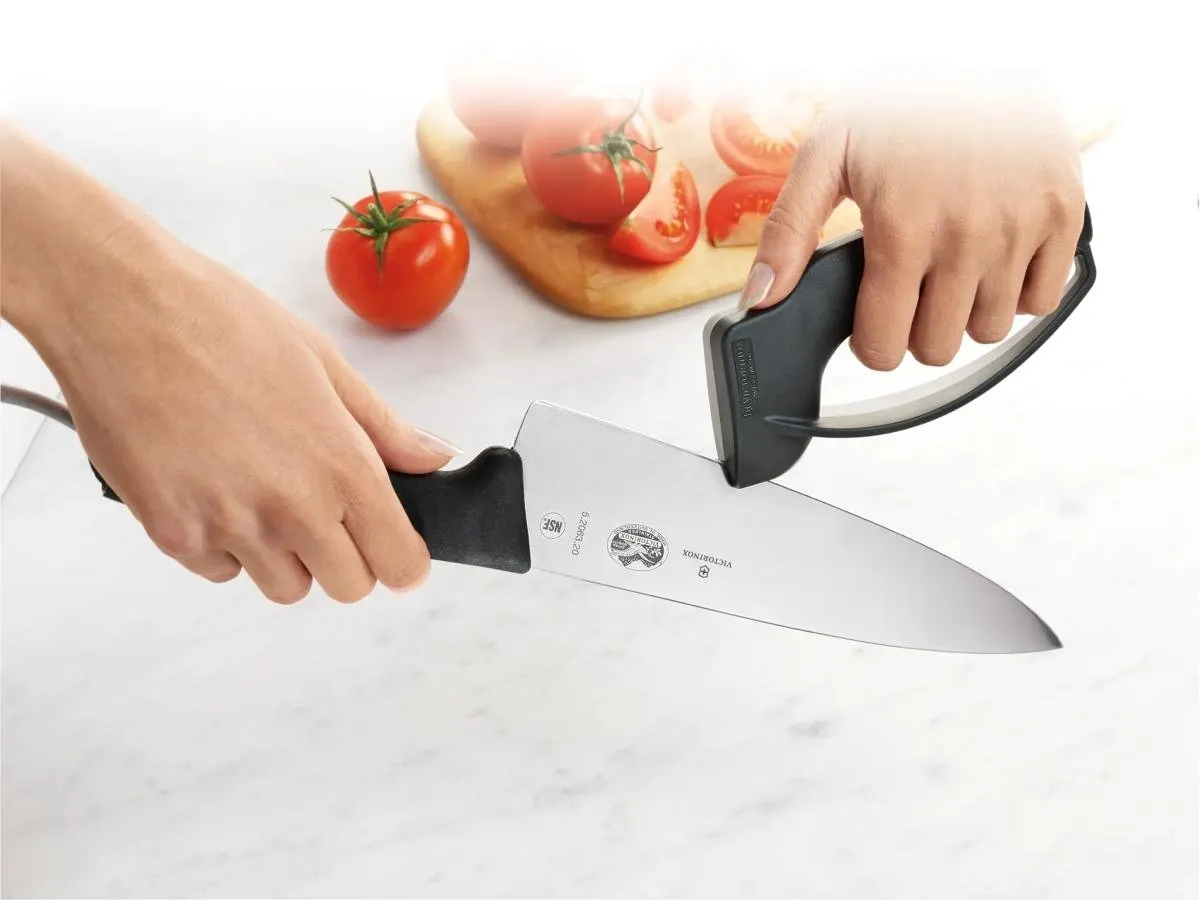
The Victorinox Fibrox 8-Inch Chef Knife fits all four: Swiss-made high-carbon stainless, a textured Fibrox handle that grips when wet, 6.5 oz for low fatigue, and a lifetime warranty. Its steel is on the softer, tougher side, so it re-edges quickly on a whetstone or rod. The trade-offs are aesthetics (it looks industrial) and that it needs honing every few weeks. It is cheap enough that losing it at a campsite is an annoyance rather than a disaster.
If you already own a premium Japanese or German knife you love, bring it — just store it carefully and keep it dry. For a new van kit, we recommend avoiding bargain-bin knife sets that cost less for the whole block than one good chef's knife: the steel is usually too soft to hold an edge and the handles tend to be poorly shaped.
Choosing a pocket or utility knife
For the second knife, look for a stainless blade around 3–3.5 inches, a lock that prevents accidental closing, and a simple design without "tactical" features (thumb studs, serrations, glass breakers) that do nothing for food.
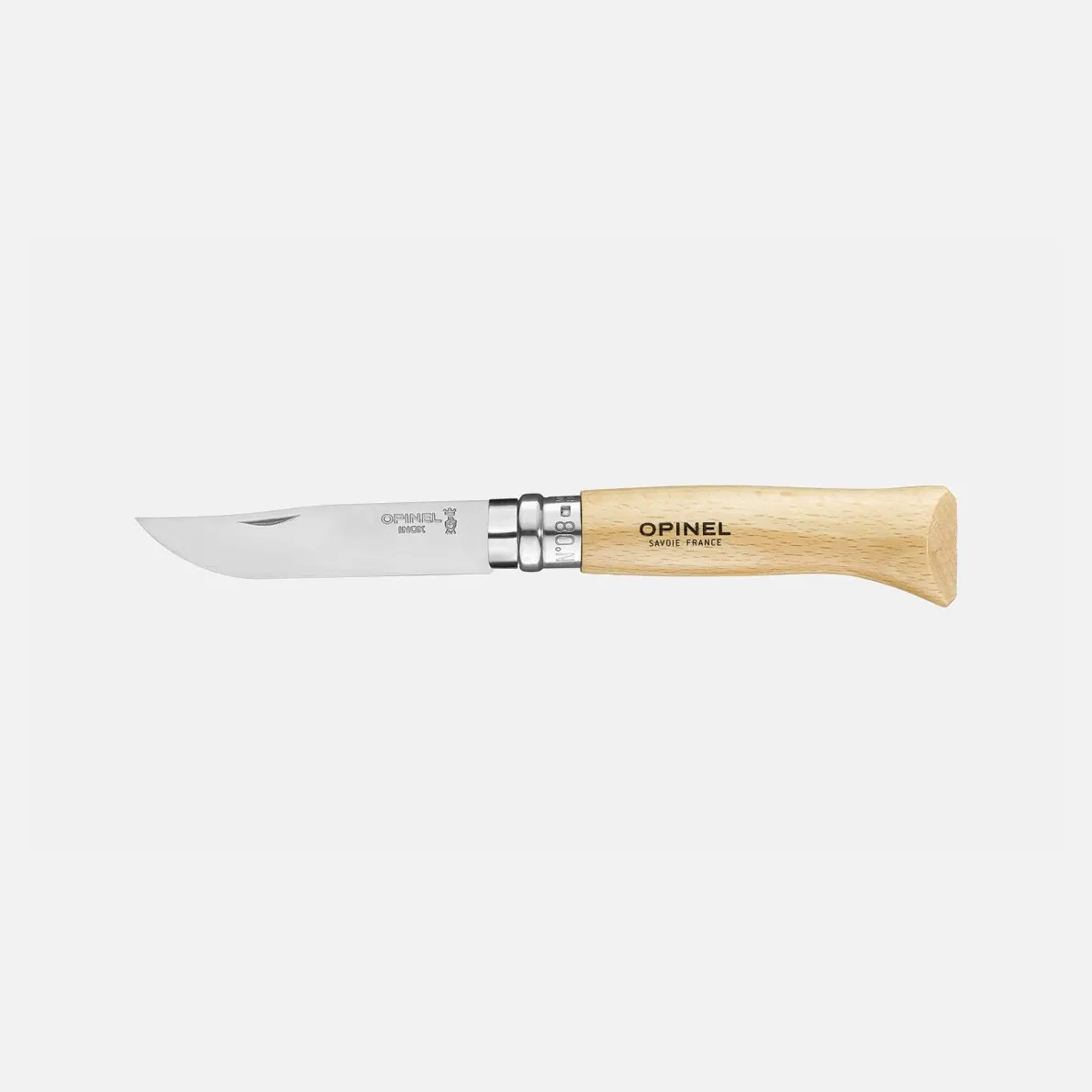
The Opinel No. 8 Stainless Folding Knife is the classic answer: a 3.3-inch Sandvik 12C27 stainless blade, a beechwood handle, and the Virobloc rotating ring that locks the blade open (and closed). It weighs about 1.6 oz. The trade-offs: the wood handle can swell if left soaking, so wipe it rather than submerging it; the lock needs two hands; and at 3.3 inches it is too short to be a primary kitchen knife for cabbages, squash or whole chickens.
For a head-to-head, see Victorinox Fibrox vs Opinel No. 8.
If your second knife never leaves the galley, a fixed-blade paring knife is the alternative. The WÜSTHOF Classic 3.5-inch paring knife is forged and full-tang, with a 58 HRC blade, a 14-degree edge and a synthetic handle that won't swell in a humid van. It needs a guarded slot or an in-drawer block while you drive, and WÜSTHOF says to wash it by hand. WÜSTHOF Classic paring vs Opinel No. 8 compares the two.
The cutting board decision
The board matters almost as much as the knife: it determines how stable your prep is, how fast your edge dulls, and how easy cleanup is with limited water.
Edge-grain hardwood (maple, cherry, walnut) is our first choice for full-time builds. It is gentle on edges, stable on a counter, and can be sanded smooth when it gets scarred. The John Boos R-Board 18x12 Maple Cutting Board is the pick: edge-grain hard maple, 18 × 12 × 1.5 inches, made in the USA from domestic and imported materials (per Boos), with a 1-year warranty against defects on the Amazon listing. The trade-offs are real: Boos lists it at about 10 lb, it needs mineral oil every few weeks, and it must never soak in water.
How the alternatives compare:
- Plastic: light, cheap and easy to wash, which makes a thin plastic board a reasonable choice for raw meat. Deep knife grooves are hard to clean, so replace plastic boards once they are heavily scarred.
- Bamboo: technically a grass laminated with glue. It is harder on knife edges than maple, and glue lines can separate over time, especially with soaking.
- Glass or stone: dull knives very quickly. Use them for serving, never cutting.
- Wood-fiber composite (such as Epicurean): a sensible middle ground — lighter than hardwood, no oiling, tolerates more water — but harder on edges than maple.
Size: around 18 × 12 inches is the sweet spot for most van counters — big enough to hold two prepped ingredients at once, small enough to stow. Measure your counter and your stowage slot before buying. If that weight is too much for your build, a composite board such as the Epicurean Kitchen Series is the lighter compromise; see Epicurean Kitchen Series vs John Boos R-Board. Our van kitchen layouts guide covers counter sizing.
Stability tip: a damp cloth or a small piece of non-slip shelf liner under the board stops it sliding on a smooth counter — important when the van is parked on a slight slope.
Specialty prep tools worth the space
Beyond knives and a board, a few tools earn a spot because they do jobs a knife does badly in a cramped galley.
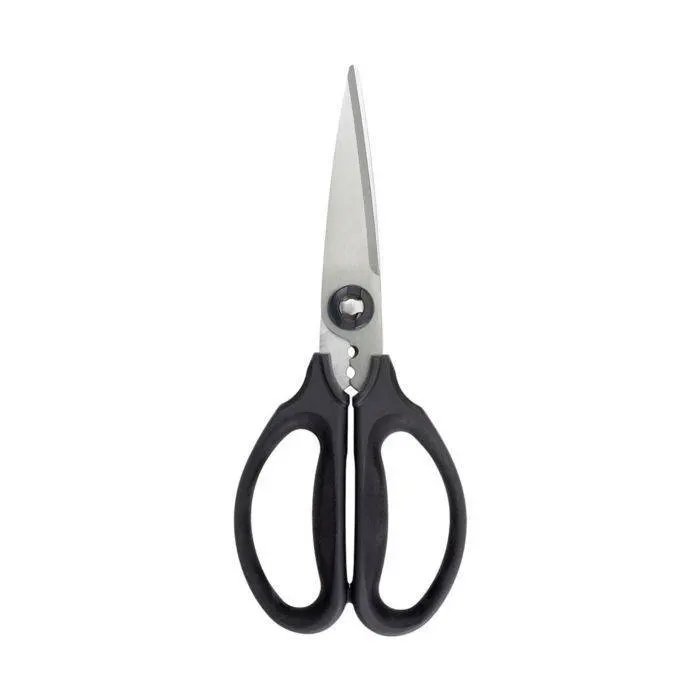
Kitchen shears. Probably the most underrated tool in a van kitchen. The OXO Good Grips Kitchen and Herb Scissors snip herbs straight into the pot, trim bacon, cut tortillas and pizza, spatchcock a chicken, and open clamshell packaging without pulling out a blade. The blades come apart so the pivot can actually be cleaned, and the cushioned handles work one-handed. They are less precise than dedicated poultry shears and the plastic grip can discolor over time.
Mandoline. The Benriner Classic Japanese Mandoline produces uniform slices adjustable from 0.5 to 5 mm — paper-thin radishes, even potato slices for gratins, julienned carrots — and packs flat into a drawer. It is genuinely dangerous without protection: always use the hand guard, or a cut-resistant glove, and stop slicing when the piece gets small rather than chasing the last bit. It is a niche tool; buy it only if you cook a lot of vegetable-forward meals.
Instant-read thermometer. Not a cutting tool, but it belongs in the prep kit because it is the only reliable way to know poultry, pork and reheated leftovers are safely cooked — especially on small burners with uneven heat. The ThermoWorks Thermapen ONE reads in about one second and is IP67 waterproof. It is expensive for a thermometer; any accurate instant-read thermometer is far better than none.
A peeler. A basic Y-peeler or swivel peeler is one of the cheapest tools in the kitchen and takes up almost no space. Any decent one will do.
Skip: garlic presses (a knife does the job and cleans faster), single-use slicers and choppers, and electric food processors unless you have a large electrical system and a specific need.
Sharpening on the road
A dull knife needs more force, and more force means more slips. Every van kitchen needs a sharpening plan.
- Honing rod (ceramic). Does not remove much metal — it realigns and lightly refreshes the edge between sharpenings. A compact ceramic rod is ideal for a van; a few light strokes before a big prep session keeps a Victorinox-style knife performing well.
- Whetstone (combination grit). The best long-term answer for anyone willing to spend 5–10 minutes every few weeks. A 1000/6000 combination stone sharpens and polishes; a coarser 400/1000 stone helps repair a very dull or chipped edge. It needs only a flat surface, a damp towel underneath, and a little water — a stone that only needs water, not oil, keeps things simpler in a van.
- Pull-through sharpener. Fast and foolproof but removes metal aggressively and can leave a rougher edge. Acceptable for occasional use on tough, inexpensive knives like the Victorinox and Opinel; avoid it on hard Japanese blades.
Our recommended setup: a combination whetstone plus a ceramic honing rod — an inexpensive pair that keeps every other blade in the kit working. Hone before heavy prep, sharpen when honing no longer brings the edge back.
Storage in a moving vehicle (summary)
A knife loose in a drawer shifts on every corner and speed bump, and becomes a hazard for the next hand that reaches in. Four storage methods work in a van:
- In-drawer knife block — blades enclosed under a closed drawer; the most secure option. The Joseph Joseph DrawerStore Compact holds up to nine knives with blades up to 9 inches and needs a drawer at least 3⅜ inches tall inside, per Joseph Joseph.
- Magnetic strip inside a closed cabinet — fastest access; choose a strong, screw-mounted strip and keep it behind a door while driving.
- Knife roll — no installation, good for small or weekend kits.
- Individual blade guards or sheaths — cheapest and most flexible for one- or two-knife setups.
Avoid countertop knife blocks, loose knives in a utensil drawer, and knives standing in a mug or jar. The van knife storage and safety guide compares all four methods in detail, with mounting advice.
Safe prep and hygiene with limited water
- Cut on a stable surface. Board on a non-slip liner, counter clear of clutter, van as level as you can park it. Do not prep while the vehicle is moving.
- Separate raw meat from ready-to-eat food. Either use a separate (thin plastic) board for raw meat, or prep vegetables and other ready-to-eat items first and raw meat last, then wash the board.
- Wash boards and knives with hot, soapy water after raw meat, then rinse and dry. A small basin and a kettle of hot water stretch your supply; see our van kitchen dishwashing system for low-water routines.
- Dry wooden boards on edge so air reaches both sides, and oil them with food-grade mineral oil when they look pale or dry.
- Wipe knives dry immediately — even stainless can spot or rust in a humid van.
- Keep a basic first-aid kit within reach of the galley. The broader van cooking safety guide covers fire, CO and other kitchen hazards.
Best van kitchen knives and prep tools (2026)
Our picks from the knives and prep tools we've reviewed. Check current prices on Amazon — they move often.
Best chef's knife — Victorinox Fibrox 8-Inch. Tough, easy-to-sharpen stainless with a grippy handle and a lifetime warranty. The one knife we would buy first for any van kitchen.
Best pocket and utility knife — Opinel No. 8 Stainless. A locking folder with a 3.3-inch stainless blade for fruit, cheese, small prep and trailhead lunches. Keep the wood handle out of standing water.
Best cutting board — John Boos R-Board 18x12 Maple. Edge-grain maple that is kind to knives, stable and long-lived. Heavy (about 10 lb per Boos) and needs regular oiling; choose a composite board if weight matters more.
Best kitchen shears — OXO Good Grips Kitchen and Herb Scissors. Take-apart blades for real cleaning and a dozen jobs knives do awkwardly in a small galley.
Best mandoline — Benriner Classic Japanese Mandoline. Uniform 0.5–5 mm slices in a drawer-sized tool. Use the guard every time.
Best food-safety tool — ThermoWorks Thermapen ONE. Fast, accurate, waterproof instant-read thermometer for anyone who regularly cooks meat.
Kits by build type
| Build type | Kit | Cost level |
|---|---|---|
| Ultralight or weekend | Opinel No. 8 + small plastic or composite board + OXO shears | Budget |
| Weekend warrior | Victorinox Fibrox + Opinel No. 8 + OXO shears + composite board | Budget to mid-range |
| Full-time core kit | Victorinox + Opinel + John Boos R-Board + OXO shears + whetstone | Mid-range |
| Full-time cook | Core kit + Benriner mandoline + Thermapen ONE + ceramic honing rod | Premium |
For a budget-conscious full kitchen build, see the Ford Transit Weekend Warrior setup and our minimal budget van kitchen guide, or browse every tool in the knives and prep category.
Frequently asked questions
What knife should I buy for a van kitchen?
Start with the Victorinox Fibrox 8-Inch Chef Knife. It is tough, easy to sharpen, has a handle that grips when wet, and carries a lifetime warranty. Add an Opinel No. 8 folding knife for small tasks and pocket carry. Those two knives handle almost every cooking task in a van.
How many knives do you need in a van?
Two for most people: a 7–8 inch chef's knife and a small utility or folding knife. Add a serrated bread knife only if you regularly buy whole crusty loaves, or a boning knife if you often break down whole poultry or fish. Larger knife sets mostly add clutter and weight.
How do you store knives safely in a van?
Four methods work: an in-drawer knife block (most secure), a screw-mounted magnetic strip inside a closed cabinet (fastest access), a tied knife roll (best for small or weekend kits), or individual blade guards (cheapest). Never store loose knives in a utensil drawer, and avoid countertop blocks, which tip over on the first hard corner.
What is the best cutting board for a van?
An edge-grain hardwood board around 18 x 12 inches, such as the John Boos R-Board in maple, is the best all-round choice: kind to knife edges, stable, and repairable by sanding. Boos lists it at about 10 lb, and it needs regular oiling. If weight matters more, a wood-fiber composite board is lighter and lower-maintenance, and a thin plastic board is useful for raw meat. Avoid glass and stone boards, which dull knives quickly.
How do I sharpen knives in a van?
Use a ceramic honing rod before heavy prep sessions to keep the edge aligned, and a combination whetstone (such as 1000/6000 grit) every few weeks when honing no longer restores sharpness. A whetstone needs only a flat surface, a damp towel underneath and a little water. A pull-through sharpener is acceptable for occasional use on tough, inexpensive knives but removes metal aggressively.
How do I keep cutting boards food-safe with limited water?
Prep ready-to-eat foods before raw meat, or use a separate thin plastic board for raw meat. After raw meat, wash the board and knife with hot, soapy water, rinse, and dry. A small basin and a kettle of hot water use much less water than a running tap. Dry wooden boards on edge and oil them when they look dry, and never leave them soaking.
Is a mandoline worth it in a van kitchen?
Only if you cook a lot of vegetables and want uniform thin slices quickly. The Benriner Classic is compact and precise, but it is one of the most dangerous tools in any kitchen: always use the hand guard or a cut-resistant glove, and stop before your fingers get close to the blade. If you rarely slice vegetables thinly, a sharp chef's knife is enough.
The verdict
For most van kitchens, the right prep kit is the Victorinox Fibrox 8-Inch, an Opinel No. 8, the John Boos R-Board (or a lighter composite board), OXO kitchen shears and a combination whetstone — a mid-range kit that handles everyday cooking for years. Add the Benriner mandoline if you cook vegetable-heavy meals and will always use the guard, and a Thermapen ONE or any accurate instant-read thermometer if you cook meat regularly.
Skip cheap all-in-one knife sets, "tactical" folding knives, glass cutting boards and any knife you have no plan to sharpen. Store blades so they cannot move while driving, and keep them sharp — a sharp knife on a stable board is the safest setup in any kitchen. The van cookware materials guide covers the pans that complete the kit.
Products covered in this guide
Disclosure: As an Amazon Associate I earn from qualifying purchases. Links to Amazon on this page are affiliate links: if you buy through one, VanLifeKitchens.com may earn a commission at no extra cost to you. Read our affiliate disclosure.



More in Buying Guides

Summer Van Kitchen Survival Guide: Cooking in 100°F Heat
How to cook real meals in a van when the interior hits 110°F — solar cooking, outdoor prep zones, heat-shedding gear, and the workflow changes that keep the cabin livable in peak summer.
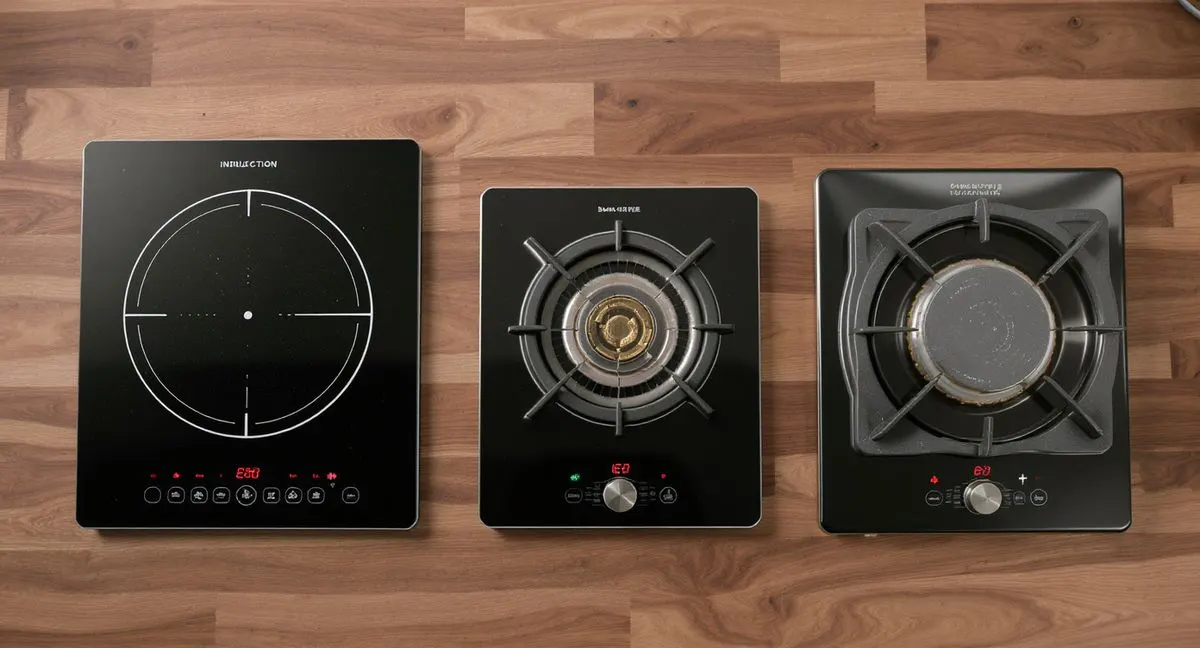
Induction vs Butane vs Propane: Which Wins in a Van?
An honest head-to-head of the three main van cooktop fuel sources — with real power, cost, and cold-weather numbers.
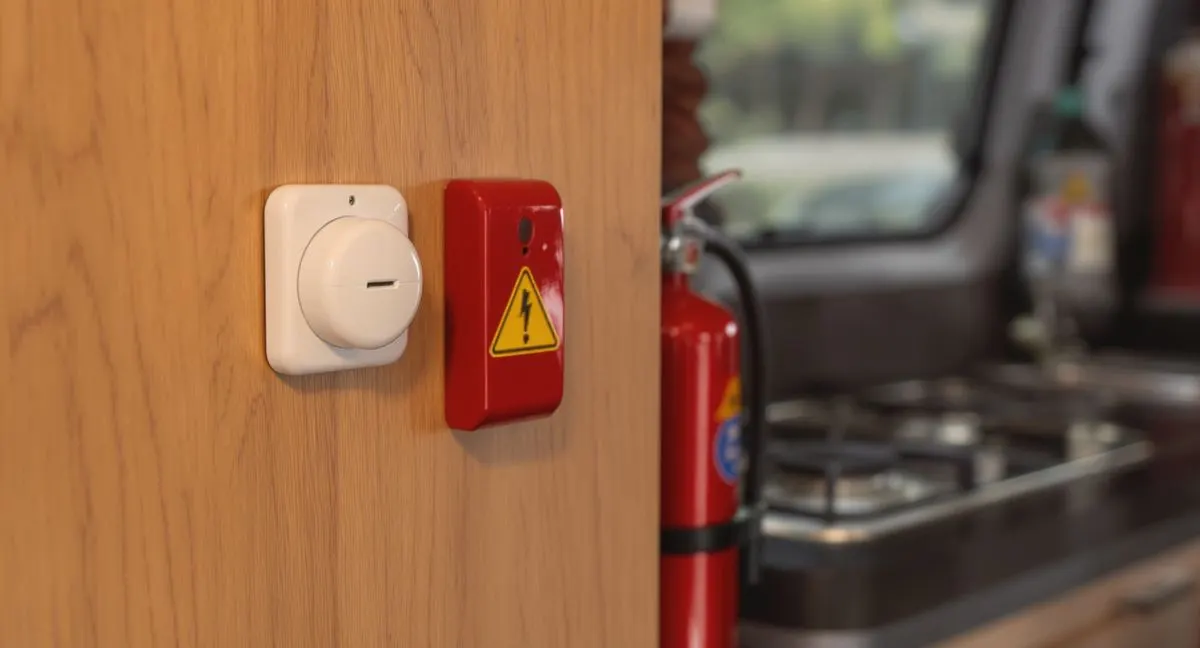
Van Cooking Safety: Carbon Monoxide, Fire, and Burns
The three safety risks every van cook needs to manage — CO from propane and butane, fire from grease and fabric, and burns from tight quarters. With the gear and habits that prevent each one.