Victorinox Fibrox 8-Inch Chef Knife
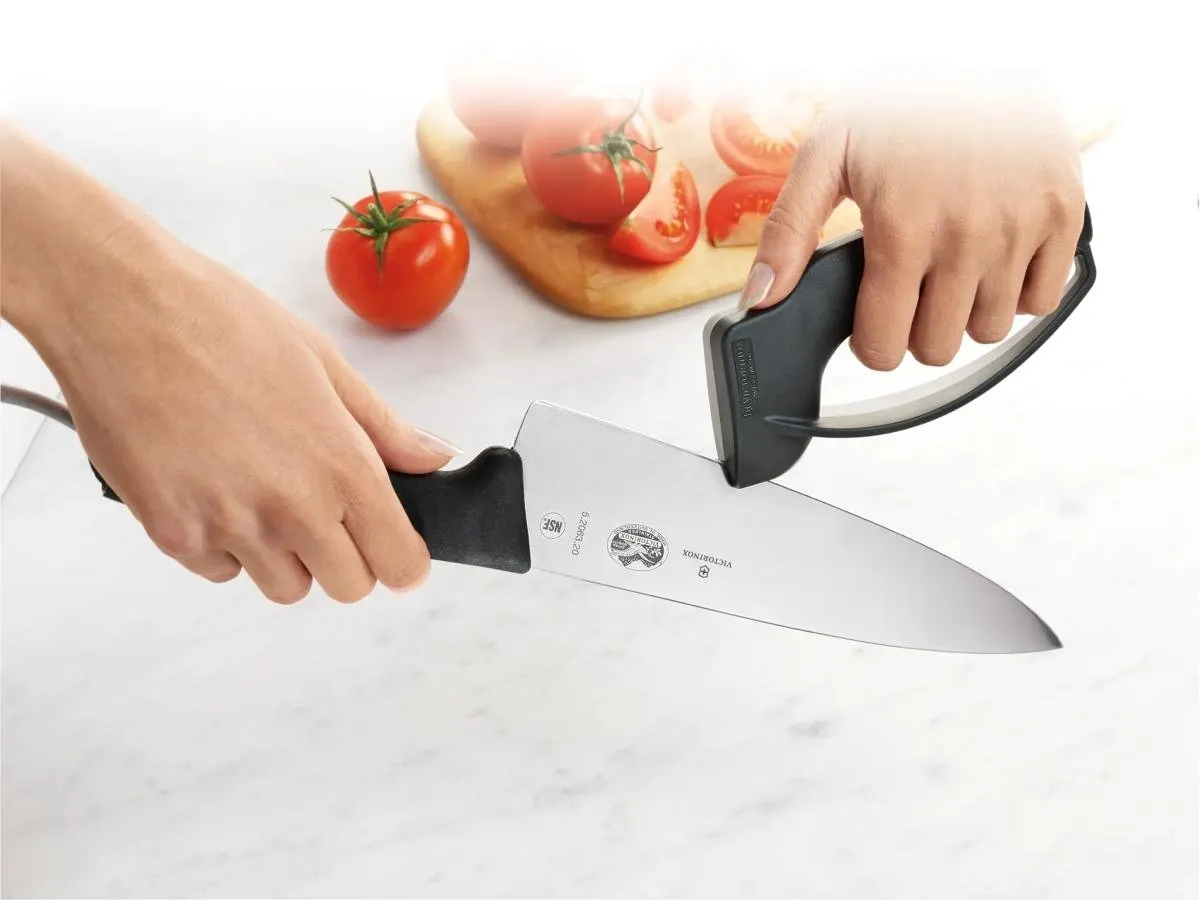
- Model
- 5.2063.20 (Victorinox)
- Blade Length
- 7.9 in (sold as 8 in)
- Total Length
- 13.4 in
- Weight
- 6.4 oz
- Material
- Stamped high-carbon stainless steel
- Handle
- Textured TPE (Fibrox)
- Warranty
- Lifetime
Overview — Who is this for?
The Victorinox Fibrox 8-Inch Chef Knife (sold today as the Fibrox Pro 8-inch chef's knife, the black-handled version the site links to) is a stamped, Swiss-made, budget-priced chef's knife that's common in commercial kitchens. It can be the only knife a van kitchen owns and still handle nearly every cutting task a home cook does. If you're choosing your first real chef's knife for a van build and want something that's easy to keep sharp, the Fibrox is our pick.
What the Amazon link sells: the Victorinox Fibrox Pro Chef's Knife, 8 inch, black handle (model 5.2063.20BK). Victorinox's own item number for the knife is 5.2063.20.
Choose this if:
- You want one chef's knife for everyday van cooking at a budget price.
- You are new to sharpening and want a steel that is easy to re-edge.
- You want a grippy handle that works with wet or oily hands.
Skip this if:
- You want a thin, very hard Japanese blade for precision slicing.
- You care about looks: the Fibrox is plain and industrial.
- You already own a good chef's knife you're happy with.
It's also the knife we recommend for people who don't know how to sharpen a knife yet. European-style stainless blades like this one are generally softer than Japanese kitchen knives, so they're easier to re-edge and less prone to chipping if knocked against a hard surface. A beginner's whetstone technique will usually produce a workable edge within a few tries. A Japanese white-steel knife is a better performer on paper, but it is punishing to learn on, and a van kitchen is the last place to be learning a punishing skill at 7 a.m. before coffee.
What you are actually getting
Victorinox's product page lists the Fibrox Pro Chef's Knife (item 5.2063.20) as follows:
| Spec | Victorinox |
|---|---|
| Blade length | 7.9 in (sold as "8 inch") |
| Overall length | 13.4 in |
| Blade width | 2.2 in |
| Weight | 6.4 oz |
| Construction | Not forged (stamped), straight edge |
The handle is thermoplastic elastomer (TPE), which Victorinox calls Fibrox. Victorinox lists the knife as Swiss made, dishwasher safe and covered by a lifetime warranty. The Amazon listing adds that the blade is high-carbon stainless steel and the knife is NSF approved. Victorinox's page doesn't give a steel grade or hardness figure. An earlier version of this review quoted both from secondary sources, and they've been removed.
Even though it's dishwasher safe, hand washing and drying straight away is kinder to any edge. Dishwasher racks and other cutlery knock against the blade. In a van you'll be hand washing anyway. At 6.4 oz it's light for a chef's knife of this length. The blade geometry is a gentle German curve — flatter than a true French profile, more belly than a Japanese gyuto — which suits both rock-chopping and push-cutting techniques.
The Fibrox line is made in Switzerland by Victorinox, the company best known for the Swiss Army knife. It is not a fashion item and there is no attempt to make it pretty — the handle is industrial black plastic, the blade is unpolished, and the bolster is nonexistent. You are paying for utility, not looks. A plain TPE handle has no wood to crack or swell and no finish to wear off, which suits a damp van.
How it performs in a van kitchen
The performance argument for the Fibrox is not that it is the sharpest possible knife. A premium Japanese knife can outperform it on paper thickness and edge retention for a while. The performance argument is that the Fibrox takes a very good working edge with about ten minutes on an inexpensive stone, and that edge is enough for nearly everything a van cook does — onions, carrots, chicken breasts, cabbage, hard squash, herbs, garlic, tomatoes, bread (at a pinch, though a serrated is better).
The real-world sharpness test that matters in a van is: can you dice an onion without crushing it? Can you slice a ripe tomato without smearing it? Can you butcher a whole chicken into eight pieces without sawing? A well-maintained Fibrox does all three cleanly. Can you slice a piece of sashimi-grade tuna into perfect translucent fans? No, that needs a Japanese yanagiba. Are you going to be slicing sashimi-grade tuna in a van? Probably not.
A softer stainless edge holds its sharpness for a moderate time. There is no fixed sharpening interval. How long the edge lasts depends on how much you cut, what you cut, the board you cut on, and how often you hone. Regular honing stretches the time between real sharpenings, and heavy prep of hard vegetables (roots, squash, ginger) shortens it. Watch the edge, not the calendar — when it starts sliding off a tomato skin, it is time. A quick pass on a pull-through sharpener brings it back to working sharpness; a full whetstone tune-up takes about ten minutes and produces a better edge that typically lasts longer than the pull-through version.
Weight is the other underrated feature. At 6.4 ounces (Victorinox), the Fibrox is light enough for long prep sessions without much forearm fatigue. Heavier forged knives can tire some cooks on long sessions. That matters in a van if a restock day means an hour of chopping to portion and vacuum-seal the week's food.
Why it works for van life specifically
Four van-specific reasons to pick this knife:
First, it is cheap enough to replace if something happens. Losing a Fibrox is an unpleasant afternoon, not a financial catastrophe. Losing a premium Japanese knife is a bad week. Van kitchens see more abuse than home kitchens — things get dropped, sand gets into drawers, roof leaks get onto blades — and a knife you are not afraid to use is the one that gets used.
Second, the softer steel is forgiving. Hard Japanese-style blades can chip if they hit a bone or the edge of a hard surface. A softer European-style edge tends to roll instead, and a rolled edge is easy to straighten on a honing rod or a stone.
Third, the textured handle grips well in wet hands. Victorinox describes it as "non-slip." Van dish washing is splashy and knife handles end up wet a lot, and a textured TPE handle doesn't swell or go slick the way an oiled wooden one can.
Fourth, replacement is easy. The Fibrox 8-inch is a long-running, widely stocked model on Amazon, so a replacement is usually easy to order to a pickup point or mail forwarding address. Japanese specialty knives are harder to source quickly.
What the Fibrox is NOT good at
Being fair to the buyer, here are the honest limitations.
Paper-thin precision slicing. If you need to cut translucent slices of sashimi, carpaccio, or vegetables for Japanese-style presentation, the Fibrox is too thick behind the edge and the profile is wrong. Get a dedicated Japanese slicing knife for that work.
Long-term edge retention under heavy use. Harder steels generally hold an edge longer, so a professional doing hours of prep a day sharpens a softer knife more often. At van-level cooking volume, this is rarely a concern.
Aesthetics. The Fibrox is industrial. It looks like a commercial kitchen tool because it is one. If you want a knife that looks beautiful hanging on a magnetic strip, this is not it. Function-over-form buyers do not care.
Bolstered balance. The Fibrox has no bolster (the thick part of the blade where it meets the handle). Some cooks prefer a bolstered knife for the "pinch grip" hand position. The Fibrox needs a slightly different grip that most cooks adjust to quickly.
Sharpening and maintenance
The Fibrox responds well to a variety of sharpening methods, each with different tradeoffs for van use:
- Carbide pull-through sharpener: fast and inexpensive, but it removes metal aggressively, so use it sparingly. It's fine as the only method for an occasional cook. For a daily cook it wears the blade down faster than a stone.
- Rolling sharpener: the HORL 3 Cruise holds the blade at a fixed angle on a magnetic support and needs no water, which suits a van. Choose the angle that matches how you want the edge set.
- Whetstone (400/1000 or 1000/6000 grit): The correct answer for anyone who will commit to learning. Ten minutes every couple of months produces a sharper edge than a pull-through and removes far less metal. Needs a flat surface and a little water, which any van has.
- Honing steel (ceramic or smooth): Not a sharpener — it realigns a rolled edge between true sharpenings. Use it before every major prep session to extend time between real sharpenings. A folding ceramic rod from a camping supply store is the compact van-friendly version.
Cleanup is trivial: wipe with a damp cloth, dry immediately, return to the storage location. Never leave the knife wet or allow food residue to dry on the blade — stain-resistant does not mean stain-proof, and onion and tomato acids will discolor the steel over time if left.
Comparison to alternatives in this category
Vs forged German chef's knives: a forged knife with a bolster is heavier and costs considerably more, with better fit and finish. For van-scale prep the cutting advantage is small. Choose one if you want a knife to take pride in. Choose the Fibrox for the most knife for the money.
Vs MAC Superior santoku SK-65: a shorter, thinner Japanese-style blade (see that review for MAC's specs) that is very good for vegetable prep on a small counter. It costs more and needs more care around bone and hard surfaces. Choose the MAC if vegetables are most of your cooking and you'll sharpen carefully. Choose the Fibrox if you want one forgiving knife for everything.
Vs Opinel No. 8 Stainless Folding: The Opinel No. 8 is a folding knife for a very different job. It's compact, at 1.6 oz with a 3.28-inch blade (Opinel USA), and better for a picnic table or a daypack than for galley prep. For a main van chef's knife, the Fibrox is far better suited. Our Fibrox vs Opinel comparison covers when to own both.
The verdict
The Victorinox Fibrox Pro 8-Inch Chef Knife is the chef's knife we'd hand a first-time van builder. Victorinox's published specs back up why it suits a van: a 7.9-inch stamped blade, 6.4 oz, a non-slip TPE handle, Swiss made, dishwasher safe and a lifetime warranty. Its softer edge is easy to bring back, and if something happens to it, a replacement is inexpensive and easy to order.
If you already own a better knife and you are happy with it, skip this review. If you do not own a real chef's knife yet, or if the one you own is a cheap supermarket piece that is dulling faster than you can sharpen it, the Fibrox is a sensible upgrade.
See the van knife storage and safety guide for how to mount and protect this knife safely in a moving vehicle, and the van cookware materials guide for the pans this knife will be preparing food for.
FAQ
Is the blade really 8 inches? Victorinox sells it as the 8-inch chef's knife and lists the blade at 7.9 inches (20 cm), with an overall length of 13.4 inches.
Is it dishwasher safe? Victorinox lists it as dishwasher safe. Hand washing and drying straight away is still kinder to the edge, and it's what most vans do anyway.
Is it forged? No. Victorinox lists it as not forged, which means it's a stamped blade with no bolster. That's part of why it's light at 6.4 oz.
What warranty does it have? Victorinox lists a lifetime warranty. The Amazon listing describes it as covering manufacturer defects.
How should I sharpen it? Hone it before big prep sessions and sharpen it on a stone or a fixed-angle sharpener when it starts sliding off tomato skin. Use carbide pull-through sharpeners sparingly, because they remove a lot of metal.
Sources and verification
- https://www.swissarmy.com/us/en/Products/Kitchen-Knives/Chefs-Knives/Fibrox-Pro-Chef%27s-Knife/p/5.2063.20: item 5.2063.20, 13.4 in overall length, 2.2 in width, 0.8 in height, 6.4 oz, 7.9 in blade, not forged, straight edge, TPE handle, made in Switzerland, dishwasher safe, lifetime warranty (checked 2026-10-12)
- Amazon listing ASIN B000638D32: Victorinox Fibrox Pro Chef's Knife 8 inch, black, model 5.2063.20BK, high-carbon stainless steel blade, non-slip handle, dishwasher safe, NSF approved, lifetime warranty against manufacturer defects (checked 2026-10-12)
- https://www.opinel-usa.com/products/no-8-opinel-stainless-steel-blade: Opinel No. 8 blade length and weight, used in the comparison (checked 2026-10-12)
Compare with similar products
See how this stacks up against the other knives & prep we've reviewed.
Head-to-head comparisons
Related Reviews
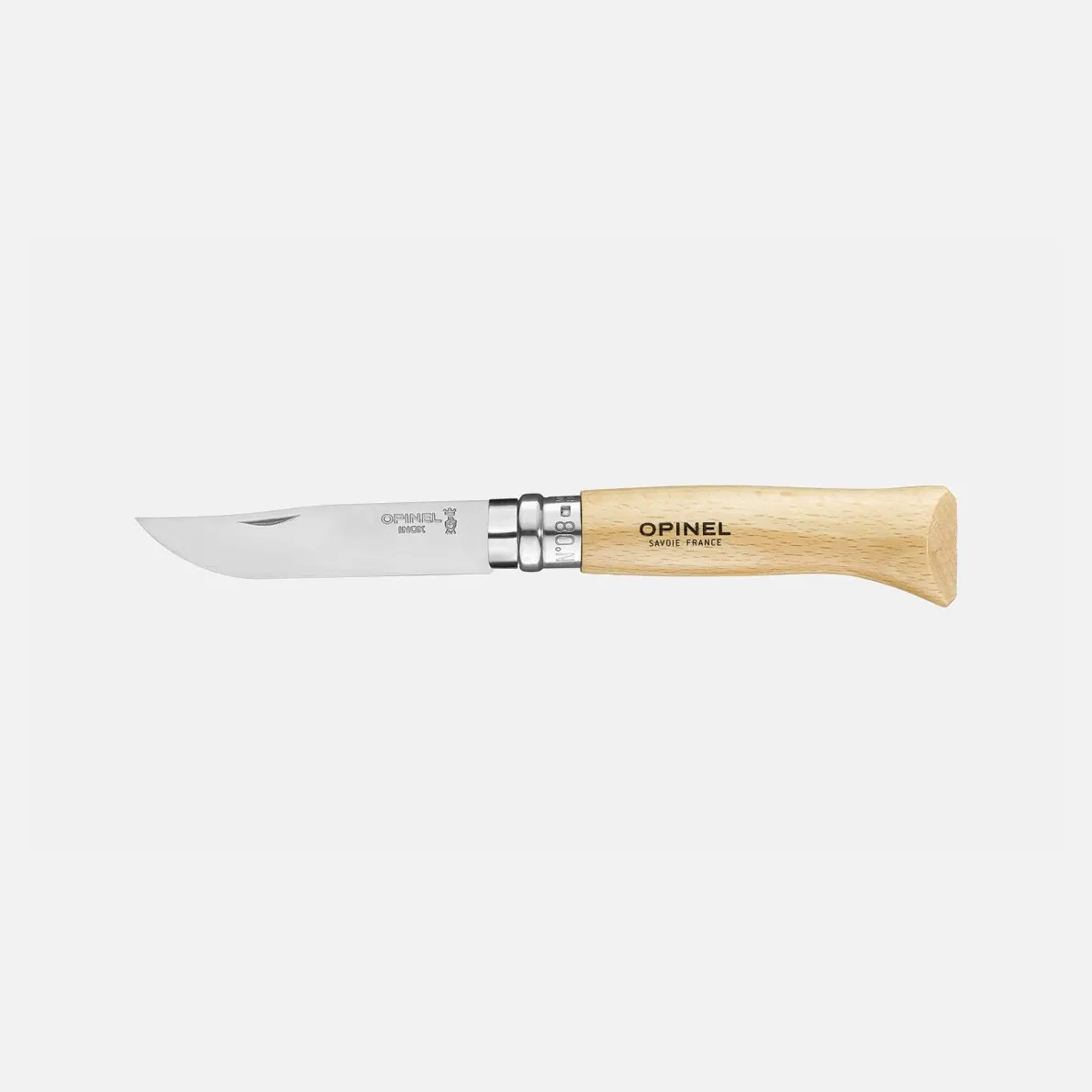
For: Folding knife for picnics, trail
Opinel No. 8 Stainless Folding Knife
A French folding knife made since 1890: a 3.28-inch Sandvik 12C27 stainless blade, beechwood handle and Virobloc ring that locks the blade open or closed. This listing includes a faux-leather sheath. Pocket-friendly and good for cheese, fruit and trail lunches; a practical second knife for a van.
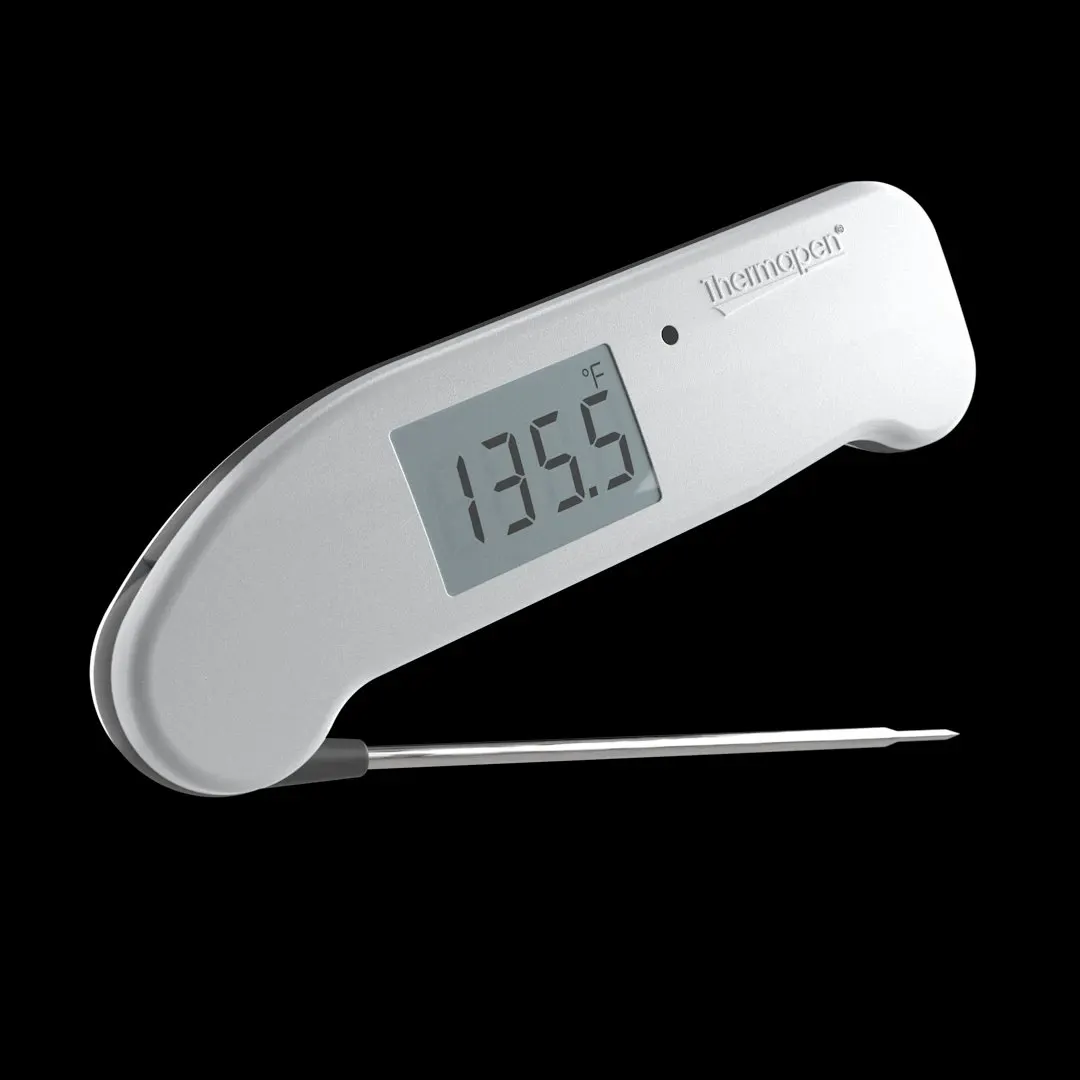
For: Checking meat doneness
ThermoWorks Thermapen ONE Instant-Read Thermometer
A fold-out instant-read thermometer that ThermoWorks rates at about one second and ±0.5°F in key temperature ranges, with IP67 sealing, a NIST-traceable certificate and a five-year warranty. Worth the cost for anyone who cooks protein often; keep it off hot surfaces and out of the dishwasher.
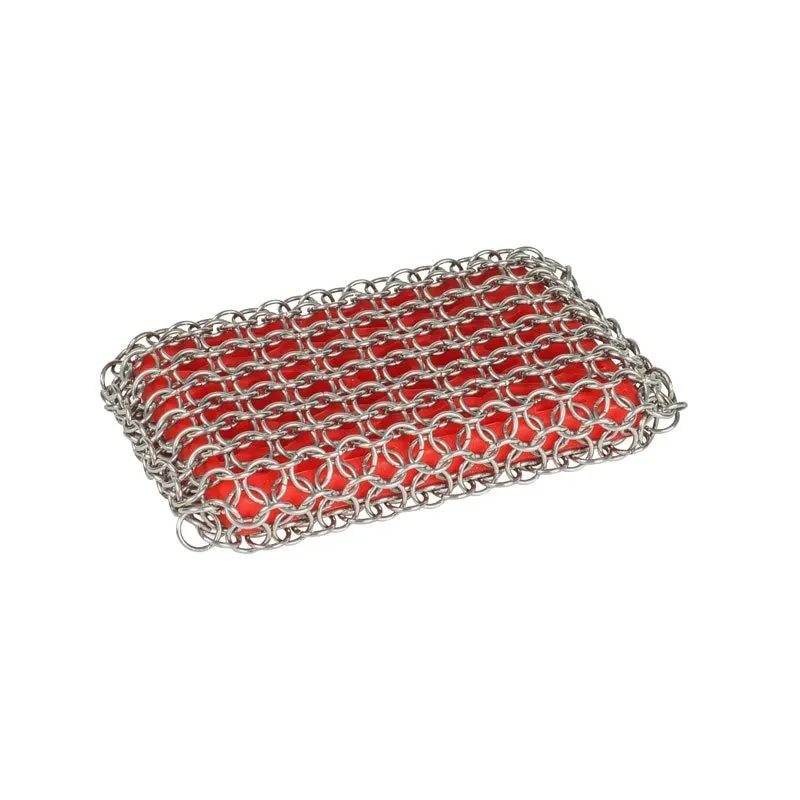
For: Cleaning cast iron
Lodge Chainmail Cast Iron Scrubber
A stainless chainmail scrubber with a silicone core for cleaning cast iron. It lifts stuck food with hot water and leaves seasoning largely intact; Lodge says a little mild soap is fine.