Van Cookware Materials: Cast Iron vs Carbon Steel vs Stainless vs Titanium
The five cookware materials van dwellers actually choose between — cast iron, carbon steel, tri-ply stainless, hard-anodized nonstick, and titanium — with the two-pan kit recommendation that covers every cooking task.
Disclosure: As an Amazon Associate I earn from qualifying purchases. Links to Amazon on this page are affiliate links: if you buy through one, VanLifeKitchens.com may earn a commission at no extra cost to you. Read our affiliate disclosure.
The cookware materials question — why it matters more in a van
In a house kitchen you can own a cast iron skillet, a carbon steel pan, a stainless All-Clad set, a hard-anodized nonstick, and a Dutch oven, and swap between them based on what you are cooking. In a van, you are choosing two or three pans that will do every job for years, in a cabinet that bounces over washboard roads, on a cooktop that may be induction, butane, propane, or all three depending on season. The material you pick is not a style choice. It determines whether your cookware survives the build, whether it heats evenly on a cheap butane burner, whether it can go on induction at all, and whether you will still like it a year from now.
This guide walks through the five materials you will realistically consider for van kitchens — cast iron, carbon steel, stainless steel (tri-ply and multi-ply), hard-anodized nonstick, and titanium — and tells you what each is actually good for, what it is bad at, and which van kitchens they belong in. If you are deciding between an All-Clad D3 stainless skillet and a Lodge cast iron skillet right now, skip to the comparison section near the end.
The five properties you are actually choosing between
Every cookware material trades off among five properties, and no material is best at all five:
- Heat capacity and evenness. How well the pan holds temperature once hot, and how evenly heat spreads across the cooking surface. Important for searing, braising, and anything where "medium heat" needs to stay medium for fifteen minutes.
- Heat responsiveness. How quickly the pan changes temperature when you change the burner setting. Important for sauces, eggs, anything where you need to back off instantly.
- Induction compatibility. Whether the pan works on induction cooktops at all. This is a hard yes/no — ferromagnetic metals (cast iron, carbon steel, most stainless) work; aluminum, copper, and pure titanium do not.
- Durability. Whether the pan survives dropping, washboard roads, thermal shock, utensil scrapes, and years of daily use without needing replacement.
- Weight and cleanup. How much of a pain it is to lift and wash. This is a bigger deal in a van than in a house because you are handling the pan in a cramped space every single day, often with limited water.
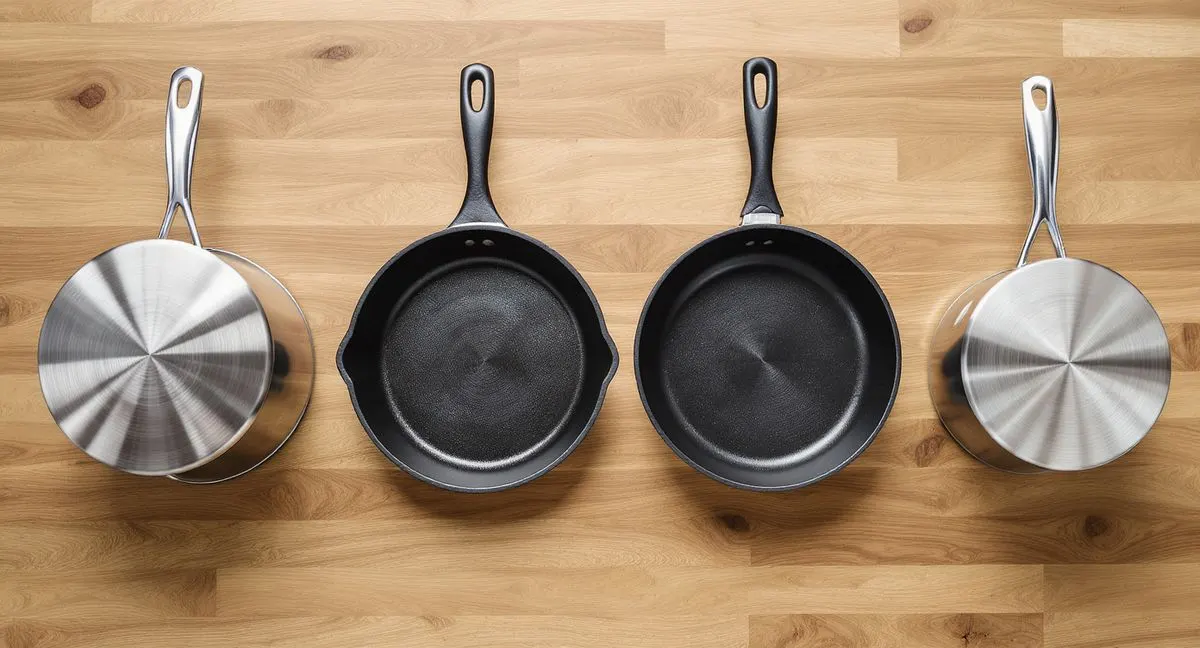
Cast iron wins on 1 and 4, loses on 2 and 5. Stainless wins on 2 and 4, middling on 1. Carbon steel splits the cast-iron-stainless difference. Nonstick wins on 5, loses on 4. Titanium wins on 5, loses on 1. Pick the trade-offs you can live with.
Cast iron: the default for serious van cooks
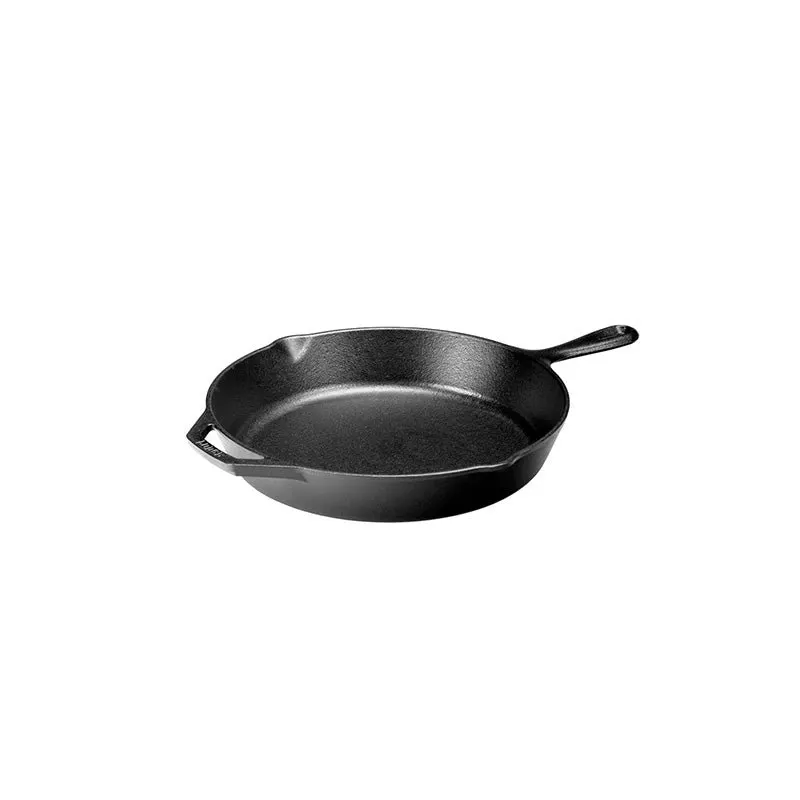
Cast iron is the default recommendation for most full-time van kitchens and for good reason. A seasoned 10-inch Lodge, one of the cheapest pans in our catalog, does five things few other pans at any price can do at the same time: it sears a steak properly, it bakes a cornbread, it holds a low simmer for a long braise, it goes on any heat source including direct campfire coals, and it shrugs off metal utensils and scouring because there is no coating to damage. It is not unbreakable: cast iron can crack if it is dropped onto a hard surface or if a very hot pan is plunged into cold water, so let it cool a little before washing. Lodge states its cast iron works on any stovetop including induction, in the oven, on the grill and over a campfire. If you had to pick one pan for a van and were not allowed a second choice, cast iron makes the strongest case: it works on every heat source, has no coating to wear out, and holds heat well.
The downsides are real. Cast iron is heavy. Lodge's catalog lists the 10.25-inch L8SK3 at about 5.3 lb, and its 12-inch skillets weigh around 7 lb. In a van where every ounce matters, this is a real tax. The seasoning has to be maintained, which means oiling the pan after every wash and not leaving it wet in a dish bin overnight. And the heat response is slow: you cannot turn a cast iron skillet from high to low and expect the food to follow. The thermal mass that makes cast iron great for searing also makes it sluggish for delicate work.
Cast iron also rusts. A van lived in year-round has humidity swings that can put a coat of orange on an unseasoned or under-oiled pan within a day or two. The fix is simple — wipe dry after every wash, oil once a week whether you think it needs it or not, and store the pan with a paper towel between the surface and the lid — but it is a discipline.
Cast iron is right for: full-time cooks, one-pan minimalists, any kitchen that values durability over responsiveness, any build that uses butane or propane as primary heat.
Carbon steel: the sleeper pick most van cooks should consider
Carbon steel is cast iron's lighter, faster cousin. Same material chemistry (iron and carbon), same seasoning requirement, same ferromagnetic induction compatibility. But where cast iron is thick and chunky, carbon steel is rolled from sheet, so a carbon steel skillet of the same diameter is usually noticeably lighter than a 10.25-inch cast iron skillet. The exact figure depends on the brand and the gauge, so check the listing weight before you buy. That difference is something you feel every morning in a van kitchen.
Carbon steel heats faster than cast iron, responds faster to burner changes, and cooks eggs better once the seasoning is developed. It handles high-heat searing almost as well as cast iron and handles delicate work substantially better. The seasoning maintenance is the same discipline as cast iron: oil after washing, never leave wet.
The reason most van cooks do not default to carbon steel is that it is less forgiving during the seasoning-in period. Many carbon steel pans ship with a protective wax or oil coating that has to be removed, then need several rounds of seasoning, and used for a month or two before it reaches nonstick-egg territory. Cast iron from Lodge comes pre-seasoned out of the box and is cooking within an hour of unboxing. Carbon steel asks for more patience up front in exchange for a lighter pan.
Carbon steel is right for: weight-conscious full-timers, cooks who want one pan that does almost everything, anyone upgrading from a base cast iron setup and wanting something lighter.
Stainless steel (tri-ply and multi-ply): the versatility king
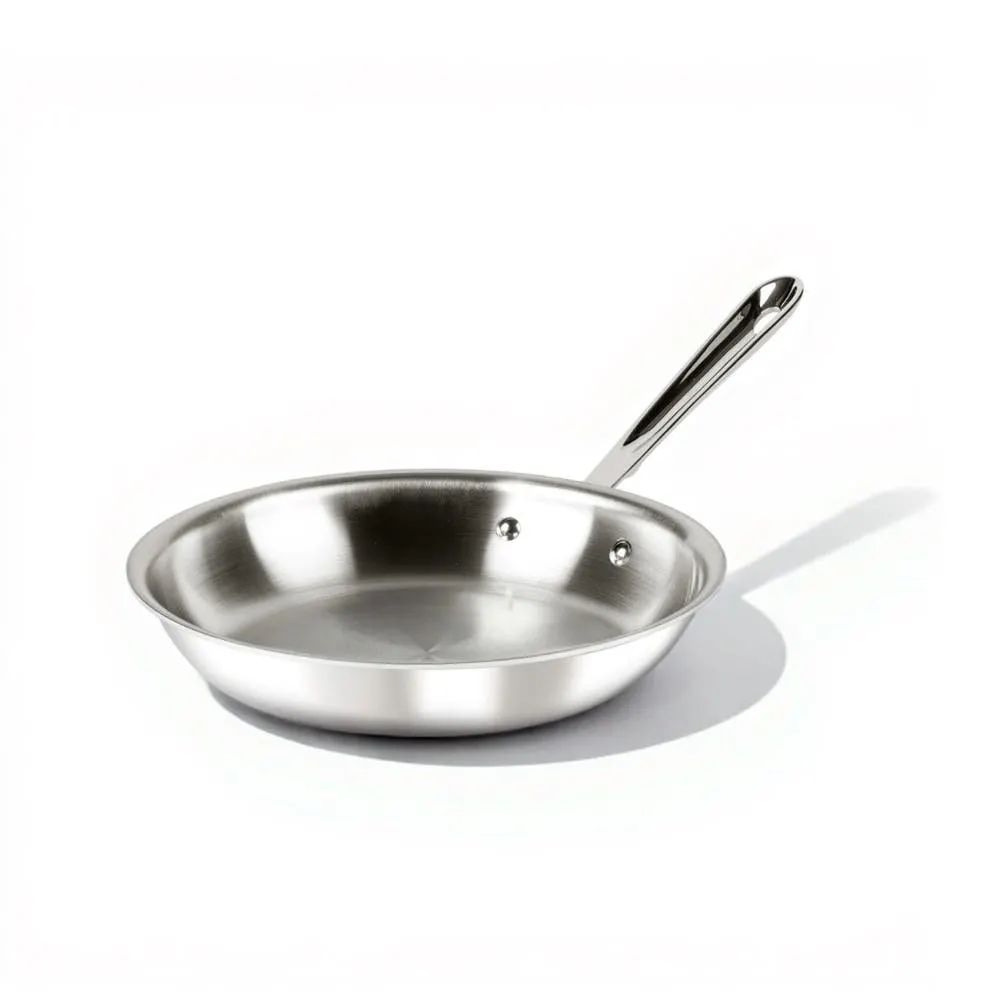
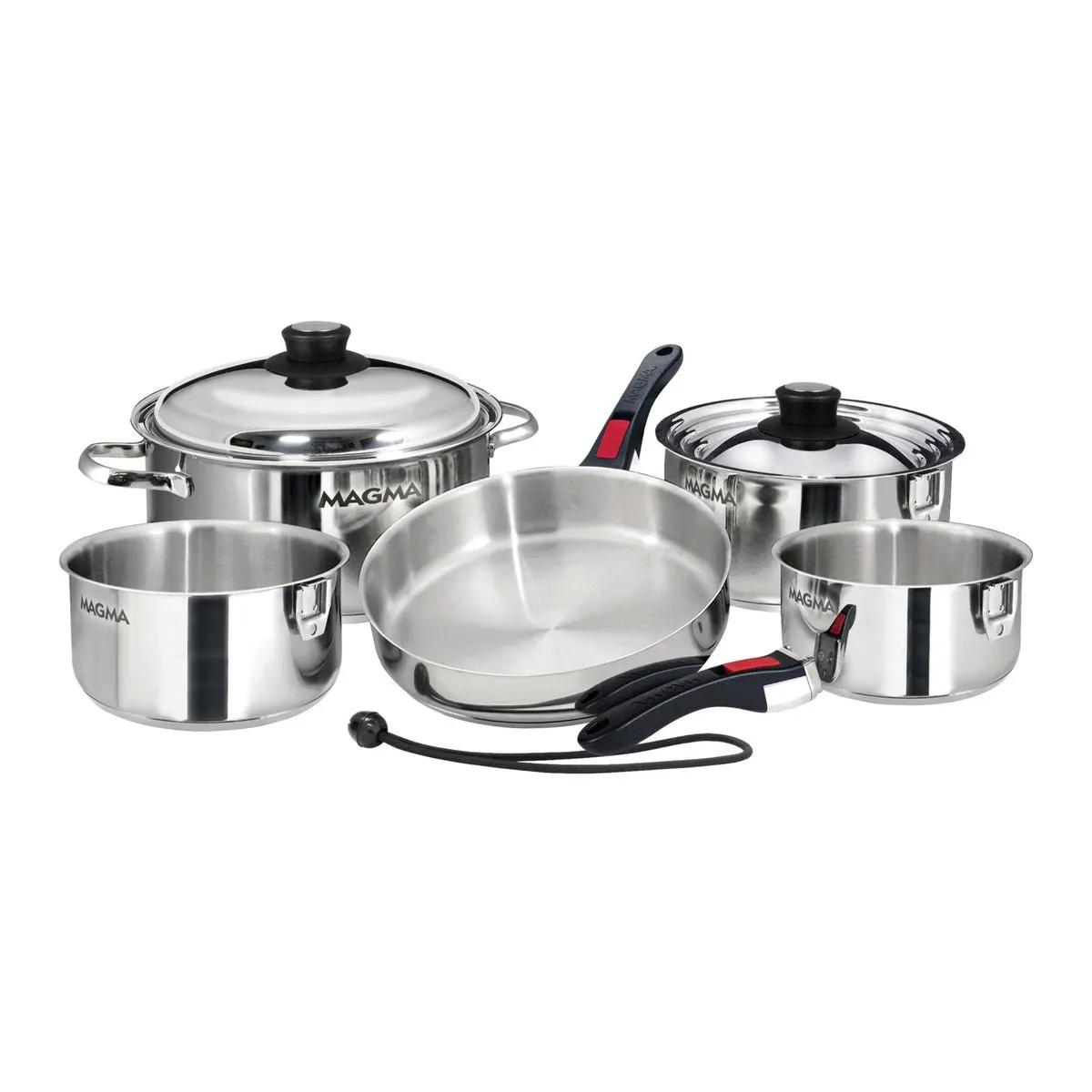
A good tri-ply or multi-ply stainless pan — a core of aluminum or copper bonded between layers of stainless steel — combines stainless steel's durability and neutrality with aluminum or copper's heat conductivity. This is the construction of the All-Clad D3, the Tramontina Signature 3-quart saucepan (an aluminium core between two layers of 18/10 stainless), the Made In 5-ply, and most mid-to-premium stainless you can buy. The Magma Nesting cookware uses a related approach: 18-10 stainless with a tri-clad disk bottom rather than cladding that runs up the sides.
Stainless is the right answer when you are doing work that cast iron and carbon steel cannot. Acidic tomato sauces — cast iron will strip its seasoning and iron-flavor the sauce. Pan sauces where you want a hard deglaze and need to see the fond — stainless shows you what is happening; cast iron hides it. Braising where the pan needs to go from a sear into a simmer, and you need the simmer to actually respond when you turn down the burner — stainless responds, cast iron does not. For van kitchens that do varied cooking (not just one-pan comfort food), stainless is the most useful second pan to pair with cast iron, because it covers exactly the jobs cast iron handles poorly.
The induction question matters here. Most — but not all — stainless pans work on induction. The rule: if a magnet sticks to the bottom, it works. All-Clad lists the D3 as compatible with any stovetop including induction, and Magma's A10-360L-IND set has a tri-clad base with a magnetic stainless outer layer that Magma lists as induction-compatible. Some stainless, including some camp sets, uses grades that are only weakly magnetic or not magnetic at all. Always check the manufacturer's listing, or test with a magnet, before buying. For which nesting sets and collapsible pots on this site their makers list for induction, see the guide to nesting cookware for induction.
Stainless multi-ply is right for: varied-cuisine cooks, anyone making tomato sauces or pan sauces regularly, builds with two-pan kitchens where cast iron handles searing and stainless handles everything else.
Hard-anodized nonstick: the weekend-and-egg solution
Hard-anodized nonstick — a ceramic or PTFE coating bonded to an anodized aluminum base — is the pan type that homes use for eggs and pancakes and nothing else. In a van, it occupies a narrower niche: it is the right answer if you are cooking occasionally, weekends or less, and you want the lowest-maintenance eggs-and-skillet experience available.
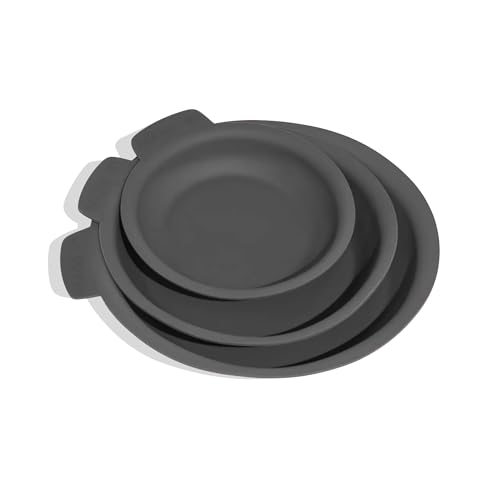
The problem with nonstick in a van is durability. The coating wears off with metal utensils, with over-scrubbing, with thermal shock, and eventually with nothing at all — how long it lasts depends on heat, utensils and cleaning habits. Daily use, stacking in a cabinet and rough scrubbing with limited water all shorten that. Treat any nonstick pan as cookware with a finite life, and stack it with a pan protector; silicone ones such as the Made In pan protectors don't hold moisture against the pan below the way felt can.
Because these pans are aluminium underneath, they don't work on induction unless the maker adds a magnetic base. The Anolon X 10-inch Hybrid Nonstick pan is built differently: Anolon describes a titanium nonstick surface protected by a stainless steel mesh, which it says makes the pan metal-utensil-safe, on a full-cap stainless base that it lists as induction-suitable. Anolon rates it oven-safe to 500°F. The coating still wears eventually, so it suits the dedicated egg-pan role below rather than a primary pan. Our Anolon X vs de Buyer Mineral B comparison sets it against bare carbon steel.
PTFE nonstick (the Teflon family) is also thermally unstable above about 500°F, which means it cannot go in a hot oven, cannot be used for serious searing, and releases compounds if accidentally overheated. Ceramic nonstick does not contain PTFE, but its release generally fades sooner than PTFE, and most makers recommend low to medium heat.
Nonstick is right for: weekend warriors who want an easy egg pan, anyone who does not want to learn cast iron seasoning, as a dedicated second pan where it is used only for eggs and delicate work.
Titanium: the ultralight specialty pick
Titanium cookware — Snow Peak titanium cooksets, Toaks titanium pots — is the ultralight specialty answer. To put the weight in context: retailers list the four-piece Snow Peak Titanium Multi Compact Cookset (two pots and two lid-pans) at about 11.6 oz, while MSR lists its single 1.6 L stainless Alpine StowAway pot at 19.5 oz. That makes titanium a serious argument for packable car-camping and bikepacking builds that double as van kitchens.
The trade-off is hot spots. Titanium conducts heat roughly a tenth as well as aluminum, in the same range as stainless steel but without stainless pans' aluminum cladding, which means it develops localized hot spots directly over the burner flame. Eggs in a thin titanium pan tend to stick and scorch over the flame while the edges lag behind. Titanium cookware is really best used as a boiler — water, rice, pasta, simple soups — rather than a sauté pan. Pure titanium is also not induction-compatible; some titanium cookware adds a ferromagnetic disc to the base, but most does not.
Titanium is right for: weight-obsessed minimalists, hybrid van-backpacking builds, anyone using the cookware primarily to boil water.
Cleanup with limited water
Material also decides how much water and effort each wash takes, which matters when every litre comes out of a jug.
- Cast iron and carbon steel: scrape while warm, wipe, a short rinse, dry on the burner, a few drops of oil. Very little water, but you must dry it fully every time. A chainmail scrubber removes stuck food without soaking.
- Stainless: stuck-on food usually releases if you deglaze with a splash of water while the pan is still hot. Burnt residue can take a soak or a scouring powder, which uses more water.
- Nonstick and ceramic: the easiest to wipe clean with a paper towel and a little water, but no metal scrubbers and no abrasive powders.
- Titanium: easy to wash because most use is boiling, but scorched food over a hot spot can be stubborn.
Head-to-head: the two-pan van kitchen recommendation
If a van kitchen gets two pans and the cook is willing to learn seasoning, the answer is: a 10-inch cast iron (or carbon steel) for searing, braising, breads, and one-pan meals, plus a 10-inch tri-ply stainless skillet for sauces, delicate work, and anything acidic. With the Lodge L8SK3 (about 5.3 lb per Lodge's catalog) and the All-Clad D3 10-inch with its lid (3.73 lb per All-Clad), the pair weighs about 9 lb. The cast iron is budget-tier and the All-Clad is premium; the "Check price on Amazon" buttons on each review show current prices. This combination covers most everyday cooking tasks, the two pans stack in one low drawer with a protector between them, and both work on induction, butane, and propane.
If the cook will not learn seasoning, swap the cast iron for a second stainless pan of a different shape (a 3-quart sauté pan instead of a skillet), and accept that you will never get the perfect sear. It is a legitimate trade-off. Cast iron seasoning is a skill, not a mystery, but it is a skill that takes a couple of months to feel natural.
Avoid: nonstick as a primary pan (wears out), pure titanium as a primary pan (hot spots), cheap single-layer stainless (hot spots, and it may not work on induction), bargain-bin full cookware sets (the metal is too thin to cook evenly).
See the induction vs butane vs propane guide for how your heat source affects this decision, and the van kitchen storage solutions guide for how to stow a two-pan kit so nothing rattles.
Products covered in this guide
Disclosure: As an Amazon Associate I earn from qualifying purchases. Links to Amazon on this page are affiliate links: if you buy through one, VanLifeKitchens.com may earn a commission at no extra cost to you. Read our affiliate disclosure.


Frequently asked questions
What is the best cookware material for van life?
Cast iron for searing and braising, tri-ply stainless for sauces and delicate work. The two-pan combo (Lodge cast iron + Magma stainless) covers every cooking task.
More in Buying Guides
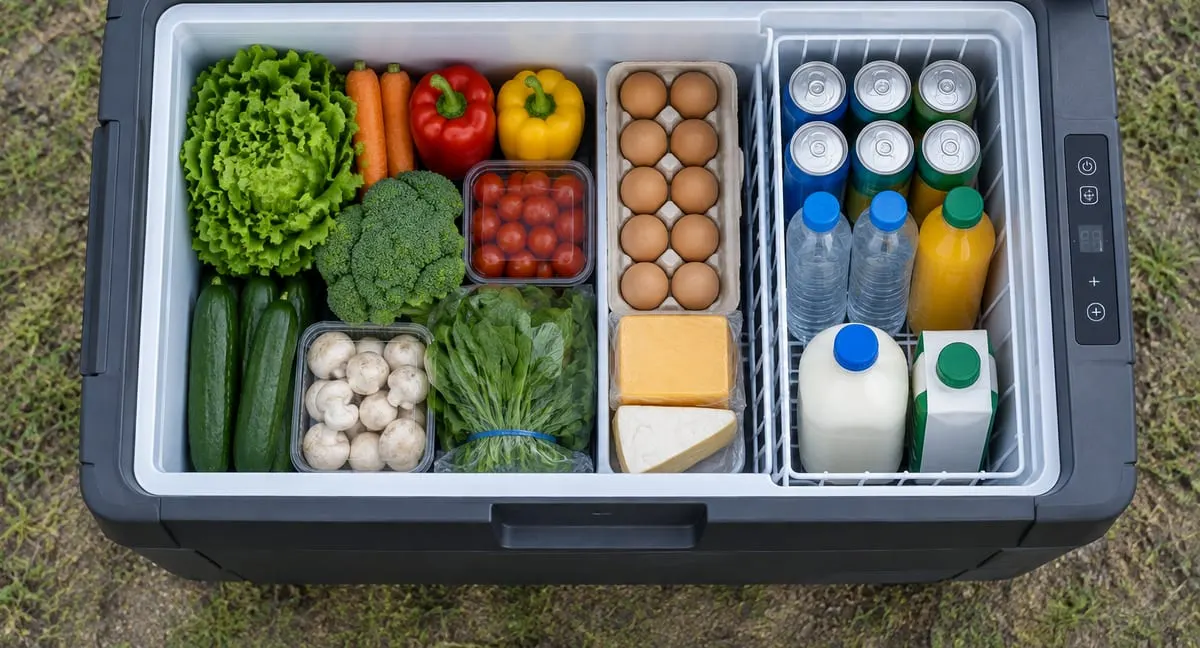
What Size 12V Fridge Do You Need for One or Two People?
Size a 12V fridge by resupply interval, fresh vs shelf-stable food, usable space and freezer needs, not headcount alone. Worked examples, clearances and published energy figures.
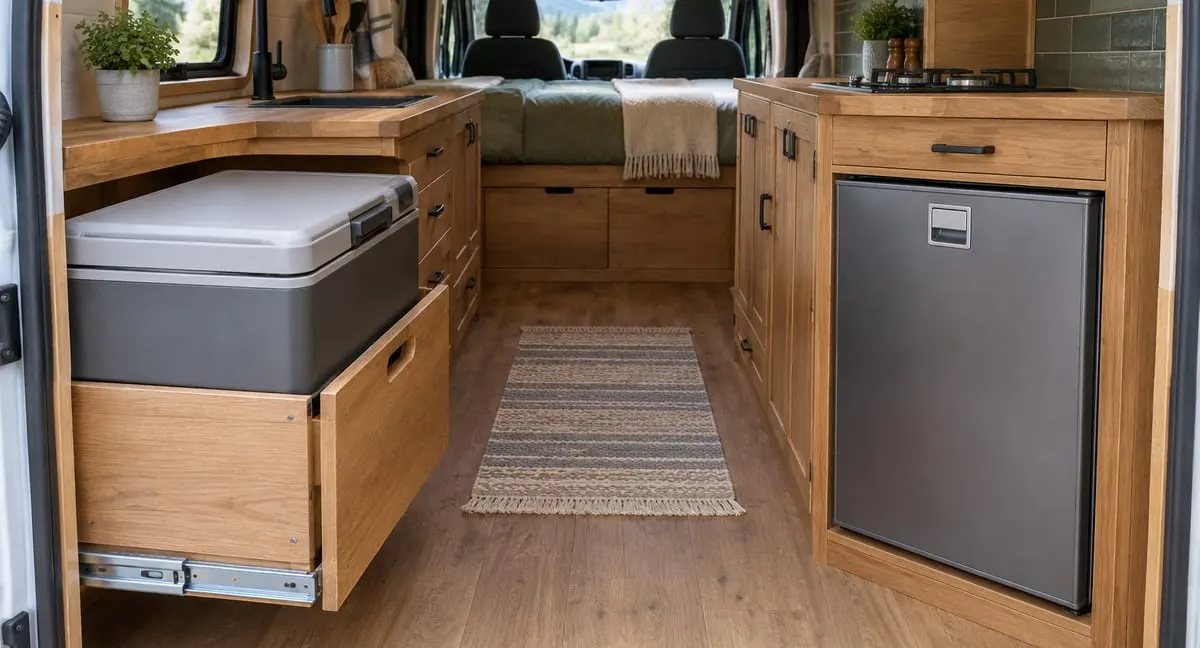
Chest vs Upright Fridge for a Campervan
Chest or front-opening 12V fridge? Floor space, lid vs door clearance, ventilation per the manuals, slides and tie-downs each maker offers, and model-specific energy figures.
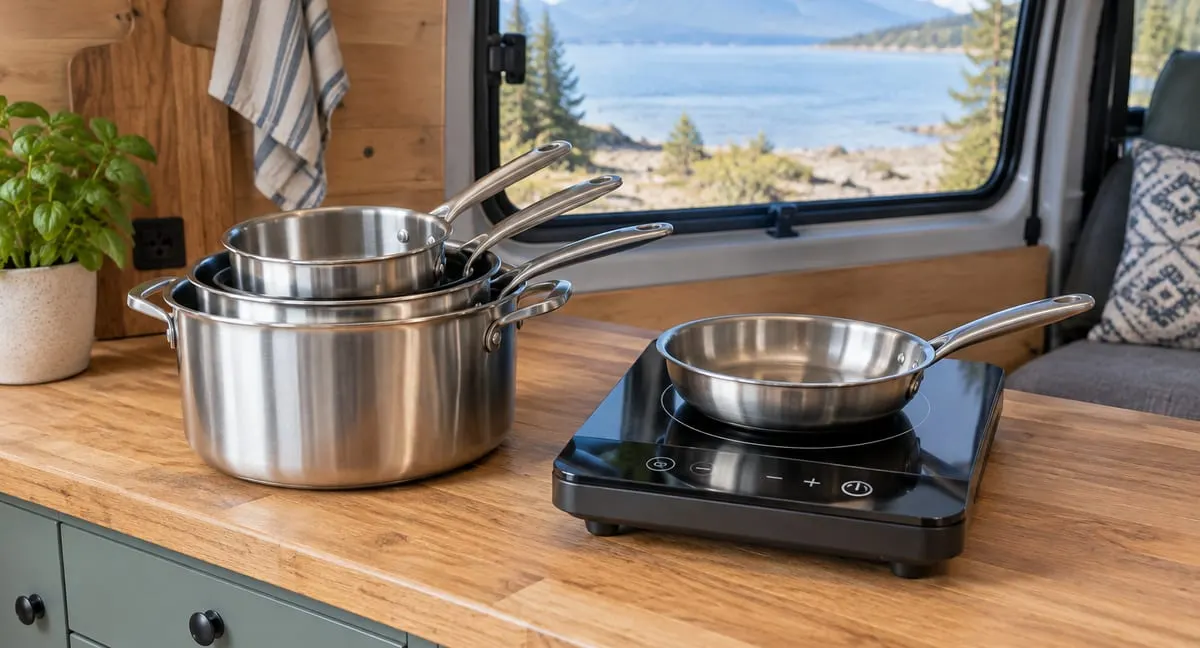
Nesting Cookware for Induction: Compatibility and Storage
Which nesting and packable pots actually work on a portable induction hob, per their makers: magnet tests, pan-size limits for the Duxtop and NUWAVE, what nests inside what, handles, lids and glass-top care.