AcuRite 00986M Wireless Refrigerator and Freezer Thermometer

- Model
- 00986M
- Sensors
- 2 wireless (fridge + freezer)
- Sensor Range
- -40°F to 100°F (-40°C to 37°C)
- Wireless Range
- 75 ft (23 m)
- Alarms
- Programmable min/max; triggers after 15 min out of range
- Mounting
- Display: magnet or keyhole; sensors: suction cup or clip
- Warranty
- 1-year limited (Amazon listing)
AcuRite 00986M Review: An Independent Temperature Check for a 12V Fridge
A 12V compressor fridge shows you a number on its display, but that number comes from the fridge's own sensor, usually in one spot near the evaporator. It tells you what the controller is aiming at, which isn't necessarily what the milk at the top of the basket is sitting at. Some independent reviews of dual-zone fridges report a zone drifting several degrees from its setpoint. Our 12V fridge guide recommends a standalone thermometer as a check on the unit's own display. This page covers a specific one.
The AcuRite 00986M is a wireless refrigerator and freezer thermometer: one display unit and two small wireless sensors. Each sensor goes inside a compartment, and the display shows both readings along with the highest and lowest temperatures since you last reset it. An alarm sounds if a compartment stays outside the range you set.
This review is research-based. VanLifeKitchens doesn't test products hands-on. The specs come from AcuRite's product and support pages and the Amazon listing we link to. The van-specific advice reflects how 12V fridges are typically used.
Choose this if:
- You want to know whether your fridge actually holds food-safe temperatures, not just what it's set to.
- You run a dual-zone fridge, or a fridge plus a separate freezer, and want one sensor in each.
- You want an alarm if a lid is left ajar or the fridge cuts out on low voltage overnight.
Skip this if:
- You want readings on your phone. This is a standalone display with no app.
- You only want an occasional spot check. A simple dial fridge thermometer does that.
- Your fridge sits in a cold vehicle well below -4°F and you don't want to buy lithium batteries.
What you get
AcuRite lists the 00986M as including one refrigerator thermometer and one freezer thermometer (the two wireless sensors) plus the display. The display has a magnetic back and a keyhole for wall mounting. Each sensor has an integrated suction cup and a clip, so it can stick to a wall or clip to a shelf or basket wire inside the compartment.
Because the sensors are wireless, no cable runs under the lid seal. That's a real advantage on a 12V fridge. A wired probe running across the gasket of a top-opening fridge keeps the lid from sealing fully at that point, which lets warm, moist air in and makes the compressor run more.
Specifications and sources
| Spec | Figure | Source |
|---|---|---|
| Model | 00986M | AcuRite, Amazon |
| Sensors | 2 wireless (fridge + freezer) | AcuRite |
| Sensor range | -40°F to 100°F (-40°C to 37°C) | AcuRite, Amazon |
| Wireless range | 75 ft (23 m) | AcuRite |
| Alarm delay | Triggers after 15 min out of range | AcuRite support |
| Warranty | 1-year limited | Amazon listing |
AcuRite's support page adds that the display shows current readings plus the high and low records "since the batteries were inserted or since the CLR button was last pressed". It recommends lithium batteries for sensors placed where temperatures go below -4°F / -20°C. It also says to use batteries with a nominal 1.5 volts, because some rechargeables run at lower or inconsistent voltage. Batteries aren't included.
Why a separate thermometer helps with a 12V fridge
Checking the setpoint against reality. A compressor fridge cycles: it runs until its sensor reaches the setpoint, then rests while the box warms a little. The air temperature swings, and different parts of the basket sit at different temperatures. A second sensor placed where your perishables actually sit shows whether they stay at or below 40°F (4°C), and frozen food at or below 0°F (-18°C). Those are the standard food-safety targets our fridge guide uses.
Catching overnight problems. The high/low memory is the most useful feature in a van. Clear it at bedtime and check in the morning. If the high reading climbed overnight, something happened while you slept: a hot night, a battery protection cutoff, or a lid not fully latched. The fridge's own display only shows you the present moment.
Low-voltage cutoffs. 12V fridges have a battery protection setting that switches the compressor off when voltage drops too far. If your battery is undersized, the fridge can stop running overnight without you noticing. A thermometer with an alarm and a high-reading memory makes that visible. Our fridge battery calculator helps size the battery so it doesn't happen.
Dual-zone fridges. With two sensors, you can put one in each zone of a dual-zone fridge like the ICECO VL60, or one in the fridge and one in a separate freezer.
The 15-minute alarm delay
AcuRite's support page says an alarm triggers when a temperature is out of range for longer than 15 minutes. That prevents false alarms while the door or lid is open for loading. In a van, a lid is opened often but briefly, so this delay is a good fit: a quick look for a drink won't trigger it, but a lid left resting on a bag strap all afternoon will.
Set the fridge sensor's high limit a little above your target (for example 41°F if you aim for 37–38°F) so normal cycling doesn't set it off. Set the freezer sensor's high limit around 5–10°F so you hear about a thaw before food is lost.
Placement in a 12V fridge
- Fridge sensor: clip it to the basket wire or stick it to the wall at mid-height, near where you keep meat and dairy. Avoid putting it against the evaporator wall or directly on frozen items, or it will read colder than the food.
- Freezer sensor: among the frozen food, not right at the evaporator plate.
- Keep the sensor out of meltwater. Fridges collect condensation in the bottom. AcuRite's pages we checked don't publish a water-resistance rating for the sensors, so keep them off the floor of the basket.
- The display: within sight of the galley. The magnetic back needs steel, and many 12V fridges have plastic or aluminium exteriors, so the keyhole mount on a cabinet side is often the better option.
Signal through the fridge wall. AcuRite rates the wireless range at 75 ft (23 m). That figure is for open air. A fridge's insulated walls and metal liner can weaken a signal, so keep the display close to the fridge, within a few feet in a van. AcuRite's support page includes a reset procedure for sensors that stop connecting: remove all batteries, put batteries in the display first and hold reset for 20 seconds, then put batteries back in sensor 1, then sensor 2.
Batteries and cold
- The sensors sit inside the fridge or freezer, so they run cold. AcuRite recommends lithium batteries below -4°F / -20°C. Most 12V fridge freezers are set around 0°F, which is above that line, but a deep freeze setting or a van parked in winter can drop below it.
- Use fresh batteries and don't mix brands or old and new cells, per AcuRite's support page.
- Remember the high/low memory resets when you change batteries.
Limitations
- No app, no remote alerts. The alarm only helps if you're near enough to hear it.
- Batteries not included, and lithium cells are recommended for very cold placements.
- Wireless range is rated in open air; through a fridge wall it may be shorter.
- No published water-resistance rating on the pages we checked.
- Magnet mount needs a steel surface, which many 12V fridge exteriors aren't.
- 1-year limited warranty per the listing.
Which guides and products it fits
- 12V fridge complete guide: "A cheap standalone fridge thermometer is a good check on the unit's own display." This is a two-sensor version of that advice.
- Fridge battery tool: if the high-reading memory shows overnight warming, your battery or low-voltage cutoff setting may be the cause.
- Fridges on the site: Dometic CFX5 35, Dometic CFX2 45, ICECO VL35 ProS, ICECO JP40 Pro, ICECO VL60 dual zone and BougeRV CR30. The thermometer works with any of them because it doesn't connect to the fridge.
Verdict
The AcuRite 00986M gives you an independent reading of what your fridge and freezer compartments are actually doing, with high/low memory and an alarm that ignores brief lid openings. Its wireless sensors avoid running a wire under the lid seal, and two sensors cover both zones of a dual-zone fridge. It's not a smart device and it needs batteries, lithium in very cold placements. As a check on whether food stays at or below 40°F, it's a simple tool that catches problems the fridge's own display won't.
FAQ
What temperature range do the AcuRite 00986M sensors cover? AcuRite lists each sensor as measuring -40°F to 100°F (-40°C to 37°C), which covers both fridge and freezer settings on a 12V compressor fridge.
Will opening the fridge lid set off the alarm? Not for a short opening. AcuRite says the alarm triggers when a temperature has been out of range for more than 15 minutes.
Does it work through the wall of a 12V fridge? The sensors are wireless with a rated range of 75 ft (23 m) in open air. Insulated walls can shorten that, so keep the display close to the fridge.
What batteries does it need? Batteries aren't included. AcuRite recommends 1.5-volt batteries and lithium cells for sensors where temperatures drop below -4°F / -20°C.
Can I use one sensor in each zone of a dual-zone fridge? Yes. It comes with two sensors, so one can go in each zone.
Why not just trust the fridge's own display? The fridge's sensor sits in one spot, usually near the cooling plate, and the display shows the present moment. A separate sensor where your food sits, with a high/low memory, shows what the food actually experienced, including overnight.
What temperature should my van fridge be? At or below 40°F (4°C) for the fridge side and at or below 0°F (-18°C) for a freezer, which are the standard food-safety targets in our fridge guide.
Sources and verification
- AcuRite, 00986 Refrigerator Thermometer with 2 Wireless Temperature Sensors product page: included sensors, -40°F to 100°F range, 75 ft wireless range, mounting options, min/max alarm. https://www.acurite.com/products/00986m-warranty (checked 2026-10-09)
- AcuRite Support, Digital Refrigerator and Freezer Thermometer Model 00986: high/low memory behaviour, lithium battery recommendation below -4°F/-20°C, 1.5 V battery note, reset procedure, 15-minute alarm delay. https://support.acurite.com/hc/en-us/articles/360007520594-Digital-Refrigerator-and-Freezer-Thermometer-Model-00986 (checked 2026-10-09)
- Amazon product listing for ASIN B004QJVU78, the listing this review links to: title, model 00986M, sensor range, mounting, 1-year limited warranty, availability (checked 2026-10-09)
Compare with similar products
See how this stacks up against the other 12v fridges we've reviewed.
Related Reviews

For: CFX5 35 pull-out access
Dometic CFX Series Slide 35/45 (9610000651)
Dometic's own pull-out slide for its 35 and 45 size class, listed as fitting the CFX5 35, CFX5 45 and comparable legacy CFX3 models, with a 220 lb (100 kg) load rating, a latching mechanism and a dust cover. It makes a top-opening fridge reachable under a counter, but it costs considerably more than universal slides, isn't listed for the CFX2 45, and needs bolting to solid structure.

For: 36L single-zone with Wi-Fi
Dometic CFX3 35 Powered Cooler
The CFX5 35's predecessor: a 36L single-zone VMSO3 fridge with Bluetooth and Wi-Fi app control, the same footprint as the CFX5 and a lower published US energy figure. Amazon stock is limited, so check the listing.
For: Quiet 35L with app control
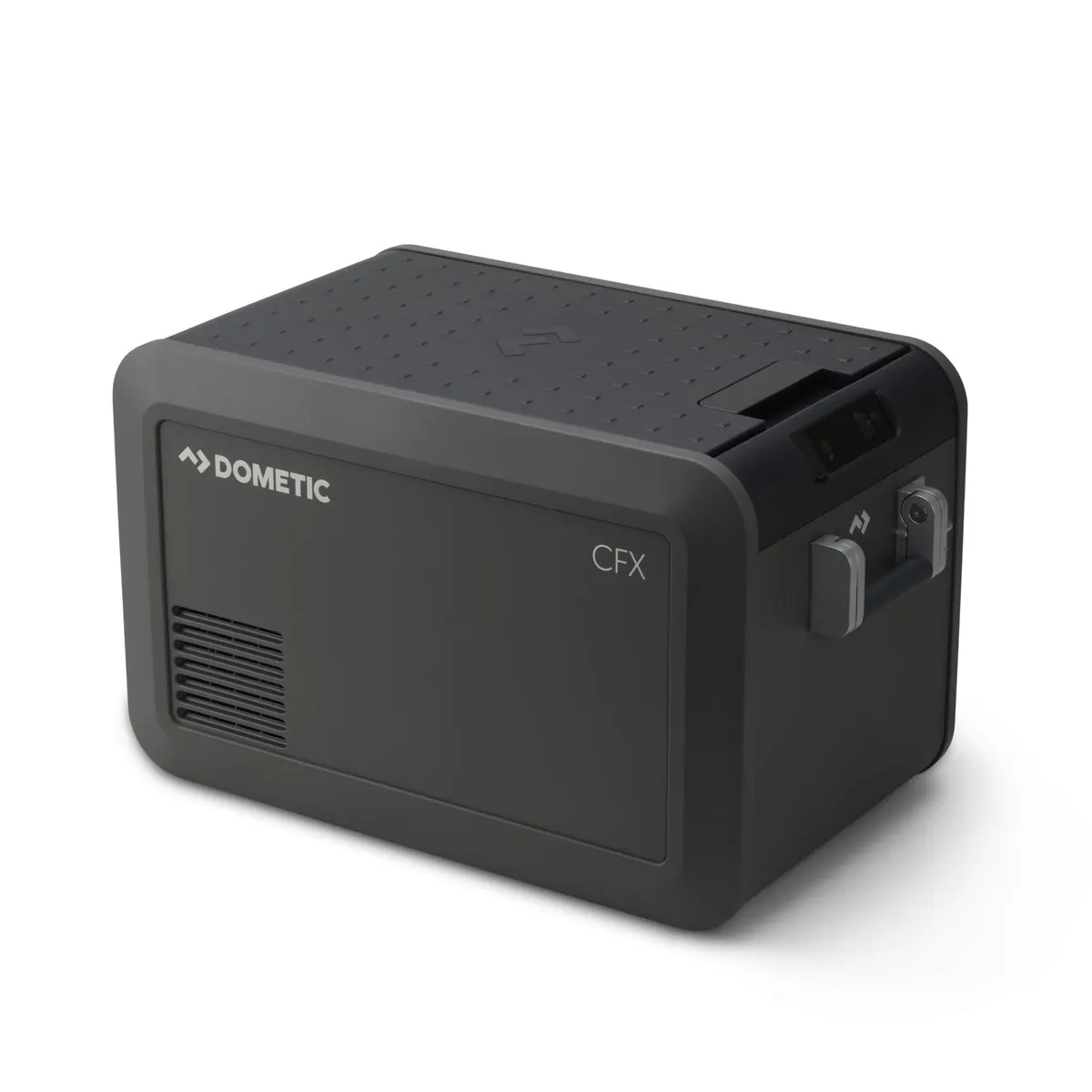
Dometic CFX5 35 Electric Cooler
The CFX3 35's successor adds vacuum insulated panels, a quieter VMSO 3.5 compressor, and a weatherproof color display. The premium 35L pick, if the price fits.