Whale Babyfoot GP4618 Manual Galley Foot Pump

- Part Number
- GP4618 (Babyfoot)
- Operation
- Foot-operated, self-priming
- Max Flow
- 8 L/min (2.2 US gal/min)
- Max Suction Lift
- 1.5 m (5 ft)
- Max Discharge Head
- 3 m (10 ft)
- Hose Connection
- 13 mm (1/2 in) flexible hose
- Weight
- 0.3 kg (0.7 lb)
- Materials
- Nylon body, acetal ports, neoprene seals, stainless and phosphor bronze fasteners
- Service Kit
- AK4615
Whale Babyfoot GP4618 Review: A Foot Pump for a Jug-Fed Van Sink
The Whale Babyfoot is the part that lets a van sink work with no electricity at all. It's a small, foot-operated diaphragm pump that bolts to the floor or a cabinet base, pulls water up a hose from a jug or tank, and pushes it to a spout at the sink. Press it and water flows. Stop pressing and the flow stops. There's no switch, fuse, wiring, pressure switch or accumulator, and nothing draws from your battery.
The model sold under this listing is Whale part number GP4618, which Whale's own catalogue names the Babyfoot. That matters because the name gets mixed up online. Some build guides, including older notes on this site, have called GP4618 the "Tiptoe". Whale's current catalogue lists GP4618 as the Babyfoot, and that is the pump this page and its Amazon button refer to.
This review is research-based. VanLifeKitchens doesn't test products hands-on. The specs below come from Whale's published catalogue pages and the Amazon listing we link to, and the installation advice reflects how jug-fed van sinks are commonly built.
Choose this if:
- You want running water at a van sink from a portable jug, with no 12V wiring.
- You want to use less water. A foot pump only delivers while you press it.
- You're building the budget sink described in our DIY van sink guide or want a manual backup alongside a 12V pump.
Skip this if:
- Your water tank sits more than about 5 feet below the pump. That's beyond Whale's published suction lift.
- You want pressurised water at the tap for showers or a hot-water heater that needs steady flow.
- You need a pump with a published drinking-water certification. Whale doesn't publish one for this model.
What it is and how it works
The Babyfoot is a manual diaphragm pump. Inside is a flexible diaphragm and a pair of one-way valves. Pressing the pedal flexes the diaphragm and pushes water out through the outlet valve. When the spring returns the pedal, the diaphragm draws water in through the inlet valve. Each press moves a fixed slug of water.
Whale describes it as a "simple foot operated solution for pumping water in the galley" and as self-priming. That means it can pull water up an empty hose by itself with a few strokes, so you don't have to fill the line first. Whale also suggests it as a priming pump for its inline electric pumps, which is a clue to how many boat and RV builders use it: as a manual pump on one branch of a system that also has a powered pump.
Whale says the pump suits fresh and salt water. Salt-water use is a boat feature; in a van it simply tells you the materials resist corrosion.
Specifications and sources
| Spec | Figure | Source |
|---|---|---|
| Part number | GP4618 (Babyfoot) | Whale catalogue |
| Max flow | 8 L/min (2.2 US gal/min) | Whale catalogue |
| Max suction lift | 1.5 m (5 ft) | Whale catalogue |
| Max discharge head | 3 m (10 ft) | Whale catalogue |
| Hose connection | 13 mm (1/2 in) flexible hose | Whale catalogue, Amazon |
| Weight | 0.3 kg (0.7 lb) | Whale catalogue |
| Service kit | AK4615 | Whale catalogue, Amazon |
Whale lists the materials as a nylon pump body, acetal ports, neoprene seals, and stainless steel and phosphor bronze fasteners. The Amazon listing adds a five-year warranty. Whale's catalogue page doesn't state a warranty, so check the listing and the paperwork in the box.
Whale's catalogue doesn't publish overall dimensions or a mounting-hole pattern. The Amazon listing's dimension fields look like packaging data and don't describe the pump's footprint. Measure the space under your counter and leave room to swing your foot. Don't plan to the inch from a listing.
What "8 litres per minute" means. That's a maximum flow, so treat it as a ceiling rather than a typical figure. Real delivery per press depends on how far you press the pedal, how high the water has to lift, and hose length and diameter. A foot pump is designed for short bursts: rinsing a plate, filling a kettle, wetting a cloth. The design limits waste because water stops when your foot does, not because the pump is slow.
Fittings: what connects to what
This is where most first builds go wrong, so here's exactly what the Babyfoot accepts and what it doesn't.
- Inlet and outlet: Whale specifies both as suitable for 13 mm (1/2 inch) flexible hose. That means hose with a 1/2-inch inside diameter pushed over the pump's barbed ports and secured with a hose clamp.
- Not threaded pipe. The ports aren't specified as NPT or BSP threads. Don't plan to screw rigid pipe or PEX fittings directly into the pump. If the rest of your system uses PEX or 3/8-inch tubing, you need a reducer or barb adapter that is specifically 1/2-inch barb on one side and your system's fitting on the other.
- 3/8-inch tubing won't fit. Tubing with a 3/8-inch inside diameter is too small to stretch over a 1/2-inch barb securely. Forcing it invites leaks and air leaks on the suction side.
- Spout and sink fitting are separate. The pump doesn't come with a faucet or spout. Most jug-fed builds run the outlet hose to a simple gooseneck spout or a bulkhead through the counter. Whatever you choose must take 1/2-inch ID hose, or you'll need an adapter. The no-plumbing campervan sink guide walks through matching the pump to a jug, hose and basin.
For the hose itself, use flexible hose marketed for drinking water or food contact, in a 1/2-inch inside diameter. Reinforced (braided) vinyl resists kinking and resists collapsing on the suction side better than thin unreinforced tube. We couldn't find a braided 1/2-inch tubing on Amazon with a manufacturer drinking-water certification we could verify, so we don't recommend a specific hose here. Read the hose maker's own claims before you buy, and look for a stated standard rather than the words "food grade" alone.
Clamps matter more than the pump. On the inlet side the pump is pulling a partial vacuum. A loose clamp there doesn't drip. It sucks air, and the pump feels like it has lost prime. Owners commonly trace "weak" foot pumps to an inlet clamp. Use a stainless clamp sized for the hose's outside diameter on every barb.
Suction lift: the limit that decides placement
Whale's published maximum suction lift is 1.5 m (5 ft). That's the furthest the pump can pull water upward from the water surface to the pump. In a van this is rarely a problem, because the jug normally sits on the floor beside the pump. It does matter in three cases:
- A tank mounted under the van, with the pump above the floor and the tank's outlet well below it.
- A long, rising hose run to a pump mounted at counter height rather than on the floor.
- A partly empty tall jug. As the level drops, the lift grows, though in a 19-inch-tall jug this is a few inches.
Maximum figures are measured under ideal conditions, so don't design right at 5 feet. Keep the pump low and close to the water, and keep the suction hose short and free of high loops where air can collect.
The 3 m (10 ft) discharge head covers how high the pump can push water above itself. Floor to spout in a van is usually under 4 feet, which is well within it.
Material suitability and drinking water
Whale calls the Babyfoot a freshwater galley pump, and galley pumps are routinely used for drinking water on boats. Whale's catalogue doesn't publish an NSF/ANSI 61 listing or any other drinking-water certification for the GP4618, though. So the accurate statement is: it's designed for galley freshwater, and the manufacturer doesn't publish a potable certification.
In practice:
- Treat the pump as a transfer device. Water quality is set by your source, your jug, your hose and any filter you add.
- If you drink from the tap, a separate drinking-water filter or purifier is the place to handle water quality. Our water filtration guide explains which filters handle bacteria and protozoa, which also handle viruses, and which only improve taste. No pump makes questionable water safe.
- Flush the line with clean water after the pump has sat unused for a while, and sanitise the jug and hose periodically as you would any drinking-water system.
Installing it in a van
The basic jug-fed build is covered step by step in our DIY van sink guide. The points specific to this pump:
- Mount it to something solid. The pedal takes your body weight many times a day. Screw it through its mounting flange into the cabinet floor or a solid plywood base, not thin paneling.
- Position for your foot, not the plumbing. Put the pedal where your foot lands naturally when you stand at the sink, usually directly below and slightly forward of the basin. Mount it too far back and you end up pumping on tiptoe.
- Keep the inlet hose short. Run it from the jug's opening to the pump with gentle curves. Long suction runs make priming slower and leaks harder to find.
- Reach the bottom of the jug. Cut the intake hose so it sits just above the jug floor, or weight the end so it doesn't curl up as the level drops.
- Plan the jug opening. Most portable water jugs have no hose port. The intake usually drops in through the main cap opening, as with the Scepter 05177 water container. That's fine for daily use, but it leaves the jug open to dust unless you cover the gap.
With a 12V pump. Whale itself suggests the Babyfoot as a priming pump for electric pumps. Some van builders tee a foot pump and a 12V pump off the same tank so they have a manual backup. If you do this, follow both manufacturers' plumbing instructions. Check that the 12V pump's pressure can't push water backwards through the manual branch: add a check valve if the electric pump's maker calls for one. Any 12V wiring should follow the pump maker's instructions on fusing and wire size.
Cold weather
Water left in the pump body and hoses will freeze when the van drops below 32°F, and freezing water can split hose and damage pump valves. Whale's catalogue page doesn't publish a winterising procedure, so the conservative approach is the usual one for any manual pump:
- Lift the intake out of the jug and pump until no more water comes out.
- Disconnect the intake hose and let the pump drain if you expect a hard freeze.
- Keep the fresh jug inside the heated part of the van, or bring it in at night.
Our winter van kitchen guide covers cold-weather water storage in more depth.
Maintenance and service
Whale sells a service kit, AK4615, which its catalogue lists as containing diaphragm valves, O-rings, a spring and fasteners. That makes the Babyfoot a repairable part rather than a throwaway one. The parts that wear in any diaphragm pump are the valves and the diaphragm, and a kit is a cheaper fix than a new pump. Keep the kit's part number written down near the pump.
Signs it may need attention:
- It takes more presses than usual to get water: check inlet clamps first, then valves.
- Water flows back down the hose between presses: often a worn inlet valve.
- The pedal feels soft or doesn't return: often the spring.
Limitations
- Hands-free but not effort-free. You'll be pressing the pedal through every dish session, so expect slow fills on large pots.
- No pressure. It won't feed a pressurised water heater, a shower mixer or a pull-out sprayer properly.
- No published dimensions. Measure before you commit to a cabinet layout.
- No published potable certification. See above.
- Accessories add up. You'll still need hose, clamps, a spout and possibly adapters.
Which guides it fits
- DIY van sink setup: this is the foot pump that build is centred on.
- Van water system setup: the "foot pump" option in the pumps section.
- Van dishwashing system: a foot pump suits the low-water two-bin method.
- Pair it with a slim fresh-water jug such as the Scepter 05177. A rigid basin isn't needed if you wash in a collapsible bowl such as the Sea to Summit Ultra-Sil Kitchen Sink.
Verdict
The Whale Babyfoot GP4618 is a simple, serviceable way to get water from a jug to a sink with no electrical work. Whale's published figures (1/2-inch hose connections, 5 feet of suction lift, 10 feet of discharge head and 8 litres per minute at most) fit a typical floor-mounted van install with room to spare. Its real limits are the absence of a published drinking-water certification, the lack of pressure for anything beyond a basic tap, and the need to drain it before a freeze. Plan the fittings around the 1/2-inch barbs, clamp every connection, and it's an easy part to build a low-water van kitchen around.
FAQ
Is the Whale GP4618 the Babyfoot or the Tiptoe? Whale's current catalogue lists part number GP4618 as the Babyfoot. Some older build guides call it the Tiptoe. The Amazon listing we link to is titled Babyfoot GP4618.
What size hose does the Whale Babyfoot take? Whale specifies 13 mm (1/2 inch) flexible hose for its connections. That's hose with a 1/2-inch inside diameter, pushed over the barbs and clamped. 3/8-inch tubing is too small.
Can it pull water from a tank under the van? Only if the lift is within Whale's published maximum of 1.5 m (5 ft), and it's better to stay well under that. Most jug setups sit beside the pump on the cabinet floor, which is no problem.
Is the Babyfoot safe for drinking water? Whale sells it as a freshwater galley pump but doesn't publish a drinking-water certification such as NSF/ANSI 61 for this model. Use drinking-water hose, keep the system clean, and rely on a suitable filter or purifier for water quality.
Does it need electricity? No. It's entirely manual. There's no wiring, fuse or battery draw.
How do I stop it freezing? Lift the intake out of the jug and pump the lines dry before a freezing night. Disconnect and drain the hose for a hard freeze, and keep the water jug in the heated part of the van.
Can it be repaired? Yes. Whale sells service kit AK4615 with diaphragm valves, O-rings, a spring and fasteners.
Can I use it alongside a 12V pump? Whale suggests it as a priming pump for its electric pumps, and some builders tee a foot pump and a 12V pump off one tank. Follow both manufacturers' instructions, and add a check valve where they call for one so the electric pump can't push water back through the manual branch.
Sources and verification
- Whale Marine Catalogue (Navico), Babyfoot GP4618 page: part number, hose connection, flow, suction lift, discharge head, weight, materials, service kit AK4615. https://docs.navico.com/view/177634415/58 (checked 2026-10-09)
- Whale RV 2024 Catalogue (Navico), Babyfoot GP4618 entry: hose connection, flow, suction lift, materials. https://docs.navico.com/view/178041564/34 (checked 2026-10-09)
- Amazon product listing for ASIN B003ELUZHK, the listing this review links to: title (Babyfoot GP4618), 1/2-inch hose connection, 2.2 GPM maximum, five-year warranty claim, availability (checked 2026-10-09)
Compare with similar products
See how this stacks up against the other water & sink gear we've reviewed.
Related Reviews

For: Fresh-water jug storage
Scepter 05177 5 Gallon (20 L) Military Water Container, Green
A narrow, military-pattern 20-litre water can made from food-grade, BPA-free polyethylene, with a carry handle, a pour spout and a separate breather. Its slim 6.8-inch profile suits van cabinets better than cube jugs, but it has no spigot and no hose port, so a foot-pump intake has to go in through the cap opening.

For: Two-bin dishwashing
Sea to Summit Ultra-Sil Kitchen Sink 10L (044601)
A 10-litre, seam-sealed nylon wash basin with a steel-wire rim that packs to roughly the size of a deck of cards. It suits the two-bin dishwashing method in vans with no plumbed sink, as long as you keep water at or below 140°F and accept that thin 30D fabric needs care around sharp knives and grills.
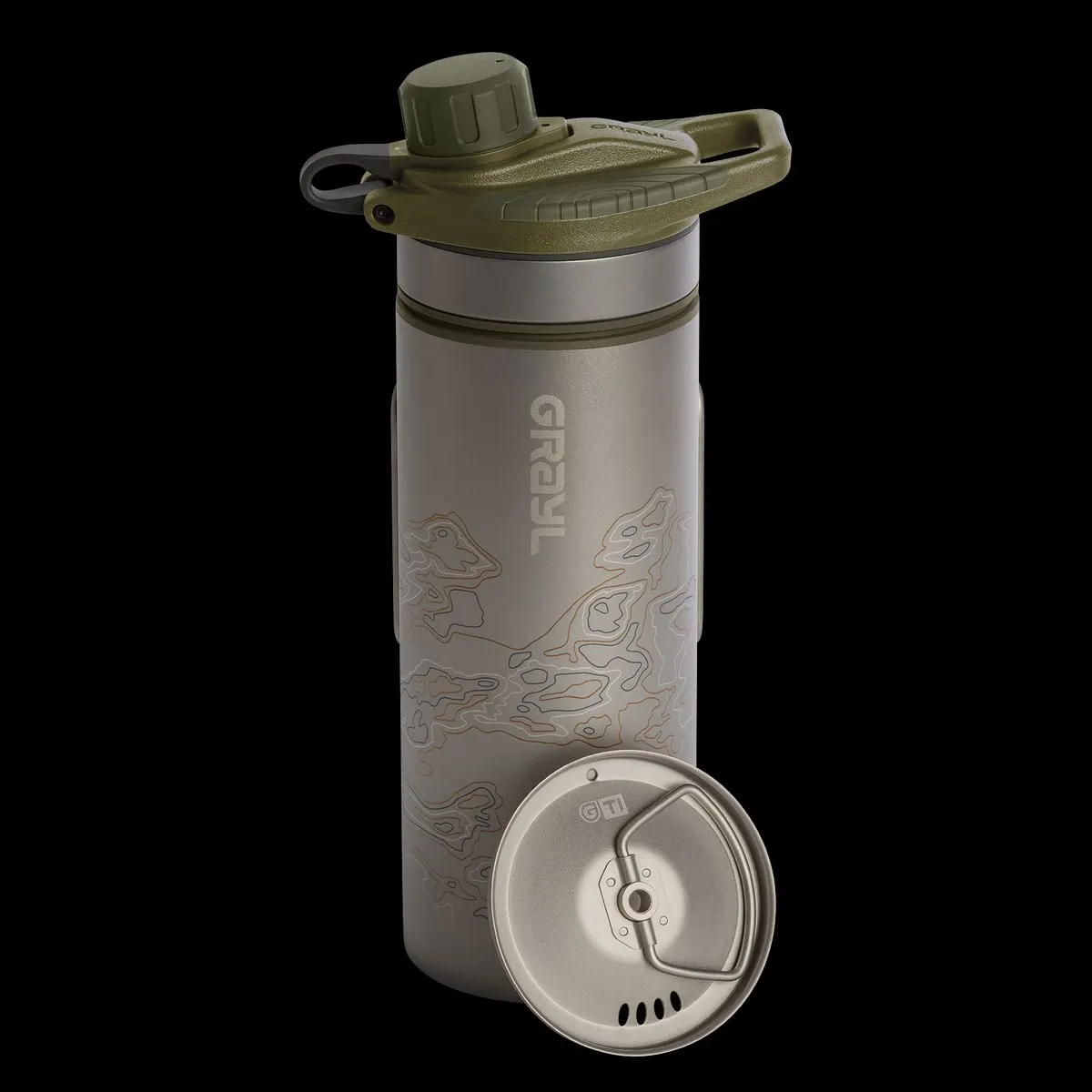
For: Travel and untreated water
Grayl GeoPress 24oz Water Purifier Bottle
A bottle-style purifier that Grayl rates to remove viruses, bacteria and protozoa and to reduce many chemicals, heavy metals and microplastics, in one eight-second press with no pumping, power or tablets. It is the only purifier on this site rated for viruses, which matters for international travel and sources downstream of people or livestock. It does not desalinate seawater, and the cartridge must be replaced on schedule.