Best Water Filters for Van Life: Complete Guide
What van water filters actually remove — bacteria, protozoa, viruses, metals, chemicals — plus certifications, a layered setup for full-timers, winterizing, and our 2026 picks.
Disclosure: As an Amazon Associate I earn from qualifying purchases. Links to Amazon on this page are affiliate links: if you buy through one, VanLifeKitchens.com may earn a commission at no extra cost to you. Read our affiliate disclosure.
Water is the one van kitchen system where a failure is a health problem rather than an inconvenience. A bad fridge spoils food; a bad cooktop means cold dinners; bad water can make you seriously ill. This guide is for van dwellers deciding how to treat the water they drink and cook with — from weekenders filling jugs at campgrounds to full-timers with plumbed tanks and travelers heading across borders.
It covers what you are actually protecting against, what each type of filter can and cannot remove, how to read certification claims, the layered setup we recommend for full-timers, maintenance and winterization, and our picks for 2026. Tanks, pumps, plumbing and grey water are covered in our van water system setup guide; this guide focuses on making the water safe and pleasant to drink.
A note on our approach: we have not lab-tested these products. Contaminant claims below come from manufacturers' published specifications and certifications. Always check the current packaging or the manufacturer's site for the exact contaminants a model is certified for, because ratings change between product versions.
What you are protecting against
A filter is only useful if you know what it removes. Marketing often blurs "filter", "purifier" and "system", so start with the contaminant categories.
Bacteria (E. coli, Salmonella, Campylobacter and others). Typically around 0.2–10 microns. Cause acute stomach and intestinal illness. Present wherever water has been contaminated by human or animal waste: creeks below grazing land or wildlife, poorly maintained wells, flooded systems. The most common microbial risk for van dwellers.
Protozoa (Giardia, Cryptosporidium). Roughly 2–15 microns as cysts and oocysts. Cause illness that can last weeks. Giardia is common in untreated surface water across North America. Cryptosporidium is highly resistant to chlorine, which is why chemical tablets alone are not a complete answer for surface water.
Viruses (norovirus, hepatitis A, rotavirus and others). Roughly 0.02–0.3 microns — far smaller than the pores of standard 0.1–0.2 micron hollow-fiber filters, which is why those filters are not rated to remove them. Waterborne viruses come mainly from human sewage, so risk rises downstream of towns, septic systems or heavily used areas, after floods, and in regions with limited sanitation infrastructure. In remote North American backcountry, viruses are generally considered a lower risk than bacteria and protozoa, but "lower" is not "zero".
Heavy metals (lead, mercury, arsenic and others). Cause harm through long-term exposure rather than acute illness. Sources include old plumbing and fixtures, some wells, and mining areas. Mechanical (hollow-fiber) filters do not remove dissolved metals; specific carbon or ion-exchange media certified for the metal in question are needed.
Chemicals (chlorine and chloramine from municipal treatment, pesticides, VOCs, PFAS and others). Range from a taste issue (chlorine) to long-term health concerns. Activated carbon reduces many of them, but no single carbon cartridge removes everything — check certifications for the specific chemicals you care about.
Sediment (sand, silt, rust). Mostly a cosmetic issue for drinking, but grit damages 12 V pump diaphragms and faucet valves and clogs downstream filters faster. A sediment pre-filter is cheap protection for a plumbed system.
Filter vs purifier. In US convention, a "purifier" is a device tested to remove or inactivate viruses as well as bacteria and protozoa. A "filter" in backpacking terms usually means bacteria and protozoa only. If a product does not specifically claim virus removal with test data behind it, assume it does not remove viruses.
How to read certification claims
The standard numbers on packaging tell you which kind of contaminant the product was evaluated against:
- NSF/ANSI 42 covers aesthetic effects — chlorine taste and odor, particulates. It says nothing about pathogens or heavy metals.
- NSF/ANSI 53 covers specific health-related contaminants such as lead, certain VOCs and cysts. A product is certified for particular contaminants under 53, not "everything in 53".
- Microbiological protocols — the EPA Guide Standard for microbiological purifiers and NSF protocols such as P231 and P248 — are what portable filters and purifiers are tested against for bacteria, protozoa and (for purifiers) viruses.
Two practical rules: read the list of contaminants a product actually claims, not just the standard number, and note the difference between "certified by" an accredited body and "tested to" a standard, which may mean the manufacturer commissioned testing without ongoing certification. Both are useful information; certification is the stronger claim.
The six ways to treat water in a van
1. Gravity pitchers and countertop filters
A reservoir on top, a multi-stage cartridge in the middle, filtered water below. No power, no pumping, nothing to break. Good models combine a membrane stage for microbes with a carbon stage for taste, chlorine and some metals. The trade-off is speed — a pitcher takes several minutes per refill — and small capacity.
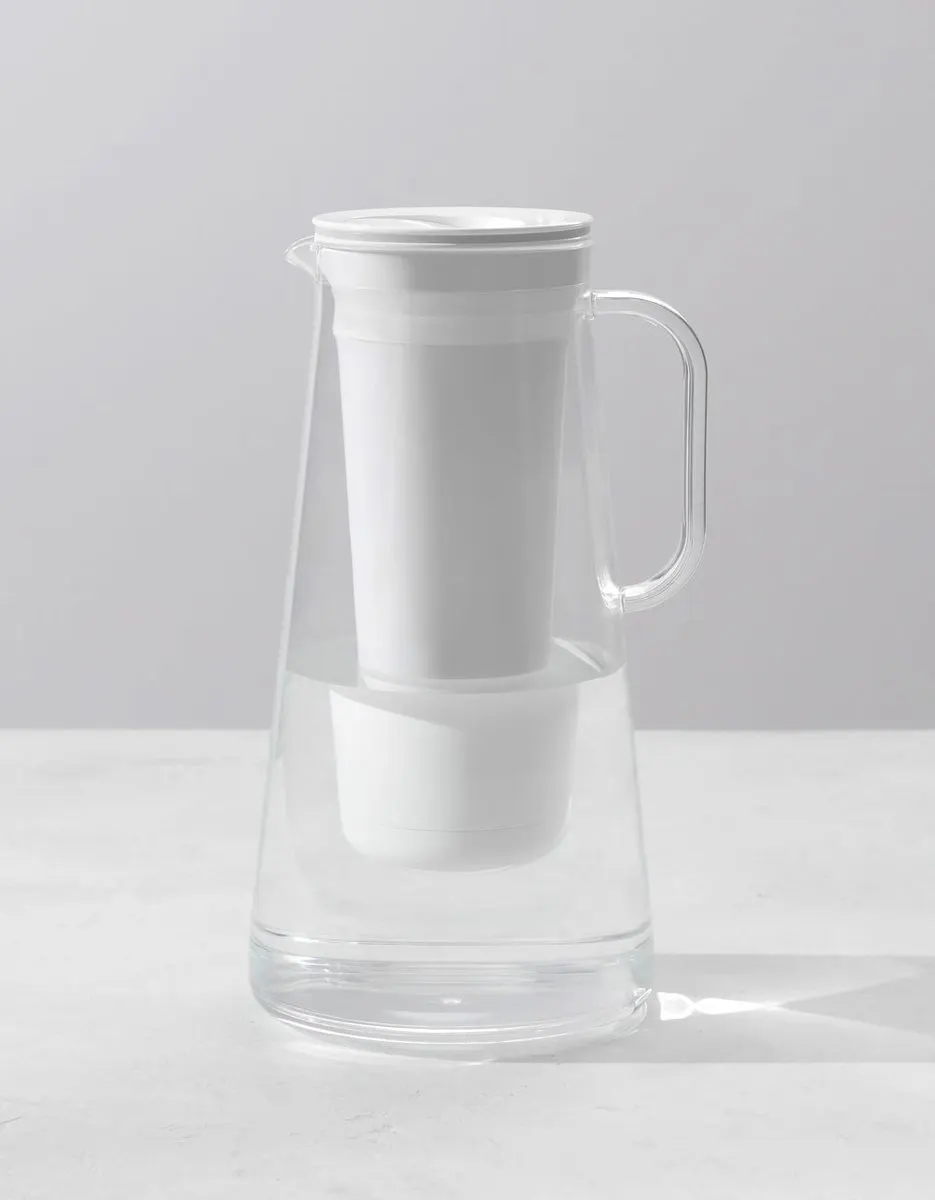
Our pick is the LifeStraw Home 7-Cup Gravity Pitcher, a budget pick. LifeStraw states its membrane removes 99.999999% of bacteria, 99.999% of parasites and 99.999% of microplastics, and its carbon and ion-exchange stage reduces lead, mercury, PFAS, chlorine and some other chemicals. It says the pitcher is independently lab-tested to NSF/ANSI 42, 53 and 401, NSF P473 (PFOA and PFOS) and the EPA and NSF P231 microbiological protocol. LifeStraw makes no virus claim for it, and positions it for tap water rather than untreated surface water. Note the two filter lives: 264 gallons (about a year) for the membrane but only 40 gallons (about 150 litres, or two months) for the carbon stage. At an assumed 3 litres a day per person for drinking, coffee and cooking, that is a new carbon stage about every seven weeks solo, or about monthly for a couple. LifeStraw's 7-cup glass pitcher page, which uses the same filter stages, gives about 20 to 25 minutes for a full reservoir once the filter is primed.
2. Inline RV filters (at the tank fill)
Cartridge housings plumbed into the fill hose between the spigot and your fresh tank. Their main jobs are protecting the pump and tank from sediment and improving taste by reducing chlorine. Most basic single-stage hose filters are carbon or sediment cartridges rated in the 5–20 micron range — they improve taste but are not designed to remove bacteria or protozoa.
The Clearsource Ultra RV Water Filter System with VirusGuard, the premium option in this guide, is a free-standing three-canister system: a 5-micron sediment stage, a 0.5-micron coconut-shell carbon block for taste, chlorine and VOCs, and a VirusGuard stage that Clearsource says removes or reduces bacteria, cysts and viruses. Clearsource quotes about 4.5 gal/min at 40 psi, and the unit weighs 28 lb. Its FAQ also claims over 95% lead and heavy-metal removal. The pages we read don't name a certification standard or log reduction for the virus or lead claims, so treat them as manufacturer claims. Even so, treat an inline filter as protection for the tank and pump, not as your only line of defense for drinking water: water can be recontaminated inside the tank and lines afterwards, so keep a point-of-use filter for drinking and sanitize the tank periodically (see the van water system setup guide). Clearsource rates its cartridges at 2,000 gallons and suggests replacing them every 2–3 months for full-timers, so the cartridges are an ongoing cost.
3. Squeeze and hollow-fiber filters
Hollow-fiber membranes with tiny pores, sold as squeeze pouches, inline bottle filters or gravity bags. They physically block bacteria and protozoa. They do not remove viruses, dissolved chemicals or heavy metals, and they do nothing for chlorine taste.
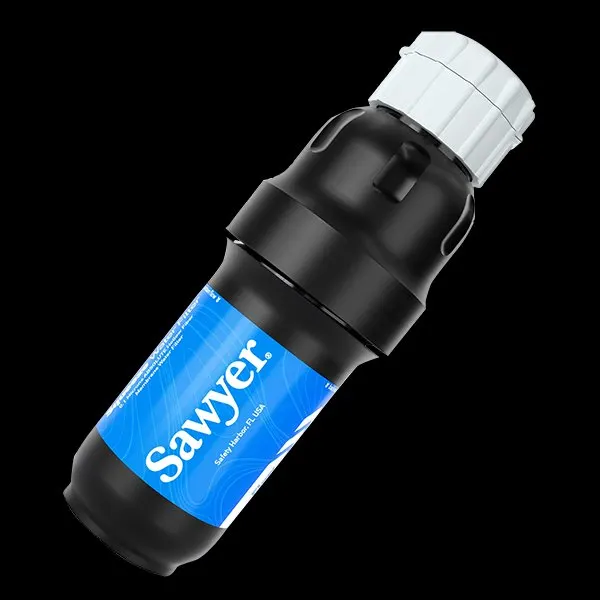
- The Sawyer Squeeze (the SP129 kit with two 32 oz pouches), a budget pick, uses a 0.1-micron absolute hollow-fiber membrane and weighs about 3 oz. Sawyer claims 99.99999% bacteria, 99.9999% protozoa and 100% microplastics removal, makes no virus claim, and gives no gallon rating on its current product page: it backs the filter with a lifetime limited warranty and expects you to backflush it. Retailers list about 1.5–1.7 L/min new; flow drops as it clogs. It is the backup filter we think every van should carry.
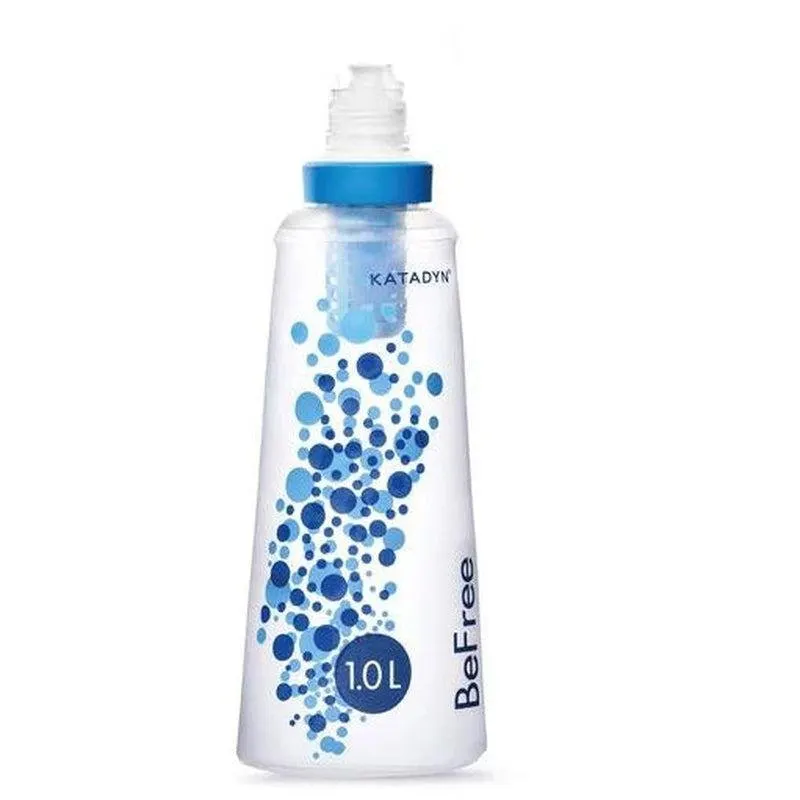
- The Katadyn BeFree 1L, also budget-priced, uses a 0.1-micron membrane attached to a collapsible soft flask. Katadyn says it meets the EPA purifier standard for bacteria (99.9999%) and protozoan cysts (99.9%), reduces microplastics, and states plainly that it does not remove viruses. It flows faster when fresh (Katadyn quotes up to 2 L/min), and the membrane is rated for 1,000 L. The Amazon listing we link (Katadyn part 8018006, the BeFree 1.0L) is now titled "BeFree AC 2-Stage": the AC version adds a removable activated-carbon insert that Katadyn says improves taste, odour and clarity and reduces chlorine. The insert needs replacing after 200 L or 3 months and slows the flow.
4. Gravity bag systems
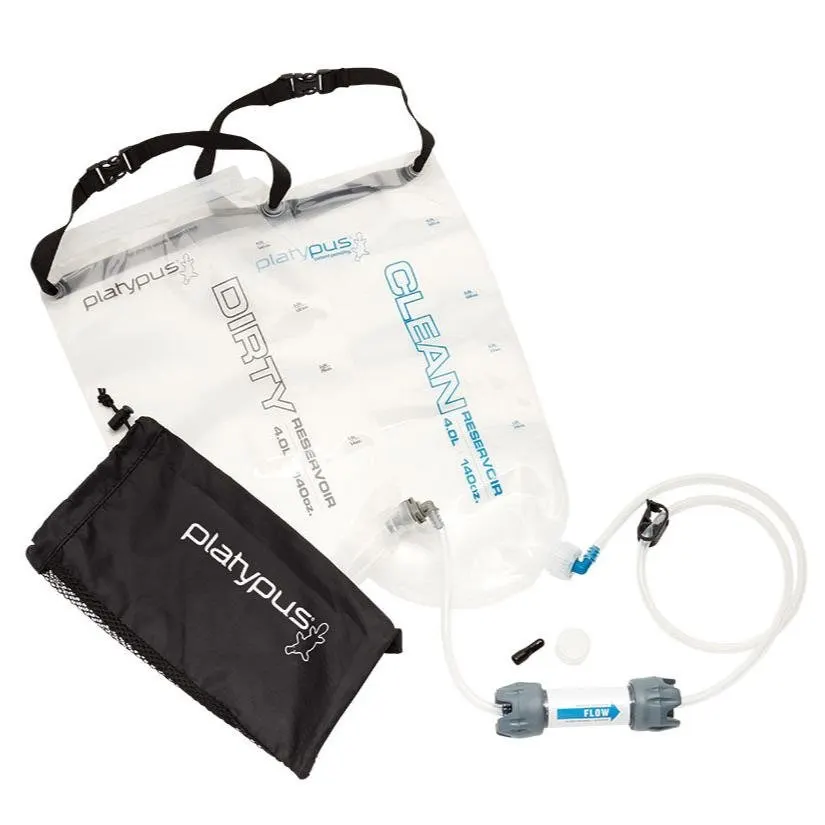
Same hollow-fiber principle as squeeze filters, scaled up: hang a "dirty" bag, and gravity pushes water through the filter into a clean bag or your jug. The Platypus GravityWorks 4L, a mid-range pick, is rated at up to 1.75 L/min (so 4 L in a little over two minutes) through a 0.2-micron hollow-fiber element rated for 1,500 L. Cascade Designs says it meets EPA and NSF guidelines for 99.9999% bacteria and 99.9% protozoa removal, states that it does not remove viruses or chemicals, and notes that it does not remove tastes. It packs flat, needs no pumping, and suits couples or families filtering several gallons at a time. The dirty bag is awkward to fill directly from a spigot.
5. Purifier bottles
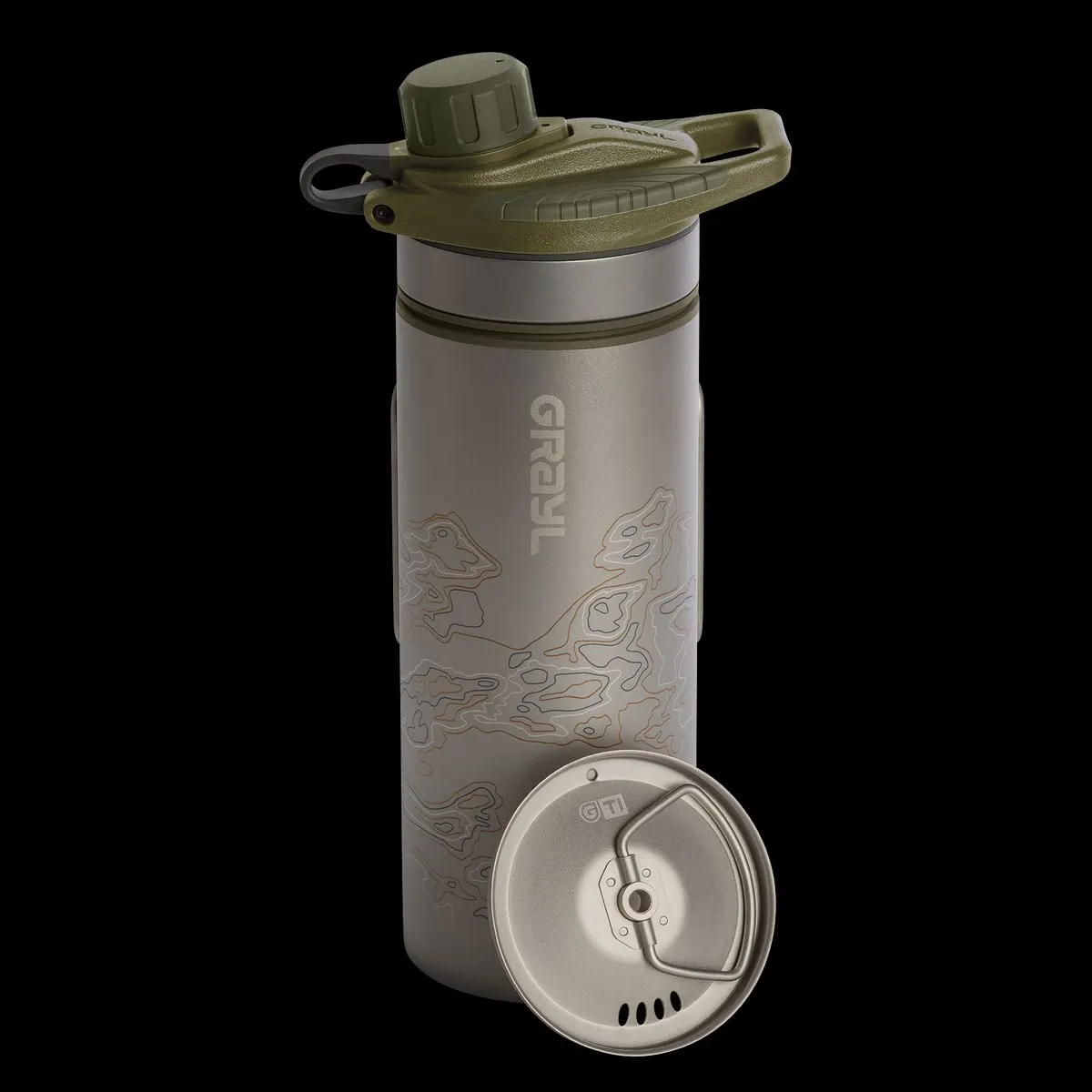
Bottles that push water through a cartridge combining very fine filtration with adsorption media. The Grayl GeoPress 24oz Purifier, a mid-range pick, is the only product on this site with a virus claim tested to a named purifier protocol: Grayl claims 99.99% of viruses, 99.9999% of bacteria and 99.9% of protozoan cysts, tested to the US EPA Guide Standard for microbiological purifiers, and says its carbon reduces many chemicals and heavy metals (tested to NSF/ANSI 42 and 53 protocols). It presses 24 oz in about eight seconds. Grayl says to avoid salty or brackish water and that the cartridge isn't designed for heavily polluted water (industrial spills, high lead or mercury, toxic algae). The trade-offs are volume (one bottle per press), hand strength needed to press, and cartridge cost: each cartridge is rated for about 350 presses, 65 gallons, or three years after first use. It is the right tool for international travel or any source where sewage contamination is a realistic possibility.
6. Boiling, UV and chemical treatment
- Boiling is the most reliable way to kill or inactivate bacteria, protozoa and viruses. The CDC guidance is a rolling boil for 1 minute, or 3 minutes above 6,500 feet. It does nothing for chemicals, metals or sediment, and it costs fuel and time. Every van with a stove has this backup available.
- UV-C treatment (pens and UV bottle caps) inactivates bacteria, protozoa and viruses in clear water. It does not remove sediment, chemicals or metals, cloudy water reduces its effectiveness, and it depends on batteries. Use it as a complement to filtration, not a replacement.
- Chemical tablets (chlorine dioxide is the common choice) are light and cheap emergency backups. Follow the label contact times carefully — Cryptosporidium requires much longer treatment times than bacteria and viruses — and remember they do not remove chemicals, metals or sediment.
The layered setup we recommend for full-timers
No single affordable product covers every contaminant, every volume and every situation. Layering devices with different strengths gives you redundancy.
Layer 1 — At the fill: Clearsource Ultra between the spigot and the fill inlet. Keeps sediment out of the tank and pump, reduces chlorine taste, and adds a microbiological stage before water enters the tank. Only relevant if you have a plumbed fresh tank and room for a 28 lb unit.
Layer 2 — At the galley: LifeStraw Home Gravity Pitcher for drinking and cooking water. Catches anything that got past the fill filter or grew in the tank or lines, and adds reduction of lead and mercury that hollow-fiber filters do not provide.
If your van has a 12 V pump feeding a faucet, an under-sink filter can do the galley job instead of a pitcher. The Aquasana Claryum Direct Connect sits on the cold line to your existing tap, and Aquasana says it is certified by IAPMO R&T to NSF/ANSI 42, 53 and 401, with published reductions for chlorine, lead, cysts, PFOA/PFOS and VOCs. Three limits matter in a van. It needs at least 10 psi, which a 12 V pump supplies but a foot pump or gravity jug doesn't. It's a filter, not a purifier: Aquasana makes no bacteria or virus claim and says not to use it on microbiologically unsafe water, so it belongs on treated tap water. And it filters washing-up water too, which uses up its 784-gallon or six-month cartridge life faster. Keep it from freezing; Aquasana's warranty excludes freeze damage.
Layer 3 — Portable backup: Sawyer Squeeze in the emergency kit. For questionable sources, hikes away from the van, and the day another filter fails.
Layer 4 — Travel and high-risk sources: Grayl GeoPress. Add it for travel outside the US and Canada, or wherever water might be contaminated by human sewage.
Most of the cost of the full stack sits in layer 1, the inline filter; layers 2–4 are budget to mid-range. For US travel filling mostly from municipal and campground taps, layers 1–3 cover the realistic risks. If you have no plumbed tank, skip layer 1 and use the pitcher plus Sawyer — a solid two-layer budget setup.
Water from treated municipal taps is already disinfected, so filtering it is mostly about taste (chlorine) and protection against old plumbing, hoses and your own tank. Untreated surface water (creeks, lakes, springs) needs at minimum bacteria and protozoa removal, plus virus treatment if sewage contamination is plausible. Wells and unknown spigots sit in between; treat them as untreated unless clearly labeled potable.
Your fill hose matters too: use a drinking-water-safe hose, keep the ends capped, and do not use it for anything else.
Maintenance and replacement schedules
Filters only work within their rated life, and most give little warning when they stop working well.
- Hollow-fiber filters (Sawyer, Katadyn, Platypus): backflush or clean according to the manufacturer when flow slows. Replace when backflushing no longer restores flow, at the rated life, or if the filter may have frozen.
- Carbon stages (pitcher carbon, inline carbon block): replace by volume or time even if water still flows normally — exhausted carbon stops reducing chemicals and metals without any visible sign. The LifeStraw's carbon stage, at about 40 gallons, is the one people most often overrun.
- Purifier cartridges (Grayl): replace at the rated press count or when pressing becomes very difficult.
- Inline cartridges: replace sediment pre-filters when they discolor or flow drops, and follow the carbon block's rated schedule.
Write the install date on each cartridge with a marker. It is the simplest way to stay on schedule.
Winterization and freezing
Freezing is the most common way van water filters are destroyed.
- Hollow-fiber filters (Sawyer, Katadyn BeFree, Platypus): water expanding as it freezes can crack fibers invisibly, after which the filter may let pathogens through. Manufacturers advise treating a filter that may have frozen as compromised and replacing it. In cold weather keep them in a sleeping bag, jacket or heated cabin, never in an unheated storage compartment.
- Inline filters: drain the housings and remove cartridges before freezing temperatures; store them where they cannot freeze.
- Gravity pitcher: keep it inside the heated living space; frozen water can crack the reservoir.
- Purifier bottles: store indoors. Grayl says to stop using a GeoPress cartridge after three or more freeze–thaw cycles.
Our cold-weather van cooking guide covers broader winter operations, and the van water system setup guide covers winterizing tanks, pumps and lines.
Best water filters for van life (2026)
Our picks from the filters we've reviewed, with a rough price tier for each — check current prices on Amazon, they move often. The linked reviews list full specs and the manufacturer's contaminant claims.
Best value backup — Sawyer Squeeze (budget). 0.1-micron hollow fiber for bacteria and protozoa, 3 oz, no cartridge to replace if you backflush it and keep it from freezing. Every van should carry one. Not for viruses, chemicals or metals.
Best daily galley filter — LifeStraw Home Gravity Pitcher (budget). Membrane plus carbon stages, with lead and mercury reduction a squeeze filter cannot match, and no power or pumping. Small capacity, slow, and no virus removal; replace the carbon stage on schedule.
Best fast squeeze filter — Katadyn BeFree 1L (budget). Faster rated flow than the Sawyer and a collapsible flask, at the cost of a 1,000 L membrane life. The linked listing is the AC version with a carbon insert for chlorine taste. A good daypack filter; no virus removal.
Best for travel and virus risk — Grayl GeoPress 24oz (mid-range). The only purifier in our catalog with a virus claim tested to the EPA purifier protocol, plus reduction of many chemicals and metals. Fresh water only, small volume per press, and the highest cost per gallon.
Best high-volume gravity — Platypus GravityWorks 4L (mid-range). Rated at up to 1.75 L/min with no effort; ideal for filling jugs from untreated sources for two or more people. Bacteria and protozoa only.
Best inline for plumbed tanks — Clearsource Ultra RV Inline (premium). Three stages (sediment, carbon block, VirusGuard) protect the tank and pump and improve taste for everything downstream. Large and heavy. Pair it with a point-of-use filter for drinking water.
Comparison table
| Filter | Type | Tier | Rated life |
|---|---|---|---|
| Sawyer Squeeze | Squeeze, 0.1 micron | Budget | No cartridge (backflush) |
| LifeStraw Home | Gravity pitcher | Budget | 264 gal membrane, 40 gal carbon |
| Katadyn BeFree 1L | Squeeze, 0.1 micron | Budget | 1,000 L (carbon 200 L) |
| Grayl GeoPress | Purifier bottle | Mid-range | 350 presses, 65 gal |
| Platypus GravityWorks | Gravity bag, 0.2 micron | Mid-range | 1,500 L |
| Clearsource Ultra | Inline, 3-stage | Premium | 2,000 gal per cartridge |
What each one claims to remove, per its manufacturer:
| Filter | Bacteria, protozoa | Viruses | Lead, metals | Chlorine taste |
|---|---|---|---|---|
| Sawyer Squeeze | Yes | No claim | No | No |
| LifeStraw Home | Yes | No claim | Lead, mercury | Yes |
| Katadyn BeFree AC | Yes | No (stated) | No | Yes (AC insert) |
| Grayl GeoPress | Yes | Yes (99.99%) | Low levels | Yes |
| Platypus GravityWorks | Yes | No (stated) | No | No |
| Clearsource Ultra | Claimed | Claimed, no standard named | Claimed | Yes |
For a direct head-to-head, see LifeStraw Home vs Sawyer Squeeze and Sawyer Squeeze vs Grayl GeoPress, or browse the water filters category.
Quick decision table
| Your situation | Recommended setup | Build tier |
|---|---|---|
| Weekender filling at campgrounds | Sawyer Squeeze | Budget |
| Full-time, jugs only, US travel | LifeStraw Home Pitcher + Sawyer Squeeze | Budget |
| Full-time, plumbed tank | Clearsource Ultra + LifeStraw Home + Sawyer Squeeze | Premium |
| Couple or family filtering surface water | Platypus GravityWorks + Sawyer Squeeze | Mid-range |
| International travel | Grayl GeoPress + LifeStraw Home (plus boiling as backup) | Mid-range |
Frequently asked questions
What is the best water filter for van life?
For daily drinking water, the LifeStraw Home Gravity Pitcher. For a plumbed tank, the Clearsource Ultra inline filter at the fill. As a backup, the budget-priced Sawyer Squeeze. For international travel or possible sewage contamination, the Grayl GeoPress purifier. Most full-timers do best layering two or three of these rather than relying on one.
Do I need a water filter in my van?
If you fill from campground spigots, wells, or any source you don't fully trust, yes. Even treated municipal water benefits from carbon filtration for chlorine taste and as protection against contamination from hoses, tanks and old plumbing. A budget-priced Sawyer Squeeze is a sensible minimum for any van, and boiling is always available as a backup if you carry a stove.
What is the difference between a water filter and a water purifier?
In US usage, a purifier is tested to remove or inactivate viruses in addition to bacteria and protozoa. Most backpacking-style filters, including hollow-fiber squeeze and gravity filters, remove bacteria and protozoa but not viruses, because viruses are far smaller than their pores. Neither label tells you about chemicals or heavy metals; those require carbon or other media certified for specific contaminants.
Do I need a virus-rated water purifier for van life?
For typical US and Canadian travel filling from treated taps or remote backcountry sources, a bacteria-and-protozoa filter is usually considered adequate, though virus risk is not zero. Use a purifier such as the Grayl GeoPress, or boil your water, when traveling in regions with limited sanitation, or when a source could be contaminated by human sewage, such as downstream of towns, septic systems or after flooding.
Does an inline RV filter make tank water safe to drink?
Not on its own. Most basic inline filters only handle sediment and chlorine taste. Even a three-stage unit like the Clearsource Ultra protects water going into the tank, but the tank and lines can still be recontaminated afterwards. Use a point-of-use filter such as a gravity pitcher for drinking and cooking water, and sanitize the tank periodically.
What happens if my water filter freezes?
Hollow-fiber filters such as the Sawyer Squeeze, Katadyn BeFree and Platypus GravityWorks can be damaged invisibly by freezing and may then let pathogens through. Manufacturers advise replacing a filter you suspect has frozen. In cold weather, keep filters in the heated cabin or close to your body, and drain inline filter housings before freezing nights.
What happened to Berkey water filters?
Starting in late 2022, the EPA issued stop-sale orders across the Berkey supply chain. The agency's position is that the silver-containing Black Berkey elements, combined with their claims to remove microorganisms, make them unregistered pesticides under federal law. Berkey's maker disputes that and has been fighting it in court since 2023, but genuine Black Berkey elements have been hard to buy ever since, and Berkey says it does not sell through Amazon, where counterfeit elements are common. For a similar countertop gravity approach that is widely available, the LifeStraw Home Gravity Pitcher is our pick, or the Platypus GravityWorks if you need more volume.
How often should I replace water filter cartridges?
Follow each manufacturer's rated life, by volume or time, whichever comes first. Carbon stages are the easiest to overrun because water still flows normally when the carbon is exhausted; the LifeStraw Home's carbon stage, for example, is rated for about 40 gallons. Hollow-fiber filters should be replaced when backflushing no longer restores flow or after possible freezing. Write the install date on each cartridge.
The verdict
For full-time van life in the US with a plumbed tank, our recommended setup is the Clearsource Ultra inline at the fill, the LifeStraw Home Gravity Pitcher for drinking and cooking water, and a Sawyer Squeeze as the portable backup — a premium build that buys redundant coverage of sediment, bacteria, protozoa, chlorine taste and lead. Without a tank, the budget pitcher-plus-Sawyer combination covers most US travel. Add the Grayl GeoPress or plan to boil whenever virus risk is realistic, especially abroad.
Avoid relying on a basic 5–20 micron hose filter for pathogen protection, using UV as your only treatment for cloudy or chemically contaminated water, and running carbon cartridges past their rated life. See the Off-Grid Chef Promaster setup for how a layered filtration system fits into a full-time van kitchen, and the no-plumbing van sink guide for a simple foot-pump sink that pairs with these filters.
Products covered in this guide
Disclosure: As an Amazon Associate I earn from qualifying purchases. Links to Amazon on this page are affiliate links: if you buy through one, VanLifeKitchens.com may earn a commission at no extra cost to you. Read our affiliate disclosure.
More in Buying Guides
Best Van Kitchen Storage: Complete Organizing Guide
How to organize a van kitchen that survives washboard roads: pantry tiers, spices, cookware, fridge and knife storage, plus the best bins and cases by budget.
The Complete Van Life Solar Cooking Guide
Can you really cook with the sun from a van? The definitive guide to tube cookers, box ovens, and hybrid solar-electric systems — 4 products compared, with honest notes on what actually works.

Best Coffee Gear for Van Life: Complete Guide
How to brew great coffee in a van: AeroPress, pour-over, moka, French press and real espresso compared, plus grinders, kettles, power and water use, and our 2026 picks.