How to Stop Pots, Plates, and Drawers Rattling in a Van
Find where the noise comes from with a labelled-door drive, fix most of it with things you already own, choose liners, pan protectors and positive latches, and know why quiet is not the same as secured.
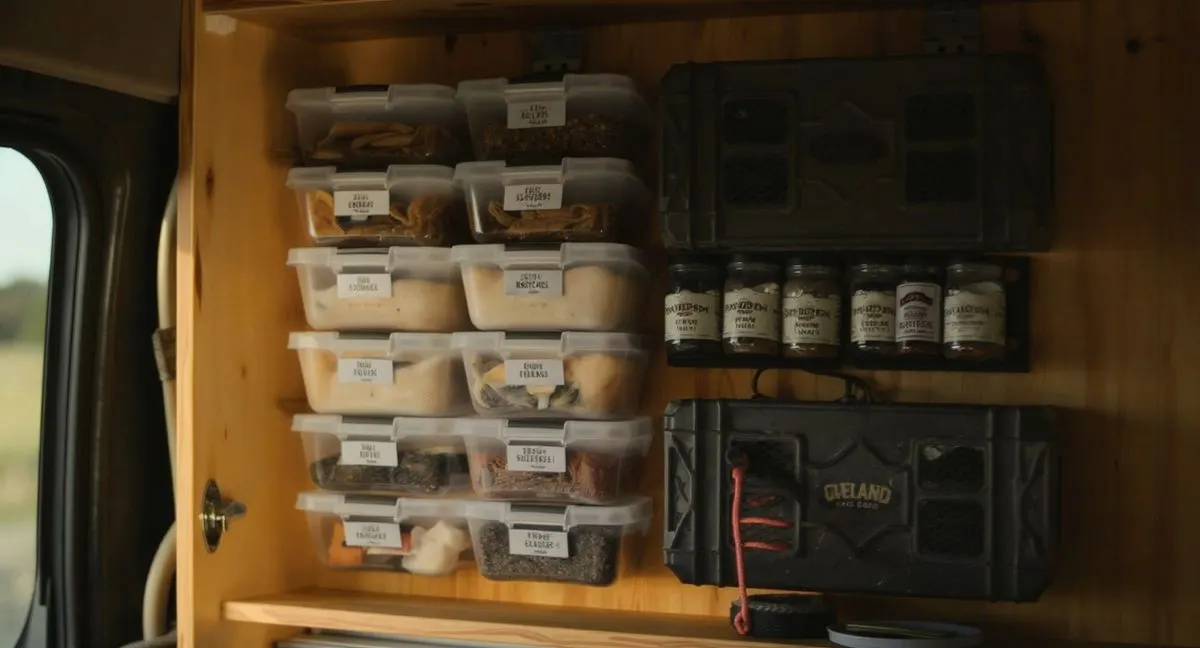
Disclosure: As an Amazon Associate I earn from qualifying purchases. Links to Amazon on this page are affiliate links: if you buy through one, VanLifeKitchens.com may earn a commission at no extra cost to you. Read our affiliate disclosure.
A van kitchen that clatters on every bump is more than annoying. The noise tells you something is moving, and anything that moves on a washboard road can chip, scratch, spill or, in a hard stop, come out of its cabinet. This guide is a troubleshooting page: how to find where the noise comes from, what to change for free, which products help and where each one stops helping, and the line between making the kitchen quiet and actually securing it for travel.
It doesn't repeat the buying advice elsewhere on the site. For bins and how to organise a whole galley, see the storage complete guide. For which cookware nests well, see the cookware complete guide. For drawer and cabinet placement before you build, see van kitchen layouts. VanLifeKitchens is a research site and doesn't test products hands-on; what follows comes from manufacturer documentation and what van and RV owners commonly report.
Short answer
- Find the source before buying anything. Most rattles come from three or four places: lids, stacked pans, plates and mugs, and a utensil drawer. A labelled-door drive (below) finds them in one trip.
- Fix it for free first. A tea towel between pans, a rubber band round a bundle of utensils, lids stored on edge and heavy items moved low solve a surprising share of the noise.
- Then add the cheap layer. Non-slip liner such as Con-Tact Grip Premium in every drawer and cabinet, and felt or silicone pan protectors between stacked cookware.
- Fix the doors and drawers themselves. Magnetic and push-to-open catches can release on a bump. A positive-locking latch, such as the Southco MP push-to-close latch, keeps a door or drawer shut until you pull the knob.
- Quiet is not secure. Liners, dividers and protectors reduce noise and shifting. They are not restraints. Heavy items (cast iron, the fridge, water containers) need mechanical securing, and nothing from a household kitchen aisle is crash-rated.
Step 1: find where the movement comes from
Rattles are hard to place from the driver's seat. A cabinet behind you sounds like it's under the floor, and two sources at once sound like one. Work through the likely sources one at a time.
The diagnosis checklist
| Source | What it sounds like | What's usually moving |
|---|---|---|
| Pot and pan lids | Sharp, ringing clatter | Lid edges against each other or a pot rim |
| Nested pots | Dull metallic knock | Gaps between nested pieces |
| Plates and bowls | Ceramic chatter | Stack shifting, plates edge-on to a wall |
| Mugs and glasses | Clinking | Handles and rims touching |
| Utensil drawer | Steady jingle | Loose tools in a tray, or the tray itself |
| Drawer slides | Knock on every bump | Drawer box moving on its slides, or creeping open |
| Cabinet doors | Tapping against the frame | Door with play on its catch or hinge |
| Fridge basket | Glass clinks, rolling thud | Jars, bottles and cans in the basket |
| The fridge itself | Heavy thump or squeak | Fridge shifting on its slide or mount |
| Jars and bottles | Glass knock or slosh | Pantry jars, oil and sauce bottles |
Two things on that list are not just noise. A drawer that knocks on its slides may be creeping open, and a fridge that thumps is moving on its mount. Treat both as restraint problems, not comfort problems; see the restraint section below.
The labelled-door test
This finds most sources in a single drive.
- Label every door and drawer with masking tape and a number. Write the same numbers on a sheet of paper.
- Pick a short, known rough stretch: a gravel road, a car park with speed bumps, or a section of broken pavement you can drive at a safe, legal speed.
- Have a passenger listen, seated and belted in their normal seat. They note which numbered area each noise seems to come from. The driver just drives. Nobody unbuckles to walk into the back or open cabinets while the van is moving.
- Pull over somewhere safe and change one thing: empty one drawer into a bin on the floor, or wedge a towel into one cabinet. Drive the same stretch again.
- Repeat until the noise changes. When emptying cabinet 3 stops the clatter, you know where to work.
A phone voice memo running on the dash helps you compare one run with the next. If you drive solo, the elimination method still works: empty or pad one area at a time and drive the same stretch.
At a standstill, a quick shake test also helps. Open each cabinet, press each stack and item with your hand, and rock the drawer box on its slides. Anything that moves under hand pressure will move on a rough road.
Step 2: low-cost changes with things you already own
Most van kitchens get noticeably quieter before any money is spent. These changes use household items.
Tea towels and dish cloths between pans. A folded cloth between nested pots, or laid over a stack of pans, stops metal touching metal. It also does a second job as your drying towel. A cloth isn't a long-term substitute for a pan protector if it ends up damp: cast iron needs to go away completely dry, and Lodge's cleaning page says to dry it "completely with a paper towel or lint-free cloth" before storing.
Paper towel in cast iron. A sheet of paper towel on the cooking surface of a skillet cushions anything stacked on it and soaks up stray moisture. For lidded cast iron, Lodge's care page for its camp Dutch oven suggests storing it with the lid ajar, using rolled-up paper towels to hold the lid open so moisture doesn't collect. The same idea stops a lid rattling on its pot.
Rubber bands and hair ties. Bundle spatulas, spoons and tongs into one handful with a rubber band and they stop jingling in the tray. A band round a stack of nested measuring cups or a set of lids does the same. Rubber perishes, so replace bands when they get sticky or brittle.
Lids on edge, not stacked flat. Lids are the loudest thing in most van kitchens. Store them upright in a narrow slot, upside down inside their own pot with a cloth between, or on a hook inside a closed cabinet door. A loose stack of lids in the bottom of a cabinet is the classic source of the "ringing" rattle.
Repack heavy items low. Move the cast iron, the Dutch oven, cans, jars and full bottles to floor-level drawers or the bottom of a cabinet. Heavy things in upper cabinets make more noise, put more load on the doors and catches, and are more dangerous if a door opens. The storage guide explains why cast iron never goes in an upper cabinet.
Fill the gaps. A half-empty drawer rattles more than a full one, because everything has room to slide. Pack the space with soft items: oven gloves, a bag of clean cloths, a roll of paper towels or the produce bag. Soft packing is a noise fix, not a restraint (see below).
Separate plates with something soft. A paper plate, a paper towel or a cork trivet between ceramic plates stops the chatter and protects glaze. Lighter, less brittle plates and bowls help too; the cookware guide and the camp sets it covers include options.
Put mugs where they can't touch. Lay mugs on their side in a padded drawer, or stand them in a small bin with a cloth between each. Nesting mugs designed to stack, such as the YETI Rambler 14 oz stackable mug, reduce the clink of mismatched mugs knocking together.
Decant glass where you can. Pantry staples in glass jars knock and can break. Move them into plastic or stainless containers that can't shatter. Where you keep glass, wrap the jar in a sock or a sleeve of cloth, and stand it among other items so it can't build speed.
Tighten what's loose. A rattling cabinet door often has a slightly loose hinge screw, a loose pull, or a gap where the catch doesn't pull the door tight. Tighten screws, and add a self-adhesive rubber or felt bumper where the door meets the frame.
Step 3: products that help, and what each one doesn't do
When the free fixes run out, these are the categories worth considering. Each reduces noise in a different way, and each has a clear limit.
Pan protectors and cookware separators
What they do. Felt or silicone discs that sit inside a pan so the next pan rests on padding, not metal. They stop the knock of nested cookware and protect nonstick and seasoned surfaces from scratches.
Limits. They pad contact between pieces; they don't stop the stack moving as a unit. A stack of pans with protectors still slides across a bare drawer and still needs to be held in place. Felt that gets wet holds moisture against the pan, which matters for cast iron and carbon steel. Let felt dry before it goes back.
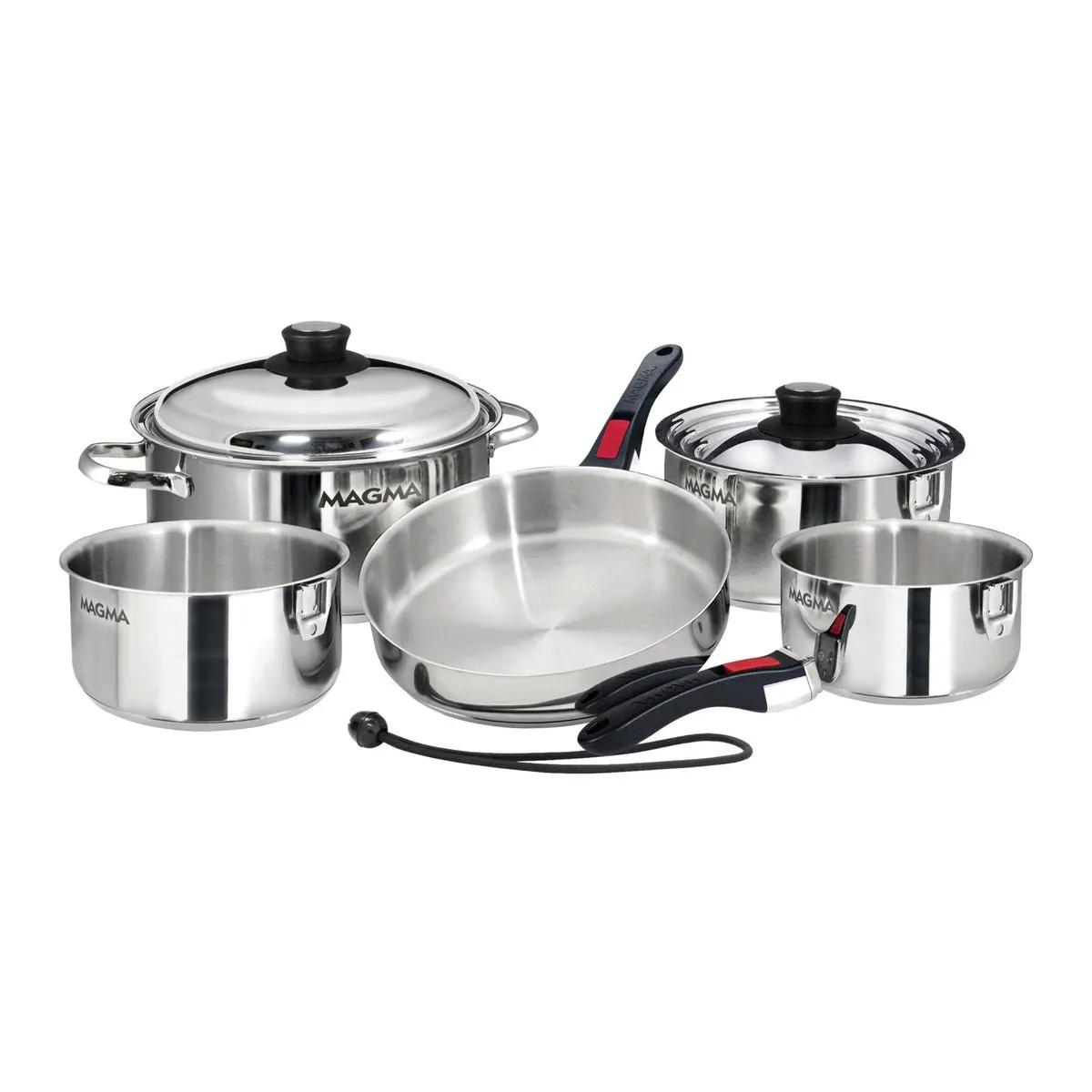
Alternative: buy cookware that nests by design. The Magma Nesting 10-Piece set was designed for boat galleys. Magma lists the set as nesting into less than half a cubic foot (13 x 10.25 x 7.25 in), and the 10 pieces include "a convenient bungee storage cord" that holds the stack together. A set with removable handles nests more tightly than pans with fixed handles, which leaves fewer gaps to rattle. The cookware guide's nesting section shows what fits inside what across the sets the site covers.
The site doesn't review a specific pan protector yet. Look for a set with several sizes so each pan gets a disc that covers its base, from a maker that publishes the dimensions.
Non-slip shelf liner
What it does. A grippy, cushioned mat that raises friction between a drawer bottom and what sits on it. Small everyday sliding mostly stops, and hard-on-hard contact noise is damped. The Con-Tact Grip Premium review covers one liner in detail: Con-Tact describes it as foamed PVC with an open scrim, non-adhesive and repositionable.
Limits. A liner is friction, nothing more. In ordinary driving the forces are small and friction wins. In a hard stop or a swerve, the forces on a heavy object are many times larger and a liner won't hold it. It also does nothing to keep the drawer or door itself shut. Con-Tact doesn't publish a food-contact claim or a heat rating for Grip Premium, so keep it under containers, not food, and away from the stove.
Drawer dividers and organiser trays
What they do. Dividers split a drawer into compartments, so each tool has a home and can't travel the length of the drawer. An organiser tray does the same for utensils, and fixed vertical slots inside a cabinet hold cutting boards, sheet pans and trivets on edge. The storage guide describes the vertical slot organiser.
Limits. Spring-loaded or expanding dividers hold by pressure against the drawer sides, and a hard jolt can shift them. A loose tray sitting in a drawer moves as a unit unless it fits snugly or sits on liner. Dividers organise; they don't restrain anything heavy. Knives need their own answer: a block, sheath or strip, as covered in the knife storage and safety guide.
Bins with latching lids
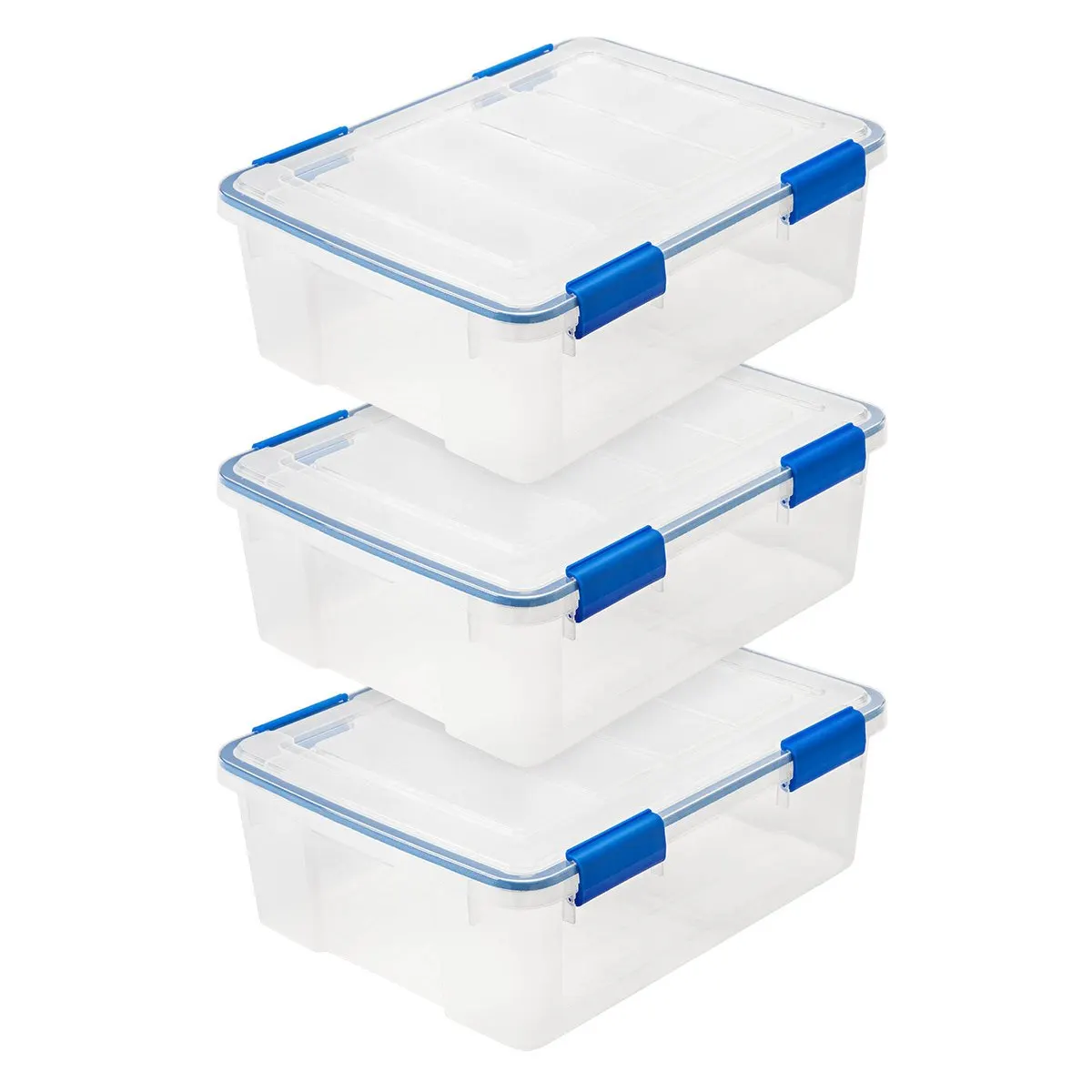
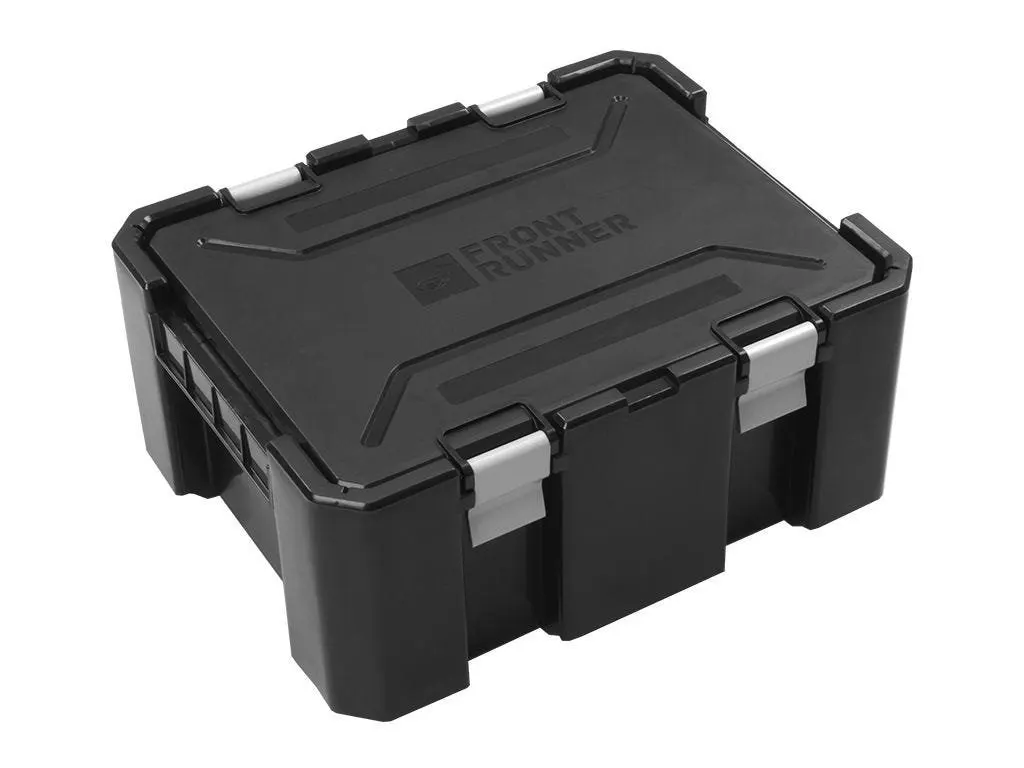
What they do. A bin that holds a group of items, with a lid that latches, turns thirty small rattles into one container that can be wedged or strapped. The IRIS USA Weathertight 19-Qt bins set has gasketed latching lids on six identical 19-quart bins. The Front Runner Wolf Pack Pro has a nesting design, where the base of each box fits into the recessed lid of the box below, so a stack can't slide off itself on a bump.
Limits. A bin contains its contents; it doesn't secure itself. A bin on the floor still slides, and a loaded bin is a heavy object. Front Runner doesn't publish a stacked load rating on the pages the site checked, so a stack still needs a strap to stay put in a hard stop. Line the inside of a bin with liner to stop contents sliding within it.
Cabinet and drawer latches
This is where most "the drawer flew open" problems are solved, and the types are easy to confuse.
Magnetic and friction catches. The default in many house cabinets. A magnet or a spring roller holds the door against the frame. These can pop open from a jolt on a rough road or when the van is parked on a slope, and they let the door tap against the frame. They are a noise source and not a travel latch.
Push-to-open (touch) latches. You press the door and it springs open. They're popular because they need no handle, but the same action that opens them, pressure on the door, can come from inside: a pan sliding into the door in a turn, or a bump that flexes the cabinet. That makes them a poor match for a moving vehicle, and they're best avoided for anything that carries weight.
Positive-locking latches. The latch engages a keeper and stays engaged until you operate a knob, button or lever by hand. Pressure on the door from inside doesn't open it. The Southco MP point push-to-close latch is a common example in boats and RVs: Southco's data sheet describes it as push-to-close and pull-to-open, with a flush knob that pops out and a cam that you release by pulling the knob. Note the difference in wording: push-to-close means it latches itself when you shut the door, while push-to-open means pressing the door releases it. Only the first is a positive lock.
Positive latches have their own limits. They need a hole cut through the door or drawer front and a keeper fixed to the frame; Southco sells the MP latch without a keeper. Southco's MP data sheet publishes dimensions, door-thickness range and materials but no load rating, so a latch keeps a door shut against normal driving forces and contents shifting, not against a heavy object thrown into it in a crash. A latch also only holds as well as the door, hinges and frame it's fixed to.
Slide locks for drawers. A drawer can have a positive latch on its front, like a cabinet door, or the lock can be in the slide itself. Heavy-duty drawer slide makers sell versions that lock when closed (often called lock-in) and versions that lock when fully open (lock-out), released by a lever on the slide. A detent or "hold-in" feature is different: it's a light catch that resists the drawer creeping open, and a heavy drawer can override it under braking. If a drawer holds anything heavy, use a true lock, and check what the slide's maker says the slide is rated to carry.
Rails, lips and straps. For open shelves and upper cabinets, a tall front lip or a rail across the opening stops things sliding out when the door is opened after a drive, and a hook-and-loop strap holds tall bottles to the cabinet wall.
The limits of household storage accessories
Most organisers on the market are designed for a house kitchen. A house kitchen doesn't brake, corner or vibrate for hours at a time, and these products assume gravity is the only force on them. In a van that shows up in a few predictable ways:
- Adhesive mounts let go. Stick-on hooks, lid racks and organisers rely on adhesive that softens in a hot van and loses grip with vibration. Where something needs to stay on a wall, use screws into solid wood or backing.
- Tension and spring fit loosens. Expanding dividers and tension rods hold by pressure, which vibration gradually works loose.
- Over-the-door organisers swing. They hang free and bang against the door on every bump.
- Open racks have no restraint. Plate racks, pot racks and open shelves without a lip let items bounce out.
- Thin plastic cracks. Light organiser trays can crack when a heavy pan lands on them.
- No ratings. Household organisers don't publish load ratings for vehicle use, and none of them is designed or tested as a restraint.
None of this means household accessories are useless in a van. They are good at what they were made for: organising and reducing noise. They just aren't the thing holding your kitchen together.
Noise reduction vs secure restraint during travel
This is the most important section of the guide. It's easy to mistake a quiet kitchen for a secure one.
Organisers, liners and dividers reduce noise and shifting. They are not restraints.
Every product in Step 3 works on small forces: the gentle, constant movement of ordinary driving. They stop pans knocking, plates chattering and tools sliding, and they protect surfaces. In a hard stop, a swerve or a crash, the force on an object is many times its weight. Friction from a liner, padding from a felt disc and the walls of a plastic divider aren't designed to hold against that, and you shouldn't count on them to.
Heavy items need mechanical securing
Anything heavy enough to hurt someone if it moved belongs in a mechanical restraint: something bolted or strapped to the vehicle's structure.
- Cast iron. A 10-inch skillet weighs over 5 lb, and a Dutch oven considerably more. Keep cast iron in a floor-level drawer with a positive latch, in a fixed slot, or in a bin that is strapped down. Never in an upper cabinet.
- The fridge. A loaded 12V fridge is one of the heaviest single objects in a van kitchen. Mount it the way its manufacturer says, with the manufacturer's mounting kit or a slide built for it. The Dometic CFX Series Slide 35/45 is rated by Dometic to 220 lb, comes with four straps and four screws, and Dometic describes its "rugged latching system" as reducing rattling noise while driving. Dometic doesn't publish a crash-test rating for it, so the slide is only as secure as the structure you bolt it to; the review covers mounting.
- Water containers. Water weighs a little over 8 lb per US gallon, so a full 5-gallon jug is a 40-plus-pound object. The Scepter 5-gallon container has no tie-down points of its own; strap it through the handle to a solid anchor, or box it in. Bungees stretch and let a heavy jug move.
- Loaded bins and boxes. A full bin of cans or cookware needs a strap to a tie-down point, not just a liner underneath.
Use real anchor points: the vehicle maker's factory tie-down points, a bolted track or anchor, or a cabinet base that is itself fixed to the vehicle structure. Use cam or ratchet straps rated for the load, not bungee cords, for anything heavy.
Nothing household is crash-rated
As far as the site has found, none of the household accessories in this guide, and none of the storage bins, latches or liners the site covers, publishes a crash-test rating. Neither does the Dometic slide. A product being sold for RVs or boats doesn't make it a vehicle restraint either. If an item is heavy enough to matter in a crash, assume no organiser is holding it and secure it mechanically.
For vehicle restraint, follow the manufacturer and ask a qualified upfitter
How strongly a fridge, slide or cabinet needs to be fixed, and what it can safely be fixed to, depends on your vehicle and your build. Follow each product manufacturer's installation instructions, and the vehicle manufacturer's guidance on tie-down points and body modifications. For anchoring cabinets, fridges, water tanks and other heavy items to the vehicle, consult a qualified van upfitter, particularly if your conversion has to meet a standard or your insurer asks how it's built. This guide is about noise; it isn't installation guidance for vehicle restraints.
Troubleshooting table
| Problem | Likely cause | Low-cost fix | Product option |
|---|---|---|---|
| Ringing clatter | Loose lids stacked flat | Store lids on edge or inside their pot with a cloth | Magma nesting set |
| Metallic knock | Pans touching in a stack | Tea towel or paper towel between pans | Felt or silicone pan protectors |
| Ceramic chatter | Plates sliding on each other | Paper plate between plates; pack the gap | Con-Tact liner under the stack |
| Constant jingle | Loose utensils | Rubber-band bundles; towel on top | Organiser tray on liner |
| Drawer knocks or creeps | Play on slides; no lock | Pack drawer full; bumper pad | Locking slide or Southco MP latch |
| Door taps or opens | Magnetic or touch catch | Bumper pad; tighten hinge | Southco MP latch |
| Clinks in fridge | Jars and bottles loose | Bin or divider in the basket | Dometic slide for the fridge itself |
| Pantry glass knocks | Glass jars touching | Decant to plastic; wrap in a sock | IRIS USA Weathertight 19-Qt bins |
| Heavy thump | Bin or jug sliding on floor | Move it low and against a wall | Strap to a tie-down point; Wolf Pack Pro for stacks |
Fridge-specific fixes
The fridge gets its own short section because it combines a noise problem with a restraint problem.
- Inside the basket, split the space with small bins or a divider so bottles and jars can't roll. Stand bottles together so they support each other, and keep glass to a minimum. The storage guide's fridge section covers loading order: heavy on the bottom, soft on top.
- The basket itself can rattle against the fridge walls. A piece of liner under sealed containers in the bottom of the basket cuts that noise; the Con-Tact review explains why it should go under containers rather than food.
- The fridge body must not move at all. If it thumps on bumps, the mount or straps are loose. Re-tension the manufacturer's straps, check that a slide is locked closed before driving, and check the bolts.
- Compressor noise is different. A steady hum or click when the compressor starts is the fridge running, not a rattle. If the hum turns into a buzz on rough roads, something is touching the fridge body; give it the clearance its manual specifies.
A pre-drive checklist
Run through this before pulling out, especially after cooking:
- Everything on the counter is put away. The counter is not storage while driving.
- Cast iron and other heavy items are low, dry and in their fixed spot.
- Lids are on edge or in their pots; nothing is loose on top of a stack.
- Every door and drawer is latched. Give each one a tug.
- The fridge slide is locked closed and the fridge straps are tight.
- Water jugs and loaded bins are strapped.
- Nothing glass is loose in an upper cabinet.
- Knives are in their block, sheath or strip.
FAQ
How do I find out what's rattling in my van kitchen? Number each door and drawer with masking tape, then drive a short rough stretch with a seated, belted passenger noting where each noise seems to come from. Stop somewhere safe, empty or pad one area, and drive the same stretch again. When the noise changes, you've found the source.
What's the cheapest way to stop pots and pans rattling? Put a tea towel or paper towel between stacked pans, store lids on edge rather than stacked flat, and pack the gaps in the drawer with soft items. Add non-slip liner under the stack and felt or silicone pan protectors when you're ready to spend a little.
Will shelf liner stop things moving in a crash? No. Liner adds friction, which stops small sliding and rattle in normal driving. The forces in a hard stop or crash are far larger. Heavy items need a latched door, a fixed slot or a strap to a solid anchor.
Are push-to-open latches safe in a van? They're a poor choice for anything heavy. Pressure on the door opens them, and that pressure can come from contents sliding into the door or from a bump. Use a positive-locking latch that stays shut until you operate a knob or button by hand.
What's the difference between push-to-close and push-to-open? A push-to-close latch, like the Southco MP, latches itself when you shut the door and stays locked until you pull the knob. A push-to-open latch releases when you press the door. Only push-to-close is a positive lock.
How do I stop drawers sliding open while driving? Use a positive latch on the drawer front, or drawer slides with a true lock-in feature released by a lever. A detent or "soft hold" catch on a slide only resists creeping and can be overridden by a heavy drawer under braking.
How should I secure a cast iron skillet in a van? Keep it low: a floor-level drawer with a positive latch, a fixed slot, or a bin strapped down. Dry it completely first and put a paper towel on the cooking surface. Never store it in an upper cabinet.
Are household drawer organisers crash-rated? No household organiser, liner, divider or bin the site has looked at publishes a crash rating, and none is designed as a vehicle restraint. They're for organising and reducing noise. For heavy items, use mechanical securing and follow the manufacturer's instructions, and consult a qualified upfitter for anchoring to the vehicle.
Sources and verification
- Southco, MP Point Push-to-Close Latch data sheet (mp-pl.en.pdf, page 228 of Southco's catalog): push-to-close and pull-to-open operation, flush pop-out knob, keeper sold separately, door thickness 4 to 25.4 mm, glass-filled nylon housing and zinc alloy knob, no load rating listed. Opened via the copy Fisheries Supply hosts at fisheriessupply.com/product-resources/southco/mp-pl-en-pdf (checked 2026-10-09)
- Fisheries Supply, Southco MP-05-312-11 product page: round chrome style, pull-to-open, keeper sold separately. fisheriessupply.com/southco-point-push-to-close-latch-mp/mp-05-312-11 (checked 2026-10-09)
- Magma, 10 pc Nesting Cookware Set: nested size 13 x 10.25 x 7.25 in, under half a cubic foot, bungee storage cord, contents. magmaproducts.com/products/nesting-cookware-set-10-piece (checked 2026-10-09)
- Lodge Cast Iron, How to Clean: dry completely with a paper towel or lint-free cloth. lodgecastiron.com/pages/how-to-clean (checked 2026-10-09)
- Lodge Cast Iron, Cleaning and Care: Camp Dutch Oven: store with the lid ajar using rolled-up paper towels. lodgecastiron.com/pages/cleaning-and-care-camp-dutch-oven (checked 2026-10-09)
- Dometic, CFX Series Slide 35/45 (9610000651): latching system, 220 lb maximum load, straps and screws included. dometic.com/en-us/product/dometic-cfx-series-slide-35-45-9610000651 (checked 2026-10-09)
- Amazon product listing for ASIN B076FR4S1J, Southco MP-05-312-11, pack of 2: title, brand, availability (checked 2026-10-09)
Products covered in this guide
Disclosure: As an Amazon Associate I earn from qualifying purchases. Links to Amazon on this page are affiliate links: if you buy through one, VanLifeKitchens.com may earn a commission at no extra cost to you. Read our affiliate disclosure.



More in Layout Guides

Van Kitchen Layout Guide: Small Space, Real Kitchen
The five functional zones of a van kitchen, how they scale from cargo van to skoolie, and the layout mistakes that kill first-time builds.
Van Kitchen Ventilation: Fans, Hoods, and Why It Matters
Why every serious van kitchen needs active ventilation, the difference between MaxxFans and rangehoods, and how to install a 300 CFM hood that actually works.
How to Cool a Van Without AC: 12 Strategies That Actually Work
Insulation, ventilation, reflective covers, parking strategy, and the fans worth buying — the 12 ways to keep a van under 80°F without burning 800W on air conditioning.