Duxtop 9100MC Portable Induction Cooktop vs Coleman Triton+ 2-Burner Propane Stove
Single-burner induction vs a regulated two-burner propane stove for van kitchens. One runs off your battery bank and works indoors; the other burns propane, cooks two pans at once, and belongs outside.
Disclosure: As an Amazon Associate I earn from qualifying purchases. Links to Amazon on this page are affiliate links: if you buy through one, VanLifeKitchens.com may earn a commission at no extra cost to you. Read our affiliate disclosure.
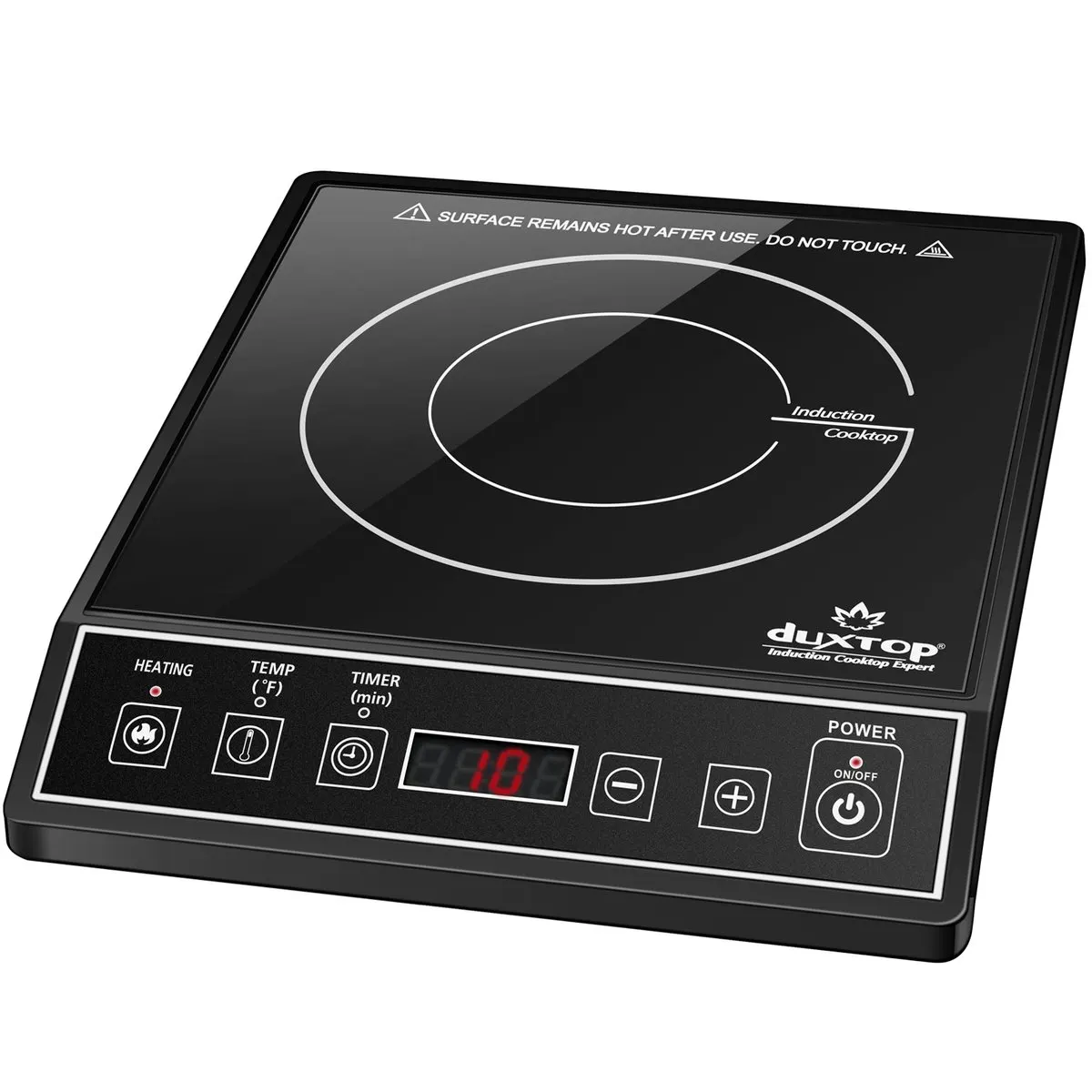
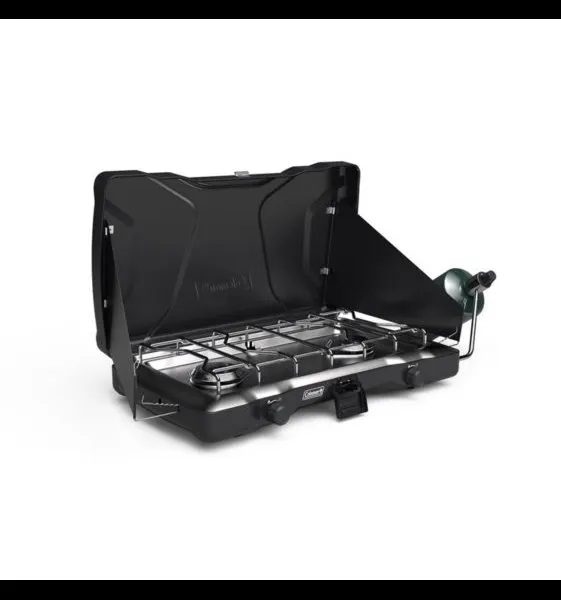
We recommend the Duxtop 9100MC Portable Induction Cooktop
“The Duxtop wins for vans with a real electrical system: no combustion gases indoors, 15 power levels with instant response, flat glass that wipes clean, and a lower price. The Coleman Triton+ wins for builds without a big inverter and battery bank, for cooking for three or more, and for cold-weather cooking outside, where its PerfectFlow regulator holds the flame steady. It also carries a 5-year warranty. Pick the Duxtop if you can power it. Pick the Triton+ if you can't, and cook outdoors: Coleman's propane stove instructions say "For outdoor use only" and never to use one inside a camper, tent or vehicle.”
Read the full Duxtop 9100MC Portable Induction Cooktop reviewSpecifications
| Spec | Duxtop 9100MC Portable Induction Cooktop | Coleman Triton+ 2-Burner Propane Stove |
|---|---|---|
| Best for | Induction with a large inverter | Regulated outdoor propane, two burners |
| Power | 1800W | — |
| Voltage | 120V AC | — |
| Dimensions | 11.4 x 14 x 2.5 in | 21.9 x 13.5 x 5 in |
| Weight | About 6 lb (listing / manual) | 12.4 lbs |
| Materials | Ceramic glass, ABS | — |
| Warranty | 2 years (Duxtop manual) | 3-year limited (Coleman) |
| Clearance | 4 in around the fan (manual) | 12 in sides, 48 in above (Coleman manual) |
| Power Levels | 15 levels, 200–1,800 W (manual) | — |
| Model | — | 2157318 |
| Burners | — | 2 |
| Output | — | 22,000 BTU total (11,000 each) |
| Ignition | — | InstaStart push-button |
| Fuel | — | Propane, 16 oz disposable cylinders only (Coleman manual) |
| Burn Time | — | Up to 1 hr on high per 16 oz cylinder (Coleman) |
Duxtop 9100MC Portable Induction Cooktop
- 1,800 W maximum, power and temperature modes
- Push-button controls
- Timer + child lock
- Budget-tier price
- Needs induction-compatible cookware
- Fan is audible
Coleman Triton+ 2-Burner Propane Stove
- 22,000 BTU total across 2 burners
- InstaStart push-button ignition, no matches
- PerfectFlow regulator for a consistent flame
- Two wind guards and a removable chrome-plated grate
- Heavy for its size at 12.4 lbs
- Manual allows 16 oz disposable cylinders only
- Outdoor use only (Coleman)
The short answer
If your van has a real electrical system, buy the Duxtop 9100MC. That means an inverter rated around 2,000 W continuous or more, a battery and BMS that can supply roughly 170 A at 12 V, and enough solar or alternator charging to put back what you use. The Duxtop makes no combustion gases, so it's the one you can use inside the van, and its push-button controls give fine steps up to 1,800 W. It's a budget cooktop and usually costs less than the Coleman. Our Duxtop 9100MC review explains the battery math in detail.
Buy the Coleman Triton+ (model 2157318, the version with InstaStart push-button ignition) if you don't have that electrical system, if you cook for more than two people, or if you cook outside at camp in cold weather. You get two 11,000 BTU burners and a PerfectFlow regulator that keeps the flame steadier in the cold than an unregulated stove, backed by a three-year limited warranty. It doesn't touch your battery bank. The trade-off is location: Coleman's manual says it is for outdoor use only and "Not for home or recreational vehicle use." The Coleman Triton+ review covers it in detail.
For a full breakdown of fuel types, see the induction vs butane vs propane guide.
Quick comparison
| Duxtop 9100MC | Coleman Triton+ | |
|---|---|---|
| Heat source | 1,800 W induction | 2 x 11,000 BTU propane |
| Where to use | Inside (household appliance) | Outdoors only |
| Needs | Big inverter and battery | 16 oz propane cylinders |
| Burners | 1 | 2 |
| Warranty | 2 years (listing) | 3-year limited |
Where you can actually cook
This decides the purchase more than anything else.
The Duxtop makes no flame and no combustion gases, so you can use it at the galley counter with the doors shut on a rainy night. It's a household appliance: Duxtop's manual asks for a dedicated 120 V / 15 A outlet and about 4 inches of clearance for its cooling fan, and it needs to be kept dry. You still want general cooking ventilation, such as a roof fan or a cracked window, for steam and odour.
The Triton+ is a propane camp stove, and Coleman's 5461 Series manual is direct: "For outdoor use only. Never use inside house, camper, tent, vehicle or other unventilated or enclosed areas. This stove consumes air (oxygen) and produces carbon monoxide (CO)." It also says "Not for home or recreational vehicle use," and sets minimum clearances from combustibles of 12 inches at the sides and 48 inches above. Plan to cook outside the van: on a tailgate, a folding table, or a table at the open slider with the stove and cook outside. Open doors, a roof fan or a CO alarm don't make indoor use acceptable; a CO alarm is a last-line warning device, not permission. Our van cooking safety guide has more.
It helps to separate the two kinds of ventilation. Combustion ventilation (supplying air to a flame and removing CO, CO₂, NO₂ and water vapour) is what the Coleman's outdoor-only rule covers. General cooking ventilation (steam, grease, odour) applies to both stoves, and is what the ventilation guide is about.
Edge: Duxtop. It's the only one of the two you can use inside the van.
Cooking power and control
On raw heat into one pan, the two are closer than you'd expect. The Duxtop puts up to 1,800 W into a single pan, and owners report a covered litre boiling in about four minutes. Neither Duxtop nor Coleman publishes boil times. The Triton+'s advantage is two burners: pasta and sauce at the same time, which the single-burner Duxtop can't do.
On control, the Duxtop's power steps (the current listing says 20 levels from 100 to 1,800 W; Duxtop's US manual describes 15 levels from 200 to 1,800 W) let owners hold a simmer on chili or rice. Induction responds immediately when you change the setting. Owners describe the Triton+'s low end as usable for eggs and pancakes, with attention.
Pan fit: Coleman's listing says the Triton+ fits a 12-inch and a 10-inch pan together, though owners note large pans crowd each other. The Duxtop's coil is smaller than its glass, so 9 or 10 inch pans heat most evenly, and Duxtop asks for a magnetic base at least 5 inches across.
Edge: Split. The Duxtop has finer control and instant response for one pan. The Triton+ cooks two things at once.
Power vs fuel: what each one needs
The Duxtop costs nothing to "fuel" if your solar is sized for it, but it's demanding. These are our estimates from the rated draw, assuming 85–90% inverter efficiency and a 12 V nominal battery:
- Continuous draw at full power: 1,800 W AC, or about 2,000–2,120 W from the battery, which is about 167–176 A at 12 V.
- Inverter: the continuous rating (not surge) must exceed the cooktop's draw at the setting you use plus other loads, or its overload protection trips. That makes about 2,000 W continuous a practical floor, and 3,000 W comfortable. Pure sine wave is the general recommendation for induction; it isn't a Duxtop manual instruction.
- Per session: a typical 25-minute dinner using about 400 Wh at the cooktop takes roughly 37–39 Ah from a 12 V bank; 20 minutes at full power takes about 56–59 Ah.
- Per day: two people cooking two meals a day can plausibly use 50–100 Ah on induction alone, on top of the fridge.
If you don't have the system yet, the inverter, batteries, cabling and solar cost far more than the cooktop. An inverter this size is a serious DC install: follow the manufacturer's instructions and use a qualified RV electrical technician where codes or your insurer require one. Run your own numbers in the power calculator.
The Triton+ draws nothing from your batteries. Coleman's listing says up to one hour on high from one 16 oz cylinder, which matches the arithmetic for both burners on full; mixed cooking lasts longer. Coleman's manual says to use only 16 oz disposable propane cylinders, so the common advice to run a Coleman two-burner from a 5 or 20 lb tank with an adapter hose isn't supported for this model. Disposable cylinders are more expensive per meal and more wasteful than bulk propane.
Edge: Depends on your build. The Duxtop wins if your electrical system already exists. The Triton+ wins if it doesn't.
Cold weather and winter use
This is where the Triton+ beats a typical camp stove. Propane keeps vaporizing far below freezing (it boils at about −44°F), and the PerfectFlow regulator holds burner pressure steadier as a cold or part-used cylinder loses pressure. Owners report the regulated stove keeping a steadier flame on cold mornings than unregulated stoves. Coleman doesn't publish cold-weather figures, and a regulator can't fully overcome severe cold on a 1 lb cylinder.
The Duxtop doesn't care about air temperature, but your battery bank does. In sub-freezing weather, solar output drops, LiFePO4 batteries generally must not be charged below about 32°F, and a heater may compete for the same power. That's why many induction vans also carry a propane stove for winter, used outdoors. See the cold weather van cooking guide.
Edge: Coleman Triton+, for cold-weather cooking outside. Induction is only as dependable in winter as your battery bank.
Size, storage and cleanup
The Duxtop is a slab about 2.5 inches thick and 6.2 lb according to the listing, so it slides into a drawer or a padded vertical slot. The Triton+ folds into a latching case about 22 inches wide, which takes a full shelf, and you also have to store fuel cylinders, out of the sun and away from heat.
Cleanup favours the Duxtop. Flat glass with no grates or burner ports means most spills come off with a damp cloth. The Triton+ has a removable chrome-plated grate and an aluminized steel cooktop that Coleman describes as rust-resistant, but you still have grates to scrub and drips around the burners. The Duxtop's weak spot is its fan vents, which pull in crumbs and sand.
Edge: Duxtop. It's lighter, smaller and easier to clean.
Durability and warranty
Coleman's manual gives the Triton+ a limited three-year warranty. (An older version of this page said five years; the current manual says three.) The current Duxtop listing gives a 2-year manufacturer warranty. The Triton+'s steel case dents rather than breaking. Its only electronic part is the InstaStart igniter; if that fails, a lighter still lights it. The Duxtop's glass can crack under a dropped pot, and its electronics don't tolerate water. Because it's inexpensive, replacing it after several years of daily use is part of the plan.
Edge: Coleman Triton+, narrowly. Longer warranty and fewer electronics to fail.
Value
Both are budget-to-mid-range, and on sticker price alone the Duxtop is usually cheaper. But the comparison depends on what you already own. If you still need a 2,000 W-plus inverter and a battery bank big enough to cook on, the Duxtop's real cost is far higher than the cooktop. In that case the Triton+ is the cheaper way to cook, outdoors. If you've already built a lithium-and-solar system, the Duxtop is the better value, and your solar covers the fuel.
Which one should you buy?
Buy the Duxtop 9100MC if:
- You have, or are building, an inverter of about 2,000 W continuous or more and roughly 200 Ah or more of lithium
- You want to cook inside the van, with no combustion gases
- You cook for one or two people and one burner is enough
- Storage space is tight and quick cleanup matters
Buy the Coleman Triton+ if:
- Your van has little or no inverter and battery capacity
- You cook for three or more, or regularly need two burners at once
- You're happy to cook outside, including in cold weather or at altitude
- You want a three-year warranty and minimal electronics
FAQ
Is induction or propane better for van life?
It depends on your electrical system and where you want to cook. Induction can be used indoors, but needs a large inverter and battery bank. Propane needs no electrical system, but Coleman labels the Triton+ for outdoor use only.
Can I use the Coleman Triton+ inside my van?
No. Coleman's manual says "For outdoor use only," "Never use inside house, camper, tent, vehicle or other unventilated or enclosed areas," and "Not for home or recreational vehicle use." Cook outside the van, for example on a tailgate or a table at the open slider, with 12 inches of side and 48 inches of overhead clearance from combustibles.
How much battery does the Duxtop 9100MC need?
Our estimate, at 85–90% inverter efficiency and 12 V nominal: about 37–39 Ah for a typical 25-minute dinner, and about 56–59 Ah for 20 minutes at full power. The inverter's continuous rating must exceed the cooktop's draw plus other loads; about 2,000 W is the practical floor at full power.
Can I run the Triton+ off a 20 lb propane tank?
Coleman's manual for this stove says to use only 16 oz disposable propane cylinders, so we don't recommend adapting it. If you want to cook from a bulk tank outdoors, the Camp Chef Everest 2X manual allows tanks up to 20 lb with Camp Chef's adapter hose.
Should I own both?
Many full-timers do. Induction handles everyday cooking inside, and a propane stove covers outdoor group meals and winter stretches when solar can't keep up.