Duxtop 9100MC Induction Cooktop vs NuWave PIC Gold Induction Cooktop
Two popular budget portable induction cooktops. One trades raw power for temperature precision; the other prioritizes wattage and physical buttons.
Disclosure: As an Amazon Associate I earn from qualifying purchases. Links to Amazon on this page are affiliate links: if you buy through one, VanLifeKitchens.com may earn a commission at no extra cost to you. Read our affiliate disclosure.
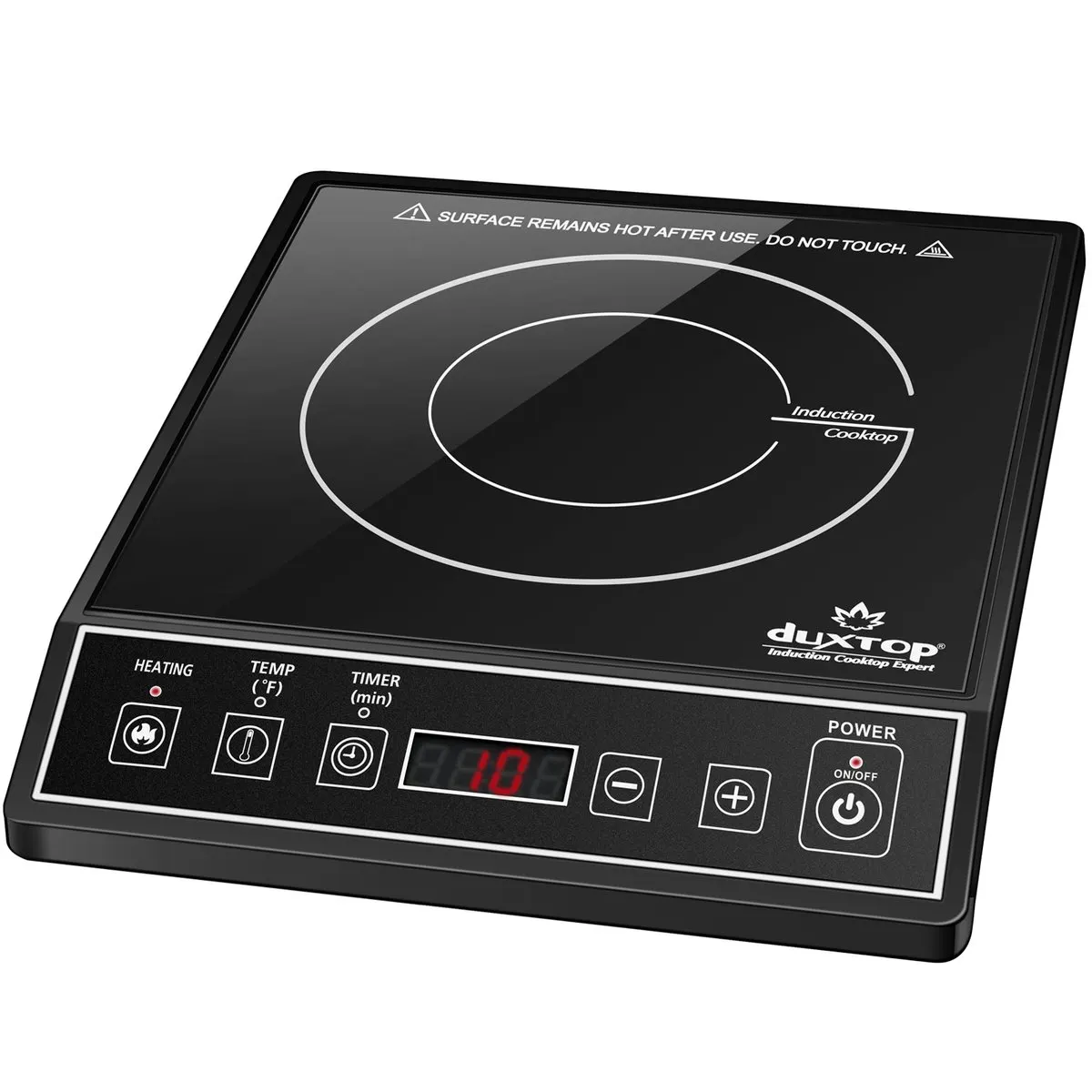
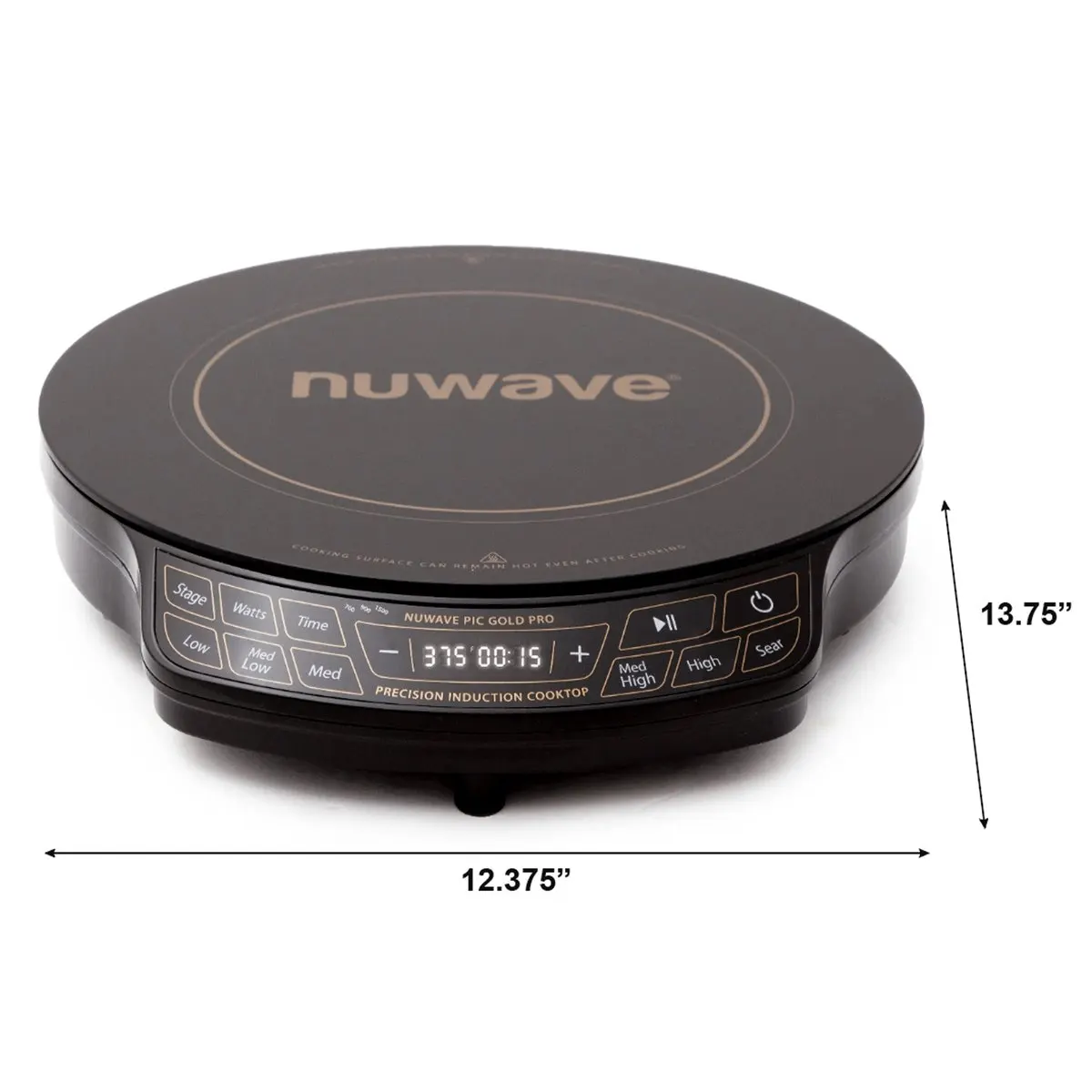
We recommend the Duxtop 9100MC Portable Induction Cooktop
“The Duxtop wins for most van dwellers. 1800W vs 1500W is a real difference in boil times and sear capability, the push buttons are less fussy with wet hands than a touch panel, and it usually costs less. The NUWAVE wins only if you genuinely need precise low-temperature control (100–300°F) for chocolate or custards.”
Read the full Duxtop 9100MC Portable Induction Cooktop reviewSpecifications
| Spec | Duxtop 9100MC Portable Induction Cooktop | NUWAVE PIC Gold (Gold Precision) 1500W Induction Cooktop |
|---|---|---|
| Best for | Induction with a large inverter | Precise low-heat induction |
| Power | 1,800 W max, 120 V / 60 Hz, 15 A circuit (manual) | 1,500 W, 120 V AC (manual) |
| Power Levels | 15 levels, 200–1,800 W (manual); listing says 20 levels, 100–1,800 W | — |
| Temperature | 140–460°F (manual); listing says 100–460°F | — |
| Dimensions | 11.4 x 14 x 2.5 in (manual) | — |
| Weight | 5 lb 12 oz (manual); 6.2 lb (listing) | — |
| Cookware | Magnetic base, 5 in minimum (listing) | Magnetic, 3 in minimum; up to 10 in recommended (manual) |
| Clearance | At least 4 in from walls (manual) | 3 in back, sides, top (manual) |
| Timer | Up to 170 min; auto shut-off after 120 min without input (manual) | — |
| Warranty | 2 years limited (manual) | 1 year limited (manual) |
| Settings | — | 1,500 / 900 / 600 W (manual) |
| Temp Range | — | 100°F–575°F; 10°F steps per manual, 5°F per listing |
| Coil | — | 8 in (listing) |
| Voltage Limits | — | 85–144 V (manual error codes) |
Duxtop 9100MC Portable Induction Cooktop
- 1,800 W maximum, power and temperature modes
- Push-button controls
- 170-minute timer and 120-minute auto shut-off (manual)
- Budget-tier price
- Needs induction-compatible cookware
- Fan is audible
NUWAVE PIC Gold (Gold Precision) 1500W Induction Cooktop
- Temperature control from 100°F to 575°F (manual)
- Display shows the target temperature or wattage
- Programmable timer and multi-stage cooking (manual)
- Selectable 600 / 900 W modes for smaller inverters
- 1500W vs 1800W Duxtop ceiling
- Capacitive touch panel, not buttons
The short answer
For most van kitchens, buy the Duxtop 9100MC. It has the higher 1,800 W ceiling, so water boils faster and a skillet recovers faster after you add food. Its push-button controls work with wet or greasy fingers, and it's usually the cheaper of the two. If your cooking is pasta, rice, stir-fries, eggs and weeknight dinners, the Duxtop is the better tool. Our Duxtop 9100MC review goes deeper on its power needs.
The Nuwave PIC Gold, which Nuwave now sells as the "Nuwave Gold Precision Induction Cooktop" (same model; the listing gives the model number as PIC GOLD), is the pick for one kind of cook: someone who works at low temperatures and wants to set an actual number. You choose a target from 100°F to 575°F, with presets starting at 100°F and 175°F, which suits chocolate, confit, custards and gentle water baths. It peaks at a lower 1,500 W and can be capped at 900 W or 600 W, which is easier on a smaller inverter. The Nuwave PIC Gold review covers its temperature control.
Both are indoor appliances. Neither produces combustion gases. Nuwave's manual says the PIC is "for household use only" and "not intended for outdoor use"; Duxtop's manual describes household use on a dedicated 120 V / 15 A circuit. That makes them the opposite of the fuel stoves on this site, which their makers label outdoor-only. You still want general cooking ventilation (a roof fan or open window) for steam and odour.
If you're still choosing between induction, butane and propane, start with our induction vs butane vs propane guide. Both burners come with the same condition: your battery bank and inverter have to be able to feed them.
Quick comparison
| Duxtop 9100MC | Nuwave PIC Gold | |
|---|---|---|
| Max power | 1,800 W | 1,500 W (or 900 / 600 W) |
| Control | Power levels, push buttons | Target temp, touch panel |
| Temp range | 140–460°F (manual) | 100–575°F |
| Min pan base | 5 in, magnetic | 3 in, magnetic |
| Clearance | 4 in from walls | 3 in back, sides, top |
| Warranty | 2 years (manual) | 1 year (manual) |
The Duxtop's Amazon listing advertises 100–460°F; its US manual says 140–460°F. Both manuals give the warranty as limited.
Raw power and everyday cooking speed
The Duxtop's 300 W advantage shows up whenever you need to put heat into food quickly. Neither maker publishes a boil time. Our estimate for the Duxtop: heating a litre from about 60°F to boiling takes roughly 90 Wh of heat, which at 1,800 W and the listing's 83% efficiency is a little under four minutes with a lid. At 1,500 W the PIC Gold puts about a sixth less energy into the pot each minute, so it is slower.
Searing runs into the limits of portable induction on both. The Nuwave listing gives an 8-inch heating coil; Duxtop doesn't publish a coil size, but on plates this size the coil is smaller than the glass. An 8 to 10 inch pan heats most evenly on either, and a 12-inch skillet ends up with cooler edges. Nuwave's manual is inconsistent on maximum pan size (one passage says pans over 10 inches aren't recommended, a notice box says up to 12 inches), so 10 inches is the safe reading. Duxtop's manual says that if cookware overheats in Power Mode, typically while frying, the unit drops to Temperature Mode, and it shuts down with an E2 code above its 460°F limit. Even so, the Duxtop has more headroom for getting a crust on a steak or bringing a pan of vegetables back up to temperature.
Edge: Duxtop. More watts means faster boils and better recovery for everyday high-heat cooking.
Low-temperature precision
This is the PIC Gold's reason to exist. The Duxtop gives you power levels (the current listing says 20 levels from 100 to 1,800 W; Duxtop's US manual describes 15 levels from 200 to 1,800 W). Like most budget induction plates, it cycles the element on and off at low settings. That is generally adequate for simmering chili or cooking rice with normal stirring, but it isn't smooth low-heat holding.
The PIC Gold works differently. You set a target temperature and the display shows it. Preset buttons jump to 100, 175, 275, 375, 425 and 575°F, and the minus and plus keys adjust from there; Nuwave's manual says in 10°F steps, while the Amazon listing says 5°F. It still cycles power under the hood, since induction works that way, and how closely the food tracks the number depends on the pan and its contents. Treat the setting as a repeatable dial rather than a thermometer. The interface matters most in roughly the 100–300°F range; above about 400°F any induction plate is running near full power and the two behave much alike.
"Good enough for chili" and "precise enough to melt chocolate without a double boiler" are different standards. Use a thermometer for anything where a few degrees matter; both cooktops sense through the glass, not inside the food. Neither is a substitute for a sous vide circulator.
Edge: Nuwave PIC Gold, for anything that depends on holding a specific low temperature.
Controls and build for a moving kitchen
The Duxtop uses push buttons (Amazon's product details list "Push Button" controls). That matters on the road: capacitive touch panels can misread when the glass or your fingers are wet, while buttons register through wet fingers. That's a design difference, not a reliability guarantee.
The PIC Gold uses a touch panel with a display. Touch controls are inherently more sensitive to water than buttons, and a van galley has plenty of water, so keep the panel dry and wipe spills promptly.
Both have plastic housings and ceramic glass tops that scratch under dragged cast iron; Nuwave calls its glass "shatter-proof", but we'd still pack either one padded. Both fans are audible, and Nuwave's manual says its fan can run for up to 60 seconds after you pause. Duxtop's manual asks for at least 4 inches from walls and an unblocked air inlet; Nuwave's asks for 3 inches at the back, sides and top. Don't recess either into a tight, unventilated cutout.
Edge: Duxtop. Buttons are the safer bet with wet hands.
Power draw, inverter and battery sizing
Both are 120 V AC appliances, so in a van they run through an inverter, and that's where most of the cost of induction goes. Our estimates below assume 85–90% inverter efficiency and a 12.8 V nominal LiFePO4 battery, and don't include other loads:
| Setting | Battery draw | Amps at 12.8 V |
|---|---|---|
| Duxtop at 1,800 W | 2,000–2,120 W | 156–165 A |
| Nuwave at 1,500 W | 1,670–1,760 W | 130–138 A |
| Nuwave at 900 W | 1,000–1,060 W | 78–83 A |
A sagging or lead-acid bank sits at a lower voltage, which raises the amps.
Inverter size. The inverter's continuous rating (not its surge rating) has to exceed the cooktop's draw at the setting you use plus anything else running, or its overload protection trips. For the Duxtop at full power, about 2,000 W continuous is the practical floor, and 3,000 W gives headroom. The PIC Gold at 1,500 W leaves a few hundred watts of headroom on a 2,000 W inverter, and its 900 W setting fits an inverter of about 1,200 W continuous with some margin. Pure sine wave inverters are the general recommendation for induction; that's general guidance, not an instruction in either manual.
What the manuals do say. Duxtop asks for a 120 V / 60 Hz, 15 A circuit and shows an E3 error for input voltage that's too high or too low. Nuwave says the PIC should have its own outlet, flags input below 85 V or above 144 V, and says extension cords must be rated at least as high as the appliance. An inverter that sags under heavy load can push either one out of range.
Battery per session (estimate). A 25-minute mixed dinner uses about 400 Wh at the cooktop on the Duxtop, or about 35–37 Ah from a 12.8 V bank, and about 350 Wh on the Nuwave, or about 30–32 Ah. Twenty minutes at full power uses about 52–55 Ah on the Duxtop and 43–46 Ah on the Nuwave. Per meal, the gap is smaller than the wattage suggests, because the faster cooktop runs for fewer minutes. The reviews spell out the minute-by-minute assumptions behind each dinner figure.
A cooking-sized inverter is a serious DC install. Check the BMS can supply the current, size cables and fuses to the inverter, follow its installation instructions, and use a qualified RV electrical technician where codes or your insurer require one. Run your numbers in the power calculator or the van kitchen power budget guide.
Edge: Nuwave PIC Gold. The lower peak and selectable wattage are easier on modest inverters.
Size, weight and storage
Duxtop's manual gives the 9100MC as 11.4 x 14 x 2.5 inches and 5 lb 12 oz (the Amazon listing says 6.2 lb), with a 5 ft attached cord. Nuwave's manual doesn't give dimensions or weight, and the listing's 12 x 14.25 x 4.5 inches looks like a packed size, so measure the slot you have in mind generously before committing. Either should fit a drawer or a padded vertical slot. Neither has a carry handle; a padded sleeve protects the glass in transit.
Edge: Duxtop, narrowly, because its published dimensions let you plan a slot with confidence.
Value
Both are budget-to-mid-range cooktops, and the PIC Gold usually costs a bit more. For the extra, Nuwave gives you the temperature-target interface and selectable wattage. If you cook below 300°F often, that's money well spent. If you cook mostly at medium to high heat, the Duxtop's extra power is worth more.
Either way, the cooktop is the cheap part. The inverter, battery bank and solar cost far more than the gap between these two.
Which one should you buy?
Buy the Duxtop 9100MC if:
- You cook mostly fast, high-heat meals: pasta, rice, stir-fries, eggs and soups
- You want the fastest boil of these two
- You often cook with wet hands and want physical buttons
- You already have an inverter of 2,000 W continuous or more
Buy the Nuwave PIC Gold if:
- You often cook below 300°F: chocolate, custards, confit, infusions or slow sauces
- You want to set an actual temperature, not a power level
- Your inverter is around 2,000 W, or smaller and you'll use the 900 W setting
- You'd trade a slower boil for finer control
FAQ
Is the Duxtop 9100MC or the Nuwave PIC Gold better for van life?
For most van dwellers, the Duxtop: more power, push buttons and usually a lower price. The Nuwave is better if precise low-temperature cooking is central to how you cook, or if your inverter is on the small side.
Is the Nuwave Gold Precision the same as the PIC Gold?
Yes. Nuwave sells the PIC Gold as the "Gold Precision Induction Cooktop"; the listing's model number is PIC GOLD and the manual is titled "PIC Gold Precision Induction Cooktop".
Can I run either cooktop on a 2,000 W inverter?
Generally yes, if the inverter's continuous rating covers the cooktop plus other loads. The Nuwave at 1,500 W pulls roughly 1,670–1,760 W from the battery and leaves some headroom; the Duxtop at 1,800 W pulls roughly 2,000–2,120 W, right at or above a 2,000 W inverter's limit, so run it a step below maximum or avoid other heavy AC loads at the same time.
Can I use either inside the van?
Yes. Both are household induction appliances with no combustion. Nuwave's manual says the PIC is not intended for outdoor use. Give each its specified clearance (Duxtop at least 4 inches from walls, Nuwave 3 inches around the back, sides and top), keep them dry and give each its own outlet.
Will my cast iron or stainless pans work on both?
Any pan with a magnetic base works. If a magnet sticks firmly to the bottom, it will heat. Cast iron, magnetic stainless and carbon steel work; aluminium, copper, glass, titanium and non-magnetic stainless don't. The minimum base is 5 inches on the Duxtop and 3 inches on the Nuwave, and an 8 to 10 inch pan suits either unit.
Which lasts longer in a van?
Neither maker publishes durability data. The manuals give the Duxtop a 2-year limited warranty and the Nuwave 1 year; Nuwave's excludes drops and vibration damage. Both have plastic-and-glass construction. The Duxtop's buttons avoid the touch panel's sensitivity to water. With either, keep it dry, keep the fan vents clear and store it padded.
Sources and verification
- Duxtop 9100MC review: specs and sources for the 9100MC, including the Duxtop US manual and the Amazon listing it cites (checked 2026-10-12)
- Nuwave PIC Gold review: specs and sources for the PIC Gold, including the Nuwave owner's manual and the Amazon listing it cites (checked 2026-10-12)
- Battery, inverter and boil-time figures on this page are our estimates from rated draw, using the assumptions stated above, not measurements.