Can Your Power Station Run an Induction Cooktop?
Continuous vs surge watts, usable vs rated watt-hours, and worked runtime math for running the Duxtop 9100MC or Nuwave PIC Gold from a portable power station.
Disclosure: As an Amazon Associate I earn from qualifying purchases. Links to Amazon on this page are affiliate links: if you buy through one, VanLifeKitchens.com may earn a commission at no extra cost to you. Read our affiliate disclosure.
The short answer
Usually yes, but only if the power station clears two separate bars, and plenty of popular stations clear one and miss the other.
- Power (watts). The station's continuous AC output rating has to be higher than the most the cooktop can draw, plus anything else plugged into the AC side at the same time. The Duxtop 9100MC is rated at 1,800 W. The Nuwave Gold Precision (PIC Gold) tops out at 1,500 W and has 900 W and 600 W wattage caps.
- Energy (watt-hours). The battery has to hold enough usable energy for the cooking you plan to do before you can recharge. Usable AC energy is lower than the capacity printed on the box, because the inverter loses some energy turning battery power into 120 V AC.
A station that can deliver 2,000 W but only stores 500 Wh will run the cooktop, but not for long. A station that stores 2,000 Wh but is rated for 1,000 W continuous can't run either cooktop at full power at all. It will shut off its AC output.
This guide walks through both bars and shows worked runtime arithmetic. It also covers what the two cooktop manuals actually say about power supply and what we could and couldn't confirm. Every figure below is an approximate example with its assumptions stated. It is not certified electrical advice. For a permanently installed inverter and battery system, follow the equipment manufacturers' installation instructions and use a qualified RV electrical technician where codes or insurers require one.
Watts vs watt-hours: the two numbers people mix up
- Watts (W) measure how fast power is drawn right now. A cooktop at full power draws about 1,800 W. Your station's AC output rating, in watts, is the most it can deliver at any moment.
- Watt-hours (Wh) measure energy, meaning power multiplied by time. 1,000 W for one hour is 1,000 Wh. 1,000 W for 20 minutes is about 333 Wh.
A power station's AC output rating is in watts. Its capacity is in watt-hours. A cooktop's nameplate is in watts. How much of the battery a meal uses depends on watts × time, so you need both numbers.
If you think in amp-hours, an amp-hour figure only means something when you state the voltage. For example, 370 Wh drawn from a 12.8 V nominal lithium battery is about 29 Ah (370 ÷ 12.8). The same 370 Wh is only about 7 Ah at 51.2 V, which some larger stations use internally. Watt-hours avoid that confusion, so this guide sticks with them.
Continuous output vs surge (peak) ratings
Power-station spec sheets usually list two AC output figures:
- Continuous (rated) output: what the inverter can deliver indefinitely, within its temperature limits.
- Surge or peak output: a higher figure it can deliver only very briefly, typically to start motors and compressors. Spec sheets often don't say exactly how long "briefly" is.
Surge ratings don't help with an induction cooktop. A cooktop at high power draws its full wattage for minutes at a time, not milliseconds. If the cooktop draws more than the station's continuous rating, you're relying on overload behaviour, not surge capacity.
What happens when the cooktop exceeds the continuous rating
Power stations protect their inverters. When the AC load goes over the rating, the station typically cuts AC output and shows an overload warning, sometimes after a short grace period. Then you have to restart the AC output by hand. One power-station user guide we opened describes exactly this: an overload or warning icon flashes and buzzes, and the AC output has to be switched back on after the load is reduced. In practice the cooktop goes dead mid-boil. That doesn't damage anything, but you lose the cook, and repeatedly tripping the protection isn't a good way to run any electrical equipment.
The practical rule: choose a station whose continuous rating sits comfortably above the cooktop's maximum draw plus any other AC loads. Don't pick one that only matches it exactly. A 1,800 W continuous station running a cooktop rated at 1,800 W has no margin left for a laptop charger, a kettle or measurement tolerance. Two ways to make room are to lower the cooktop's ceiling (see the PIC Gold's wattage caps below) or to choose a station with a higher continuous rating.
Watch for "voltage-reduction" boost modes
Some stations advertise a mode that lets them run heating appliances rated above the inverter's limit by lowering the output voltage. That works with simple resistive loads such as a kettle element. An induction cooktop has its own electronics and checks the supply voltage. The Duxtop 9100MC manual lists an E3 voltage error: "voltage input is too high or too low," after which the unit shuts down. The PIC Gold manual lists 85 V minimum and 144 V maximum. Don't expect a reduced-voltage boost mode to run either cooktop reliably. Rely on the station's true continuous rating at normal 120 V output.
Pure sine wave output
Induction cooktops are electronic appliances, and the standard advice for running them from batteries is a pure sine wave inverter. Modified sine wave output is known to make electronics with switching power supplies misbehave or run hot. Most portable power stations already state pure sine wave AC output on their spec sheets. Check the spec rather than assuming. Neither cooktop manual we opened mentions inverters, generators or power stations at all. Both are written for household 120 V outlets. So "pure sine wave" here is general electrical guidance, not a Duxtop or Nuwave instruction.
Cooktop operating modes: low setting does not always mean low draw
This is the part that surprises people. You'd expect "level 2" to draw a steady trickle. On many portable induction units it doesn't. At low settings, many induction electronics regulate output by cycling full or high power on and off (pulsing), so the average power is low but the instantaneous draw during each pulse can be much higher. Owners of budget units commonly describe an audible click and a visible on-off rhythm in simmering liquid at low settings.
Why it matters for a power station:
- Energy follows the average. A setting that pulses 1,800 W on for a third of the time uses about the same energy as a steady 600 W.
- Overload protection follows the instantaneous draw. If each pulse is 1,800 W and the station's continuous rating is below that, each pulse can trip it. A pulse lasting several seconds is not a "surge".
Temperature modes behave similarly. The cooktop heats toward the set temperature, then backs off or cycles to hold it, so the draw changes throughout the cook.
What we could and couldn't confirm for the site's two cooktops
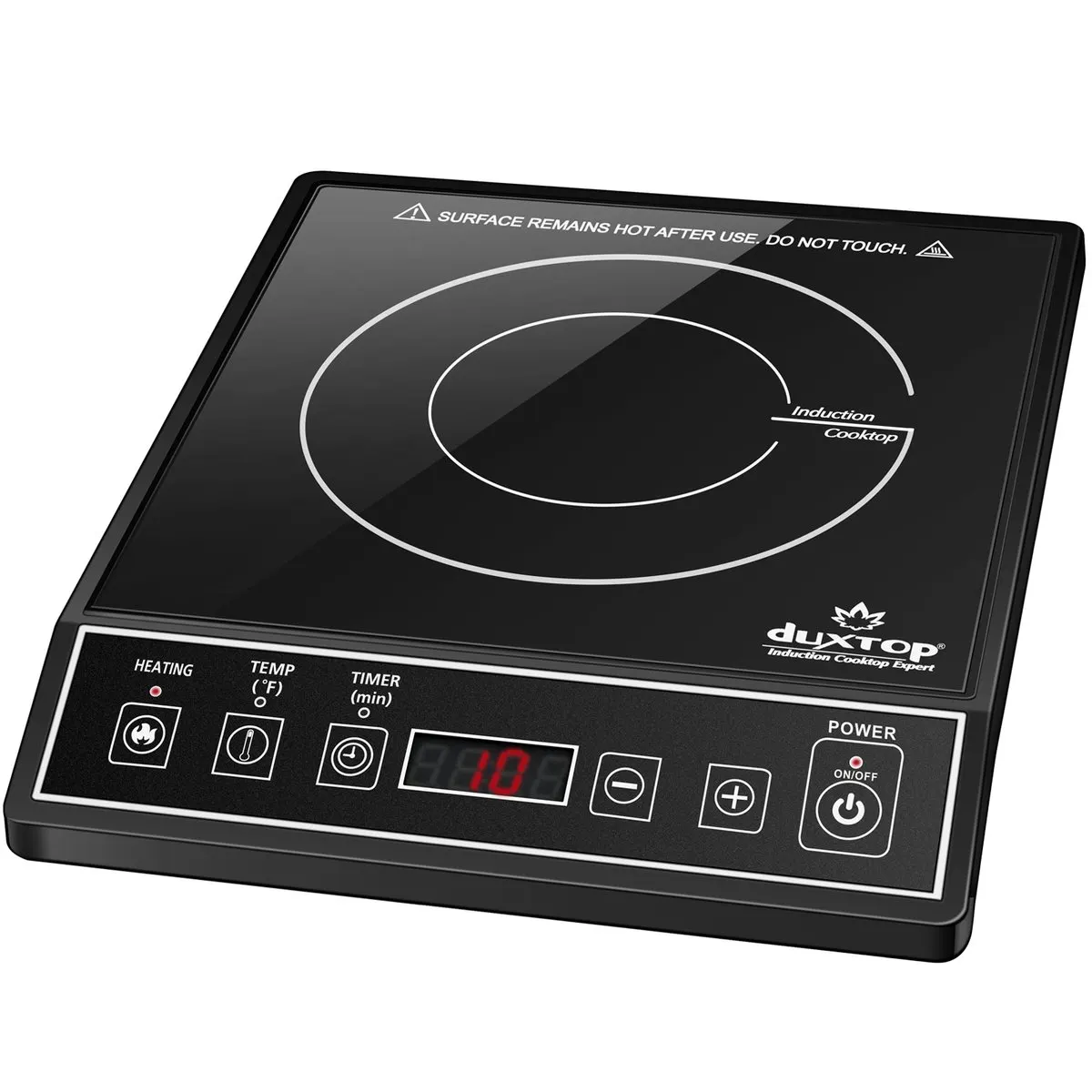
Duxtop 9100MC (1,800 W). The 9100MC/9120MC user manual lists:
- A Power (Heating) mode with 15 levels from 200 W to 1,800 W. Level 1.0 is 200 W ("Simmer-keep warm") and level 10 is 1,800 W ("High"). The manual says "the power level selected directly relates to the amount of wattage... the cooktop generates."
- A Temperature mode with 15 settings from 140°F to 460°F, in which "the built-in micro processor monitors and regulates the cookware temperature to the preset temperature."
- A 120 V/60 Hz, 15 A power source. The manual tells owners not to share a 120 V, 15 A outlet with another electrical item, and not to run another appliance on the same outlet or circuit.
The US manual pages we opened do not say whether low power levels are delivered as a steady low draw or as full-power pulses. The related UK-market 9100MC-UK manual labels its lowest power setting "Simmer-keep warm, intermittent heating." That suggests the low end on that model pulses, but it is a different voltage version, so we can't confirm the US unit behaves the same way. Treat the 9100MC as able to draw up to 1,800 W at any setting until you've measured your own unit. A plug-in watt meter, or the station's own output display, will show what it actually draws.
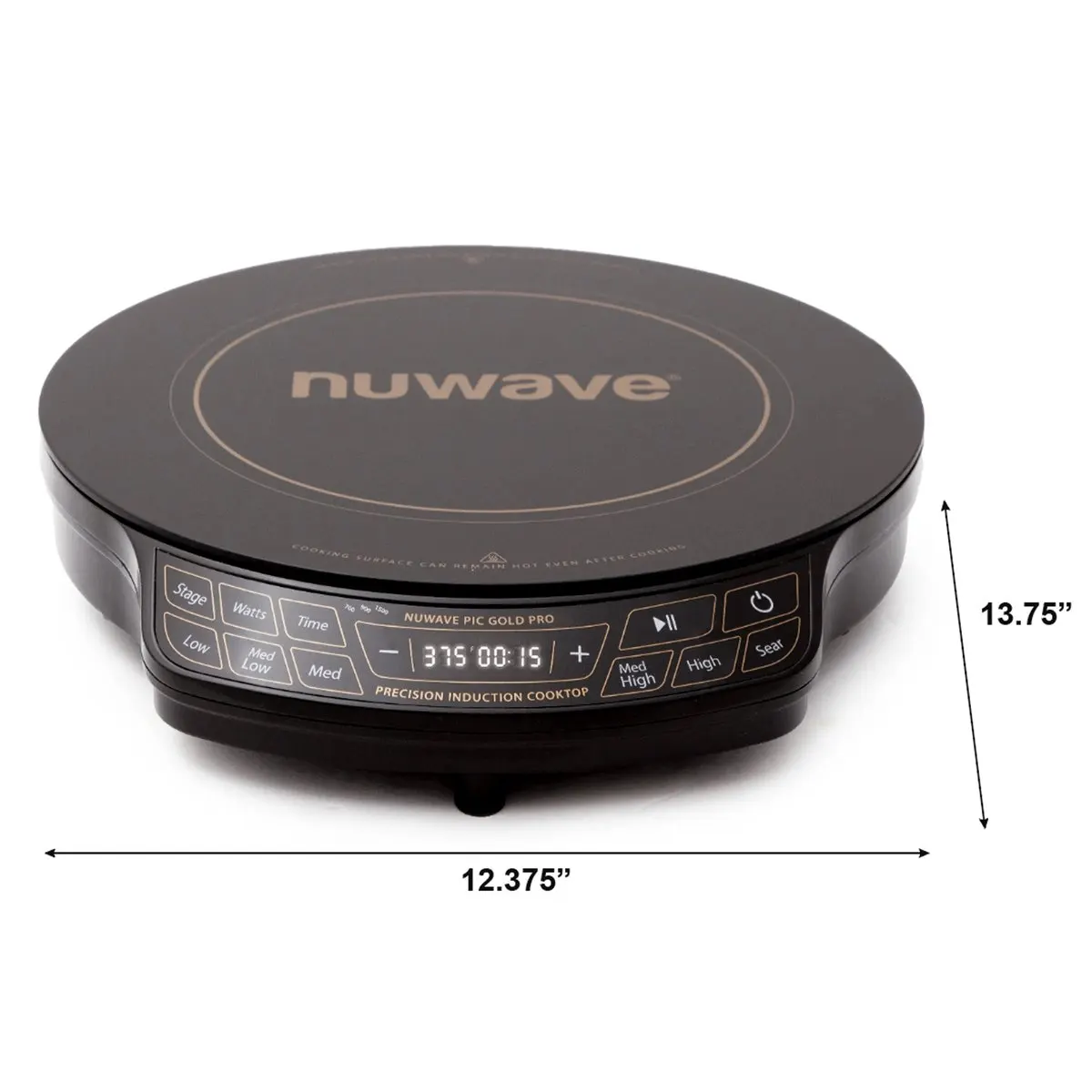
Nuwave Gold Precision / PIC Gold (1,500 W). The Amazon listing the site links to describes the unit as having 100°F to 575°F temperature control and 3 wattage settings. The PIC Gold (model 30211) owner's manual says the WATTS button "controls the power consumption," that the default is 1,500 W, and that it can be changed to 900 W or 600 W. The manual adds that the lower wattage is "ideal if your home does not take 1500 watts." Nuwave presents this as a way to fit circuits that can't supply full power, which is exactly the situation on a smaller power station. The manual also describes holding a set temperature. However, it does not publish measured draw at each wattage setting, and it doesn't explain whether temperature holding is done by pulsing. So we can't confirm that the 600 W setting never draws more than 600 W instantaneously. The manual's framing suggests it is meant as a ceiling. A watt meter will tell you for certain.
One inconsistency is worth knowing about. The PIC Gold manual we opened gives the maximum as 500°F in one place and lists a 575°F "Sear" preset in another. The Amazon listing says 575°F.
Usable energy: rated Wh vs usable Wh
A power station's advertised capacity (1,024 Wh, 2,048 Wh and so on) is the battery's rated energy. What you can actually draw from the AC outlets is lower, mainly because the inverter turns some energy into heat while converting battery DC to 120 V AC. Power-station makers' own runtime guides commonly subtract around 10–15% for inverter losses.
This guide assumes 85–90% inverter efficiency, applied as:
Usable AC energy ≈ rated Wh × efficiency
Battery Wh used ≈ cooktop W × hours ÷ efficiency
Real efficiency varies with load, temperature and the specific station, and is often lower at very light loads. Some stations also reserve part of the battery, or shut off before reaching true zero. Treat the 85–90% range as an assumption, not a promise.
Note that the Duxtop's advertised "83% energy efficiency" refers to how much of its electrical input ends up as heat in the pan. It has nothing to do with the inverter's efficiency, and the two shouldn't be multiplied together for runtime. Runtime is set by what the cooktop draws from the outlet.
Worked runtime examples
These are approximate examples, not measurements. Assumptions: inverter efficiency 85–90%, cooktop draw at the stated wattage, no other loads, station starting at full charge, and no reserved capacity.
Example 1: one 20-minute cook at a steady 1,000 W
Energy at the cooktop: 1,000 W × (20 ÷ 60) h = about 333 Wh
Energy drawn from the battery:
- at 90% efficiency: 333 ÷ 0.90 = about 370 Wh
- at 85% efficiency: 333 ÷ 0.85 = about 392 Wh
| Station rated capacity | Usable AC (85–90%) | Share used per cook | 20-min cooks per charge |
|---|---|---|---|
| 1,024 Wh | 870–922 Wh | about 36–38% | about 2.5 |
| 2,048 Wh | 1,741–1,843 Wh | about 18–19% | about 5 |
Arithmetic for the table: 1,024 × 0.85 = 870 and 1,024 × 0.90 = 922. Dividing by 333 Wh per cook gives about 2.6–2.8, rounded down to about 2.5 to allow for real-world losses. For the larger station, 2,048 × 0.85 = 1,741 and 2,048 × 0.90 = 1,843, so 1,741–1,843 ÷ 333 gives about 5.2–5.5.
In amp-hours, the same 370–392 Wh equals about 29–31 Ah from a 12.8 V nominal battery.
Example 2: full power, flat out
How long a full station lasts with the cooktop pinned at its maximum:
| Cooktop draw | 1,024 Wh station | 2,048 Wh station |
|---|---|---|
| 1,800 W (Duxtop max) | about 29–31 min | about 58–61 min |
| 1,500 W (PIC Gold max) | about 35–37 min | about 70–74 min |
Arithmetic: usable Wh ÷ cooktop W = hours. For example, 870 ÷ 1,800 = 0.48 h, or about 29 minutes.
The 1,024 Wh row comes with a catch. If the 1,024 Wh station is rated for 1,800 W continuous, the Duxtop at full power uses all of that rating, with no headroom for anything else on the AC side and nothing to spare for measurement tolerance. The PIC Gold at 1,500 W leaves about 300 W of headroom on the same station. At its 900 W setting it leaves much more.
Example 3: a low setting that pulses
Suppose a low setting averages 600 W by pulsing 1,800 W on for about a third of the time, over 20 minutes:
- Energy: 600 W × (20 ÷ 60) h = 200 Wh at the cooktop, or about 222–235 Wh from the battery.
- Peak draw during each pulse: 1,800 W.
The battery sees a modest load, but the inverter still has to handle the full 1,800 W on every pulse. This is why a station's continuous rating has to suit the cooktop's maximum draw, even if you only plan to simmer. As noted above, we couldn't confirm from the US manuals whether either cooktop pulses this way at low settings.
Running your own numbers
Real meals mix a few minutes at full power (boiling water, searing) with longer stretches at lower settings. Add up each stretch as W × hours, divide the total by 0.85 to 0.90, and compare it with your station's rated Wh × 0.85 to 0.90. The power planner does the van-wide version of this sum. For the bigger picture of sizing a whole kitchen's daily load, see How to Size Your Van Kitchen Power Budget.
What the cooktop manuals say about plugging in
Both manuals were written for household outlets. They still matter on a power station:
- Duxtop 9100MC: the manual specifies a 120 V/60 Hz, 15 A circuit. Its safeguards say not to share a 120 V, 15 A outlet with another electrical item, and not to run another appliance on the same outlet or circuit. The FAQ section says each unit "will draw about 15 amps" and strongly recommends a dedicated outlet per unit. The pages we opened did not contain extension-cord wording either way. The manual also says not to use the unit "in a wet outdoor environment," which matters if you cook under a rear hatch in the rain.
- Nuwave PIC Gold: the manual says a short cord is supplied to reduce tangling and tripping risk. It allows extension cords "if care is exercised," provided the cord's marked electrical rating is at least as great as the appliance's, and the cord is arranged so it can't be pulled or tripped over. It also says the PIC should be run "on a separate electrical outlet from other operating appliances due to wattage limitations," and notes the polarised plug.
On a power station, all the AC outlets share one inverter, so the "dedicated outlet" advice really means don't run other AC loads from the station while the cooktop is on full power. A 12 V fridge on the station's DC port may not use the inverter. Even so, some stations have a combined total-output limit as well as an AC limit, so check how your station's spec sheet describes it. If you do need an extension cord, use a short, heavy-gauge cord rated for at least the cooktop's draw. Avoid thin household cords and multi-outlet power strips.
Practical limitations
Recharge time
Cooking from a power station only works if you can put the energy back. A rough estimate is hours to recharge ≈ Wh to replace ÷ net charging watts. Charging has its own losses, so add a margin. For example, replacing the 370–392 Wh from Example 1 at a steady 200 W of net charge takes roughly 2 hours. Real solar input swings with sun angle, clouds and panel temperature, so a panel's rated wattage is a best case, not a daily average. Wall (AC) charging and alternator charging are usually more predictable. A cook who boils water on induction every morning and evening needs to be confident they can replace that energy daily. If not, a fuel stove is the better fit for some meals. The induction vs butane vs propane guide covers that trade-off.
Heat
A power station delivering 1,500–1,800 W for long stretches is working near its limit. It gets warm, its fans run hard, and if it gets too hot it can cut output to protect itself, just as it does on overload. Manufacturers publish operating temperature ranges for discharging, so check them, particularly in a closed van in summer. Keep the station's vents clear and well away from the cooktop's own exhaust. The Duxtop manual asks for its fan to have at least 4 inches of clearance. Remember that induction still produces steam, grease and heat in the pan, so general cooking ventilation still applies. The van cooking safety guide and ventilation guide cover that.
Cookware
Induction only heats magnetic-based cookware: cast iron, carbon steel, and stainless steel with a magnetic base. If a fridge magnet sticks firmly to the bottom, the pan will work. The Duxtop's pan detection needs a magnetic base at least 5 inches across, and the PIC Gold manual gives a 3-inch minimum and a 10-inch recommended maximum. Aluminium, copper and most hard-anodised pans won't heat unless they have a bonded magnetic plate. The cookware guide covers which van-friendly sets are induction-compatible.
Battery life and capacity planning
Every cook uses part of a charge cycle. A large share of a small station's capacity per meal means frequent deep cycles. That doesn't harm the station in the short term, but it does leave little in reserve for the fridge, lights and devices. For sizing a fixed battery bank around a kitchen, see Choosing a Battery Bank for Your Van Kitchen.
Power-station categories and how they fit induction
This isn't a shopping list. These are rough patterns in published specs that help you read a spec sheet. Always check the continuous AC rating and Wh capacity of the exact unit.
- Small stations (a few hundred Wh, AC output well under 1,000 W): made for phones, laptops, lights and small fans. They can't run either cooktop. A 1,500 W or 1,800 W load will trip the AC overload protection.
- Mid-size stations (roughly 1,000–1,500 Wh, AC output around 1,500–2,000 W): can run the PIC Gold at 1,500 W, or at its 900 W or 600 W caps, with headroom on the higher-rated units. Running the Duxtop at full 1,800 W leaves little or no margin. Expect about two to three moderate 20-minute cooks per charge (Example 1).
- Large stations (2,000 Wh and up, AC output above 2,000 W): handle either cooktop at full power with headroom, and give several cooks per charge. They are heavy and take longer to recharge.
- Installed systems (a fixed lithium bank with a separate pure sine wave inverter): the same two bars apply, continuous inverter watts and usable battery Wh. Installation should follow the manufacturer's instructions and, where required, be done by a qualified technician.
Which cooktop suits a power station better?
For most power-station users, the lower ceiling is the more useful feature. The Duxtop vs Nuwave comparison covers cooking performance in detail. On power, the PIC Gold's documented 1,500 / 900 / 600 W settings let you match the cooktop to a station's continuous rating. The Duxtop's 1,800 W maximum suits stations with a higher continuous rating, and it boils faster when the station can supply it. Neither makes a small station big enough. The cooktops complete guide covers the wider choice of fuels and stoves.
FAQ
Can a 1,000 W power station run an induction cooktop? Not at full power. The Duxtop 9100MC draws up to 1,800 W and the PIC Gold up to 1,500 W, so either one will trip a 1,000 W station's AC overload protection. The PIC Gold's 900 W or 600 W wattage setting is designed to cap its consumption. That might fit a 1,000 W station, but Nuwave doesn't publish measured draw at those settings, so check it with a watt meter before relying on it.
Does the surge or peak rating count? No. Surge ratings cover very short starting loads. A cooktop draws its full wattage for minutes, so compare it with the continuous AC output rating.
If I cook on a low setting, can I use a smaller power station? Not necessarily. Many induction units hold low settings by pulsing high power on and off. The average draw is low, but each pulse can still exceed a small station's continuous rating. We couldn't confirm from the US manuals whether the Duxtop 9100MC does this, and Nuwave describes the PIC Gold's 600 W and 900 W settings as consumption limits without publishing measured draw.
How many watt-hours does a 20-minute cook use? At a steady 1,000 W, about 333 Wh at the cooktop, or about 370–392 Wh from the battery at 85–90% inverter efficiency. That's roughly 36–38% of a 1,024 Wh station, or 18–19% of a 2,048 Wh station. These are approximate examples, not measurements.
Why can't I use the full rated capacity of my power station? The inverter loses some energy turning battery power into 120 V AC. Makers' own runtime guides commonly subtract 10–15%, and some stations reserve part of the battery. This guide assumes 85–90% of rated Wh is usable on the AC side.
Do I need a pure sine wave power station for induction? Pure sine wave output is the standard recommendation for electronic appliances like induction cooktops, and most power stations already list it. Neither cooktop manual we checked mentions inverters or power stations, so this is general electrical guidance rather than a manufacturer instruction.
Can I use an extension cord between the station and the cooktop? Nuwave's PIC Gold manual allows one if the cord's rating is at least the appliance's rating and it is routed safely. Duxtop's 9100MC manual specifies a dedicated 15 A outlet and no other appliance on the same circuit. The pages we checked didn't address extension cords. If you use one, keep it short, heavy-gauge and rated for the cooktop's full draw.
Sources and verification
- Duxtop 9100MC / 9120MC user manual (ManualsLib), pages 1, 5, 6, 10, 11, 12, 15, 16 and 17: power levels, temperature mode, 120 V/15 A circuit, dedicated-outlet safeguards, E3 voltage error, FAQ. https://www.manualslib.com/manual/1595103/Duxtop-9100mc.html (checked 2026-10-09)
- Duxtop 9100MC-UK user manual (ManualsLib): lowest setting described as "intermittent heating" on that model. https://www.manualslib.com/manual/2968873/Duxtop-9100mc-Uk.html (checked 2026-10-09)
- Secura (Duxtop) 9100MC/BT-M20B product page: 1,800 W, 15 power levels 200–1,800 W, 140–460°F, 83% efficiency claim, magnetic cookware 5-inch minimum. https://www.thesecura.com/product/duxtop-1800w-portable-induction-cooktop-countertop-burner-black-9100mc-bt-m20b/ (checked 2026-10-09)
- Nuwave PIC Gold model 30211 owner's manual (ManualsLib), pages 1, 5, 8, 9, 10 and 15: electrical information, extension cords, wattage settings 1,500/900/600 W, temperature presets, 85–144 V limits. https://www.manualslib.com/manual/2970903/Nuwave-Pic-Gold-30211.html (checked 2026-10-09)
- Amazon product listing for ASIN B01CHB1Y22, the listing the PIC Gold review links to: product title, 3 wattage settings, 100–575°F (checked 2026-10-09)
- Anker SOLIX, "Portable power station runtime per charge": runtime formula and 10–15% inverter-loss allowance. https://www.ankersolix.com/uk/blogs/power-station/portable-power-station-runtime-per-charge (checked 2026-10-09)
- iTechworld PS1800 PRO user guide: example of power-station overload warning and AC output reset procedure, pure sine wave output spec, operating temperature range. https://itechworld.com.au/cdn/shop/files/PS1800_PRO_User_Guide.pdf (checked 2026-10-09)
Products covered in this guide
Disclosure: As an Amazon Associate I earn from qualifying purchases. Links to Amazon on this page are affiliate links: if you buy through one, VanLifeKitchens.com may earn a commission at no extra cost to you. Read our affiliate disclosure.
More in Power & Solar
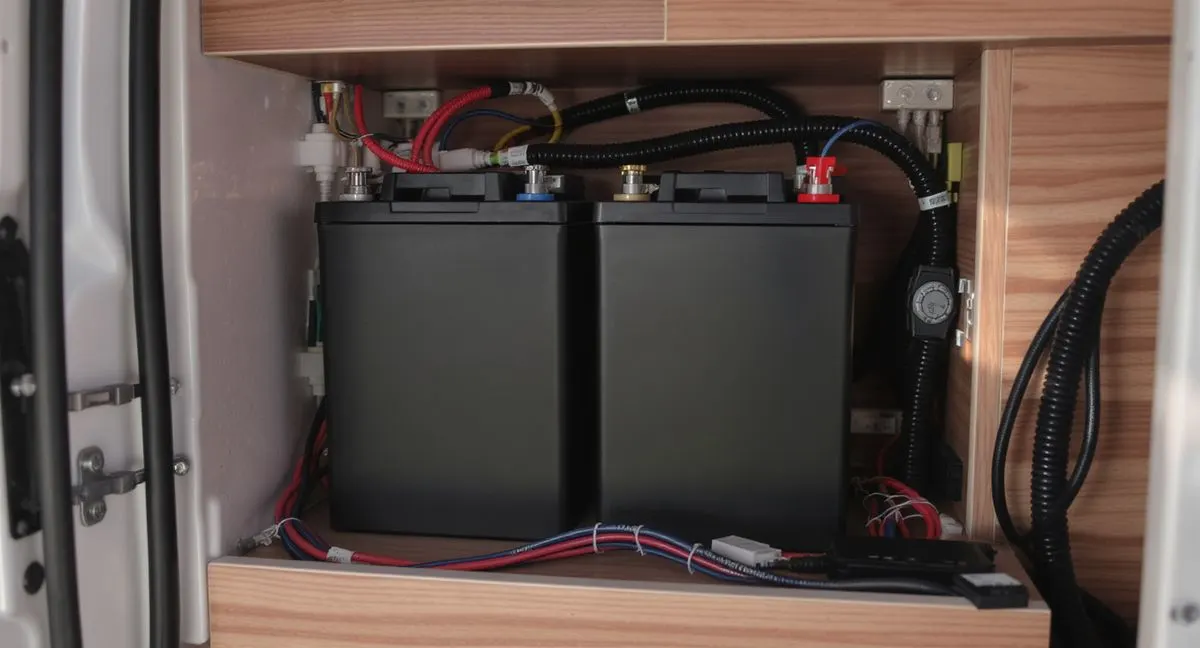
How to Size Your Van Kitchen Power Budget
A worked example of sizing a lithium battery and solar array around a realistic kitchen load — fridge, induction cooktop, water pump, and lights.

Cold-Weather Van Cooking: Gear & Power Strategy
Why induction falls apart below freezing, why butane underperforms in cold, and the winter cooking setup that actually works.
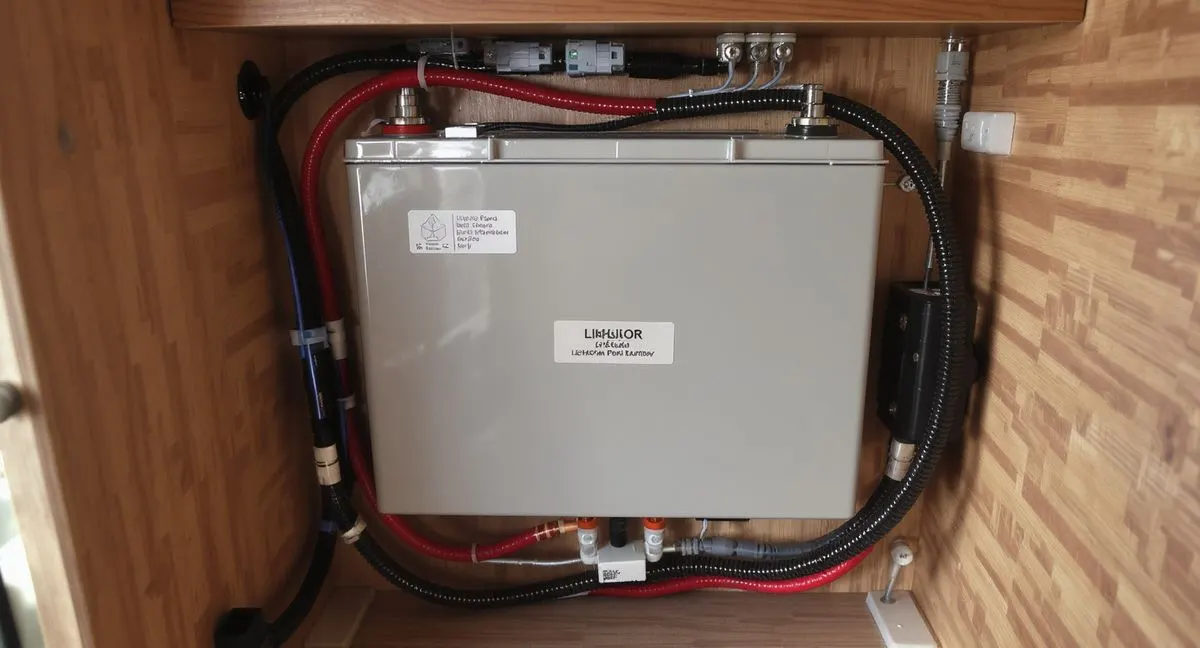
Choosing a Battery Bank for Your Van Kitchen
How to size, spec, and install a lithium battery bank for a van kitchen running fridge, induction, and water pump. Includes 100Ah, 200Ah, and 300Ah build comparisons.