The Complete Van Life Solar Cooking Guide
Can you really cook with the sun from a van? The definitive guide to tube cookers, box ovens, and hybrid solar-electric systems — 4 products compared, with honest notes on what actually works.
Disclosure: As an Amazon Associate I earn from qualifying purchases. Links to Amazon on this page are affiliate links: if you buy through one, VanLifeKitchens.com may earn a commission at no extra cost to you. Read our affiliate disclosure.
The pillar guide for van life solar cooking
Solar cooking is the most misunderstood category in van life gear. It is easy to dismiss as a gimmick, and a cheap box oven can disappoint after two cloudy days, but in reliably sunny places a good solar cooker can take over a real share of the daytime cooking. The truth is nuanced: solar cooking is either the wrong tool or the best tool, and it depends entirely on your climate, your cooking patterns, and your willingness to plan meals hours in advance.
This pillar guide explains how solar cookers actually work, the three technology categories, which climates and builds they are right for, the 2 solar cookers we currently recommend, and the honest limitations that every solar oven marketing page tries to hide.
Why you should actually care about solar cooking in a van
Three reasons van dwellers take solar cooking seriously, beyond the ethos of "free energy from the sun":
1. Zero indoor heat. Cooking inside the van means induction (butane and propane camp stoves are manufacturer-labelled for outdoor use, so they belong outside anyway). Every watt an induction hob draws ends up as heat in the cabin, either in the pot or around it: a 1,800 W hob running flat out releases roughly 6,100 BTU per hour, most of it into the food and the rest into the air, and the steam and hot pan keep warming the cabin after you switch off. On a 105°F Arizona afternoon that is the last thing you want in a closed van before bed. Solar cookers sit outside and add no heat to the living space.
2. Unattended cooking. Solar cookers slow-cook while you do something else. You set it up at 11 a.m., go for a 4-hour hike, come back to a cooked dinner. No other cooking method in van life works while you are 10 miles away. This feature alone justifies a solar cooker for anyone who adventures during cook time.
3. Free energy. A solar cooker turns sunlight straight into heat in the pot. The electric route goes sunlight → panel (typical rigid panels convert roughly 20% of sunlight to electricity) → charge controller → battery → inverter → induction hob, losing a little at every step. As a rough estimate, a solar cooker gets considerably more cooking heat out of each square foot of sunshine than roof panels feeding an induction hob, and it uses none of your battery. That matters for off-grid builds where every watt-hour counts.
The three technology categories
Box ovens (such as the Sun Oven). A rigid box with an insulated black interior, a clear glass or polycarbonate top, and reflective wings that bounce additional sunlight into the chamber. Operating temperature: 250-325°F. Cooking capacity: 6-12L. Best for slow-cooking family meals (stews, roasts, bread). Simplest technology, fewest moving parts, longest track record. We don't currently recommend a rigid box oven: the one we previously covered is no longer reliably available on Amazon. If you want box-oven-style slow cooking, the fabric Sunflair below cooks the same kinds of meals and folds flat.
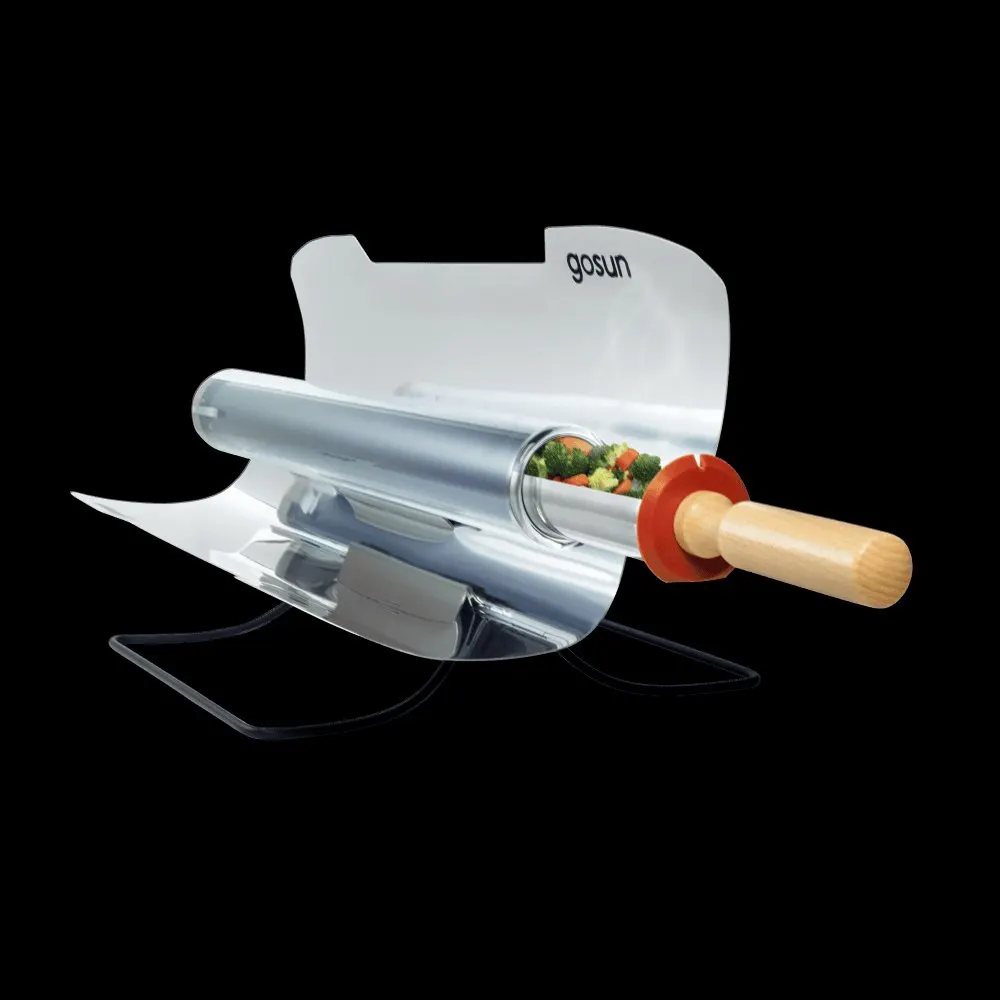
Evacuated tube cookers (such as the GoSun Sport). A vacuum-sealed glass tube cooking chamber with reflective wings that concentrate sunlight onto the glass. Operating temperature: up to 550°F in strong sun for the GoSun Sport (GoSun's rated peak). Cooking capacity: small, because the food goes inside the tube (about 1.2L in the Sport). Faster than box ovens, higher peak temperatures, more compact for storage. The GoSun Sport is GoSun's original tube cooker and our tube-style pick. It has no electric backup, so on cloudy days you cook on your regular stove. GoSun has sold hybrid and compact tube models, but none is in our current lineup.
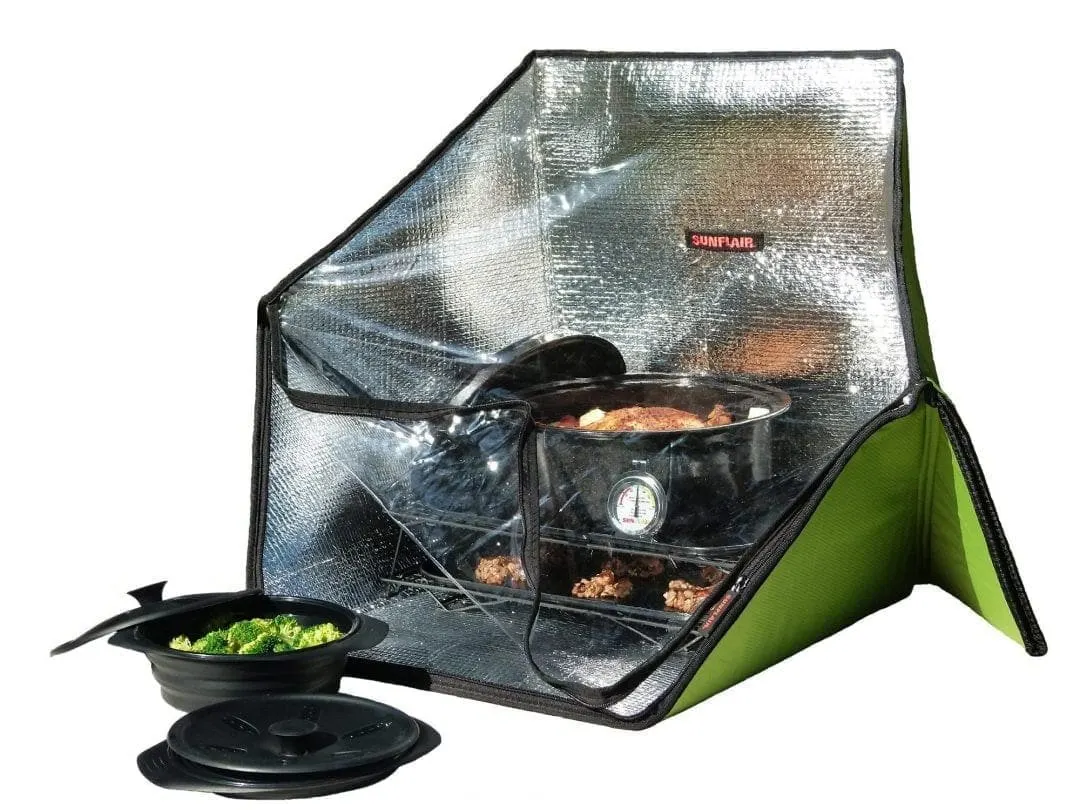
Fabric/flat-pack solar ovens (Sunflair Portable, Haines Solar Cooker). Collapsible fabric or panel ovens that fold flat for storage. Operating temperature: typically around 200-285°F. Cooking capacity: roughly 4-6L. Lightest category, cheapest, simplest. The Sunflair Portable Solar Oven is our fabric-oven pick: it folds to about 2 inches thick (Sunflair), reaches about 285°F, and comes with two cooking pots. If storage space matters more than capacity, Sunflair also makes the Sunflair Mini: an 8 oz oven, about 2 lb as a kit, that folds to 2 x 11 x 13 inches and comes with one collapsible silicone pot. Sunflair doesn't publish the pot's size; by our estimate it's a one-pot cooker for one or two people.
The 2 solar cookers we recommend
- Sunflair Portable Solar Oven — budget-friendly fabric flat-pack that folds to about 2 inches, reaches about 285°F, includes two pots; the slow-cook and mixed-climate pick
- GoSun Sport Solar Cooker — premium; vacuum tube rated up to 550°F, about 1.2L capacity; the summer primary for sunny climates. Check the seller and warranty details on the Amazon listing before you buy
Neither has an electric backup. Every solar cooker stops working in heavy cloud, so keep your stove as the fallback.
Head-to-head comparisons
- Sunflair vs GoSun Sport — fold-flat fabric oven vs vacuum tube cooker
- Sunflair Mini vs Sunflair Deluxe — the same zip-up oven for one or two people, or for a family
The climate question (honest version)
Solar cooking is climate-dependent. Here is a rough breakdown by region for full-time van dwellers. The month counts are general estimates based on typical sunshine and cloud patterns, not measurements, and a given week can be better or worse:
Arizona, New Mexico, Nevada, Utah, Eastern California (American Southwest): solar cooking is viable 10 months per year. Summer is peak season. Winter has enough sun for slow cooking in a fabric or box-style oven.
Colorado, Wyoming, Montana, Idaho (Mountain West): viable 6-8 months per year. Summer is good. Shoulder seasons are inconsistent. Winter is effectively dead for solar cooking; plan on your stove.
California coast (LA, Bay Area, San Diego): viable 9 months per year but often marginal due to marine layer and fog. Box ovens work because they don't need peak sun; tube cookers struggle.
Pacific Northwest (Oregon, Washington): viable 4-5 months per year. Summer only. Wet, cloudy, fog-heavy climate defeats every solar cooker most of the year.
Southeast (Georgia, Alabama, Mississippi, Florida): viable 9 months but often humid and cloudy. Box ovens work well for slow cooks; tube cookers are marginal.
Northeast (New York, Vermont, Maine): viable 4-6 months per year. Summer only. Shorter days and thick cloud cover make it niche.
Mexico (Baja, Sonora): among the sunniest regions on the continent, with tube-cooker weather for most of the year.
If your van life is mostly Pacific Northwest or Northeast, solar cooking is a nice-to-have summer tool, not a primary cooking method. If your van life is Southwest US or Baja Mexico, solar cooking is a serious appliance that can carry 30-50% of your cooking load and should be a day-one purchase.
What actually cooks in a solar oven
Excellent in a solar oven:
- Whole chicken (a small bird fits in a fabric oven like the Sunflair; smaller pieces fit in tube cookers)
- Slow-cooked stews, chili, baked beans
- Rice, quinoa, grains
- Pot roasts and pulled pork
- Simple breads and cornbread
- Hard-boiled eggs in bulk
- Roasted vegetables
Mediocre or hard:
- Fast meals (everything is a 1-3 hour commitment)
- Meals for 4+ people (capacity constraints)
- Baking at high temperature (fabric ovens such as the Sunflair top out around 285°F)
- Anything requiring stirring mid-cook (opening the oven lets out much of the built-up heat and adds cooking time)
Impossible:
- Sautéing or pan-frying
- Deep frying
- Cooking after sundown
- Cooking in rain or heavy overcast
How to integrate solar cooking into a van kitchen workflow
The mistake most van dwellers make is trying to replace their primary cooktop with a solar oven. That's the wrong framing. The correct framing: solar cooking is the background-cook path for meals you plan ahead, and your primary cooktop stays for everything fast and reactive.
A realistic integrated workflow:
Morning (set it and forget it). Put the base for tonight's dinner in the solar cooker — rice cooking slowly while you break camp, a pot of beans soaking-then-simmering, a chicken marinated overnight going in for a 3-hour cook.
Midday (you're hiking or driving). The solar cooker continues cooking. You are not there. You cannot interact with it. That's the point.
Afternoon (back at camp). The main ingredient is done. You pull it out and stage it. The remaining work is assembly — chopping a salad, warming bread, setting out plates.
Evening (finish on the cooktop). Anything that needs fast high-heat finishing — a sear on the protein, a quick green vegetable in a pan, a sauce to deglaze — happens on induction, or on a butane or propane stove set up outdoors. The solar oven has already done the slow 80% of the meal. You just finish it.
As a rough estimate, this workflow takes about 30 minutes of active attention spread over 6 hours of total cook time, where a stovetop version of the same meal might need an hour or more of hands-on time. The solar path buys you time during the day.
Related resources
- Induction vs Butane vs Propane — the primary cooktop decision that pairs with solar
- Van Kitchen Power Budget Guide — how much battery a solar cooker saves you compared with induction
- One-Pot Meals Road Guide — slow-cook recipes that adapt well to solar ovens
The verdict
For van dwellers in sunny climates (American Southwest, Baja, Mexico) who cook daily and want to reduce fuel/battery use: the GoSun Sport is the pick. GoSun rates the vacuum tube up to 550°F in strong sun, so it reaches real roasting temperatures and cooks quickly, though its roughly 1.2L tube suits one or two people. Check the seller and warranty details on the Amazon listing before you buy. There is no electric backup, so cloudy days mean cooking on your stove.
For van dwellers in mixed or less-sunny climates, larger portions, or anyone who wants a summer-only solar tool: the Sunflair Portable is the right choice. Sunflair says the Deluxe kit cooks for 4 to 8, and it folds flat when the weather turns. It tops out around 285°F, so expect slow-cooker-style cook times.
Do not buy: novelty parabolic reflector cookers (too fragile for vans), DIY pizza boxes with foil (they work for single uses but fall apart), or no-name solar cookers with no published specs or warranty (cheap reflective coatings can degrade quickly).
See the Off-Grid Chef Promaster setup for the context of solar cooking in a serious full-time build, and the summer van kitchen survival guide for how solar integrates into hot-climate cooking strategy.
Products covered in this guide
Disclosure: As an Amazon Associate I earn from qualifying purchases. Links to Amazon on this page are affiliate links: if you buy through one, VanLifeKitchens.com may earn a commission at no extra cost to you. Read our affiliate disclosure.

Frequently asked questions
Can you really cook with solar in a van?
Yes, in sunny climates. Tube-style solar cookers reach 300–500°F and cook real meals in 1–3 hours. Box ovens reach 250–300°F for slow cooking. Neither type works in heavy cloud, so keep your stove as the backup.
Is solar cooking worth it for van life?
In the American Southwest, Baja, or Mexico — absolutely. Solar handles 30–50% of cooking load with zero fuel cost and zero cabin heat. In the Pacific Northwest or Northeast, it is a summer-only tool.
More in Buying Guides
Best Coffee Gear for Van Life: Complete Guide
How to brew great coffee in a van: AeroPress, pour-over, moka, French press and real espresso compared, plus grinders, kettles, power and water use, and our 2026 picks.
Best Van Kitchen Knives & Prep Tools: Full Guide
The two-knife van kit, choosing a cutting board, shears, mandolines, sharpening on the road, safe storage and low-water hygiene, plus our 2026 knife and prep tool picks.
Summer Van Kitchen Survival Guide: Cooking in 100°F Heat
How to cook real meals in a van when the interior hits 110°F — solar cooking, outdoor prep zones, heat-shedding gear, and the workflow changes that keep the cabin livable in peak summer.