ARB Elements Weatherproof 63 Quart Fridge Freezer (10810602)

- Model
- 10810602 (US version of 10810601)
- Capacity
- 60 L (63 qt), single zone (manual)
- Dimensions
- 17.3 H x 19.3 W x 32.3 D in (manual)
- Weight
- 70 lb (32 kg) (manual)
- Power Draw
- 90 kWh/year, about 247 Wh/day; conditions not stated (manual)
- Rated Current
- 6.8 A at 12 V; 1.0 A at 120 V AC (manual)
- Cooling Range
- +50°F to 0°F (manual)
- Ventilation
- 50 mm on all sides (manual)
- Battery Protection
- 12 V off/on: 10.1/11.1, 11.4/12.2, 11.8/12.6 V (manual)
- Warranty
- 3 years (ARB Australia page); confirm US term
Overview: who is the ARB Elements for?
ARB is an Australian off-road equipment maker, and the Elements is its toughest fridge: a 60-liter (63-quart) single-zone compressor fridge-freezer with a body and lid of 304-grade stainless steel, a weatherproof control panel, cast stainless hinges, a gas strut that holds the lid at any angle, and a 4-digit PIN lock. It's designed to be bolted down in exposed places, like a pickup bed, a rear tailgate area or an open trailer, where a plastic-cased fridge would take a beating.
This review is for van and truck-camper owners who want a large, secure fridge mounted where people can reach it: on a rear slide under a lifted tailgate, in a pass-through area, or on a truck bed beside the camper. For a fridge that lives inside a cabinet, there are lighter and cheaper options, covered below.
Choose this if:
- You want a large single-zone fridge that's built to be permanently mounted and to cope with dust and weather.
- Security matters: a PIN lock, a padlock point and tamperproof bolts.
- You want a lid that stays open hands-free while you dig for food.
Skip this if:
- Weight matters. ARB lists 70 pounds empty, the heaviest single-zone fridge we cover.
- You need a separate freezer. This is one zone. The ICECO VL60 Dual Zone is about the same size with two.
- You want app control. ARB's manual describes a wireless display, not a phone app.
What the Amazon link sells: "ARB Element 63Qts Fridge/Freezer 10810602 (ARB Elements Weatherproof 63 Quart Fridge)" (ASIN B073X696GN, model and part number 10810602). ARB's Australian product page covers the same fridge as part 10810601. The US part 10810602 is the North American version, which the ARB manual covers with its 120 V AC and R1234yf refrigerant specification.
A note on method: VanLifeKitchens researches products rather than testing them. Figures below come from ARB's Elements user manual, ARB's Australian product page and the Amazon listing, all listed under Sources. Where ARB's documents conflict or leave something out, we say so. See how we research.
Bottom line up front: the Elements is the tough-environment fridge in our lineup. You pay in weight, a premium price and a published energy figure you have to read carefully. You get stainless construction, a lock and a mounting system built for permanent installation.
Specifications and sources
| Spec | Figure | Source |
|---|---|---|
| Capacity | 60 L (63 qt), single zone | ARB manual |
| External size, H x W x D | 435 x 490 x 820 mm (17.3 x 19.3 x 32.3 in) | ARB manual |
| Weight, empty | 32 kg (70 lb) | ARB manual |
| Cooling range | +10°C to -18°C (+50°F to 0°F) | ARB manual |
| Energy use | 90 kWh per year; class N, T | ARB manual |
| Rated current | 6.8 A at 12 V; 1.0 A at 120 V AC | ARB manual |
| Battery cutoff, 12 V | 10.1 / 11.4 / 11.8 V | ARB manual |
| Noise | 50 dBA | ARB manual |
| Clearance | 50 mm on all sides | ARB manual |
ARB doesn't name the compressor in the Elements manual or on its Australian product page, so we don't either.
Size, clearance and mounting
External size. ARB's manual lists 435 mm tall, 490 mm wide and 820 mm deep (17.3 x 19.3 x 32.3 inches). ARB's Australian page gives 440 mm for the height, so allow 17.5 inches.
Interior. The main compartment is 332 mm tall, 355 mm wide and 477 mm long (13.1 x 14.0 x 18.8 inches). Above the compressor step is a shallower secondary section, 144 mm tall, which ARB's page calls the fruit and dairy area. The Amazon listing says ARB raised the evaporator so it now surrounds both compartments, so the secondary section is cooled rather than a warm dairy shelf. A reversible basket with a removable divider is included.
Clearance. The manual says: "A minimum clearance of 50 mm must be maintained on all sides of the fridge." That means about 36.3 x 23.2 inches of floor space, plus room above for the lid to open. On a slide, the 50 mm still applies at the compressor end when the slide is closed.
Permanent mounting. This is where the Elements differs from most portable fridges. The base has four threaded inserts. ARB's manual describes drilling four 6.5 mm holes, plus an optional 13 mm hole under the drain, and bolting through the floor with M6 bolts, rubber feet in place, to no more than 3.5 Nm (2.5 lb-ft). If you need longer bolts, ARB specifies grade 8.8 M6 x 1.0 socket-head screws, no longer than the mounting-surface thickness plus 8 mm, so you don't hit the electronics. For removable mounting, ARB recommends its tie-down kit with a quick release. Either way the fridge "must be attached to secure anchorage points," per the manual.
Angle. ARB says it can withstand a sideways angle of 30°, and asks you to avoid turning or storing it on its side.
Lid. A gas strut holds the lid in any position. The listing describes the hinges as heavy-duty, tamperproof cast stainless steel and says the lid isn't removable, so plan the hinge side into your layout. Allow full lid height above the fridge.
How weatherproof is it?
ARB's page calls the Elements "weatherproof", and the listing details why: stainless body and lid, a weatherproof control panel, ASA corner protectors and a remote-monitor transmitter recessed at the rear to keep it out of the weather.
ARB doesn't publish an IP number, and its manual sets limits worth knowing:
- Do not use the fridge if you suspect the electrical system has been exposed to water, or if it has been immersed.
- Do not clean it under running water or with a pressure washer.
- For efficiency, place it in a well-ventilated area protected from direct sunlight.
- Position the 12/24 V power socket high in the vehicle so it doesn't get wet.
Read that as: rain and dust on the cabinet are expected, but don't hose it, park it in standing water or expose the wiring. A stainless box in full sun also gets hot, which drives up the energy use below.
Power consumption
Published energy figure. ARB's manual lists annual energy consumption of 90 kWh, alongside an energy efficiency index of A+ and climate class N, T. That's an energy-label style figure. The manual doesn't state the ambient temperature or setpoint behind it. Averaged over a year, 90 kWh is about 247 Wh per day, or about 19 Ah per day at 12.8 V.
ARB's Australian page adds a second number: "Power Consumption 0.68 kWh", with no time period, alongside the 6.8 A rated current "at 20°C". If that is per day, it's about 53 Ah at 12.8 V, nearly three times the manual's figure. We can't reconcile the two from ARB's documents, so we plan with our own estimates below, which fall between them.
Rated current is not daily use. The 6.8 A at 12 V is for fuse and wire sizing. ARB recommends a dedicated circuit fused at 15 A, connected directly to the supply, using at least 6 mm automotive cable (4.5 mm², AWG 11) for runs up to 6 m (20 feet). It recommends an auxiliary battery rather than the starting battery.
| Conditions | Wh/day | Ah/day at 12.8 V | Source |
|---|---|---|---|
| ARB manual, 90 kWh/year averaged | ~247 | ~19 | ARB manual |
| Shaded, mild, fridge at 37°F | ~250–320 | ~20–25 | Our estimate |
| Hot day, fridge at 37°F, some sun | ~450–550 | ~35–43 | Our estimate |
| Hot day, freezer at 0°F | ~650–800 | ~51–63 | Our estimate |
Assumptions for our rows: a 12.8 V lithium bank, a few lid openings a day, ARB's 50 mm clearance respected, and food loaded cold. The hot rows assume an ambient around 95°F, and some direct sun on the stainless cabinet, which ARB advises avoiding. Daily consumption on any compressor fridge roughly scales with the gap between ambient and setpoint. ARB also notes the fridge can cool to at most 50°C below ambient, and above 32°C (90°F) ambient it can't reach its minimum temperature.
Low-voltage cutoff
ARB's battery monitor has three settings. From the manual's Table 1, at 12 V DC:
- Low: switch off at 10.1 V, restart at 11.1 V
- Medium: switch off at 11.4 V, restart at 12.2 V
- High: switch off at 11.8 V, restart at 12.6 V
At 24 V the levels are 21.5/23.0, 24.1/25.3 and 24.6/26.2 V. ARB recommends HIGH or MEDIUM on a starting battery and LOW on an auxiliary battery. While the monitor has the fridge off, the power LED is off and the check LED flashes red.
Battery sizing
- 100 Ah lithium + 200 W solar: workable as a fridge in mild weather; tight in summer.
- 200 Ah lithium + 300–400 W solar: our realistic recommendation for full-time use or freezer duty.
Use the fridge battery calculator with your own climate, and see best battery bank for a van kitchen for the wider system.
Features and controls
- Electronic lock. A 4-digit PIN locks the lid and the control panel, so nobody can change the temperature or switch it off. The fridge won't lock with the lid open.
- Padlock point. For a mechanical lock as well.
- Display. Dimmable, with a DC supply-voltage readout, per the listing.
- Wireless display. The manual describes ARB's wireless fridge display, sold separately, via a transmitter socket on the fridge. ARB's Australian page lists a wireless remote transmitter as included. Check what's in your box.
- Power. 12/24 V DC and built-in AC. On AC, ARB says to install a residual-current breaker in the circuit; on a generator, use one with automatic voltage regulation and a pure sine wave output.
- LED cabinet light, front drain plug, reversible basket with divider.
Limitations
- Heavy: 70 pounds empty, before food.
- Energy figures conflict: ARB's manual and Australian page don't agree, and neither states test conditions.
- No IP number: "weatherproof" with stated limits, not a submersible box.
- Single zone: fridge or freezer, not both.
- Louder than some: ARB lists 50 dBA. Mount it away from the bed in a small van.
- Warranty: ARB's Australian page lists 3 years. Confirm the US term with ARB before you buy.
How it compares with fridges we cover
- ICECO VL60 Dual Zone: about the same footprint, a steel case and two zones for considerably less money, but no lock and not built as an exposed-mount fridge.
- Dometic CFX5 55IM: a lighter single-zone box with an ice maker and an app, rated by Dometic at stated hot conditions. Better inside a van; no stainless shell or PIN lock.
- Dometic CFX5 75DZ: 75 liters in two zones, if you need fridge and freezer together and the fridge lives indoors.
- ICECO VL45 ProS: the mid-range steel-cased single zone in a smaller size.
If you're unsure about size, the what size 12V fridge guide helps. For hot-weather planning with any fridge, see the summer van kitchen guide and the 12V fridges complete guide.
Value
The Elements is a premium fridge. It costs considerably more than steel-cased mid-range fridges of the same size, and most of the difference goes into the stainless shell, the lock, the hinges and the mounting system rather than cooling performance. If your fridge lives inside a van cabinet, that money does more as battery and solar. If it lives on a truck bed or a rear slide where it takes weather and might tempt a thief, the extra cost buys something real. Check the current price on Amazon.
Final verdict
The ARB Elements 63 is the fridge we'd point to for exposed, permanent mounting, where a stainless, lockable, bolt-down box matters more than weight or price. Respect ARB's 50 mm clearance, keep the wiring and power socket dry, run a dedicated 15 A circuit from an auxiliary battery, and size the battery around our hot-day estimate rather than the 90 kWh label figure. For a fridge inside the van, a lighter mid-range box is the better buy.
FAQ
How much power does the ARB Elements use?
ARB's manual lists 90 kWh a year, about 247 Wh or 19 Ah a day at 12.8 V, without stating test conditions. ARB's Australian page lists 0.68 kWh with no time period. Our estimate is about 20 to 25 Ah a day in mild shade and 35 to 43 Ah on a hot day as a fridge.
How much clearance does it need?
At least 50 mm (about 2 inches) on all sides, per ARB's manual. With the 32.3 x 19.3 inch body, plan on about 36.3 x 23.2 inches of floor space.
What are the battery protection settings?
At 12 V: Low switches off at 10.1 V and restarts at 11.1 V, Medium at 11.4 and 12.2 V, and High at 11.8 and 12.6 V. ARB recommends High or Medium on a starting battery and Low on an auxiliary battery.
Is the ARB Elements waterproof?
ARB calls it weatherproof and doesn't publish an IP number. Its manual says not to clean it under running water or with a pressure washer, and not to use it if the electrical system may have been exposed to water.
What compressor does the Elements use?
ARB doesn't name the compressor in the Elements manual or on its Australian product page.
Can the Elements be bolted down permanently?
Yes. ARB's manual describes bolting through the four threaded inserts in the base with M6 bolts, rubber feet in place, at no more than 3.5 Nm.
Sources and verification
- ARB Elements Weatherproof Fridge Freezer 60L product page (Australia), https://www.arb.com.au/product/10810601-arb-elements-weatherproof-fridge-freezer-60l-with-stainless-steel-finish: 60 L, external and internal dimensions, 31.8 kg, cooling range, 6.8 A at 20°C, "Power Consumption 0.68 kWh", weatherproof description, 304 stainless housing, lock and padlock recess, wireless remote transmitter, 3-year warranty, link to the user manual (checked 2026-10-13).
- ARB Elements user manual, https://axulsgekbfur.objectstorage.ap-melbourne-1.oci.customer-oci.com/p/Vh1MtjHd_4eEYB8HArLM-3HcEm7NedU6vbnzzghNWSscghHVo8J5_DgGw2LFRKNY/n/axulsgekbfur/b/arb-epc-manual-bucket/o/uploads/ARB%20Supporting%20Documents/ARB_Elements_UserManual.pdf: technical data (90 kWh/annum, class N/T, 6.8 A, 32 kg, 435 x 490 x 820 mm, 50 dBA, R1234yf for USA), 50 mm clearance, 30° angle, permanent mounting procedure, 15 A circuit and cable sizes, battery monitor table, electronic lock, AC and generator guidance, water and sunlight cautions, 50°C-below-ambient note (checked 2026-10-13).
- Amazon listing, ASIN B073X696GN: title, part number 10810602, stainless construction, weatherproof control panel, recessed transmitter, non-removable lid with cast stainless hinges, gas strut, raised evaporator, PIN lock, voltage readout, availability (checked 2026-10-13).
Compare with similar products
See how this stacks up against the other 12v fridges we've reviewed.
Related Reviews
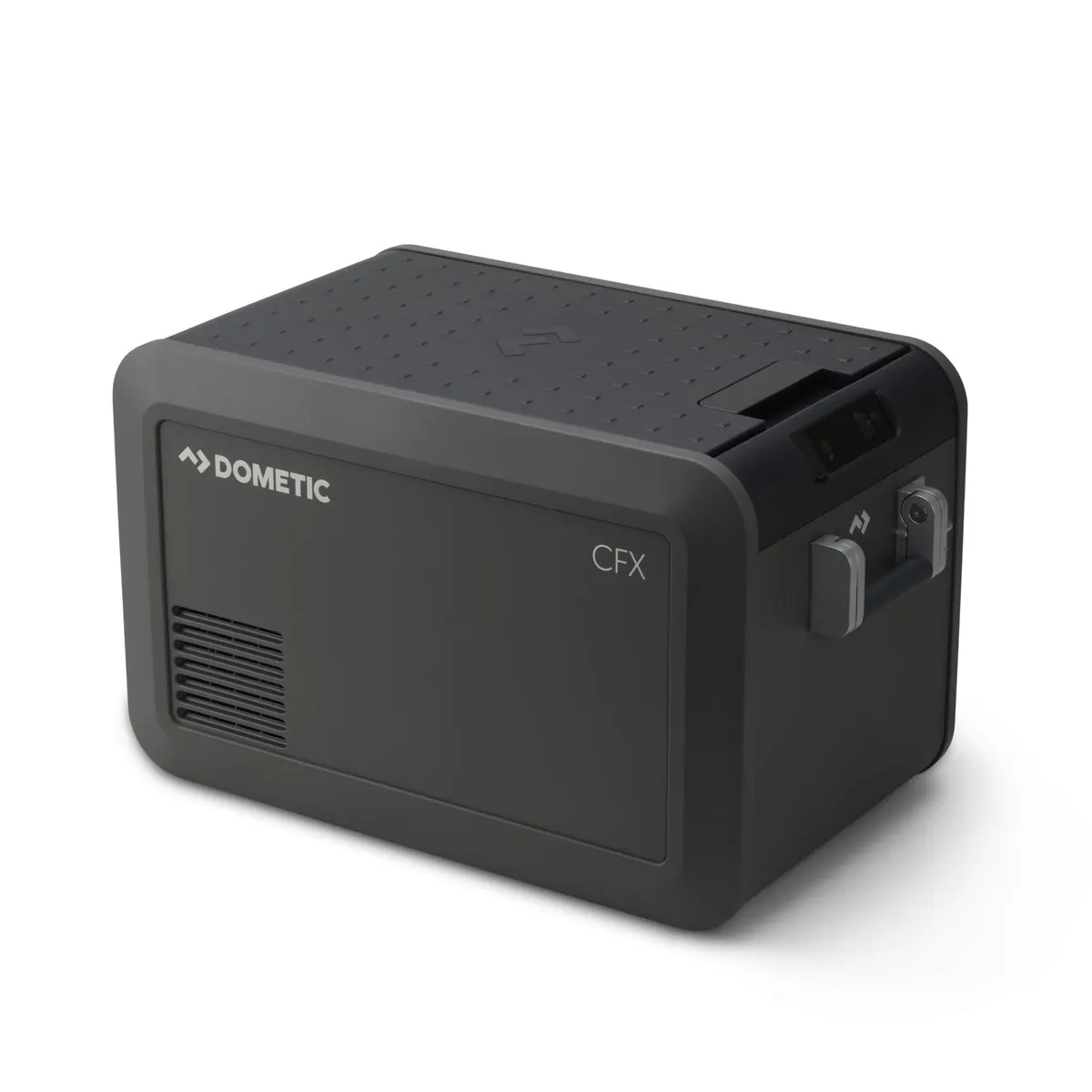
For: Quiet 35L with app control
Dometic CFX5 35 Electric Cooler
The CFX3 35's successor adds vacuum insulated panels, a quieter VMSO 3.5 compressor, and a weatherproof color display. The premium 35L pick, if the price fits.
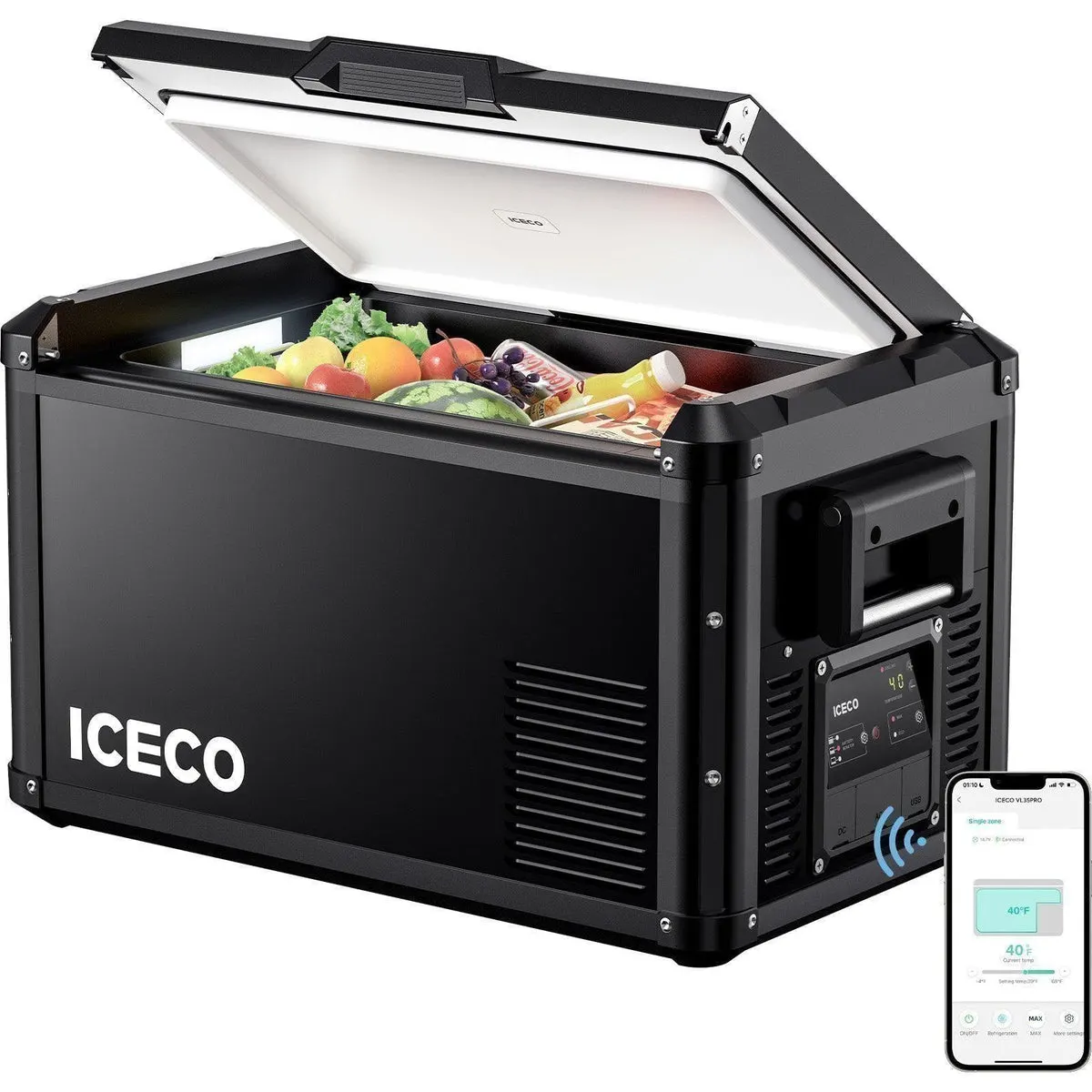
For: Steel-cased 35L single zone
Iceco VL35 ProS 12V Fridge Freezer
The value 35L option: a Secop compressor, solid insulation and simple controls for considerably less than the Dometic CFX5 35, without an app.
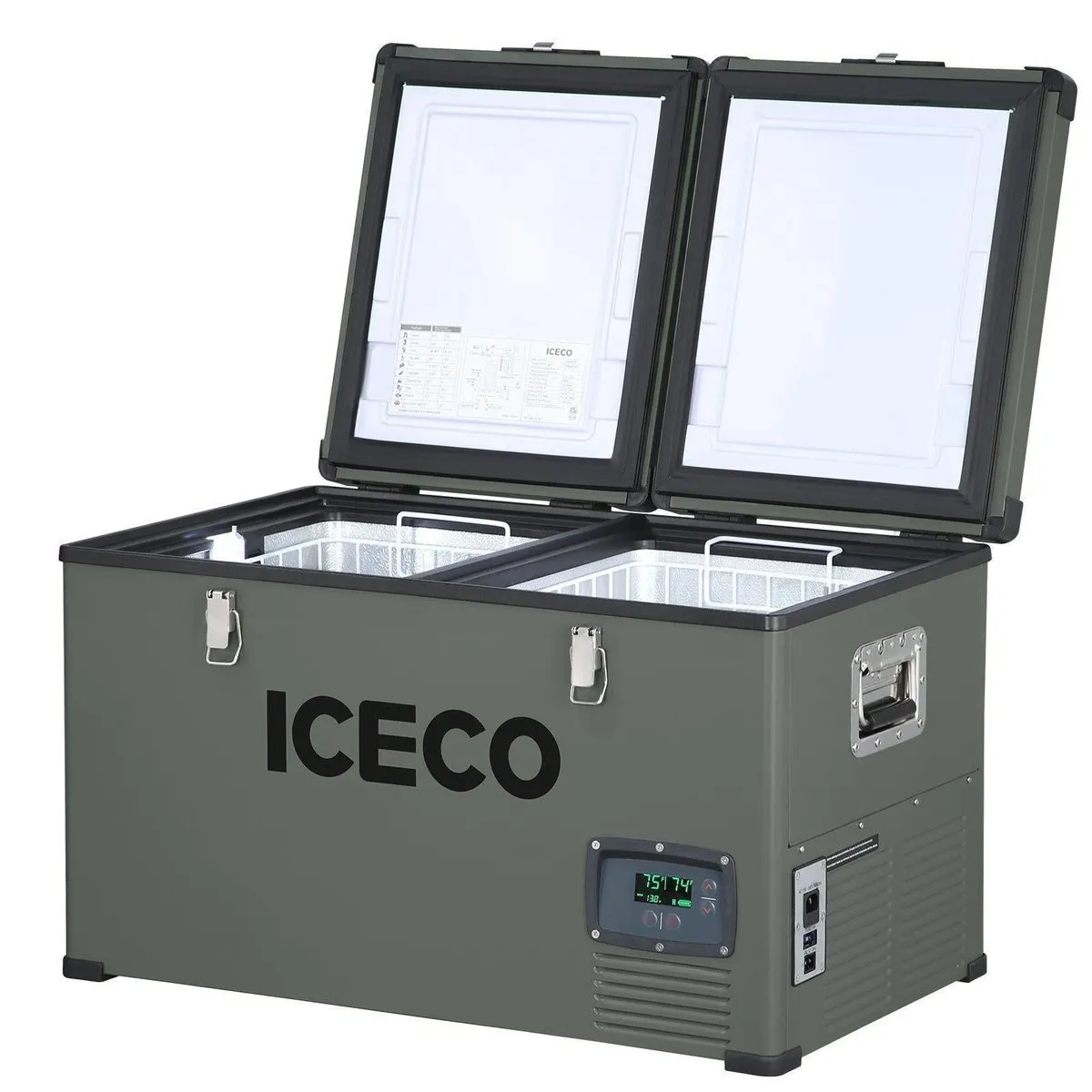
For: Full-time dual-zone cooling
ICECO VL60 Dual Zone 60L 12V Fridge Freezer
True dual zone at a mid-range price: 60L, two lids and setpoints, Secop compressor and a steel cabinet. Heavy and power-hungry, but strong value for families.