YETI Tundra 45 Hard Cooler, Desert Tan vs Iceco VL35 ProS 12V Fridge Freezer
A passive cooler or a 12V compressor fridge? Two boxes with nearly the same footprint, compared on power, ice, space and trip length.
Disclosure: As an Amazon Associate I earn from qualifying purchases. Links to Amazon on this page are affiliate links: if you buy through one, VanLifeKitchens.com may earn a commission at no extra cost to you. Read our affiliate disclosure.
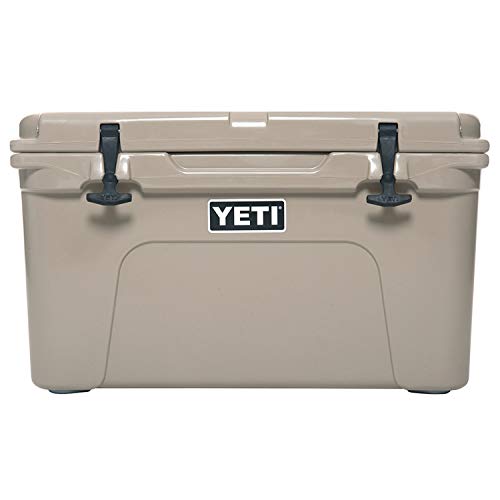
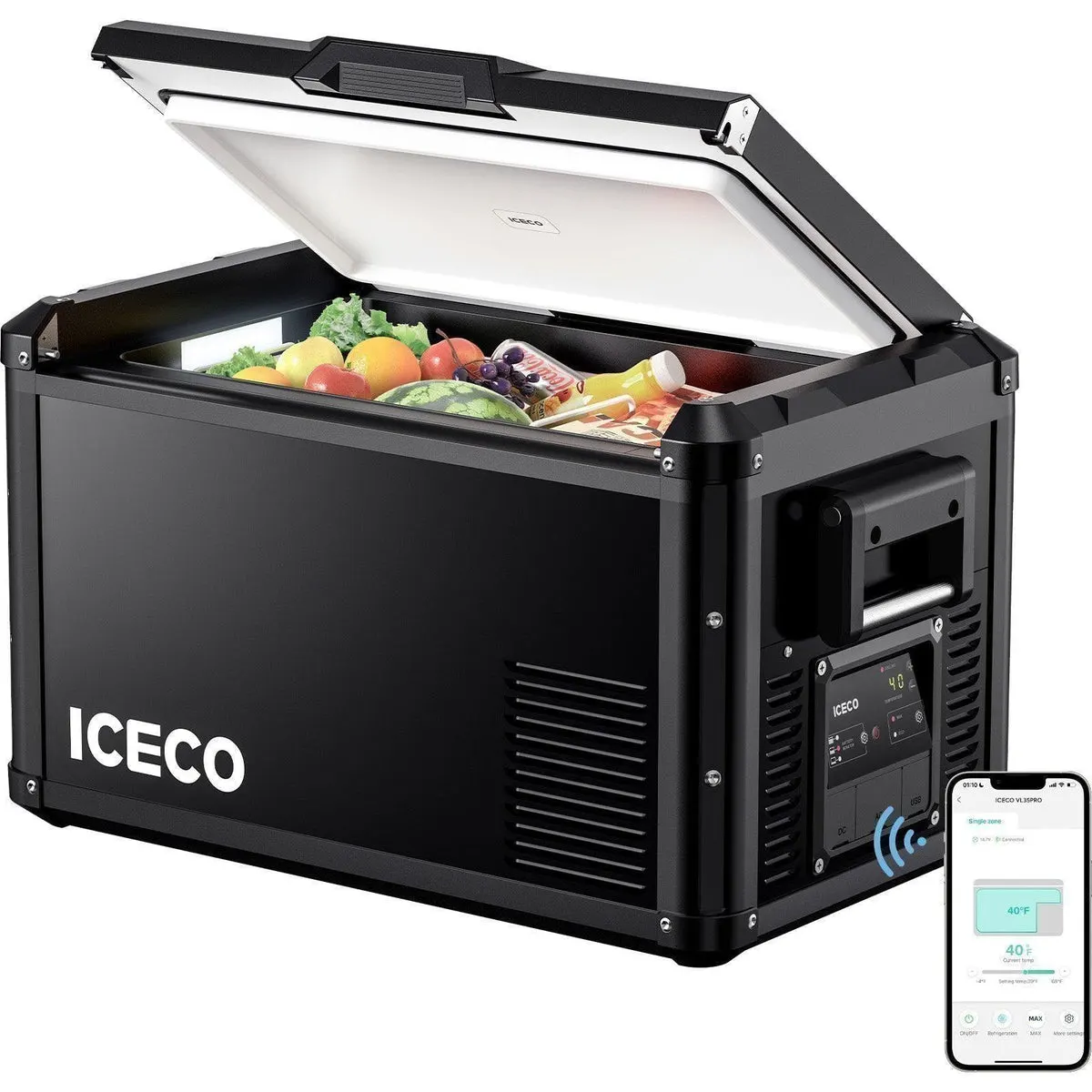
We recommend the Iceco VL35 ProS 12V Fridge Freezer
“For van travel longer than a few days with a house battery and charging, the ICECO VL35 ProS wins: all 37 quarts hold food, it holds a set temperature from 0°F to 50°F, and there's no ice to buy. ICECO rates it at 0.430 kWh per 24 hours in a lab test, about 36 Ah a day at 12 V. For weekend trips, car camping or a build with no house battery, the YETI Tundra 45 is the simpler and much less expensive choice, as long as you plan around ice runs and the 2:1 ice ratio.”
Read the full Iceco VL35 ProS 12V Fridge Freezer reviewSpecifications
| Spec | YETI Tundra 45 Hard Cooler, Desert Tan | Iceco VL35 ProS 12V Fridge Freezer |
|---|---|---|
| Best for | Bear country weekend trips | Steel-cased 35L single zone |
| Model | Tundra 45, part 10045010000 (Desert Tan) | — |
| Exterior | 25.6 x 15.9 x 15.5 in (YETI) | — |
| Interior | 18.3 x 9.4 x 10.7 in (YETI) | — |
| Weight | 24.6 lb empty (YETI; Amazon lists 23 lb) | 48.7 lbs |
| Capacity | 54 cans only or 37 lb ice only; 26 cans at 2:1 ice (Amazon) | 35L / 50 cans |
| Insulation | Up to 3 in pressure-injected polyurethane (YETI) | — |
| Bear Rating | IGBC approved with extra-long shank Master Lock padlocks (YETI) | — |
| Warranty | 5 years (YETI) | 5 yr compressor / 1 yr parts |
| Dimensions | — | 28.1 x 15.9 x 15.7 in |
| Power Source | — | 12/24V DC + 120V AC |
| Power Draw | — | 0.430 kWh/24h lab rating (~36 Ah/day) |
| Compressor | — | Secop |
| Ventilation | — | Over 5 cm at the sides, 10 cm at the front air outlet (ICECO manual) |
YETI Tundra 45 Hard Cooler, Desert Tan
- IGBC bear-resistant approval when locked with padlocks (YETI)
- Compact 25.6 x 15.9 in footprint, no ventilation gap needed
- Rubber T-latches, two-pin hinge, tie-down slots, drain
- 5-year warranty; one dry goods basket included
- No published ice-retention days figure
- Heavier and smaller inside than the RTIC 52 Ultra-Light
- Premium price; padlocks for bear use not included
Iceco VL35 ProS 12V Fridge Freezer
- Secop compressor, 5-year compressor warranty
- Rated 0.430 kWh/24h (~36 Ah/day)
- Steel-cased body; basket and drain plug included
- Simple digital controls
- No app or Wi-Fi
- Heavy for its size at 48.7 lb
The short answer
If you travel in a van for more than a few days at a time and have, or plan to build, a house battery with solar or alternator charging, the ICECO VL35 ProS 12V fridge is the better choice. Its whole 35-liter (37-quart) interior holds food instead of ice, it keeps a set temperature anywhere from 0°F to 50°F, it can run as a freezer, and you never shop for ice or drain meltwater. ICECO rates it at 0.430 kWh per 24 hours, about 36 amp-hours a day at 12 V, in a lab test.
If you camp for weekends, don't have a house battery, or travel in a car, the YETI Tundra 45 cooler is the better choice. It needs no power at all, costs considerably less than a fridge plus the battery to run it, weighs about half as much empty, and takes slightly less floor space. The catch is ice: you buy it every few days, two-thirds of the box is ice if you follow the recommended 2:1 ratio, and the food space shrinks accordingly.
For full detail, read our YETI Tundra 45 review and ICECO VL35 ProS review. This comparison uses the Tundra 45 because its footprint is closest to the VL35's. The same reasoning applies to the RTIC 52 QT Ultra-Light and Engel 35.
Specs side by side
| Spec | YETI Tundra 45 | ICECO VL35 ProS |
|---|---|---|
| Exterior (in) | 25.6 x 15.9 x 15.5 | 28.1 x 15.9 x 15.7 |
| Empty weight | 24.6 lb | 48.7 lb |
| Food space | About a third, at 2:1 ice | 35 L (37 qt), all usable |
| Temperature | Depends on ice | 0°F to 50°F set |
| Power | None | 0.430 kWh/24 h (lab) |
Sources: YETI's Tundra 45 page, and ICECO's VL35/45/60 ProS manual as cited in our VL35 review. The 2:1 ratio is from the Tundra 45's Amazon listing.
How cold, and how reliably
A compressor fridge holds a setpoint. ICECO lists a range of 0°F to 50°F for the VL35 ProS, so you can run it as a fridge at about 37°F or as a freezer near 0°F. Food stays at the same temperature on day 10 as on day one, as long as it has power.
A cooler's temperature depends on how much ice is left and how often it's opened. It starts near freezing and warms as the ice melts. It can't freeze food, and frozen food you put in will thaw over a day or two. Dry ice can keep things frozen, but it gives off carbon dioxide gas, which is a hazard in a closed van or car; don't carry it in a closed vehicle or sleep with it inside.
For food safety, the line that matters is 40°F. Iowa State University Extension's camping food safety guidance says raw meat, dairy, eggs, leafy greens and cut melon must stay at 40°F or below. With a cooler, a thermometer such as the AcuRite 00986M tells you when the ice has lost the battle. It's a useful check on a fridge too.
Edge: ICECO VL35, clearly.
Power: what the fridge needs and the cooler doesn't
The cooler needs nothing. That's its biggest advantage.
The fridge needs a 12 V supply all the time it's cooling. ICECO's manual lists 0.430 kWh per 24 hours as a laboratory figure without stating the ambient temperature. At 12 V nominal, that's about 36 Ah a day, an average of roughly 1.5 amps. Our VL35 review estimates around 28 Ah a day in cool weather and around 54 Ah a day in a hot van at 95°F or more; those are our estimates, not ICECO figures. Daily use rises with cabin heat, sun on the lid, a cramped bay and frequent opening.
What that means in practice:
- A starting battery alone isn't enough. Running a fridge from the vehicle's starting battery risks a no-start. ICECO's battery protection has a High setting (cut-off at 11.1 V on 12 V) for that case, but a house battery is the real answer.
- A 100 Ah lithium house bank with 200 W of solar is comfortable for three-season use in most climates, per our VL35 review. A portable power station can do the job for shorter trips if its capacity covers several days of the fridge's draw plus a margin.
- Charging matters as much as capacity. Solar, a DC-DC charger from the alternator or shore power has to replace what the fridge uses each day.
Battery and charging installs should follow the manufacturers' instructions, and use a qualified technician where codes or your insurer require one. Check your own numbers in the fridge battery calculator and our van kitchen power budget guide.
Edge: YETI Tundra 45, for needing no power at all.
Ice logistics: the cooler's running cost
Ice is where a cooler costs you, in time, space and money.
- Ice runs. You'll restock every few days depending on heat and how often you open it. On remote trips, that sets how far you can go between towns.
- Space. YETI says the Tundra 45 fits 54 cans with no ice, and the Amazon listing says 26 cans at the recommended 2:1 ice-to-contents ratio. That's roughly half the cans. The VL35 gives all 37 quarts to food.
- Meltwater. You drain it outside, keep food sealed and above it in the basket, and throw out anything that sat in water from a leaking package.
- Prep. Pre-chill the cooler, pre-chill or freeze the food, use block ice or frozen bottles. RTIC's published cooling tips, which apply to any hard cooler, suggest prechilling for up to a full day.
A fridge has none of that. Its trade-off is upfront cost and the power system.
Edge: ICECO VL35, clearly.
Space and fit in the van
The footprints are close. YETI lists the Tundra 45 at 25.6 by 15.9 by 15.5 inches. ICECO lists the VL35 at 28.1 by 15.9 by 15.7 inches. The fridge also needs ventilation clearance: ICECO's manual asks for more than 5 cm (about 2 inches) at each side and 10 cm (about 4 inches) at the front air outlet, so plan around 32 by 20 inches of floor. The cooler can sit tight against a wall.
Both open from the top, so both need height above the lid. The VL35's lid opens from either side or lifts off, per ICECO's manual. The Tundra's lid hinges along one long side.
Both need securing. The Tundra has tie-down slots; ICECO lists a tie-down kit and slide mount as optional accessories. See the chest vs upright fridge guide for access in a tight build.
Weight cuts both ways. The VL35 weighs 48.7 pounds empty, the Tundra 24.6. But the fridge's weight stays the same, while the cooler's goes up with ice: about 62 pounds with a full ice load by our arithmetic from YETI's figures. Packed for a trip, they end up in a similar range.
Edge: YETI Tundra 45, narrowly, for needing no ventilation gap.
Trip length and travel style
Weekends and one-to-three-night trips. A cooler handles these well with good packing. Our weekend car camping kitchen checklist makes the same point: for one or two nights in mild weather, a good cooler is usually enough.
Four to seven days. Doable with a cooler in mild weather if you can restock ice, but it starts to wear thin in summer heat. A fridge starts to pay off in convenience.
Full-time or multi-week travel. A fridge, almost always. Ice every few days for months adds up in cost and time, and the reduced food space means more shopping trips.
Hot climates. Both work harder. The cooler loses ice faster; the fridge draws more power. A fridge with enough battery and solar copes better. Our summer van kitchen guide covers both.
Camping in bear country. The Tundra is IGBC-approved when locked with extra-long shank Master Lock padlocks, per YETI. The fridge has no such certification. Check local rules either way.
Reliability and failure modes
A cooler has very little to fail: latches, a gasket, a drain plug. YETI warranties the Tundra for 5 years.
A fridge has a compressor, a control board, wiring and a low-voltage cutoff. ICECO backs the VL35's Secop compressor for 5 years and other parts for 1 year, per its manual. The common failure in practice is power, not the fridge: a flat battery or a cutoff set too high stops the cooling. Many fridge owners keep a small cooler as a backup.
Edge: YETI Tundra 45, for simplicity.
Value: cost of ownership in words
The cooler costs considerably less upfront. A fridge costs more on its own, and much more if you also need to add a house battery, solar or a DC-DC charger to run it. If your van already has a house electrical system, the fridge's extra cost is mostly the fridge.
The cooler's running cost is ice, every few days, for every trip. For occasional weekend trips that's small. For frequent or long trips it builds up, and over enough nights the fridge's running cost, effectively zero once the power system exists, wins back part of its upfront difference. The exact break-even depends on your ice prices, climate and how often you travel, so we don't give one. Check current prices with the "Check price on Amazon" buttons on each review.
Which one should you buy?
Buy the YETI Tundra 45 (or another hard cooler) if:
- You camp mainly on weekends or trips of a few nights.
- You don't have a house battery and don't want to build one yet.
- You travel in a car or SUV.
- You need a bear-resistant certified container.
Buy the ICECO VL35 ProS if:
- You travel for a week or more at a time, or full-time.
- You have, or will build, a house battery with solar or alternator charging.
- You want to freeze food, or keep a steady 37°F without checking ice.
- You want the full interior for food rather than ice.
FAQ
Is a 12V fridge worth it over a cooler?
For trips longer than a few days, or for full-time van life, usually yes, as long as you have a house battery and charging. For weekend trips without a house battery, a good cooler is simpler and costs considerably less.
How much power does the ICECO VL35 use compared with a cooler?
The cooler uses none. ICECO's manual rates the VL35 ProS at 0.430 kWh per 24 hours in a lab test, about 36 Ah per day at 12 V. Hot weather and frequent opening push it higher.
How much food fits in each?
The VL35 ProS gives you its full 35 liters (37 quarts) for food. The Tundra 45 holds 54 cans with no ice, but the Amazon listing says 26 cans when you pack at the recommended 2:1 ice ratio.
Can I run a 12V fridge off my car's starting battery?
It risks a no-start. ICECO's battery protection High setting cuts out at 11.1 V on 12 V to protect a starting battery, but for anything beyond short drives, use a house battery or a portable power station.
Can a cooler keep food frozen?
Not for long with regular ice. Dry ice can, but it gives off carbon dioxide gas, so don't carry it in a closed vehicle or sleep with it inside. A compressor fridge like the VL35 can run as a freezer down to 0°F.
Do I need both?
Many van owners keep a small cooler or soft cooler, such as the YETI Hopper M30, alongside a fridge for drinks, overflow and as a backup if the power runs out.
Sources and verification
- YETI, Tundra 45 Hard Cooler product page (10045010000): dimensions, 24.60 lb, 54 cans or 37 lb ice, IGBC approval with padlocks, dry ice, 5-year warranty. https://www.yeti.com/coolers/hard-coolers/tundra/10045010000.html (checked 2026-10-11)
- Amazon listing for ASIN B001COUOYK (YETI Tundra 45, Desert Tan): 2:1 ice ratio, 26 cans (checked 2026-10-11)
- RTIC, Hard Cooler Cooling Tips: prechilling and 2:1 packing. https://rticoutdoors.com/ice-retention-tips/hard-coolers (checked 2026-10-11)
- Iowa State University Extension, Camping Food Safety: 40°F threshold. https://blogs.extension.iastate.edu/wellness/tag/summer (checked 2026-10-11)
- ICECO VL35 ProS figures (capacity, dimensions, weight, clearance, temperature range, 0.430 kWh/24 h, battery protection, warranty) are from ICECO's manual and EnergyGuide label as cited in our ICECO VL35 ProS review; we did not re-open the ICECO manual for this page.