Jackery Explorer 1500 v2 Portable Power Station, 1536Wh, 2000W (JE-1500D)
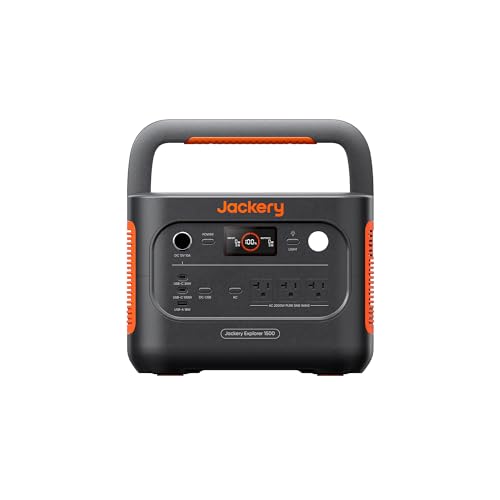
- Model
- JE-1500D
- Capacity
- 1,536 Wh (38.4 V, 40 Ah), LiFePO4 (manual)
- Cycle Life
- 6,000 cycles to 70%+ capacity (manual)
- AC Output
- 3 x 120 V; 2,000 W rated, 4,000 W surge at 14–113°F; 1,200 W at -4–14°F (manual)
- 12V Car Port
- 12 V, 10 A (manual)
- Inputs
- AC 15 A; 2 x DC8020: car 11–16 V 8 A total, solar 16–60 V, 400 W total (manual)
- Weight
- About 31.97 lb (14.5 kg) (manual)
- Dimensions
- 12.99 x 8.7 x 9.53 in (manual)
- Temperature
- Charge and discharge -4–113°F (manual)
- Warranty
- 3 years + 2 extended (manual, Jackery page)
Jackery Explorer 1500 v2 Review: Induction Headroom at About 32 Pounds
The Jackery Explorer 1500 v2 is a 1,536 Wh LiFePO4 power station rated for 2,000 W of continuous AC output, and Jackery's manual puts its weight at about 32 lb. Those two numbers place it in a gap on this site. The 1 kWh stations we cover are rated at exactly 1,800 W, the same as the maximum draw of the Duxtop 9100MC, so they run it with no headroom. The 2 kWh EcoFlow DELTA 3 Max has plenty of headroom but weighs 44.8 lb. The Explorer 1500 v2 clears the Duxtop's rating by 200 W in a box roughly 13 lb lighter than the DELTA 3 Max.
What the Amazon link sells: the listing titled "Jackery Explorer 1500 v2 Power Station, 1536Wh, 2000W Output" (ASIN B0HHRWQS47, model JE-1500D). This is the station on its own. It is not one of the Solar Generator 1500 v2 bundles with panels, and it is not the older Explorer 1500, 1500 Pro or 1500 Ultra, which are different models with different batteries. The JE-1500D manual we opened is titled simply "Jackery Explorer 1500", but its model number and specifications (1,536 Wh, 2,000 W) match this listing. When we checked, Amazon showed the listing in stock.
This review is research-based. VanLifeKitchens doesn't test products hands-on. The specs come from Jackery's JE-1500D user manual, Jackery's US product page and the Amazon listing. Runtime figures are our estimates, with the arithmetic and assumptions shown, using the method from our guide can a power station run an induction cooktop?
Choose this if:
- You want to run an 1,800 W induction cooktop from a portable station with some margin, and the station has to be light enough for one person to move.
- You camp in cold weather. Jackery rates charging and discharging down to -4°F, below the 32°F charging limit of the EcoFlow stations we cover.
- You want a long published cycle rating: 6,000 cycles to 70%+ capacity.
Skip this if:
- You cook every meal on induction and can't recharge daily. With about 1,306–1,382 Wh usable (estimate), it gives around four 20-minute cooks per charge before counting the fridge.
- You cook on induction in sub-freezing weather. Below 14°F, Jackery's manual limits AC output to 1,200 W, which won't run the Duxtop at full power or the PIC Gold at its 1,500 W default.
- You want to charge from a large solar array. Solar input tops out at 400 W across two ports.
What it is
A portable power station is a battery, inverter, charger and set of outlets in one box, with nothing wired into the vehicle. The Explorer 1500 v2 has, per its manual, three 120 V AC outlets, two USB-C ports (100 W and 30 W), one 18 W USB-A port, and a 12 V DC port. It charges from an AC socket or from two DC8020 inputs that take solar panels or a car charging cable. It has a built-in LED light, Wi-Fi and Bluetooth for the Jackery app, and a UPS mode.
Specifications and sources
| Spec | Jackery figure | Source |
|---|---|---|
| Model | JE-1500D | Manual, Amazon |
| Rated capacity | 1,536 Wh (38.4 V, 40 Ah), LiFePO4 | Manual |
| Cycle life | 6,000 cycles to 70%+ capacity | Manual |
| AC output | 3 x 120 V; 2,000 W rated, 4,000 W surge peak (14–113°F) | Manual |
| AC output in the cold | 1,200 W max (-4 to 14°F) | Manual |
| AC in bypass (UPS) mode | 12 A, 1,440 W max | Manual |
| 12 V DC port | 12 V, 10 A max | Manual |
| AC input | 100–120 V, 15 A max | Manual |
| Car input | 11–16 V, 8 A max (both ports combined) | Manual |
| Solar input | 16–60 V, 12 A per port; 400 W max total | Manual |
| Weight | About 31.97 lb (14.5 kg) | Manual |
| Size | 12.99 x 8.7 x 9.53 in | Manual |
| Charge and discharge temperature | -4 to 113°F (-20 to 45°C) | Manual |
| Warranty | 3 years standard, plus 2 extended | Manual, Jackery page |
Jackery's product page lists these charging times, all "tested in Jackery Lab (0–80% charge)": wall outlet 53 minutes, one-button super charging 48 minutes, 400 W solar 4 hours, 200 W solar 7.5 hours, DC-DC alternator charger 3.5 hours, and car charging 14.5 hours. The manual says to use emergency (fast) charging only when necessary, because normal-speed charging is better for battery life.
The manual says the box contains the station, an AC charging cable and the user manual. The car charging cable is sold separately.
Warranty wording. Jackery's manual describes a 3-year standard warranty plus a 2-year extension, and says Jackery provides its warranty for purchases from its own website, Jackery-branded third-party platforms or authorized dealers. Jackery's product page says the extension is applied automatically on its own site. The Amazon listing says "5 Years of Coverage". Keep your proof of purchase, register the unit, and check the seller name on the Amazon listing before you buy.
Usable Wh vs rated Wh
Our induction guide assumes 85–90% inverter efficiency for energy drawn from the AC outlets. Jackery doesn't publish an efficiency figure in the manual we opened.
Usable AC energy (estimate): 1,536 × 0.85 = about 1,306 Wh, and 1,536 × 0.90 = about 1,382 Wh.
Can it run the Duxtop 9100MC at 1,800 W?
Yes, with about 200 W of headroom, at temperatures above 14°F. The manual rates the AC output at 2,000 W continuous between 14°F and 113°F. The Duxtop's maximum is 1,800 W. Two hundred watts is about 11% above the cooktop's rating. That's enough margin for measurement tolerance and a phone or laptop charger. It isn't enough for a second cooking appliance.
How long, at full power (estimate):
- 1,306 Wh ÷ 1,800 W = 0.73 h, or about 44 minutes
- 1,382 Wh ÷ 1,800 W = 0.77 h, or about 46 minutes
Assumptions: the station starts full, the inverter is 85–90% efficient, the cooktop draws a steady 1,800 W, nothing else is plugged in, and no capacity is reserved.
The Nuwave PIC Gold. At its 1,500 W default, the Nuwave PIC Gold leaves about 500 W of headroom. Estimated runtime at a steady 1,500 W is 1,306 ÷ 1,500 = 0.87 h, about 52 minutes, up to 1,382 ÷ 1,500 = 0.92 h, about 55 minutes. At its 900 W setting, it's about 87–92 minutes (1,306 ÷ 900 = 1.45 h; 1,382 ÷ 900 = 1.54 h).
A typical meal pattern. Our guide's example is a 20-minute cook at a steady 1,000 W, about 333 Wh at the cooktop and 370–392 Wh from the battery. The Explorer 1500 v2 covers about four of those per charge (1,306–1,382 ÷ 333 = 3.9–4.2), compared with about two and a half on a 1 kWh station and about five on a 2 kWh station.
Cold weather changes the answer. Between -4°F and 14°F, the manual limits AC output to 1,200 W. At those temperatures, neither the Duxtop at full power nor the PIC Gold at 1,500 W fits within the rating. The PIC Gold's 900 W setting would. Bring the station into a warmer space before cooking in very cold weather, or cook on gas. Our cold-weather cooking guide covers the trade-offs.
Surge doesn't help. The 4,000 W surge figure is for brief starting loads. An induction cooktop draws its wattage for minutes, so plan around the 2,000 W continuous rating.
Running a 12 V fridge
The manual rates the 12 V DC port at 12 V, 10 A. That's above the 7.6 A maximum Dometic publishes for the CFX5 35. Running the fridge from the 12 V port avoids the inverter.
| Fridge (published daily figure) | Days on 1,306–1,382 Wh |
|---|---|
| ICECO VL35 ProS, 430 Wh/day | about 3.0–3.2 |
| Dometic CFX5 35, about 320 Wh/day | about 4.1–4.3 |
Arithmetic: 1,306 ÷ 430 = 3.0 and 1,382 ÷ 430 = 3.2; 1,306 ÷ 320 = 4.1 and 1,382 ÷ 320 = 4.3. The fridge figures are the published ones used in our power budget guide: ICECO's 430 Wh per 24 hours lab figure for the ICECO VL35 ProS, and Dometic's US rating for the CFX5 35 at 90°F ambient. Heat, setpoint and door openings change the result, so plug your own figures into the fridge battery calculator.
Turn off Energy Saving Mode for a fridge. The manual says Energy Saving Mode is on by default. It turns outputs off after 12 hours if nothing is connected or the load stays below a threshold: 25 W on AC, or 2 W on the USB and 12 V outputs. A compressor fridge that sits idle between cycles could fall under that. The manual explains how to switch the mode off with a button combination. The station also shuts down after two hours if all outputs are off and nothing is charging.
Recharging
- AC: 15 A at 100–120 V. Jackery's lab figure is 53 minutes to 80% at normal speed.
- Solar: two DC8020 inputs, 16–60 V, 400 W maximum total. The manual says each port can take at most two solar panels, that the input voltage on both ports should be the same (use the same model and number of panels on each), and that panel open-circuit voltage must stay within 16–60 V. It recommends Jackery panels and says Jackery isn't responsible for losses from other brands' panels. Jackery's lab figure is about 4 hours to 80% at 400 W. As our own estimate, replacing 1,306 Wh at an average 250 W of net solar would take about 5 hours of good sun, plus losses.
- Car: 11–16 V at 8 A, roughly 96 W, from a 12 V socket only. The manual says it's for 12 V vehicles, not 24 V. Start the vehicle before connecting, and don't use car charging on bumpy roads, which the manual forbids. Don't charge from car and solar at the same time; the manual says that can blow the car fuse. Jackery's lab figure is 14.5 hours to 80%.
- Alternator charger: Jackery lists a DC-DC alternator charger option at 3.5 hours to 80%. That's a permanent connection to the vehicle's electrical system. Follow the manufacturer's installation instructions and use a qualified installer where your vehicle maker, local codes or insurer require one.
Safety and placement
Jackery's manual includes several instructions that matter in a van:
- Indoor use. The manual's DANGER notice says the device is intended for indoor use only, and when used outdoors it should be placed in a similar indoor environment, such as an RV, tent or cabin. It isn't waterproof or dustproof, so keep it away from rain and humid conditions.
- Unattended charging. The manual says "Do not leave the battery charging unattended for long periods" and to monitor the charging process. Don't leave it charging in a parked, closed van.
- Airflow. Keep the vents uncovered in a cool, dry place with adequate airflow. Its troubleshooting steps for an over-temperature fault call for 30 cm (about 12 in) of clearance on both sides, shade and an ambient temperature below 45°C (113°F). Keep it away from the cooktop's exhaust.
- Orientation and transport. Secure it in a moving vehicle, and don't place it upside down or on its side during use or storage.
- Storage. Jackery lists storage ranges by duration: -4 to 113°F for one month, 32 to 113°F for three months, and 32 to 77°F for twelve months. It recommends checking and recharging every three months, and a full charge and discharge at least every 6 to 12 months.
- Car battery feature. Jackery sells a 12 V automobile battery charging cable. The manual limits that use to emergencies and 12 V systems, and says not to start the car while it's connected.
This is a plug-in device. Don't wire it into a vehicle's fixed electrical system or shore-power inlet yourself. A permanent installation should follow the manufacturer's instructions and be done by a qualified RV electrical technician where codes or insurers require one. Induction still makes steam and grease, so the ventilation guide still applies.
How it fits a van or camp kitchen
At 12.99 x 8.7 x 9.53 inches, the Explorer 1500 v2 is a compact box for its capacity, close in footprint to the 1 kWh Jackery Explorer 1000 v2 (12.87 x 8.82 x 9.72 in) but about 8 lb heavier. It suits a car or van camper who wants induction for some or most meals, runs a 12 V fridge, and either moves the station between vehicle and camp or has limited floor space. Strap it down when driving.
Treat it as a cooking-and-fridge station for trips where you can recharge every day or two. By the estimates above, one day of a 35-liter fridge (430 Wh) plus two 20-minute induction cooks (about 740–784 Wh) comes to roughly 1,170–1,210 Wh, which is most of its usable energy. If your trips run several days without hookups, plan some gas meals or a larger battery.
Limitations
- 200 W of headroom. Enough for tolerance and a charger, not for a second appliance.
- Cold-weather AC limit. 1,200 W maximum below 14°F.
- 400 W solar ceiling, split across two ports, with Jackery recommending its own panels.
- Car charging is slow (about 96 W), 12 V only, and forbidden on bumpy roads.
- Indoor-use instruction and no water resistance. Keep it under cover and dry.
- Warranty conditions. Check the seller and keep proof of purchase.
How it compares
- EcoFlow DELTA 3 Max: 2,048 Wh and 2,400 W, so 600 W of headroom over the Duxtop and about an hour of full-power cooking (estimate), but 44.8 lb, charging only from 32°F, and no published cycle rating in its manual.
- EcoFlow DELTA 3: 1,024 Wh and 1,800 W, with no headroom for the Duxtop, at 27.6 lb. It takes extra batteries.
- Jackery Explorer 1000 v2: 1,070 Wh and 1,500 W at 23.8 lb. It can't run the Duxtop at full power, but suits the PIC Gold at 900 W and a fridge.
Verdict
The Explorer 1500 v2 is the station on this site to look at if you want an 1,800 W induction cooktop to run with a margin, and you need the box to stay liftable. Jackery's published figures support that: 2,000 W continuous, 1,536 Wh of LiFePO4, 6,000 cycles to 70%, a 10 A 12 V port, and a -4°F to 113°F charge and discharge range, in about 32 lb. The limits are just as clear. Headroom is 200 W, AC output falls to 1,200 W below 14°F, solar is capped at 400 W, and the manual's indoor-use and unattended-charging instructions need following in a van.
FAQ
Can the Jackery Explorer 1500 v2 run an 1,800 W induction cooktop? Yes, above 14°F. Its continuous AC rating is 2,000 W, about 200 W above the Duxtop 9100MC's maximum. Our estimate is about 44–46 minutes at full power from a full charge, assuming 85–90% inverter efficiency and nothing else plugged in.
Does it work in freezing weather? Jackery rates charging and discharging from -4°F to 113°F. Between -4°F and 14°F, the manual limits AC output to 1,200 W and turns off the 100 W USB-C output, so full-power induction isn't possible in that range.
How long will it run a 12 V fridge? As an estimate, about 3.0–3.2 days at 430 Wh a day (ICECO's lab figure for the VL35 ProS), or about 4.1–4.3 days at 320 Wh a day (Dometic's US rating for the CFX5 35 at 90°F ambient), with no cooking and no charging. Turn off Energy Saving Mode so the 12 V port doesn't switch off.
Is the Explorer 1500 v2 the same as the Explorer 1500 Pro? No. The listing we link sells model JE-1500D, the 1,536 Wh, 2,000 W Explorer 1500 v2. The Explorer 1500 Pro (model JE-1500B) and the original Explorer 1500 are older, different models.
How fast does it charge from solar? Up to 400 W across two DC8020 ports. Jackery's lab figure is about 4 hours from 0 to 80% at 400 W. Real output depends on sun, angle, heat and shading.
Can I use it while it's charging? Yes. The manual describes bypass (UPS) mode, where the AC outlets are powered while it charges from the wall. In that mode, AC output is limited to 1,440 W, so don't run the Duxtop at full power while it's charging from AC.
Sources and verification
- Jackery Explorer 1500 user manual, model JE-1500D (Jackery document, PDF hosted on Home Depot's product-image server): specifications, AC output by temperature, bypass mode limit, 12 V port, DC8020 input limits, solar and car-charging cautions, Energy Saving Mode, storage ranges, troubleshooting clearances, indoor-use DANGER notice, unattended-charging warning, warranty terms, box contents. https://images.thdstatic.com/catalog/pdfImages/31/316670d9-13e0-4d40-b1a6-9331f5186bfd.pdf (checked 2026-10-11)
- Jackery US, Explorer 1500 v2 product page: 2,000 W and 4,000 W surge, 31.97 lb, 6,000+ cycles, -4 to 113°F, lab charging times by method, warranty extension wording. https://www.jackery.com/products/jackery-explorer-1500-v2-portable-power-station (checked 2026-10-11)
- Amazon product listing for ASIN B0HHRWQS47, the listing this review links to: title, model JE-1500D, warranty wording, box contents, availability (checked 2026-10-11)
- Duxtop 9100MC and Nuwave PIC Gold figures, the 85–90% efficiency assumption and the runtime method come from this site's power station and induction guide. Fridge figures come from the power budget guide.
Compare with similar products
See how this stacks up against the other portable power stations we've reviewed.
Related Reviews

For: 1,800 W induction plus fridge
EcoFlow DELTA 3 Portable Power Station, 1024Wh, 1800W (EF-DL-H10-3)
A 1,024 Wh LiFePO4 station whose 1,800 W continuous rating reaches the Duxtop 9100MC's full power, with no headroom, for about 29–31 minutes per charge by our estimate. It adds a 10 A car socket for a 12 V fridge, 500 W solar, 1,500 W AC charging and expansion batteries, but its 113°F ceiling and 27.6 lb weight need planning.

For: Cold-weather and solar setups
Anker SOLIX C1000 Portable Power Station with Car Charging Cable, 1,056Wh (A1761)
A 1,056 Wh LiFePO4 station rated for 1,800 W continuous, enough for the Duxtop 9100MC at full power with no headroom, for about 30–32 minutes per charge by our estimate. It has the highest solar input here (600 W) and discharges down to -4°F, but Anker rates it for 3,000 cycles and stops charging and discharging at 104°F.

For: Fridge plus PIC Gold cooking
Jackery Explorer 1000 v2 Portable Power Station, 1070Wh, 1500W (JE-1000D)
The lightest 1 kWh station here at 23.8 lb, with 1,070 Wh of LiFePO4 capacity and a 10 A car port for a 12 V fridge. Its 1,500 W continuous rating can't run the Duxtop 9100MC at full power, but it suits the Nuwave PIC Gold, especially at 900 W (about an hour per charge, estimated). Solar is capped at 400 W.