EcoFlow DELTA 3 Max Portable Power Station, 2048Wh, 2400W (EF-DL-H02-3M)

- Model
- EF-DL-H02-3M (DELTA 3 Max, not Max Plus)
- Capacity
- 2,048 Wh (51.2 V, 40 Ah), LFP (manual)
- AC Output
- 4 x 120 V, 2,400 W total; 4,800 W surge (EcoFlow page)
- X-Boost
- Up to 3,400 W by lowering voltage; on by default (manual)
- 12V Car Socket
- 12.6 V, 10 A, 126 W (manual)
- Inputs
- AC 15 A; solar 11–60 V, 13 A, 500 W; car 12 V/24 V 8 A (manual)
- Weight
- About 44.8 lb (20.3 kg) (manual)
- Dimensions
- 19.4 x 9.4 x 12.0 in (manual)
- Temperature
- Charge 32–113°F; discharge 14–113°F (manual)
- Warranty
- 3 years + 2 with app registration (EcoFlow page)
EcoFlow DELTA 3 Max Review: A 2 kWh Station With Headroom for an 1,800 W Cooktop
The EcoFlow DELTA 3 Max is a 2,048 Wh lithium iron phosphate (LiFePO4) power station rated for 2,400 W of continuous AC output. That rating is why it's on this site. The 1 kWh stations we cover, the EcoFlow DELTA 3 and the Anker SOLIX C1000, are rated at exactly 1,800 W, which is also the maximum draw of the Duxtop 9100MC. They can run it, but with nothing to spare. The DELTA 3 Max runs the same cooktop with 600 W of headroom and twice the stored energy, at the cost of a 44.8 lb box.
What the Amazon link sells: the listing titled "EF ECOFLOW DELTA 3 Max Portable Power Station, 2048Wh LFP Battery, 2400W" (ASIN B0FQV6LMVX, model EF-DL-H02-3M). This is the plain DELTA 3 Max. It is not the DELTA 3 Max Plus (model EF-DL3-MP, 3,000 W), and it is not one of the solar-panel bundles EcoFlow sells under the same name. When we checked, Amazon showed the listing in stock.
This review is research-based. VanLifeKitchens doesn't test products hands-on. The specs come from EcoFlow's DELTA 3 Max user manual, EcoFlow's US product page and the Amazon listing. Runtime figures are our estimates, and each one shows its arithmetic and assumptions, using the same method as our guide can a power station run an induction cooktop?
Choose this if:
- You want to cook on an 1,800 W induction cooktop from a portable station and keep a margin for a second small AC load or measurement tolerance.
- You cook most meals on induction and want roughly an hour of full-power cooking, or about five 20-minute cooks, per charge (estimate).
- You can recharge from shore power, a generator or EcoFlow's 800 W Alternator Charger, which refill a 2 kWh battery far faster than solar or a car socket.
Skip this if:
- You need to lift the station in and out of a vehicle every day. At 44.8 lb, it's a two-handed lift, and EcoFlow's manual warns against lifting it by one side handle.
- You mainly run a 12 V fridge and charge devices. The Jackery Explorer 500 v2 or the DELTA 3 does that job at a fraction of the weight.
- You want to add an extra battery later. The DELTA 3 Max manual lists no extra-battery compatibility. EcoFlow's expandable 2 kWh model is the DELTA 3 Max Plus.
What it is
A portable power station puts a battery, an inverter, a charger and a set of output ports in one box. It isn't wired into the vehicle. You charge it from a wall outlet, solar panels, a car socket or an alternator charger, then plug your loads into it.
The DELTA 3 Max is EcoFlow's 2 kWh model in its DELTA 3 generation. According to the manual, the US version has four AC outlets, one USB-A port, three USB-C ports (one rated at 100 W and two sharing 30 W), and a 12 V DC output. Inputs are an AC socket and one XT60i port that takes either solar or car charging. The manual also lists compatibility with EcoFlow's 800 W Alternator Charger (model EF-FC-301-1), which connects through a separate cable.
Specifications and sources
| Spec | EcoFlow figure | Source |
|---|---|---|
| Rated capacity | 2,048 Wh (51.2 V, 40 Ah), LFP | Manual |
| AC output (US) | 4 outlets, 120 V, 2,400 W total, 20 A max per port | Manual |
| Surge | 4,800 W | EcoFlow page |
| X-Boost (US) | Up to 3,400 W by lowering voltage; on by default | Manual |
| 12 V DC output | 12.6 V, 10 A, 126 W total | Manual |
| AC input (US) | 100–120 V, 15 A | Manual |
| Wall charging | 0–80% in 68 minutes | EcoFlow page |
| Solar input | 11–60 V, 13 A, 500 W max (XT60i) | Manual |
| Car input | 12 V 8 A, 24 V 8 A, 48 V 10.4 A max | Manual |
| Weight | About 44.8 lb (20.3 kg) | Manual |
| Size | About 19.4 x 9.4 x 12.0 in | Manual |
| Charge temperature | 32–113°F (0–45°C) | Manual |
| Discharge temperature | 14–113°F (-10–45°C) | Manual |
| Ingress rating | IP20 | Manual |
| Warranty | 3 years, plus 2 with app registration | EcoFlow page |
Two figures are missing from the documents we opened. The manual gives no cycle-life rating, and EcoFlow's product page only says the cells offer "10 years of reliable power." The 1 kWh DELTA 3, by comparison, has a published 4,000-cycle rating to 80% capacity. The manual also gives the AC input in amps (15 A at 100–120 V), not watts. The Amazon listing gives the warranty as "5 year manufacturer". EcoFlow's own page describes it as 3 years standard plus a 2-year extension when you register the unit in the EcoFlow app. Register it to be safe.
According to the manual, the box contains the station, an AC charging cable, and the manuals and warranty card. The car charging cable is sold separately.
Usable Wh vs rated Wh
The 2,048 Wh on the label is the battery's rated energy. You get less than that from the AC outlets, because the inverter turns some of it into heat while converting battery DC to 120 V AC. Our induction guide assumes 85–90% inverter efficiency. EcoFlow doesn't publish an efficiency figure in the manual we opened, so treat the result as a planning range.
Usable AC energy (estimate): 2,048 × 0.85 = about 1,741 Wh, and 2,048 × 0.90 = about 1,843 Wh.
Can it run the Duxtop 9100MC at 1,800 W?
Yes, with headroom. The DELTA 3 Max's continuous AC rating is 2,400 W at 120 V. The Duxtop's maximum is 1,800 W, which leaves about 600 W for a second small load, such as a laptop charger, or for the measurement tolerance our guide recommends allowing. That's the difference from the 1 kWh, 1,800 W stations, where the cooktop uses the whole rating. Don't run a second high-wattage appliance, such as a kettle, alongside the cooktop. Two of those together would exceed 2,400 W.
How long, at full power (estimate): usable Wh ÷ cooktop W = hours.
- 1,741 Wh ÷ 1,800 W = 0.97 h, or about 58 minutes
- 1,843 Wh ÷ 1,800 W = 1.02 h, or about 61 minutes
Assumptions: the station starts full, the inverter is 85–90% efficient, the cooktop draws its full 1,800 W the whole time, nothing else is plugged in, and no capacity is reserved. That matches the 2,048 Wh row in our induction guide.
A realistic meal pattern. Few meals run at full power for an hour. Our guide's example is a 20-minute cook at a steady 1,000 W, which uses about 333 Wh at the cooktop and 370–392 Wh from the battery. A 2,048 Wh station covers about five of those per charge, compared with about two and a half on a 1 kWh station. For two people cooking breakfast and dinner on induction, that's roughly two days of cooking from a full charge, before counting the fridge.
The Nuwave PIC Gold. At its 1,500 W default, the Nuwave PIC Gold leaves about 900 W of headroom. Estimated runtime at a steady 1,500 W is 1,741 ÷ 1,500 = 1.16 h, about 70 minutes, up to 1,843 ÷ 1,500 = 1.23 h, about 74 minutes.
X-Boost is on by default. EcoFlow's manual says X-Boost lets the station run appliances rated above 2,400 W, up to 3,400 W on the US version, by lowering the voltage. It's enabled by default, it suits heating devices such as electric blankets, and the manual warns that devices with voltage protection "may stop working due to low voltage." It's also unavailable while the station is charging from AC. An 1,800 W cooktop on its own stays well under 2,400 W, so X-Boost shouldn't come into play. But if you add loads that take the total above the rated output, the station may lower its voltage rather than simply refuse the load. The Duxtop's manual lists an E3 error for input voltage that's too high or too low, and the PIC Gold's manual gives an 85–144 V range. If you'd rather have a clean overload shutdown, check the X-Boost setting in the EcoFlow app.
Running a 12 V fridge
EcoFlow's manual rates the 12 V DC output at 12.6 V, 10 A (126 W total). That's above the 7.6 A maximum Dometic publishes for the CFX5 35, so a typical compressor fridge fits within it. Running the fridge from the 12 V port avoids the inverter, which is the more efficient route.
How many days of fridge (estimate). We use the same published figures as our power budget guide: ICECO's 430 Wh per 24 hours lab figure for the ICECO VL35 ProS, and about 320 Wh per day for the Dometic CFX5 35, from Dometic's US rating at 90°F ambient. EcoFlow doesn't publish the efficiency of the 12 V output, so we use the same 85–90% range, which probably understates the DC path a little.
| Fridge (published daily figure) | Days on 1,741–1,843 Wh |
|---|---|
| ICECO VL35 ProS, 430 Wh/day | about 4.0–4.3 |
| Dometic CFX5 35, about 320 Wh/day | about 5.4–5.8 |
Arithmetic: 1,741 ÷ 430 = 4.0 and 1,843 ÷ 430 = 4.3; 1,741 ÷ 320 = 5.4 and 1,843 ÷ 320 = 5.8. Real use depends on ambient temperature, setpoint, door openings and how warm the food is when it goes in. If you also cook on the station, subtract the cooking energy first. Try your own numbers in the fridge battery calculator.
The manual describes an AC timeout that switches off idle AC outlets and can catch intermittent loads such as a fridge. It recommends setting the timeout to "never" in the app if the fridge holds anything that matters. That applies to a fridge on an AC outlet. A 12 V fridge on the DC port isn't affected by the AC timeout.
Recharging: AC, solar, car and alternator
Doubling the battery doubles the job of refilling it. This is the part of a 2 kWh station to plan most carefully.
- AC (wall, shore power or generator): EcoFlow lists 0–80% in 68 minutes. At a campground hookup, this is how you'd normally refill.
- Solar: one XT60i input, 11–60 V, 13 A, 500 W maximum. The manual asks for total panel open-circuit voltage within 60 V and short-circuit current within 18 A. That's the same 500 W ceiling as the 1 kWh DELTA 3, so solar refills take about twice as long. EcoFlow's own bundle page estimates about 6.4 hours to fill the DELTA 3 Max from a 400 W panel. As our own estimate, replacing 1,741 Wh at an average 250 W of net solar would take about 7 hours of good sun (1,741 ÷ 250), plus charging losses. Real output depends on sun angle, cloud, heat and shading.
- Car socket: the same XT60i port takes 12 V at up to 8 A, about 96 W, or 24 V at 8 A from a 24 V vehicle. At 96 W, a full recharge from empty would take about 21 hours (2,048 ÷ 96), more with losses. EcoFlow says to connect the cable after the vehicle has started. Car charging tops the station up on a driving day; it won't refill one that ran a cooktop.
- Alternator charger: EcoFlow's 800 W Alternator Charger is listed as compatible, and EcoFlow's bundle page estimates about 5–6 hours to fill the DELTA 3 Max from its 500 W alternator charger. That device is a permanent connection to the vehicle's electrical system. Follow EcoFlow's installation instructions, and have a qualified installer fit it where your vehicle maker, local codes or your insurer require one.
If you can't count on hookups, a generator or an alternator charger, a 2 kWh station only stays useful for induction if you cook some meals on gas. The induction vs butane vs propane guide covers that trade-off.
Temperature limits and safety
- Charging: 32–113°F. The manual shows a low-temperature warning and says to move the station somewhere warmer.
- Discharging: 14–113°F, with an optimal range of 68–86°F.
- Storage: 14–113°F. EcoFlow recommends about 32–86°F for battery health, a dry, cool and well-ventilated place, and a charge and discharge every three months for long-term storage (fully charge, then discharge to 60%). The manual says the warranty is void if the device is left uncharged or unused for more than six months.
A closed van in summer sun can exceed 113°F. Don't leave the station charging in a hot, closed vehicle. Charge it while you're around, in shade or in a cooler spot.
Other points from EcoFlow's safety instructions apply directly to vans:
- IP20. The station isn't protected against water. EcoFlow says not to get it wet, and to use a waterproof bag in rainy areas or near water. Keep it away from the sink, the cooler drain and the rear door in rain.
- Heat and vents. Don't block the heat dissipation system, and don't use it near heat sources. Keep it away from the cooktop's own exhaust as well as from any flame.
- Placement. Set it on a stable, flat surface, don't stack heavy objects on it, and don't lift it by one side handle. A 44.8 lb box needs a real anchor point in a moving vehicle, not a bungee.
- Children and pets. Keep it out of reach, and supervise children near it.
- Grounding. The manual says the product must be grounded and to use the supplied grounding plug, consulting a qualified electrician if you're unsure.
It's a plug-in device. Don't wire it into a van's fixed electrical system or a shore-power inlet yourself. Any permanent installation should follow the manufacturer's instructions and be done by a qualified RV electrical technician where codes or insurers require one. The battery bank guide explains the fixed-system alternative.
Induction still makes steam, grease and heat in the pan. The ventilation guide still applies when you cook indoors on electric.
How it fits a van or camp kitchen
The DELTA 3 Max makes sense for someone with no house battery who wants induction to be the main way they cook. A 12 V fridge goes on the DC port, devices on USB-C, and the cooktop on one of the four AC outlets. Its 19.4 x 9.4 x 12.0 inch footprint is long rather than tall, so it can live under a bench or bed platform, but plan the spot so you can reach the AC outlets and keep the vents clear while it's in place. Because it's heavy, the best spot is one where it stays put and the cooktop's cord reaches it. You shouldn't be carrying it to the table at every meal.
For car campers who unload everything at camp, the weight counts against it. The Jackery Explorer 1500 v2 runs the Duxtop with 200 W of headroom at about 32 lb, with less stored energy.
Limitations
- Weight. 44.8 lb, much heavier than the 27.6 lb DELTA 3.
- Four AC outlets. Fewer than the DELTA 3's six. Enough for a cooktop and a charger, not for many AC loads.
- Solar input is no bigger than the DELTA 3's. 500 W on one XT60i port, for twice the battery.
- No expansion batteries listed. The manual's compatibility list includes no extra battery.
- No cycle rating in the documents we opened.
- IP20 and a 113°F ceiling. Keep it dry and out of a hot, closed van while charging.
How it compares
- EcoFlow DELTA 3: half the capacity (1,024 Wh), 1,800 W continuous with no headroom for the Duxtop, but 27.6 lb, six AC outlets, a published 4,000-cycle rating and optional extra batteries. See EcoFlow DELTA 3 Max vs DELTA 3.
- Jackery Explorer 1500 v2: 1,536 Wh and 2,000 W continuous, so it runs the Duxtop with 200 W to spare, at about 32 lb. It charges and discharges down to -4°F, but its AC output drops to 1,200 W below 14°F, and its solar input is 400 W.
- Anker SOLIX C1000: 1 kWh and 1,800 W, with a 600 W solar input, but no headroom for an 1,800 W cooktop.
Verdict
The DELTA 3 Max is the station on this site to choose if induction is your main way of cooking and you don't have a house battery. Its 2,400 W continuous rating clears the Duxtop's 1,800 W with a real margin, and its 2,048 Wh gives about an hour of full-power cooking per charge by our estimate, or roughly five typical 20-minute cooks. The costs are specific: 44.8 lb, four AC outlets, a 500 W solar ceiling that makes off-grid refills slow, no listed expansion batteries, and no published cycle rating in the manual. If you can't recharge from shore power, a generator or an alternator charger, plan to cook some meals on gas.
FAQ
Can the EcoFlow DELTA 3 Max run an 1,800 W induction cooktop? Yes. Its continuous AC rating is 2,400 W, about 600 W above the Duxtop 9100MC's maximum. Our estimate is about 58–61 minutes at full power from a full charge, assuming 85–90% inverter efficiency and nothing else plugged in.
How long will the DELTA 3 Max run a 12 V fridge? As an estimate, about 4.0–4.3 days for a fridge using 430 Wh a day (ICECO's lab figure for the VL35 ProS), or about 5.4–5.8 days at 320 Wh a day (Dometic's US rating for the CFX5 35 at 90°F ambient). That assumes 85–90% of the 2,048 Wh is usable, no cooking and no charging.
Is the DELTA 3 Max the same as the DELTA 3 Max Plus? No. The Amazon listing we link sells the DELTA 3 Max, model EF-DL-H02-3M, rated at 2,400 W. The DELTA 3 Max Plus is model EF-DL3-MP, rated at 3,000 W, and it's the one EcoFlow sells with expansion batteries.
Can I add an extra battery to the DELTA 3 Max? The DELTA 3 Max manual we opened lists no extra-battery compatibility. If expansion matters, the DELTA 3 (1 kWh) accepts extra batteries, and EcoFlow sells expansion for the DELTA 3 Max Plus.
How fast does it recharge? EcoFlow lists 0–80% in 68 minutes from a wall outlet. Solar is capped at 500 W, so a full solar refill takes most of a sunny day: EcoFlow estimates about 6.4 hours with a 400 W panel. A 12 V car socket supplies only about 96 W.
Should I turn off X-Boost for induction cooking? X-Boost is on by default, and it works by lowering the voltage when loads exceed 2,400 W. An 1,800 W cooktop alone stays below that. If you'd rather the station shut off on overload than lower the voltage, check the setting in the EcoFlow app. Both cooktop manuals list voltage limits.
Can it be charged below freezing? No. EcoFlow's charge range is 32–113°F. It can discharge down to 14°F.
Sources and verification
- EcoFlow DELTA 3 Max Portable Power Station user manual, model EF-DL-H02-3M (EcoFlow document, PDF hosted by a European dealer): technical specifications, US AC output, 12 V output, inputs, XT60i solar limits, car charging note, X-Boost table and default, AC timeout, alternator charger compatibility, storage, safety instructions, IP20, box contents. https://cdn.solarpowersupply.eu/files/EcoFlow%20DELTA%203%20Max%20Portable%20Power%20Station_User%20Manual%20(2)-20260202.pdf (checked 2026-10-11)
- EcoFlow US, DELTA 3 Max product page: 2,400 W, 4,800 W surge, 3,400 W X-Boost, 0–80% in 68 minutes, 20.3 kg, warranty terms, bundle charging estimates (400 W panel about 6.4 hours, 500 W alternator charger about 5–6 hours), DELTA 3 Max Plus expansion. https://us.ecoflow.com/products/ecoflow-delta-3-max-portable-power-station-2048wh and https://us.ecoflow.com/products/delta-3-max-series-portable-power-station (checked 2026-10-11)
- Amazon product listing for ASIN B0FQV6LMVX, the listing this review links to: title, model EF-DL-H02-3M, warranty field, availability (checked 2026-10-11)
- Duxtop 9100MC and Nuwave PIC Gold figures, the 85–90% efficiency assumption and the runtime method come from this site's power station and induction guide, which lists the manuals it checked. Fridge figures come from the power budget guide.
Compare with similar products
See how this stacks up against the other portable power stations we've reviewed.
Head-to-head comparisons
Related Reviews
For: Lighter induction-capable station
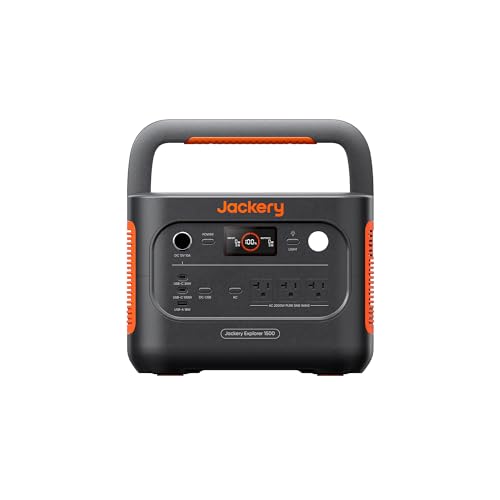
Jackery Explorer 1500 v2 Portable Power Station, 1536Wh, 2000W (JE-1500D)
The lightest station we cover that runs the Duxtop 9100MC with headroom: 2,000 W continuous and 1,536 Wh of LiFePO4 at about 32 lb, for roughly 44–46 minutes of full-power cooking per charge by our estimate. It charges and discharges down to -4°F, but its AC rating drops to 1,200 W below 14°F, solar tops out at 400 W, and Jackery's manual says not to leave it charging unattended for long periods.

For: 1,800 W induction plus fridge
EcoFlow DELTA 3 Portable Power Station, 1024Wh, 1800W (EF-DL-H10-3)
A 1,024 Wh LiFePO4 station whose 1,800 W continuous rating reaches the Duxtop 9100MC's full power, with no headroom, for about 29–31 minutes per charge by our estimate. It adds a 10 A car socket for a 12 V fridge, 500 W solar, 1,500 W AC charging and expansion batteries, but its 113°F ceiling and 27.6 lb weight need planning.

For: Cold-weather and solar setups
Anker SOLIX C1000 Portable Power Station with Car Charging Cable, 1,056Wh (A1761)
A 1,056 Wh LiFePO4 station rated for 1,800 W continuous, enough for the Duxtop 9100MC at full power with no headroom, for about 30–32 minutes per charge by our estimate. It has the highest solar input here (600 W) and discharges down to -4°F, but Anker rates it for 3,000 cycles and stops charging and discharging at 104°F.