Anker SOLIX C2000 Gen 2 Portable Power Station, 2,048Wh, 2,400W (A1783)
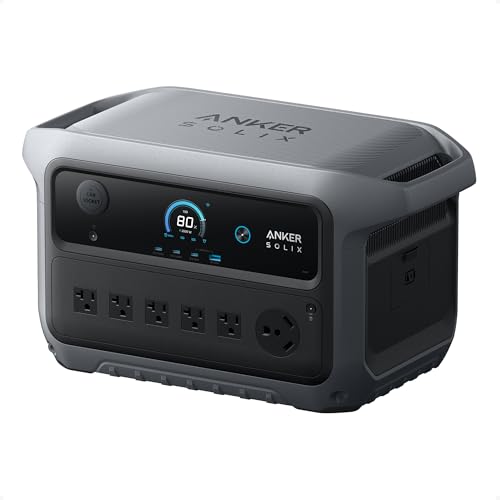
- Model
- A1783
- Capacity
- 2,048 Wh (51.2 V, 40 Ah), LFP (manual)
- Cycle Life
- 4,000 cycles to 80% (Anker spec table)
- AC Output
- 120 V, 2,400 W total incl. TT-30; 4,000 W peak; SurgePad 3,000 W (manual, Anker page)
- 12V Car Socket
- 12 V, 10 A (manual)
- Inputs
- AC 1,800 W; XT60i 11–28 V 8.2 A, 28–60 V 17 A, 800 W (manual)
- Expansion
- 1 x BP2000 (Gen 2), 4,096 Wh total (Anker page)
- Weight
- 18.9 kg (41.7 lb) (Anker page)
- Dimensions
- 18.1 x 9.8 x 10.1 in (Anker page)
- Temperature
- Charge 32–104°F; discharge -4–104°F (manual)
Anker SOLIX C2000 Gen 2 Review: A 2 kWh Induction Station That Can Grow to 4 kWh
The Anker SOLIX C2000 Gen 2 is a 2,048 Wh lithium iron phosphate (LiFePO4) power station rated for 2,400 W of continuous AC output. Like the EcoFlow DELTA 3 Max, it runs an 1,800 W induction cooktop with about 600 W to spare. Three things set it apart for a van kitchen. It accepts one expansion battery, which doubles the capacity to 4,096 Wh. It has a TT-30 outlet, the 30 A plug an RV's shore cord uses. And Anker lists an 800 W alternator charger for it, which refills the battery in about three hours of driving. At 41.7 lb, it's also lighter than the other 2 kWh stations on this site.
What the Amazon link sells: the listing titled "Anker SOLIX C2000 Gen 2 Portable Power Station, 2,048Wh, 2,400W, Camping" (ASIN B0FVFGL38H, model A1783), in gray. It's the station on its own. It isn't the bundle with a 400 W solar panel, the bundle with an expansion battery, or the bundle with an alternator charger, which Anker sells separately. When we checked, Amazon showed the listing in stock.
This review is research-based. VanLifeKitchens doesn't test products hands-on. The specs come from Anker's C2000 Gen 2 user manual (US edition), Anker's US product page and the Amazon listing. Runtime figures are our estimates, and each one shows its arithmetic and assumptions, using the same method as our guide can a power station run an induction cooktop?
Choose this if:
- You want to cook on an 1,800 W induction cooktop and keep headroom, in a 2 kWh station that's lighter than its rivals.
- You might want more capacity later. One BP2000 (Gen 2) expansion battery takes it to 4,096 Wh.
- You drive most days and want fast charging on the move. Anker lists 100% in 3 hours from its 800 W alternator charger.
Skip this if:
- You lift your station in and out every day. At 41.7 lb, it's still a heavy two-handed lift.
- Your main loads are a 12 V fridge and devices. The Jackery Explorer 500 v2 or the Anker SOLIX C1000 do that job with far less weight.
- You need the most continuous AC output. The BLUETTI Elite 200 V2 is rated at 2,600 W.
What it is
A portable power station puts a battery, an inverter, a charger and output ports in one box. It isn't wired into the vehicle. You charge it from a wall outlet, solar panels, a car or an alternator charger, and plug your loads into it.
According to Anker's manual, the C2000 Gen 2 has NEMA 5-20R AC outlets, a TT-30 outlet, a car socket with its own button, three USB-C outputs (two at 140 W and one at 15 W) and one 12 W USB-A port. Inputs are an AC socket and one XT60i port for solar or car charging, plus an expansion-battery port and an overload protection switch. Anker's manual says the USB-C ports are output only. There's app control over Bluetooth and Wi-Fi.
Specifications and sources
| Spec | Anker figure | Source |
|---|---|---|
| Rated capacity | 2,048 Wh (51.2 V, 40 Ah), LFP | Manual, Anker page |
| Cycle life | 4,000 cycles to 80% | Anker page |
| AC output | 120 V, 20 A, 2,400 W total | Manual |
| TT-30 outlet | 120 V, 20 A, 2,400 W max | Manual |
| Peak and SurgePad | 4,000 W peak; SurgePad up to 3,000 W | Anker page, manual |
| 12 V car socket | 12 V, 10 A | Manual |
| USB | 2 x USB-C 140 W, 1 x USB-C 15 W, 1 x USB-A 12 W | Manual |
| AC input | 120 V, 1,800 W max; 12 A continuous, 15 A under 3 hours | Manual |
| Solar/car input | XT60i: 11–28 V 8.2 A, 28–60 V 17 A, 800 W max | Manual |
| Alternator charger | 800 W, 100% in 3 hours (sold separately) | Anker page |
| Expansion | 1 x BP2000 (Gen 2), 4,096 Wh total | Anker page |
| Weight | 18.9 kg (41.7 lb) | Anker page, listing |
| Size | 18.1 x 9.8 x 10.1 in | Anker page |
| Charge temperature | 32–104°F (0–40°C) | Manual |
| Discharge temperature | -4–104°F (-20–40°C) | Manual |
| UPS switchover | 10 ms | Manual |
A few notes on the documents. Anker's US product page gives the cycle life as 4,000 cycles to 80% in its specifications table, but a comparison block elsewhere on the same page lists "3000+ Cycles" to 80% and a smaller size. We use the specifications table and flag the difference. Neither the manual nor the specifications table states how many 5-20R outlets the station has, so count them in the listing photos if that matters. The Amazon listing gives the warranty as 5 years. Anker's manual shows an AC charging cable and a car charging cable in the box, while the Amazon listing names only the AC charging cable, a quick start guide, a safety manual and a warranty card. Check what arrives.
Usable Wh vs rated Wh
The 2,048 Wh on the label is the battery's rated energy. You get less at the outlets, because the inverter and converters turn some of it into heat. Anker doesn't publish an efficiency figure in the manual we opened, so we use the same 85–90% range as our other station reviews.
Usable energy (estimate): 2,048 × 0.85 = about 1,741 Wh, and 2,048 × 0.90 = about 1,843 Wh. With one BP2000 (Gen 2) expansion battery, 4,096 Wh gives about 3,482–3,686 Wh.
Anker also lists a 9 W idle power consumption. Our standard method doesn't subtract idle draw, but for a slow, all-day load such as a fridge, it matters, so the fridge section shows both.
Can it run an 1,800 W induction cooktop?
Yes, with headroom. The continuous AC rating is 2,400 W at 120 V. The Duxtop 9100MC's maximum is 1,800 W, which leaves about 600 W for a second small load, such as a laptop charger, or for the measurement tolerance our guide recommends allowing. Don't run a second high-wattage appliance, such as a kettle, alongside the cooktop. Anker's manual says the total AC output is 2,400 W maximum.
How long, at full power (estimate): usable Wh ÷ cooktop W = hours.
- 1,741 ÷ 1,800 = 0.97 h, about 58 minutes, up to 1,843 ÷ 1,800 = 1.02 h, about 61 minutes.
- With the expansion battery: 3,482 ÷ 1,800 = 1.93 h, about 116 minutes, up to 3,686 ÷ 1,800 = 2.05 h, about 123 minutes.
Assumptions: the station starts full, the cooktop draws its full 1,800 W the whole time, nothing else is plugged in, and no capacity is reserved.
A realistic meal pattern. Our guide's example is a 20-minute cook at a steady 1,000 W: about 333 Wh at the cooktop and 370–392 Wh from the battery. The C2000 Gen 2 covers about five of those per charge, or about ten with the expansion battery.
The Nuwave PIC Gold. At its 1,500 W default, the Nuwave PIC Gold leaves about 900 W of headroom, for an estimated 1,741 ÷ 1,500 = 70 minutes up to 1,843 ÷ 1,500 = 74 minutes at a steady 1,500 W.
SurgePad isn't for cooking. Anker's manual says SurgePad turns on automatically when the total output exceeds the rated output, allowing up to 3,000 W for high-wattage devices. It works better with devices that generate heat, but it "does not support precision instruments and other devices that have voltage protection or strict voltage requirements", and it doesn't work while the station is charging from AC. An 1,800 W cooktop alone stays below 2,400 W, so SurgePad shouldn't come into play. If you add loads above the rating, though, the station may try to carry them through SurgePad rather than simply shut off. Both cooktop manuals list voltage limits, so keep the total under 2,400 W.
Running a 12 V fridge
Anker's manual rates the car socket at 12 V, 10 A. That's above the 7.6 A maximum Dometic publishes for the CFX5 35, so a typical compressor fridge fits within it. Running the fridge from the 12 V socket avoids the inverter.
How long (estimate). We use the published daily figures from our power budget guide: ICECO's 430 Wh per 24 hours lab figure for the ICECO VL35 ProS (about 17.9 W on average), and about 320 Wh per day for the Dometic CFX5 35 at 90°F ambient (about 13.3 W on average).
| Fridge (published daily figure) | Standard method, 1,741–1,843 Wh | If 9 W idle applied all day | With expansion, standard method |
|---|---|---|---|
| ICECO VL35 ProS, 430 Wh/day | about 97–103 hours (4.0–4.3 days) | about 65–69 hours | about 8.1–8.6 days |
| Dometic CFX5 35, about 320 Wh/day | about 131–138 hours (5.4–5.8 days) | about 78–83 hours | about 10.9–11.5 days |
Arithmetic: 1,741 ÷ 430 = 4.05 days and 1,843 ÷ 430 = 4.29 days; 1,741 ÷ 320 = 5.44 days and 1,843 ÷ 320 = 5.76 days. With 9 W added, 1,741 ÷ (17.9 + 9) = 65 hours and 1,843 ÷ 26.9 = 69 hours; 1,741 ÷ (13.3 + 9) = 78 hours and 1,843 ÷ 22.3 = 83 hours. With the expansion battery, 3,482–3,686 Wh ÷ 430 = 8.1–8.6 days and ÷ 320 = 10.9–11.5 days.
Anker doesn't say whether the 9 W idle figure applies when only the car socket is on, so the real result probably falls between the first two columns. Anker's own example, a "dual-door fridge for up to 32 hours", refers to a household-style fridge on AC, so it isn't comparable with a 12 V compressor fridge. Try your own numbers in the fridge battery calculator.
Auto-off settings. Anker's manual says the AC outlets turn off if no plug is detected for more than 15 minutes, and the car socket turns off if no plug is detected for more than five hours. Both features are on by default and can be disabled in the app. They detect a plug, not a load, so a fridge left plugged in shouldn't trip them, but check the settings. The manual also says the station's default standby duration is 12 hours, adjustable in the app. Check it before leaving a fridge running for days.
Recharging: AC, solar, car and alternator
- AC (wall, shore power or generator): up to 1,800 W. Anker's manual says the AC input draws 12 A continuously, and up to 15 A for less than three hours. Anker's page quotes 100% in 58 minutes using AC and solar together. If AC charging stops, the manual says to check and reset the overload protection switch.
- Solar: one XT60i input, 800 W maximum. Between 11 and 28 V, it's limited to 8.2 A. Between 28 and 60 V, it takes up to 17 A. So panels wired to a higher voltage, in series, reach the full 800 W, while a single 12 V-class panel is capped at about 230 W (28 × 8.2). Anker's FAQ says to keep the input voltage at or below 60 V, or the station may be damaged, and that it prioritizes solar when solar and AC are connected together. As our own estimate, replacing about 1,800 Wh at an average 300 W of net solar would take about six hours of good sun (1,800 ÷ 300). Real output depends on sun angle, cloud, heat and shading.
- Car socket: the car charging cable uses the same XT60i input. At 12 V, the 8.2 A limit means about 98 W, by our estimate. A full recharge from empty would take about 21 hours of driving (2,048 ÷ 98), more with losses. It's a top-up, not a refill.
- Alternator charger: Anker's page lists its 800 W alternator charger, sold separately, at 100% in about three hours. For a van that drives most days, this is what makes a 2 kWh station practical for daily induction cooking without hookups. It's a permanent connection to the vehicle's electrical system. Follow Anker's installation instructions, and have a qualified installer fit it where your vehicle maker, local codes or your insurer require one.
The TT-30 outlet
The TT-30 outlet is unusual on a station this size. It's the same 30 A, 120 V socket an RV's shore cord plugs into at a campground, rated at 2,400 W on this station. It lets you power a small RV's 120 V outlets from the station through the RV's own cord. The total output is still 2,400 W, so an RV's air conditioner and an induction cooktop can't run at the same time.
Connecting a station to an RV's shore inlet powers the RV's whole 120 V system. Follow Anker's instructions and your RV maker's, and have a qualified RV electrical technician check the setup where codes or insurers require it. Anker's manual also notes that the station uses a floating ground design, and that some devices need a neutral-ground bond to work. For those, it says to use a ground-neutral plug in one of the AC outlets.
Temperature limits and safety
- Charging: 32–104°F. Discharging: -4–104°F.
- Storage: Anker's manual says to power it off when not in use, store it somewhere dry and cool, check the battery level each week and charge to 100% if it's below 30%, and fully charge it at least once every three months during long storage.
The 104°F upper limit is lower than EcoFlow's 113°F. A closed van in summer sun can pass that, so keep it shaded and don't leave it charging in a hot, closed vehicle.
Anker ships a separate safety manual with the station. General guidance for any lithium station applies in a van: keep it dry and away from the sink and an open door in rain, keep its vents clear and away from a stove's exhaust, keep it out of reach of children, and strap it to solid anchor points. At 41.7 lb, it shouldn't be able to slide in a sudden stop. Don't wire it into a van's fixed electrical system yourself; the battery bank guide explains the fixed-system alternative. Induction cooking still makes steam and grease, so the ventilation guide applies when you cook inside.
How it fits a van or camp kitchen
At 18.1 x 9.8 x 10.1 inches, the C2000 Gen 2 is long and low, like the DELTA 3 Max. It suits an under-bench or under-bed spot, with the outlets facing the aisle so the cooktop's cord reaches and the vents stay clear. A 12 V fridge goes on the car socket, devices on USB-C, and the cooktop on an AC outlet. If you add the expansion battery, leave room for it in the same bay.
The strongest case for it is a van that drives most days, cooks on induction and has room for an alternator charger. That combination covers daily cooking without hookups. If you mostly stay parked, solar sizing becomes the limit, and the induction vs butane vs propane guide explains when it's worth keeping a gas stove for outdoor use as a backup. Use the power calculator to total your daily loads.
Limitations
- Weight. 41.7 lb, lighter than its 2 kWh rivals but still heavy.
- Single solar input. 800 W maximum, and only about 230 W from low-voltage panels.
- Conflicting cycle figures on Anker's own page: 4,000 in the specifications, 3,000+ in a comparison block.
- Outlet count not stated in the manual's text.
- 104°F upper temperature limit.
- Expansion battery and alternator charger cost extra.
How it compares
- EcoFlow DELTA 3 Max: the same 2,048 Wh and 2,400 W, with 500 W of solar, a 12 V or 24 V car input and an 800 W alternator charger option. It weighs 44.8 lb, its manual lists no cycle rating, and it has no expansion battery. See Anker SOLIX C2000 Gen 2 vs EcoFlow DELTA 3 Max.
- BLUETTI Elite 200 V2: 2,073.6 Wh and 2,600 W continuous, with 1,000 W of solar and 6,000 cycles to 80%, but 53.35 lb and no expansion.
- Anker SOLIX C1000: half the capacity and 1,800 W, with no headroom over the Duxtop, at about 28 lb.
Verdict
The Anker SOLIX C2000 Gen 2 is the most flexible 2 kWh station on this site. It runs an 1,800 W cooktop with 600 W to spare, for about 58–61 minutes at full power per charge by our estimate. It weighs less than its rivals, and it grows to 4 kWh with one expansion battery. For a van that drives most days, the 800 W alternator charger option is the standout: Anker lists a full refill in about three hours on the road. The things to weigh are an 800 W solar ceiling that's lower than BLUETTI's, inconsistent cycle figures on Anker's own page, and a 104°F upper limit. If you want induction headroom and an upgrade path, this is the station we'd shortlist first.
FAQ
Can the Anker SOLIX C2000 Gen 2 run an 1,800 W induction cooktop? Yes. Its continuous AC output is 2,400 W, about 600 W above the Duxtop 9100MC's maximum. Our estimate is about 58–61 minutes at full power from a full charge, or about 116–123 minutes with the BP2000 (Gen 2) expansion battery.
How long will it run a 12 V fridge? By our standard method, about 4.0–4.3 days for a fridge using 430 Wh a day and about 5.4–5.8 days at 320 Wh a day. If Anker's 9 W idle figure applied the whole time, those become about 65–69 hours and 78–83 hours.
Can I add an extra battery? Yes. Anker lists one BP2000 (Gen 2) expansion battery, for 4,096 Wh in total.
What is the TT-30 outlet for? It's the 30 A RV-style socket, rated at 2,400 W here. It lets an RV's shore cord plug into the station. The station's total output is still 2,400 W, and connecting to an RV's system should follow Anker's and the RV maker's instructions.
How fast does it charge from a vehicle? From a 12 V socket, about 98 W by our estimate, which is a top-up. With Anker's 800 W alternator charger, sold separately, Anker lists 100% in about three hours.
Can it be charged below freezing? No. Anker's charge range is 32–104°F. It can discharge down to -4°F.
Sources and verification
- Anker SOLIX C2000 Gen 2 user manual, US edition (Anker document, PDF hosted by a dealer): product overview and ports, box contents, AC, solar and car recharging, AC and car socket auto-off, default standby, UPS, SurgePad, FAQ (XT60i voltage and current limits, USB-C output only, overload switch, storage, solar priority, floating ground and ground-neutral plug), specifications (capacity, AC and TT-30 output, AC input, XT60i input, car charger output, USB, temperatures). https://cdn.shopify.com/s/files/1/0643/9128/2937/files/Anker_SOLIX_C2000_Gen_2_Manual.pdf (checked 2026-10-13)
- Anker SOLIX US, C2000 Gen 2 product page: model A1783, specifications table (2,048 Wh, LFP, 4,000 cycles to 80%, NEMA 5-20R, TT-30R and inlet-box outputs, 4,000 W peak, car charger 12 V 10 A, 800 W solar, 18.9 kg, 18.1 x 9.8 x 10.1 in, UPS 10 ms), 9 W idle figure, BP2000 (Gen 2) expansion to 4,096 Wh, 800 W alternator charging at 100% in 3 hours, 100% in 58 minutes, the comparison block listing 3,000+ cycles. https://www.ankersolix.com/products/c2000-gen2 (checked 2026-10-13)
- Amazon product listing for ASIN B0FVFGL38H, the listing this review links to: title, model A1783, warranty field, weight and size, box contents, availability (checked 2026-10-13)
- Duxtop 9100MC and Nuwave PIC Gold figures, the 85–90% efficiency assumption and the runtime method come from this site's power station and induction guide. Fridge figures come from the power budget guide.
Compare with similar products
See how this stacks up against the other portable power stations we've reviewed.
Head-to-head comparisons
Related Reviews

For: 1,800 W induction plus fridge
EcoFlow DELTA 3 Portable Power Station, 1024Wh, 1800W (EF-DL-H10-3)
A 1,024 Wh LiFePO4 station whose 1,800 W continuous rating reaches the Duxtop 9100MC's full power, with no headroom, for about 29–31 minutes per charge by our estimate. It adds a 10 A car socket for a 12 V fridge, 500 W solar, 1,500 W AC charging and expansion batteries, but its 113°F ceiling and 27.6 lb weight need planning.

For: Cold-weather and solar setups
Anker SOLIX C1000 Portable Power Station with Car Charging Cable, 1,056Wh (A1761)
A 1,056 Wh LiFePO4 station rated for 1,800 W continuous, enough for the Duxtop 9100MC at full power with no headroom, for about 30–32 minutes per charge by our estimate. It has the highest solar input here (600 W) and discharges down to -4°F, but Anker rates it for 3,000 cycles and stops charging and discharging at 104°F.

For: Fridge plus PIC Gold cooking
Jackery Explorer 1000 v2 Portable Power Station, 1070Wh, 1500W (JE-1000D)
The lightest 1 kWh station here at 23.8 lb, with 1,070 Wh of LiFePO4 capacity and a 10 A car port for a 12 V fridge. Its 1,500 W continuous rating can't run the Duxtop 9100MC at full power, but it suits the Nuwave PIC Gold, especially at 900 W (about an hour per charge, estimated). Solar is capped at 400 W.