Anker SOLIX C300 DC Portable Power Station, 288Wh, 300W (A1726)

- Model
- A1726 (C300 DC, no AC)
- Capacity
- 288 Wh, LiFePO4 (Anker page, manual)
- Cycle Life
- 3,000+ cycles to 80% (Anker page)
- AC Output
- None; 300 W total DC/USB output (Anker manual)
- 12V Car Socket
- 12 V, 10 A, 120 W (Anker manual)
- USB
- 2 x 140 W USB-C two-way, 1 x 100 W, 1 x 15 W; 2 x 12 W USB-A (Anker)
- Inputs
- USB-C up to 140 W per port; XT60 11–28 V, 8.2 A, 100 W (Anker manual)
- Weight
- 2.8 kg (6.17 lb) (Anker manual)
- Dimensions
- 4.88 x 4.72 x 7.87 in (Anker manual)
- Temperature
- Charge 32–104°F; discharge -4–104°F (Anker manual)
Anker SOLIX C300 DC Review: A 6.2 lb DC-Only Battery for a 12 V Fridge and Devices
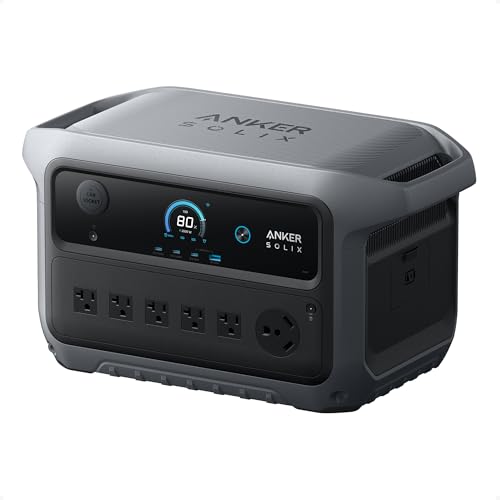
The Anker SOLIX C300 DC is a 288 Wh lithium iron phosphate (LiFePO4) power station with no AC outlets. Instead of an inverter, it has a 12 V car-style socket, four USB-C ports and two USB-A ports, and it charges through USB-C, solar or a car. That design is why it's on this site. Many small van and car-camping kitchens need only DC power: a 12 V compressor fridge, phones, a headlamp, a lantern and a laptop that charges over USB-C. Dropping the inverter makes the C300 DC the lightest station we cover, at about 6.2 lb. It also means it can't run any induction cooktop, kettle or other AC appliance.
What the Amazon link sells: the listing titled "Anker SOLIX C300 DC Portable Power Station, 288Wh, 300W, Outdoor Camping" (ASIN B0D62PMB3R, model A1726), in dark gray. This is the DC-only model. It isn't the Anker SOLIX C300 with AC outlets (model A1722), and it isn't one of the bundles with a solar panel or a bag. When we checked, Amazon showed the listing in stock.
This review is research-based. VanLifeKitchens doesn't test products hands-on. The specs come from Anker's US product page, Anker Japan's A1726 user manual (in Japanese, used for the specifications table) and the Amazon listing. Runtime figures are our estimates, with the arithmetic and assumptions shown, using the same method as our van kitchen power budget guide. See how we research.
Choose this if:
- Every load you run is DC: a 12 V fridge, USB-C devices, USB lights and phones.
- Weight and size matter most. At about 6.2 lb and 4.9 x 4.7 x 7.9 inches, it's the smallest station on this site.
- You already carry a USB-C laptop charger and want to recharge from it, or from a car on the move.
Skip this if:
- You need any AC outlet, even for a small device. Look at the EcoFlow RIVER 3 Plus, about the same capacity with three AC outlets.
- You want more than about a day of fridge power. The Jackery Explorer 500 v2 stores about 78% more energy.
- You plan to cook on electricity. No station this size can, and this one has no inverter at all. The EcoFlow DELTA 3 Max and Anker SOLIX C2000 Gen 2 are the induction options.
What it is
Think of the C300 DC as a large LiFePO4 battery bank with a car socket. It has a 12 V socket with its own on/off button, two 140 W USB-C ports that work as both inputs and outputs, a 100 W USB-C output, a 15 W USB-C output and two 12 W USB-A outputs. Charging comes in through the two-way USB-C ports or an XT60 port that takes solar panels or a car charging cable. Anker's page lists app control over Wi-Fi and Bluetooth.
It stands upright, like a thick book on its spine, with a carry-strap point. Anker sells the shoulder strap separately.
Specifications and sources
| Spec | Anker figure | Source |
|---|---|---|
| Rated capacity | 288 Wh, LiFePO4 | Anker page, A1726 manual |
| Cycle life | 3,000+ cycles to 80% | Anker page |
| AC output | None (DC-only model) | Anker page |
| Total output | 300 W | A1726 manual, listing |
| 12 V car socket | 12 V, 10 A (120 W) | A1726 manual, listing |
| USB-C | 2 x 140 W two-way, 1 x 100 W, 1 x 15 W | A1726 manual, Anker page |
| USB-A | 2 x 12 W | Anker page |
| Solar or car input | XT60, 11–28 V, 8.2 A, 100 W max | A1726 manual, Anker page |
| USB-C input | Up to 140 W per two-way port | A1726 manual |
| Weight | 2.8 kg (6.17 lb) | A1726 manual, Anker page |
| Size | 12.4 x 12.0 x 20.0 cm (4.88 x 4.72 x 7.87 in) | A1726 manual, Anker page |
| Charge temperature | 32–104°F (0–40°C) | A1726 manual |
| Discharge temperature | -4–104°F (-20–40°C) | A1726 manual, Anker page |
A few notes on the documents. Anker's English-language US product page gives the headline figures but only part of the specifications. The full specifications table we used is in Anker Japan's A1726 manual. Its numbers match the US page wherever both give a figure. The warranty is listed differently in two places: the Amazon listing says 3 years, and a specification block on Anker's US page says 5 years. Plan on 3 years and check the warranty card in the box.
Per the Amazon listing, the box contains the station, a 60 cm 140 W USB-C to USB-C cable, a safety manual and warranty information. No wall charger, solar cable, car charging cable or strap is included.
Usable Wh vs rated Wh
The 288 Wh on the label is the battery's rated energy. Some is lost as heat in the DC converters that produce 12 V and the USB voltages. Anker doesn't publish an efficiency figure, so we use the same 85–90% range as our other station reviews. With no inverter in the path, the real figure for the 12 V socket may sit at the top of that range or above it.
Usable energy (estimate): 288 × 0.85 = about 245 Wh, and 288 × 0.90 = about 259 Wh.
Can it run an 1,800 W induction cooktop?
No. The C300 DC has no AC outlets and a total output of 300 W, so it can't power the Duxtop 9100MC, the Nuwave PIC Gold or any other 120 V appliance. Its continuous AC rating and surge rating are both "none", because it has no inverter. A plug-in inverter in the car socket doesn't change that: the socket is limited to 120 W, a small fraction of what a cooktop draws. If electric cooking is part of the plan, our induction guide explains how to size a station for it.
Running a 12 V fridge: hours, not days
The fridge is the C300 DC's main job. Anker rates the car socket at 12 V, 10 A (120 W). That's above the 7.6 A maximum Dometic publishes for the CFX5 35, so a typical compressor fridge fits within it.
How many hours of fridge (estimate). We use the same published daily figures as our power budget guide: ICECO's 430 Wh per 24 hours lab figure for the ICECO VL35 ProS, and about 320 Wh per day for the Dometic CFX5 35, from Dometic's US rating at 90°F ambient.
| Fridge (published daily figure) | Hours on 245–259 Wh |
|---|---|
| ICECO VL35 ProS, 430 Wh/day | about 14 |
| Dometic CFX5 35, about 320 Wh/day | about 18–19 |
Arithmetic: 245 ÷ 430 × 24 = 13.7 hours and 259 ÷ 430 × 24 = 14.5 hours; 245 ÷ 320 × 24 = 18.4 hours and 259 ÷ 320 × 24 = 19.4 hours.
Assumptions: the station starts full, nothing else draws from it, there's no charging, and the fridge uses its published daily figure. Hot weather, a low setpoint, frequent lid opening and warm food all shorten it. A 20-liter fridge such as the Alpicool C20 or the ICECO GO20 may use less, so check its published figure and run your own numbers in the fridge battery calculator.
What that means in practice. The C300 DC carries a 35-liter fridge through one night and part of the next day, then needs recharging. That suits car camping and short van trips where you drive most days. It doesn't suit a multi-day stop without sun or hookups. Charging your phones and laptop from the same battery shortens the fridge's share. A 60 Wh laptop recharge takes about a quarter of the usable energy.
Recharging: USB-C, solar and car
- USB-C: each two-way USB-C port accepts up to 140 W, per Anker's manual, and Anker's listing says the dual USB-C ports recharge it to 80% in about an hour. That needs one or two strong USB-C PD chargers, which aren't in the box. The listing also says the very first charge, which activates the station, must be over USB-C from a charger of 18 W or more. In a van with shore power, a good USB-C laptop charger is the simplest way to refill it.
- Solar: the XT60 input takes 11–28 V at up to 8.2 A, 100 W maximum. Anker recommends its 100 W or 60 W panels, and the listing says it isn't compatible with Anker's PS30 USB-C panel or its PS200 and PS400 panels. That 28 V ceiling rules out connecting two typical 100 W panels in series. As our estimate, at an average of 60 W net from a 100 W panel, replacing 250 Wh takes about four hours of good sun (250 ÷ 60). A day of fridge use at 430 Wh is more than a single 100 W panel reliably replaces, so treat solar as a top-up.
- Car: Anker lists car charging, through the same XT60 input with a car charging cable, sold separately. With 8.2 A at 12 V, that's about 98 W, so about three hours from empty by our estimate (288 ÷ 98), more with losses. A day's driving roughly refills it.
The solar limit is the main thing to plan around. If you'll rely on panels, the EcoFlow RIVER 3 Plus accepts up to 220 W.
Temperature limits and safety
- Charging: 32–104°F. Discharging: -4–104°F.
The discharge range is wide at the cold end, so the C300 DC can run a fridge on a frosty night. But it can't be charged below freezing, and its upper limit of 104°F is lower than EcoFlow's 113°F. A closed van in summer sun can easily pass 104°F, so keep the station shaded and out of a hot, closed vehicle while it charges.
Anker ships a safety manual with the station. General guidance for any lithium station applies: keep it dry and away from the sink and an open door in rain, keep it away from heat sources and a stove's exhaust, don't cover it while it charges, strap it down in a moving vehicle, and keep it out of reach of children. It's a plug-in device. Don't wire it into a van's fixed electrical system. For a permanent setup, the battery bank guide covers the fixed alternative.
How it fits a van or camp kitchen
At 4.9 x 4.7 x 7.9 inches, the C300 DC fits in a door pocket, a cup-holder console bin or the gap beside a fridge. The fridge plugs into the car socket, a phone and lantern into USB, and a laptop into a 100 W or 140 W USB-C port. Place it where you can reach the socket's on/off button and see the screen.
A good match is a 20–35 liter fridge on a weekend or short trip, with cooking on a butane or propane stove used outdoors as its manual requires. The induction vs butane vs propane guide covers that choice. For a longer trip, consider a second battery or a larger station. The weekend car camping kitchen guide shows a complete small kit, and the power calculator helps you add up daily loads.
Limitations
- No AC outlets. Nothing that plugs into a wall socket will run on it.
- Small battery. About 14–19 hours of a 35-liter fridge, by our estimate.
- Solar capped at 100 W and 28 V. Slow to refill from panels.
- Minimal box contents. No wall charger, solar cable or car cable.
- Upper temperature limit of 104°F. Lower than some rivals.
- Warranty figures differ between the listing (3 years) and Anker's page (5 years).
How it compares
- EcoFlow RIVER 3 Plus: 286 Wh with three AC outlets (600 W), 220 W solar input, a built-in light and an expansion port up to 858 Wh, at about 10.4 lb. It's the choice if you might ever need AC.
- Jackery Explorer 500 v2: 512 Wh and 500 W of AC, charging and discharging down to -4°F, at about 12.6 lb. It runs a fridge about twice as long.
- Anker SOLIX C1000: Anker's 1 kWh, 1,800 W station, for when you want to run an induction cooktop too.
Verdict
The Anker SOLIX C300 DC does one thing well: it's a small, light LiFePO4 battery for an all-DC kitchen. A 12 V fridge, phones, lights and a USB-C laptop all run from it, and it recharges from USB-C, a car or a small panel. By our estimate, it runs a typical 35-liter fridge for about 14–19 hours on a full charge, which suits trips with daily driving. It can't cook and it has no AC outlets, and its solar input is small. If those don't matter to you, it's the lightest way on this site to keep a fridge cold.
FAQ
Can the Anker SOLIX C300 DC run an induction cooktop? No. It has no inverter and no AC outlets, and its total output is 300 W. An 1,800 W cooktop needs a station with a continuous AC rating well above 1,800 W.
How long will it run a 12 V fridge? As an estimate, about 14 hours for a fridge using 430 Wh a day (ICECO's figure for the VL35 ProS), or about 18–19 hours at 320 Wh a day (Dometic's US figure for the CFX5 35 at 90°F ambient). That assumes 85–90% of the 288 Wh is usable and there's no charging.
What's the difference between the C300 DC and the C300? The C300 DC (model A1726) has no AC outlets. The C300 (model A1722) adds AC outlets. The Amazon link in this review sells the C300 DC.
How do I charge it? Through USB-C (up to 140 W per two-way port), solar (11–28 V, 100 W maximum) or a car charging cable. Anker says the first charge must be over USB-C with a charger of 18 W or more.
What is its cycle life? Anker's US page lists 3,000+ cycles to 80% capacity for its LiFePO4 battery.
Can I use it in freezing weather? It can discharge down to -4°F, according to Anker's manual, but it can't be charged below 32°F.
Sources and verification
- Anker SOLIX US, C300 DC product page: DC-only model, 288 Wh, 300 W, LiFePO4, 3,000+ cycles to 80%, USB-C and USB-A outputs, 120 W car socket, XT60 solar input 11–28 V, 8.2 A, 100 W, weight and size, warranty field. https://www.ankersolix.com/products/c300-dc (checked 2026-10-13)
- Anker Japan, A1726 (Anker SOLIX C300 DC) user manual, Japanese edition: specifications table (capacity, DC input limits, USB-C input and output ratings, 12 V 10 A car socket, 300 W total output, charge and discharge temperatures, size, 2.8 kg weight). https://lp.ankerjapan.com/hubfs/aoos/manual/A1726Manual.pdf (checked 2026-10-13)
- Amazon product listing for ASIN B0D62PMB3R, the listing this review links to: title, model A1726, warranty field, first-charge activation note, solar panel compatibility note, port list, box contents, availability (checked 2026-10-13)
- Fridge figures come from this site's power budget guide, and cooktop figures from the power station and induction guide, which list the manuals they checked.
Compare with similar products
See how this stacks up against the other portable power stations we've reviewed.
Related Reviews

For: Induction cooking, large solar
BLUETTI Elite 200 V2 Portable Power Station, 2073.6Wh, 2600W
A 2,073.6 Wh LiFePO4 station rated for 2,600 W continuous, so it runs the Duxtop 9100MC with about 800 W of headroom, for roughly 53–62 minutes at full power per charge by our estimates. BLUETTI lists 6,000+ cycles to 80% and a 1,000 W solar input, but it weighs 53.35 lb, isn't expandable, and its own runtime formula counts about 10 W of self-consumption.
For: Expandable induction-capable station
Anker SOLIX C2000 Gen 2 Portable Power Station, 2,048Wh, 2,400W (A1783)
A 2,048 Wh LiFePO4 station rated for 2,400 W continuous, so it runs the Duxtop 9100MC with about 600 W of headroom, for roughly 58–61 minutes at full power per charge by our estimate. At 41.7 lb it's the lightest 2 kWh station we cover, it expands to 4,096 Wh, and Anker lists an 800 W alternator charger, but its solar input is 800 W and its upper temperature limit is 104°F.

For: 1,800 W induction plus fridge
EcoFlow DELTA 3 Portable Power Station, 1024Wh, 1800W (EF-DL-H10-3)
A 1,024 Wh LiFePO4 station whose 1,800 W continuous rating reaches the Duxtop 9100MC's full power, with no headroom, for about 29–31 minutes per charge by our estimate. It adds a 10 A car socket for a 12 V fridge, 500 W solar, 1,500 W AC charging and expansion batteries, but its 113°F ceiling and 27.6 lb weight need planning.