Example Shopping Plan: One-Person Compact Van Kitchen
An example shopping plan, not a tested build: a 12V fridge, an outdoor butane stove and a one-pot kit for one person in a compact van, with exact variants, fit and clearance checks, and how to size the battery in Wh and Ah.
Disclosure: As an Amazon Associate I earn from qualifying purchases. Links to Amazon on this page are affiliate links: if you buy through one, VanLifeKitchens.com may earn a commission at no extra cost to you. Read our affiliate disclosure.
What this page is
This is an example shopping plan, not a tested build. Nobody at VanLifeKitchens has built or lived with this exact combination. It's a researched starting list for one person in a compact van, assembled from manufacturer manuals and the reviews on this site, with the checks you need to run before buying. There are no prices or totals here; use the "Check price on Amazon" buttons on each review for current prices.
If you'd rather read a full build narrative, the Minimalist Sprinter setup describes a solo kitchen in a larger van, with induction as the main cooktop and a much bigger electrical system than this plan assumes.
Who it suits
- One person, cooking simple meals for themselves most days.
- A compact van or small camper: for example a Ford Transit Connect, Ram ProMaster City, Nissan NV200, or a minivan with the rear seats out. The plan also works in a larger van if you want to keep the kitchen small.
- Trips from long weekends to a few weeks, with a grocery stop every few days.
- People happy to cook outside on a butane stove in normal weather, with cold or no-cook meals as the fallback.
- People who want a small electrical system: enough to run a 12V fridge, lights and phone charging, not an induction cooktop.
Who should choose another approach
- You need to cook inside the van in rain, snow or wind. The stove in this plan is a camp stove its maker labels for outdoor use only. Indoor cooking means an electric cooktop and the power to run it. See the two-person induction kitchen plan and the power budget guide.
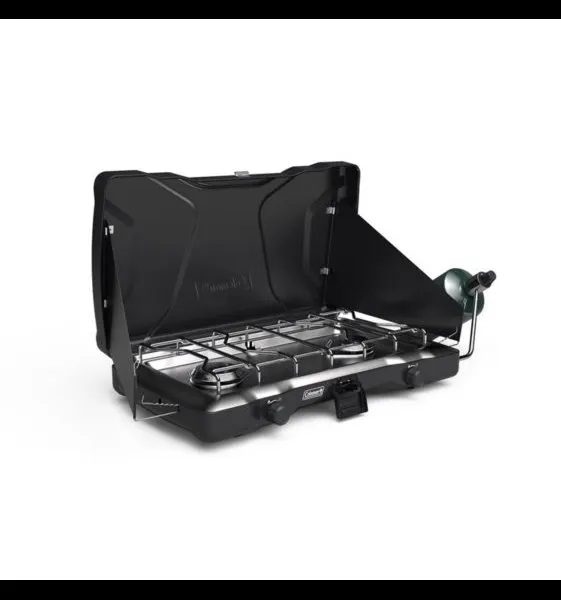
- You cook big, multi-pot meals. A single burner means cooking in sequence. A two-burner propane stove like the Coleman Triton+ helps, but it's larger.
- You only camp one or two nights at a time and drive daily. A cooler and the weekend car-camping checklist may be all you need.
- You camp in sustained freezing weather. Butane loses pressure in the cold. Read the cold-weather cooking guide first.
Assumptions
Every recommendation below depends on these. Change one and the plan may change.
- Travel style: one person, mostly stationary for one to three days at a time, then driving. Resupply of food and water every three to five days.
- Space: a floor footprint for a 35-litre-class fridge, one lidded bin for the cook kit, one for dry food, and one water jug. No cabinetry, no plumbing.
- Cooking habits: one hot meal a day plus coffee and a simple breakfast. One pot and one pan. No baking.
- Power: a 12 V battery system (a separate house battery or a portable power station) that only has to run the fridge, lights and phone charging. No inverter is needed for the essentials.
- Water: carried in jugs from treated taps. A filter only for occasional untreated sources.
Essential products
12V fridge: Iceco VL35 ProS
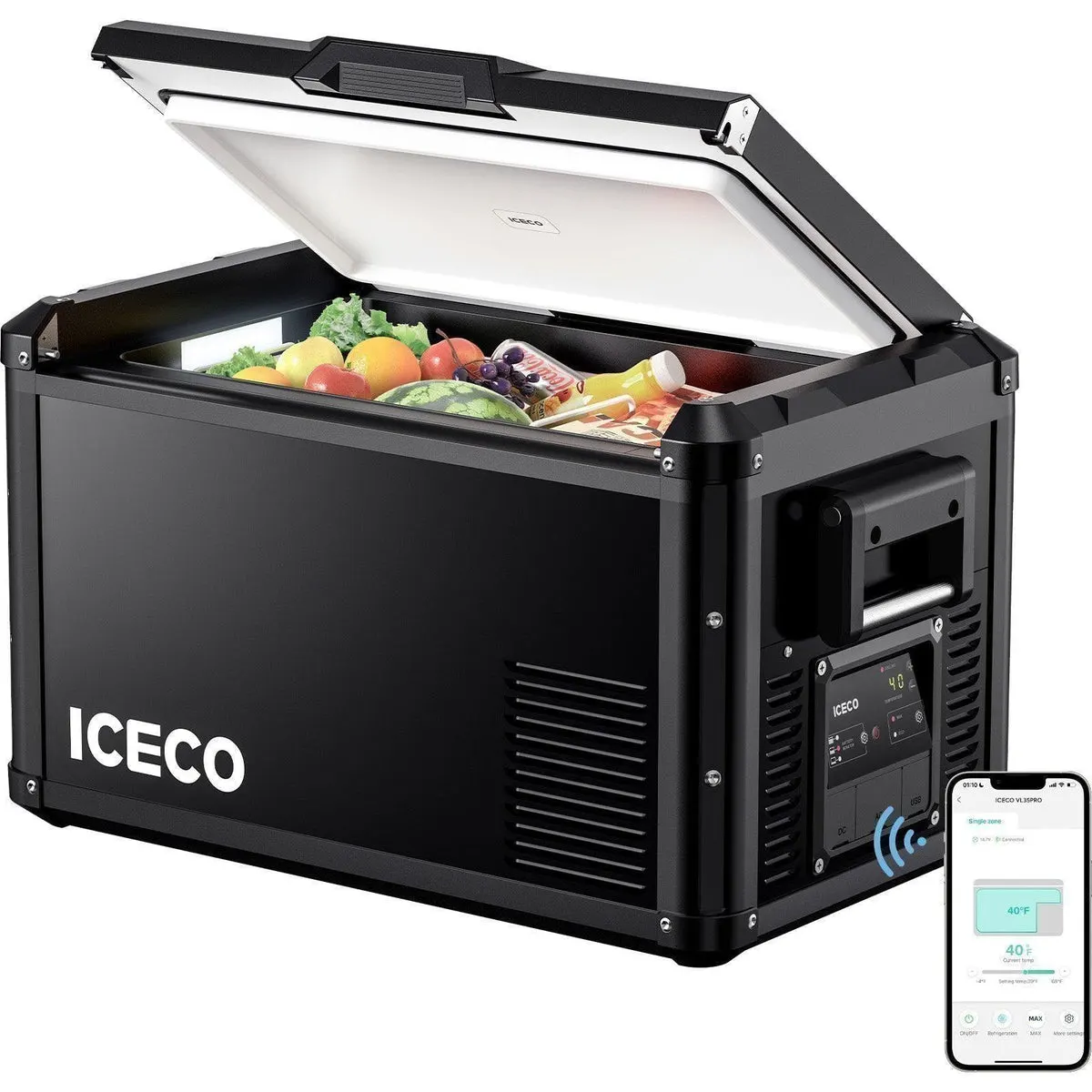
The Iceco VL35 ProS 12V Fridge Freezer is the main purchase in this plan. ICECO's manual lists it at 35 litres (37 quarts), 28.1 x 15.9 x 15.7 inches, and 48.7 lb, with a 0°F to 50°F setpoint range. It runs on 12/24 V DC or 110–120 V AC. Its steel cabinet makes it heavy for its size; if you need to lift it in and out often, that weight matters.
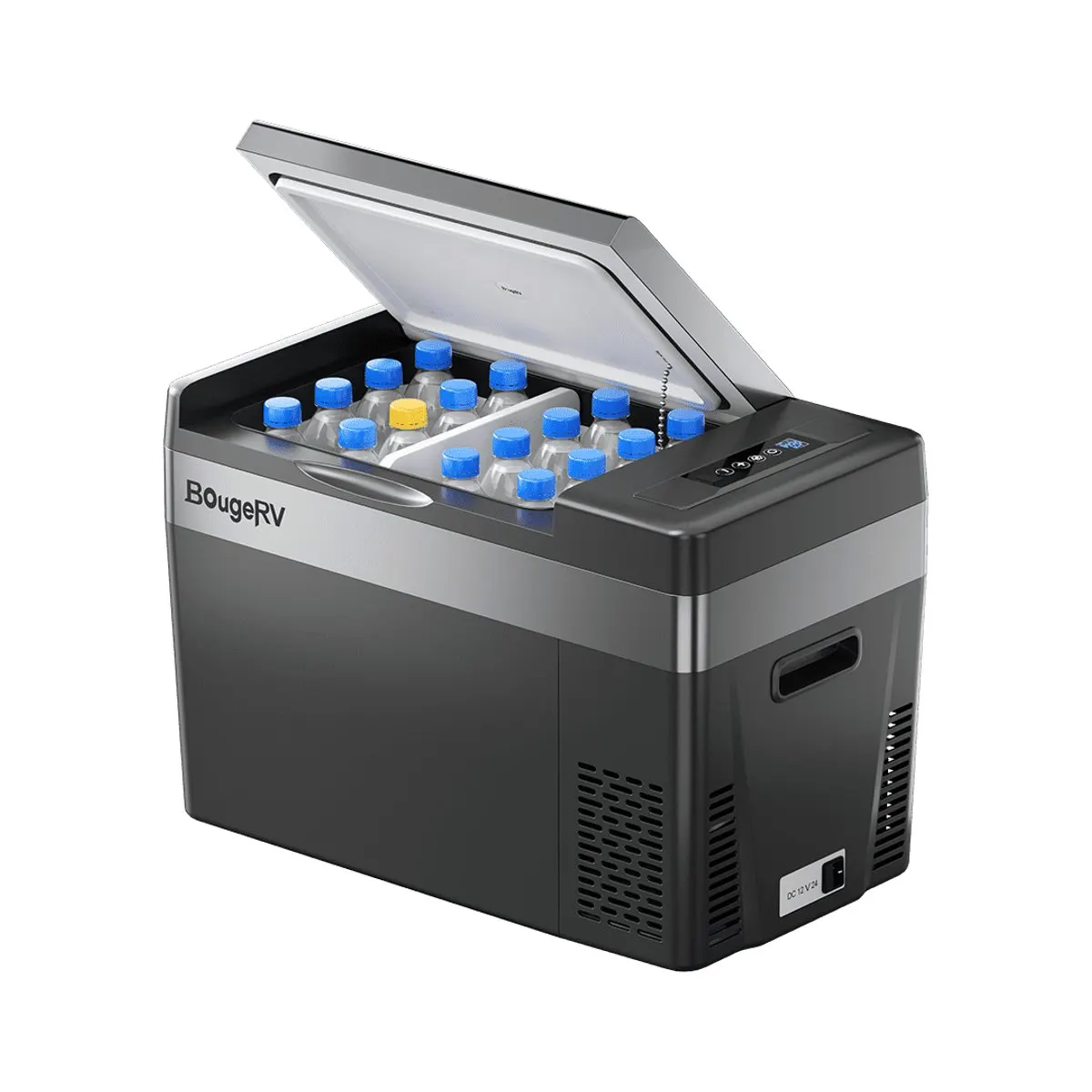
If you need something lighter and smaller, the BougeRV CR 30 Quart (28L) 12V Portable Fridge Freezer holds 28 litres. BougeRV rates it at 45 W in ECO mode and 60 W in MAX mode. Check its external dimensions on the review page and listing against your space.
Stove: Iwatani Cassette Feu, used outside
The Iwatani Cassette Feu Butane Camp Stove (Gray) runs on 8 oz butane cassettes and packs into a hard case. Iwatani's manual for its earlier ZA-3HP cassette stove labels that stove an "outdoor only camp cooking appliance" that "may not be used indoors in tents, campers, apartments or other confined areas," and warns that using it in an enclosed space such as a camper or car can kill you. We could not find a manual for the gray model sold on Amazon, so read the label and manual that come with it, and plan to use it outside the van, not inside with the doors open. A CO alarm or an open window doesn't change that.
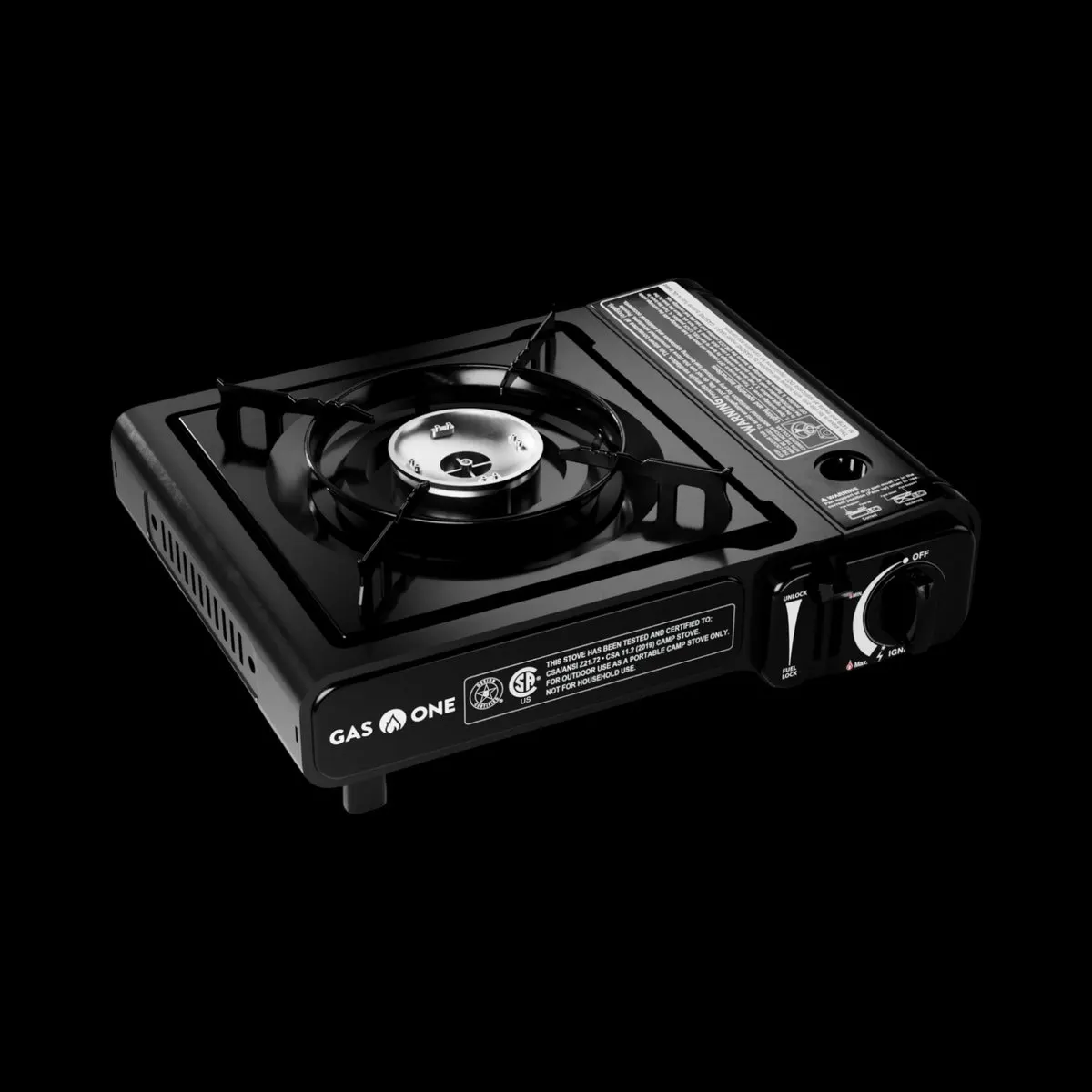
The Gas One GS-1000G is the budget alternative. Treat it as outdoor-only too, and check its label.
Cookware: one pot, one pan
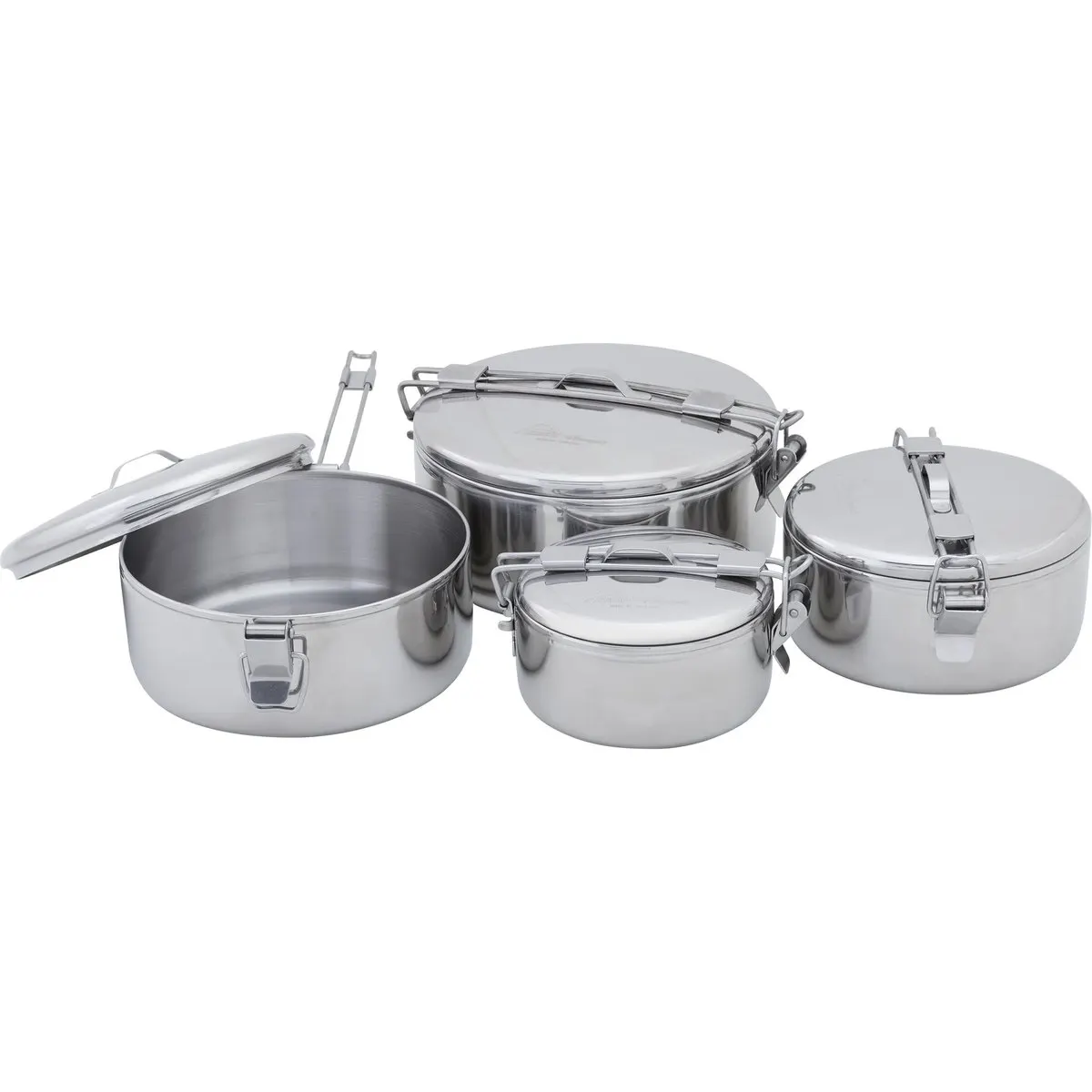
- Pot: the MSR Alpine Stowaway 1.6L Stainless Pot is a lidded stainless pot sized for one person's pasta, rice, soup or oatmeal.
- Pan: the Lodge L8SK3 10.25-inch Cast Iron Skillet. Cast iron works on butane, propane and induction, so the pan carries over if you add an induction cooktop later. It's heavy (the review lists 5.4 lb); if weight is a problem, use a pan you already own.
Prep, storage and water
- Knife: the Opinel No. 8 Stainless Folding Knife folds small, so the blade is covered when it's stowed in a bin.
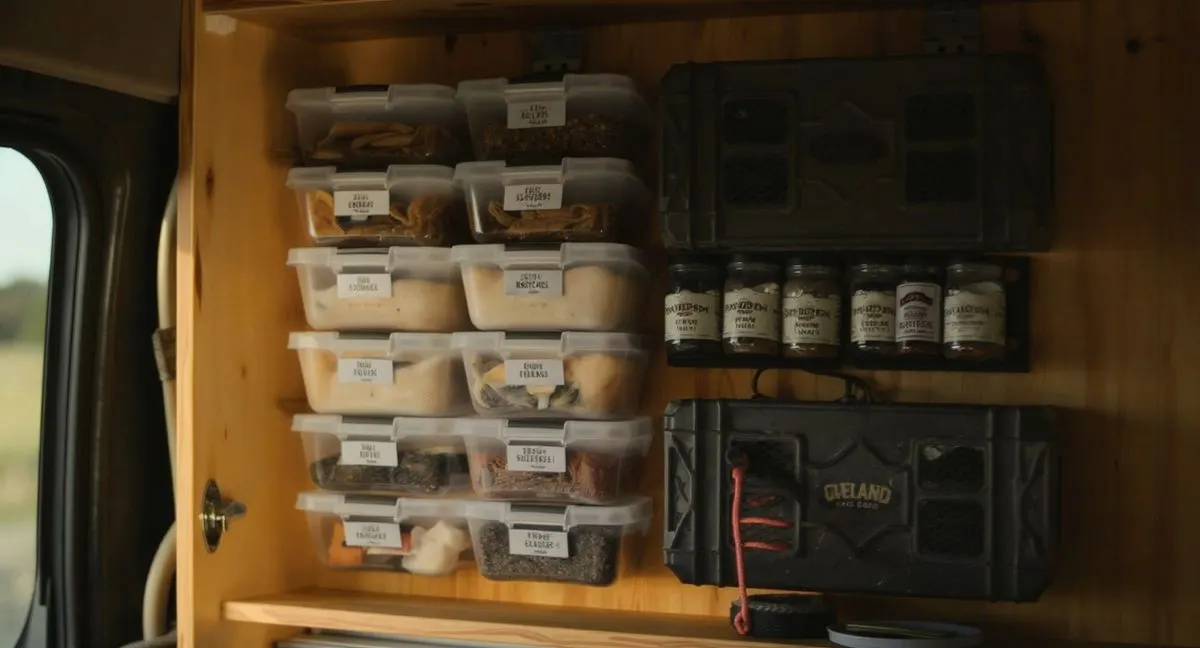
- Bins: the IRIS USA Weathertight 19-Qt bins (6-pack). One bin for the cook kit, one for dry food, the rest for spares.
- Water: a rigid jug with a spigot (not a site product; use one you own if you have it), plus a second container for grey water.
- Filter, only if you'll use untreated water: the Katadyn BeFree 1L Collapsible Water Filter is a hollow-fiber filter. Hollow-fiber filters are aimed at bacteria and protozoa. They don't remove viruses, chemicals, salt or heavy metals. Treated campground taps don't need it.
Optional upgrades
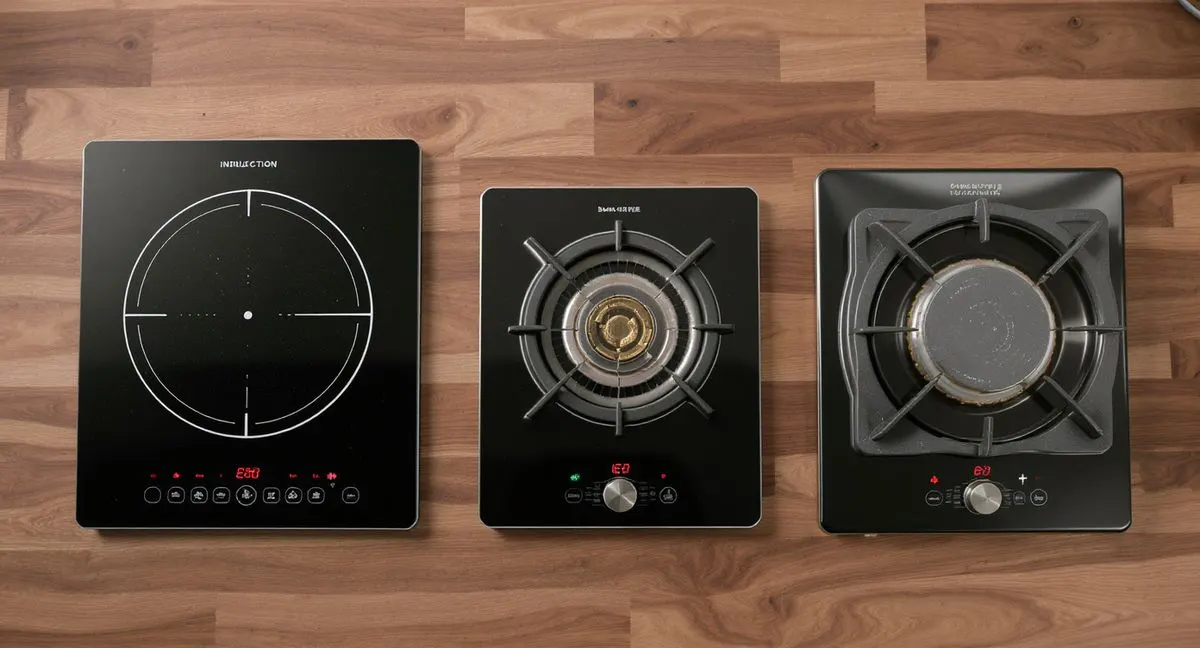
- An induction cooktop for indoor cooking. The NUWAVE PIC Gold 1500W Induction Cooktop suits a small electrical system better than most: NUWAVE's manual says its default 1500 W can be switched to 900 W or 600 W. That lets you match it to a smaller inverter, at the cost of slower cooking. This upgrade needs an inverter or power station and a much bigger battery. Work through the power section below before buying.
- Coffee: the AeroPress Original Coffee Maker makes one cup at a time and packs small.
- Cast iron cleanup: a Lodge Chainmail Cast Iron Scrubber cleans with very little water.
Exact variants
The product names below match the site's product data and the Amazon listings our review pages link to. Buy these variants if you want what the reviews describe.
| Product | Variant the review links to | Note |
|---|---|---|
| Iceco VL35 ProS 12V Fridge Freezer | VL35 ProS, 37 Qt | Manual: 35 L / 37 qt |
| BougeRV CR 30 Quart (28L) | 30 Quart, 28 L | Alternative fridge |
| Iwatani Cassette Feu Butane Camp Stove (Gray) | Gray Cassette Feu | See stove note |
| MSR Alpine Stowaway 1.6L Stainless Pot | 1.6 L | 18/8 stainless |
| Lodge L8SK3 10.25-inch Cast Iron Skillet | L8SK3 | Induction-capable |
| Opinel No. 8 Stainless Folding Knife | No. 08 stainless, beech | |
| Iris Weathertight Storage Set (6-pack) | 6 x 19 qt | |
| Katadyn BeFree 1L Collapsible Water Filter | BeFree 1 L | Only if needed |
| NUWAVE PIC Gold 1500W Induction Cooktop | PIC Gold | Optional |
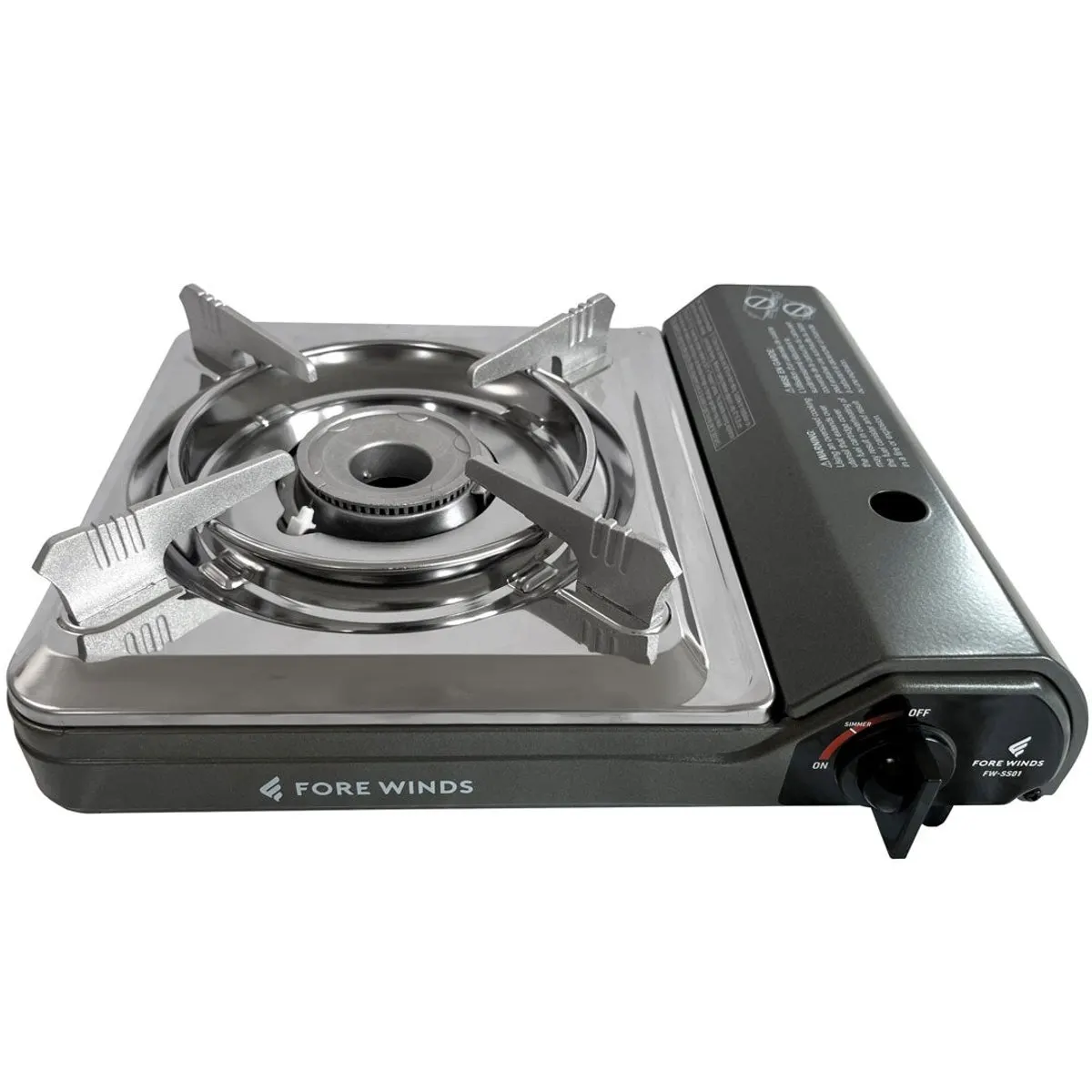
Stove note: our review found that the Amazon listing for the gray Cassette Feu gives a model number of VA-30 and pictures a stove branded Fore Winds FW-SS01. Both are Iwatani products, but they aren't the older ZA-3HP. Check the model on the box against the listing.
Compatibility checks
Run these before you buy. They are where shopping plans usually go wrong.
1. Fridge footprint plus ventilation clearance vs your space. External dimensions alone aren't enough. ICECO's manual asks for more than 5 cm (about 2 in) of space on the left and right sides and 10 cm (about 4 in) at the front air outlet so the compressor can shed heat. For the VL35 ProS at 15.9 in wide, that means planning for roughly 19.8 in of width (15.9 + 2 + 2), plus about 4 in in front of the vent. BougeRV's manual for the 30-quart asks for at least 200 mm (about 8 in) behind and 100 mm (about 4 in) at the sides. Add those to the external dimensions and compare with your floor, bench or slide.
2. Lid access from above. Both fridges open from the top. Measure the space above the fridge with the lid fully open, not just the fridge height. A fridge under a bench or bed platform needs to slide out to open.
3. Weight and mounting. A 48.7 lb fridge, full of food, needs to be strapped or bolted down so it can't move in a sudden stop. Follow the fridge maker's guidance on tie-downs or use a fridge slide rated for the load.
4. Battery protection setting vs your battery. ICECO's manual lists 12 V cut-off settings of 9.6 V (Low), 10.4 V (Medium) and 11.1 V (High). BougeRV lists 9.6 V, 10.1 V and 11.3 V. If the fridge runs from a starting battery, use the high setting. For a separate house battery, follow the battery maker's low-voltage guidance and set the fridge to match.
5. Stove location vs your parking. You need a stable, level, non-flammable surface outside the van, out of the wind, with clearance from anything that can burn. Coleman's manual for its propane camp stoves gives 12 in at the sides and 48 in above as minimum clearances from combustibles. That's a useful benchmark for not cooking under an awning or open rear door. Check your own stove's manual for its figures.
6. Cookware vs induction, if you add the upgrade. Induction needs a magnetic base. Duxtop's induction manual gives the rule of thumb (if a magnet sticks to the bottom, it will work) and lists non-magnetic 18/10 and 18/8 stainless as unsuitable. The MSR pot is listed as 18/8 stainless, so do a magnet test before counting on it for induction. The Lodge cast iron skillet is magnetic.
7. Butane in cold weather. Butane vaporises poorly near freezing. If your trips include cold mornings, keep the cassette warm before use or choose propane.
How to work out your power needs
This plan doesn't prescribe a battery size, because your fridge's real energy use depends on heat, setpoint and how often you open it. Here's how to work it out. All figures are at 12 V nominal, where Ah = Wh ÷ 12.
Step 1: list your daily loads in watt-hours.
| Load | Assumption | Wh/day | Ah/day at 12 V |
|---|---|---|---|
| 12V fridge | 20 W average over 24 h (estimate) | 480 | 40 |
| Lights and phone | 60 Wh (estimate) | 60 | 5 |
| Total | 540 | 45 |
The fridge figure is a planning estimate, not a measurement. For comparison, ICECO's manual lists the VL35 ProS at 0.430 kWh per 24 hours (about 36 Ah at 12 V) and says that figure "is only suitable for laboratory testing"; it doesn't state the test conditions. The example rounds up to 480 Wh to leave room for warmer conditions. Hot weather, a warm van, a low setpoint and frequent lid openings push it higher. Use the fridge battery calculator with your own conditions.
Step 2: multiply by the days you want to go without recharging. Two days at 540 Wh is 1,080 Wh (90 Ah).
Step 3: divide by the usable fraction of the battery. This depends on the chemistry and the maker's guidance. As an assumption for the example: if you plan to use about 85% of a lithium battery's rated capacity, 1,080 Wh ÷ 0.85 is about 1,270 Wh, or about 106 Ah at 12 V. If you plan to use only about 50% of a lead-acid battery, the same need becomes about 2,160 Wh (180 Ah).
Step 4: subtract the charging you can count on. Daily driving with a DC-DC charger, or solar in sunny weather, reduces how much storage you need. Cloudy stretches and winter reduce what you can count on.
If you add the induction upgrade: at the PIC Gold's 900 W setting, 15 minutes of cooking is 225 Wh at the cooktop. Allowing for inverter losses (an assumed 88% efficiency), that's about 256 Wh, or about 21 Ah, from the battery per session. The inverter's continuous rating must be above the cooktop's setting plus anything else running at the same time. The power calculator runs these numbers for your loads.
Battery, charger and inverter installs carry fire and shock risks. Follow each manufacturer's installation instructions, and use a qualified electrician where codes or your insurer require one.
Gear you may already own
Before you buy, check your home kitchen and camping gear:
- A skillet and a lidded pot. Any pan works on butane. For a future induction upgrade, check it with a magnet.
- A knife, board, spatula and spoon. A home kitchen knife works if you sleeve the blade for travel.
- A cooler. For trips of a night or two, a cooler can stand in for the fridge while you decide whether you need one.
- Water jugs, a dish tub, a headlamp, and plastic bins. All of these can replace items on the list.
- A butane or propane camp stove. If you already have one, check its manual for the operating location and keep using it.
Supporting reviews
- Iceco VL35 ProS 12V Fridge Freezer
- BougeRV CR 30 Quart (28L) 12V Portable Fridge Freezer
- Iwatani Cassette Feu Butane Camp Stove (Gray)
- Gas One GS-1000G Butane Stove
- MSR Alpine Stowaway 1.6L Stainless Pot
- Lodge L8SK3 10.25-inch Cast Iron Skillet
- Opinel No. 8 Stainless Folding Knife
- IRIS USA Weathertight 19-Qt bins (6-pack)
- Katadyn BeFree 1L Collapsible Water Filter
- NUWAVE PIC Gold 1500W Induction Cooktop
Background reading: 12V fridges guide, cooktops guide, van cooking safety guide, storage guide.
What you still need to verify
- Your space: measure the fridge spot including the manufacturer's ventilation clearance and lid-open height.
- The fridge's real energy use in your climate. Published ratings are lab or nameplate figures, not your daily use.
- Your battery's usable capacity and low-voltage limit, from the battery maker, and the fridge cut-off setting to match.
- The stove's manual and label for the exact unit you receive, including the operating location and clearances.
- The stove model on the box against the listing (VA-30 / Fore Winds FW-SS01 for the gray Cassette Feu).
- Magnet test on any pot you plan to use on induction.
- Water sources on your route, and whether they're treated.
- Local rules on fires, stoves and grey water where you stay.
FAQ
Is this a tested build? No. It's an example shopping plan put together from manufacturer documents and our product research. Nobody at the site has built or used this exact combination.
Why isn't there a total cost? Prices change often, and the site doesn't publish them. Each review page has a "Check price on Amazon" button for the current price.
Can I use the butane stove inside the van if I open the doors? No. Iwatani's own manual for its cassette stove calls it an outdoor-only camp cooking appliance and warns against using it in a camper or car. Cook outside, or add an electric cooktop and the power system to run it.
How big a battery do I need? It depends on your fridge's real energy use, your climate and how you recharge. Follow the four steps in the power section, or use the fridge battery calculator. In the example assumptions above, two days without charging came out at about 106 Ah of lithium at 12 V, but that's an example, not a recommendation.
Can I add induction later? Yes, if you size the electrical system for it. The NUWAVE PIC Gold's 600 W and 900 W settings make it easier to match to a smaller inverter. Check your cookware with a magnet first.
Sources and verification
Manufacturer documents we opened for the specs and safety statements above, each checked 2026-10-09:
- ICECO VL35/45/60 ProS user manual: VL35 ProS capacity, dimensions, weight, temperature range, 0.430 kWh/24 h lab figure, voltage-protection settings, compressor ventilation space. Checked 2026-10-09.
- BougeRV 30 Quart / 23 Quart user manual: 28 L capacity, 45 W ECO / 60 W MAX, cut-out voltages, ventilation space. Checked 2026-10-09.
- Iwatani Cassette Feu ZA-3HP instruction manual (Iwatani Corporation of America): outdoor-only camp-use statement and carbon monoxide warning. Earlier model; no manual found for the current gray listing. Checked 2026-10-09.
- Coleman 5461 Series propane stove instructions: clearances from combustible materials. Checked 2026-10-09.
- Duxtop BT-M20B / 9100MC / 9120MC user manual: cookware compatibility (magnet rule, unsuitable non-magnetic stainless). Checked 2026-10-09.
- NUWAVE PIC Gold owner's manual: 1500 W default with 900 W and 600 W settings. Checked 2026-10-09.
Products covered in this guide
Disclosure: As an Amazon Associate I earn from qualifying purchases. Links to Amazon on this page are affiliate links: if you buy through one, VanLifeKitchens.com may earn a commission at no extra cost to you. Read our affiliate disclosure.